%20%20--%3E%0A%3Csvg%20version%3D%221.1%22%20id%3D%22Layer_1%22%20xmlns%3D%22http%3A%2F%2Fwww.w3.org%2F2000%2Fsvg%22%20xmlns%3Axlink%3D%22http%3A%2F%2Fwww.w3.org%2F1999%2Fxlink%22%20x%3D%220px%22%20y%3D%220px%22%0A%09%20width%3D%2239px%22%20height%3D%2240px%22%20viewBox%3D%220%200%2039%2040%22%20enable-background%3D%22new%200%200%2039%2040%22%20xml%3Aspace%3D%22preserve%22%3E%0A%3Cpath%20fill%3D%22%23FFFFFF%22%20d%3D%22M38.5%2C7H28.2v26h10.3V7z%22%2F%3E%0A%3Cpath%20fill-rule%3D%22evenodd%22%20clip-rule%3D%22evenodd%22%20fill%3D%22%23FFFFFF%22%20d%3D%22M26.1%2C25.5c0%2C5.8-4.1%2C7.5-12.9%2C7.5C3.9%2C33%2C0%2C31.2%2C0%2C25.2v-1.1h11.6%0A%09v2.4c0%2C0.7%2C0.1%2C1.4%2C1.2%2C1.4c1%2C0%2C1.2-0.4%2C1.2-1.3v-0.9c0-1.6-0.9-1.6-3.5-2.2C2.2%2C21.7%2C0%2C19.7%2C0%2C15.3v-0.9C0%2C9.3%2C5.5%2C7%2C12.9%2C7%0A%09c10.2%2C0%2C12.8%2C2.6%2C12.8%2C7.4v1.8h-11v-2.9c0-0.6-0.4-1.1-1.2-1.1c-0.6%2C0-1.2%2C0.4-1.2%2C1.1v0.9c0%2C1.5%2C0.9%2C2%2C3.3%2C2.5%0A%09c8%2C1.6%2C10.5%2C3.3%2C10.5%2C7.5V25.5z%22%2F%3E%0A%3C%2Fsvg%3E%0A)
How a Banned Minor Leaguer Adopted a New Persona—and Rode It to the Majors
In this story:
Every year in the low-angled light of autumn, September call-ups give players at every stage in the baseball life cycle their first taste of the majors. Each one aspires to make a name for himself. A select few—Stan Musial, Willie Stargell, Greg Maddux, Chipper Jones—use the call as a springboard to the Hall of Fame. Many more play out the string before fading back to obscurity, still chasing their next shot, uncertain if it will ever come.
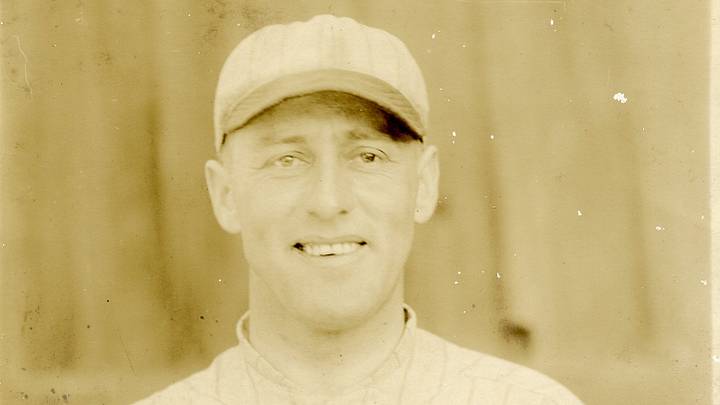
But no call-up will have a debut as implausible as catcher Bert Edgar (B.E.) Chapman, who made a name for himself quite literally—and whose time in Boston in September 1920 not only marked the realization of a dream, but the culmination of a con.
Neither cotton farming nor college appealed to Bert Chapman.
One of eight kids born in the mill town of Pelzer, S.C., in 1893, Chapman spent his childhood in and out of orphanages after his parents died within months of each other when he was 10. He eventually enrolled at the University of South Carolina in 1912. Two years later, his baseball journey began in the Class D Georgia State League, then the lowest rung of the minors.
Chapman put his career on hold to enlist in the U.S. Navy during World War I. He claimed he was on top of the Washington Monument on April 6, 1917, the day Congress formally declared war. “I’d gone there to do some sightseeing, and while I was up there, I heard all this shouting, and steamboats tootin’ and everything. So I walked down the steps and joined the Navy,” Chapman told The Sporting News in 1969.
Chapman stayed Stateside during the war, serving as a petty officer second class electrician while competing on a base team in Norfolk. After the war ended, he resumed his career in 1919 in the newly formed Florida State League, serving as a catcher and manager for the delightfully named Sanford Celeryfeds. (Sanford, outside Orlando, was known as the Celery City in honor of its most successful crop.)
The left-handed hitting, right-handed throwing Chapman enjoyed success in his return to pro baseball, batting .250 and leading Sanford to a 46–30 record, capturing the first-half title and clinching a spot in the championship series against the Orlando Caps.
Tempers ran hot throughout the best-of-nine series. Before the first game, Chapman said league president Walter W. Rose handed him a typewritten list of rules for the series, one of which forbade “freak deliveries” like an emery-ball pitch. Chapman responded by cussing out Rose out. Caps officials also accused Chapman of using ineligible players who were rumored to have come from higher classification leagues.

As the allegations persisted, emotions continued to boil over. In Game 3, a 6–1 Sanford win, the Orlando Evening Star reported that Chapman reached across a fence and slapped an Orlando fan in the face who called him “yellow.”
“Sanford’s ball players ran to their manager’s assistance, armed with bats. The prompt action of the Orlando police force and special officers promptly pushed back the large crowd, which had formed around the would-be pugilists,” the Evening Star noted.
The battle would ultimately be won by Chapman: The Celeryfeds defeated the Caps five games to three. Within days of the championship, though, the Florida State League vacated two of Sanford’s for “openly defying and refusing to abide by the rules.” League directors declared the series a tie at three games apiece.
They also had one more indignity to deliver to Chapman.
“I got this telegram from Rose telling me I’d been fined $500 and suspended from Organized Ball,” Chapman recalled to The Sporting News. Despite the capital-letter gravitas of “Organized Ball,” it’s hard to know how a punishment like that would have applied to other leagues, though the Orlando Sentinel reported that “President Rose was instructed to carry these suspensions to the national commission and urge their permanency.”
As it would have been difficult, if not downright impossible, for Chapman to resume his playing career, he found a work-around. The following year, a 5' 7", 138-pound catcher turned up on the roster of Carrollton (Ga.) in the newly re-formed Georgia State League named “Ed Chaplin.”
The chest protector covered the same stocky body. The catcher’s mask framed the same high, sunken cheekbones and close-set, bituminous eyes. The equipment was mandatory, and more than a little metaphorical. In the spring of 1920, on dusty fields across south and west Georgia, Bert Edgar Chapman needed to conceal himself even more.
Chapman derived his nom de guerre from “Chappy,” a nickname he picked up from teammates, and “Ed,” a shortened version of his middle name.
The trail runs cold on his statistics that summer, but evidently they were strong enough: On Sept. 2, days after hitting a two-run homer in a 3–1 win over Cedartown, The Boston Globe reported that the Red Sox had purchased his contract from Carrollton. “He is a pretty nifty looking player,” the Globe enthused.
“[W]hen the Red Sox bought me from Carrollton, no one knew who I was,” he admitted to The Sporting News.
Chaplin made his MLB debut on Sept. 4, 1920, drawing a walk as a pinch hitter. The Globe heralded his arrival by referring to him in its postgame recap as “Charley [sic] Chaplin, the recruit catcher from the Georgia League.” Even the papers, it seemed, couldn’t keep his name straight.

Chaplin played in three more games for the Red Sox that month, finishing 1-for-5 with one RBI, two runs and four walks. Despite the limited plate appearances, the Boston media seemed sanguine about his future. The Globe praised his defense throughout spring training in 1921, and in an April feature, reporter Melville E. Webb Jr. noted that in the offseason Chaplin “worked on one of the Florida railroads as an [sic] locomotive fireman and he says if this won’t keep a fellow in shape and his wind good, he doesn’t know what will.”
Webb’s enthusiasm proved premature: Chaplin appeared in just 31 games for the Red Sox over the next two years, the last of his major league career. Across parts of three seasons, Chaplin finished with a modest .184/.303/.237 slash line. “I just wasn’t a good enough hitter to play regularly in the majors, but I had a good eye and waited the pitchers out,” he said later.
The peripatetic life of the minors beckoned once again. Chaplin would bounce around for several more years in the South. Then in 1928, the Tampa Krewes of the Southeastern League listed a catcher on its roster named—wait for it—Bert Chapman.
Ed Chaplin had reverted back to his given name.
Did he feel secure that he’d never face punishment? Did he realize he would never make the majors again and therefore didn’t feel the need to keep up the ruse? Perhaps. Or maybe it was simply time for Bert Chapman to move on to the next chapter of his life.
Nine days before the Krewes’ 1928 season opener at Plant Field, Chapman married Rosamond Radford, a society editor for the Sanford Signal newspaper. Chapman hit .265 in 94 games for the Krewes in 1928, then was traded to Augusta (Ga.) of the South Atlantic League the following winter. He only batted .100 in 13 games for Augusta before getting released in early May.
Now 35 years old, with a young son and a daughter on the way, Chapman and his wife settled in Sanford. They built a three-bedroom house that overlooked Crystal Lake and was speckled with zinnias that Chapman grew himself. He and Rosamond raised three children there and lived in Sanford until his death in 1978 at the age of 84.
Susan Prinz was in college when Chapman passed away. She and her sister, Pam Breen, remember a doting grandfather who built a zip line and seesaw on his property
for his six grandchildren. They recall the dock that jutted out into the lake, the one he enclosed so his grandkids could splash in the water.
“He was a wonderful grandfather,” Breen says. “He was very loving and playful.”
Unfortunately, Breen and her sister can’t fill in some of the blanks on their grandfather’s playing days. Like many century-old tales, there are inconsistencies and apocryphal details that may never get resolved. And Chapman rarely, if ever, brought up his baseball career with his family.
“It was sort of like somebody who had been in a war and never wanted to talk about the war experiences. And maybe he just didn’t think we were interested,” Prinz says.
So how do Prinz and Breen square their recollections of Chapman with the man who slapped a spectator in the minors and conned his way into a major league career? Prinz believes his hardscrabble childhood, bouncing back and forth between orphanages, gave him a defiant attitude toward authority as an adult.
“Whenever the extended family needed him to help with harvesting crops, they pulled him out [of the orphanage] and then they would put him back when they were done,” says Prinz. “I have to wonder what kind of impact those experiences might have had on him. That might have influenced him to make the choices he did.”
A rejection—or suspension—may have taken him back to that poor farm boy in the orphanage, unwanted and unfairly treated. “He would not back down from a fight. I can see why he would do that,” Breen says. “I don’t think, after the childhood that he had, that he would back down easily.”
To make a living after baseball, Chapman returned to his family’s agricultural roots and became involved in celery farming—The Tampa Tribune called him “an authority on plain and fancy celery.” He also founded a company in Sanford, Chapman Concrete Products, that manufactured concrete blocks.
Bert Chapman slipped in to the low profile of retirement, his baseball life behind him, content to live out his days in anonymity.
 Add us as a preferred source on Google