
Can Brett Bateman Turn His Contact Into Opportunity With Blue Jays?
In this story:
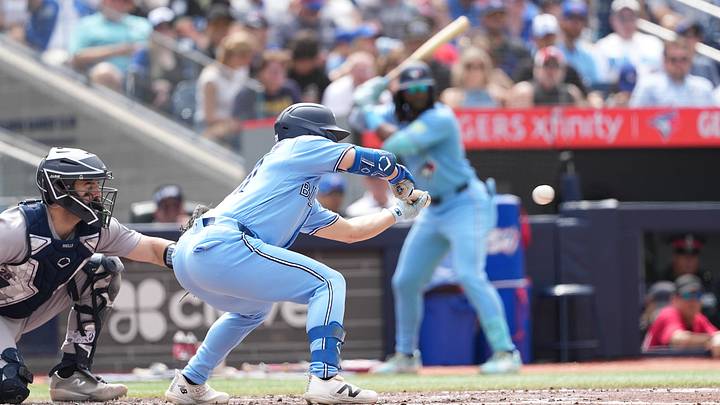
Brett Bateman's moment has arrived in the Majors. It wasn't with the Minnesota Twins or the Chicago Cubs; the opportunity came with the Toronto Blue Jays.
At 24 years old, he finally has the opportunity. He is taking advantage of it. Bateman has seen 222 pitches in his first 65 plate appearances since making his debut, after reaching base three times in four trips to the plate on Aug. 7 against the Philadelphia Phillies.
The result of that contact has been quite interesting. Bateman is slashing .305/.344/.390 with a 107 wRC+ and 0.6 fWAR. That line fits very well with the Blue Jays' offensive philosophy, based on contact. But now let's look deeper into those small-sample averages. Let's focus on his pure contact ability.
To begin with, Bateman is averaging a .383 BABIP, a mark similar to the .389 he posted in 359 plate appearances in Triple-A this year. And here I stop to analyze some trends that catch the eye.
Small samples can present themselves in many ways. Sometimes, a hitter's elite contact is concentrated in some parts of the strike zone. Rarely do the red heat tones appear spread across different zones. That said, let's take a look at the heat map, because Bateman's swing is leaving a very interesting footprint.

Yes, we probably agree with what I thought: there is a layer of heat around the infield. That has a lot to do with his ground balls and some short line drives that got past the infielders. That's how Bateman's .305 average is distributed: his average on ground balls is .296. The hit probability of line drives rises to .857, and fly balls drop to .250. It's a swing that looks for contact from the first pitch, Luis Arraez-style, and it isn't going to give up on putting the ball in play.
For a contact hitter, averages on ground balls and fly balls are two of the hardest things to sustain.
So, if Bateman keeps finding ways to make contact and his line-drive rate doesn't fall too much, he will be able to sustain an interesting level of production with that aggressiveness. Don't expect him to walk. His contact ability is based on figuring out how to put the ball in play and evade the infield defense.
The Secret Is in the Contact

Going back to the graphics, look at the one in the center. There are 12 of the 25 zones where Bateman's swing managed at least one contact without recording a whiff. That's impressive. How is he doing it? A good part of the explanation is in his 2.4 FastSw% rate. The only Blue Jays hitter with a lower rate is Nathan Lukes (0.9%), who rarely tries to shred the ball. In addition, Bateman and Lukes match their contact with the same 4.2 BlastCon% rate.
They have very similar profiles and are simply going to do their jobs. Ernie Clement can also fit into this category, but his impact has been more consistent when it comes to producing extra-base hits this season.
Sticking with Bateman, did you check his expected averages? They are in the last graphic, and it stands out that he has a couple of strong zones at every vertical point over the plate. He can also reach the outside corner and hit pitches on the edges, outside the strike zone.
Of course, we shouldn't be overly optimistic with a sample of 222 pitches. The same advanced reports we are looking at now will also change the strategies used to attack Bateman. That's clear. But even in a small sample, we can appreciate what Bateman's essence as a hitter is: he has the ability to make contact, he is a runner who can take advantage of that potential, and we can't forget his defensive ability—in 95⅓ innings, he has already accumulated +3 DRS as a center fielder.
Bateman's arrival and this opportunity to earn a starting role might not have been possible if the Blue Jays' projections had come true even at 50%. So, in the middle of the fight to reach the playoffs, Bateman's debut could be an interesting injection: a contact bat that is providing short-term results, along with his ability to cover multiple positions in the outfield.
The rest of the way will depend on how much Bateman can sustain this profile and how much Toronto is willing to trust him. But if he keeps doing the things he is showing in his first month in the Major Leagues, the Blue Jays will have to decide how much they can take advantage of a contact bat that can also contribute with his legs and on defense.
All statistics were verified using Statcast from Baseball Savant.
 Add us as a preferred source on Google
Yirsandy is a baseball writer specializing in MLB coverage with experience across multiple teams and storylines. He currently writes for Diamond Centric, where he covers the New York Mets, San Diego Padres, Chicago Cubs, Milwaukee Brewers, and Kansas City Royals. My work focuses on game coverage, player analysis, and storytelling that connects performance with context. My Substack has also been an important part of my writing development, where I’ve built much of my baseball coverage and storytelling voice over time. I’m passionate about combining reporting, research, and thoughtful analysis to produce engaging baseball content for readers.
Follow Yirsandy