
One Bonus Pool Gamble Is Shaping the Braves' Prospect Future
In this story:
Tate Southisene and Briggs McKenzie represented the Atlanta Braves in the Arizona Fall League's Fall Stars Game on Nov. 8. Southisene started at shortstop and went 0-for-2 with a walk and a run scored. McKenzie gave up two runs on three hits and three walks in two-thirds of an inning, including a 104.2 mph single that turned out to be the hardest-hit ball of the game. That's the thing about all-star games, though. They're a snapshot, and with the Fall League now in the books, I'd rather look at the bigger picture.
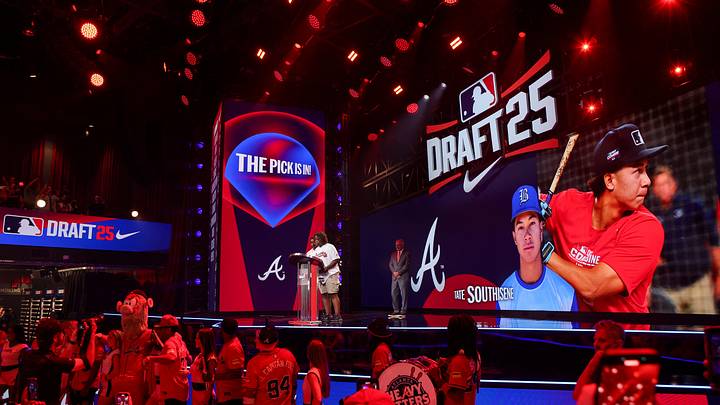
Because here's what I find most interesting. Both players are the result of one bonus-pool decision the Braves made in July 2025. The real story is the strategy behind that entire draft class, not either player alone.
First, a quick explainer on how the bonus pool works. Each pick in the first 10 rounds has an assigned slot value, and those values add up to a team's bonus pool. Atlanta's 2025 pool was $9,081,100. Teams can exceed their pool by up to 5%, but going further brings harsh penalties, including the loss of draft picks. So, the trick is to sign early picks for less than slot, then use the savings to pay later picks more than slot.
That's exactly what Atlanta did. Southisene, the 22nd overall pick, signed for $2,622,500, which was $1,361,400 below the $3,983,900 slot value. Alex Lodise, the second-round pick, signed about $225,700 under slot, and third-rounder Cody Miller signed $498,500 under.
That freed up money for the fourth round, where the Braves signed McKenzie for $2,997,500 against a slot value of just $588,900. It was the largest bonus in the class. In the fifth round, Conor Essenburg signed for $1,197,500 against a $438,600 slot value.
There's a useful way to look at it. If you value players by what they were paid, Atlanta landed two players who were paid like top-50 talents (Southisene and McKenzie) and two who were paid like top-100 talents (Lodise and Essenburg), despite having picks at only 22, 60 and 96. McKenzie needed that kind of money because he was committed to LSU, and he'd drawn late-first-round buzz. Without the savings, the Braves probably don't get him.
Southisene is the anchor of the class, and I've covered him before, so I'll keep this short. In 2026, he put up a .875 OPS with 45 stolen bases across three levels. Then, in his first taste of Double-A Columbus, he was hit by a pitch and fractured his right wrist after just two plate appearances, ending his regular season. That made the Fall League his only remaining chance to get at-bats, and he made the most of it. Through 17 games in Arizona, he hit .345 with a .500 on-base percentage and went 8-for-8 on the bases. The MLB.com No. 58 prospect is healthy, and the below-slot signing that made the rest of the class possible looks better by the day.
McKenzie is the payoff of the strategy. His 2026 season was cut short, as he opened the year in extended spring training and was then shut down with nerve irritation in his left forearm, finishing with just 26 innings at High-A Rome. But Atlanta sent him to Arizona anyway, and as the youngest pitcher in the league, he was impressive. In his first start on Oct. 16, he allowed no hits over four-plus innings, retiring 12 of the first 13 batters and striking out six. His fastball sits in the low 90s and his breaking ball has gained velocity and movement.
Even the rough Fall Stars outing came with a strong endorsement, as MLB.com described his stuff as some of the most electric in the Fall League. That a 20-year-old held his own against that kind of competition says something about how Atlanta's scouts graded him.
The rest of the class supports the "whole class" argument. Essenburg, a prep outfielder with athleticism and gap power, missed about a month during the 2026 season, but he's still one of the Braves' top-15 prospects. Lodise has quietly been the best story of all. He hit .272/.355/.486 with 28 home runs across three levels in 2026 and now ranks fifth in the system. Getting that kind of production at pick No. 60 is the whole point of the strategy.
There's also a front-office angle, and it's worth handling carefully. The Braves announced last week that former GMs Dana Brown and Perry Minasian are returning as senior advisers for amateur scouting.
I don't think it's fair to credit either one with this class, as it came from the current scouting group. But it shows how much Atlanta values finding talent in the draft. Brown helped bring in Michael Harris II, and Alex Anthopoulos has said Brown pushed hard for Spencer Schwellenbach in the draft room. Anthopoulos called the move a "no-brainer," and he said the amateur side needs help, particularly as acquiring young players becomes more important.
To be realistic, none of this makes anyone a major leaguer. Fall League honors and bonus math don't win games. But the Braves' bet is paying off so far, and there's plenty to watch in the coming year: Southisene's return to Double-A, McKenzie's workload after his forearm issue and Essenburg's first full, healthy season. If those go well, we'll look back on July 2025 as a pretty important moment.
Sign up for our free Atlanta Braves on SI newsletter for the latest news
 Add us as a preferred source on Google

Roman is the founder of Empire Sports Talk with a focus on producing written and digital content focused on MLB news, analysis and commentary.
Follow EmpireSportsPod