%20%20--%3E%0A%3Csvg%20version%3D%221.1%22%20id%3D%22Layer_1%22%20xmlns%3D%22http%3A%2F%2Fwww.w3.org%2F2000%2Fsvg%22%20xmlns%3Axlink%3D%22http%3A%2F%2Fwww.w3.org%2F1999%2Fxlink%22%20x%3D%220px%22%20y%3D%220px%22%0A%09%20width%3D%2239px%22%20height%3D%2240px%22%20viewBox%3D%220%200%2039%2040%22%20enable-background%3D%22new%200%200%2039%2040%22%20xml%3Aspace%3D%22preserve%22%3E%0A%3Cpath%20fill%3D%22%23FFFFFF%22%20d%3D%22M38.5%2C7H28.2v26h10.3V7z%22%2F%3E%0A%3Cpath%20fill-rule%3D%22evenodd%22%20clip-rule%3D%22evenodd%22%20fill%3D%22%23FFFFFF%22%20d%3D%22M26.1%2C25.5c0%2C5.8-4.1%2C7.5-12.9%2C7.5C3.9%2C33%2C0%2C31.2%2C0%2C25.2v-1.1h11.6%0A%09v2.4c0%2C0.7%2C0.1%2C1.4%2C1.2%2C1.4c1%2C0%2C1.2-0.4%2C1.2-1.3v-0.9c0-1.6-0.9-1.6-3.5-2.2C2.2%2C21.7%2C0%2C19.7%2C0%2C15.3v-0.9C0%2C9.3%2C5.5%2C7%2C12.9%2C7%0A%09c10.2%2C0%2C12.8%2C2.6%2C12.8%2C7.4v1.8h-11v-2.9c0-0.6-0.4-1.1-1.2-1.1c-0.6%2C0-1.2%2C0.4-1.2%2C1.1v0.9c0%2C1.5%2C0.9%2C2%2C3.3%2C2.5%0A%09c8%2C1.6%2C10.5%2C3.3%2C10.5%2C7.5V25.5z%22%2F%3E%0A%3C%2Fsvg%3E%0A)
The Shoulders on Which Titles Are Built: Tarik Skubal Is Calibrated for October
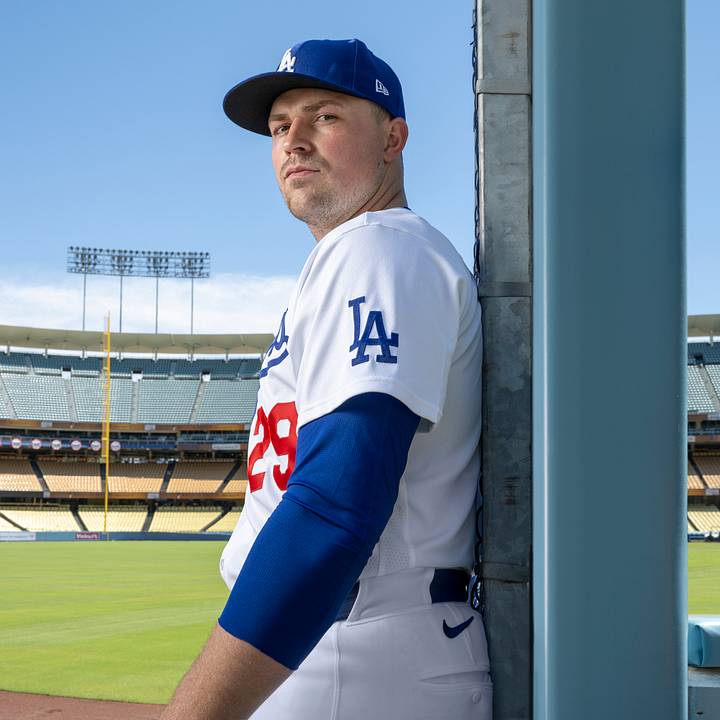
In the last moment before fury overtakes calm, Tarik Skubal stands on the plateau of a 10-inch-tall pedestal of dirt and clay as an imposing and finely calibrated 240 pounds of human pitching machinery. Nothing superfluous. Nothing without purpose. Brutally efficient.
The calibrations that lead him to the mound for a playoff game are no different than for a midseason start. The pulses of electromagnetic waves over his body, the four shots of espresso, the hot tub, the peanut butter and jelly sandwich, the dynamic warmup, the 17 to 22 pitches in the bullpen ... all of it as detailed, immutable and unassailable as Newton’s second law of motion. Skubal is so detail-obsessed that he tracks the speed of the bar when he lifts weights.
“I’m always monitoring everything,” he says. “I’m making sure that I’m doing the right things to where my body is ready to go and my nervous system is ready to go out there and pitch. It’s very complex, but it’s also simple. Everything that I do has a plan. There is always a reason for everything. I don’t do anything just mindlessly.”

All of it is done so that when it comes time for the catcher to transmit the audio signal for one of Skubal’s five pitches, Skubal is good with whatever is the choice.
The planning, scheming and studying are over. It is time to accelerate particles with ferocious force. Skubal is the only pitcher on the planet who can throw 100 mph and get hitters to miss his changeup almost half the time, the highest whiff rate on the pitch among such flamethrowers who have thrown it at least 300 times. He owns both ends of the speed spectrum.
“I’m just going to go out there and compete and try to execute pitches, so I let the catchers call what they see,” he says. “There’s a lot more stuff going on cerebrally with catchers than with me when I’m on the mound. When I’m on the mound, it’s just, get the pitch. Whatever it is, execute the pitch. I don’t really want to be thinking about too much.
“The time in between starts? I’m thinking about stuff. The time in between innings? I’m thinking about stuff. But when I’m out there, I want my process to be pretty simple.”

“If I have seen further, it is by standing on the shoulders of giants.”
The quote is attributable to Isaac Newton in 1675, though it might be appropriated these days by Dodgers president of baseball operations Andrew Friedman. While the state of starting pitching declines—starters last postseason threw fewer innings than relievers and this regular season just 57% of innings—Friedman has assembled the most expensive rotation in postseason history, if not the most decorated. He did so by seizing from other teams six elite arms whose fastballs average between 95 and 98 mph.
Dodger Stadium, ever resplendent in its timeless mid-century vibe, is home to a style of pitching that also is a throwback. Los Angeles won the World Series last year by pulling from the catalog of Koufax and Drysdale. Dodgers starters threw 10 quality starts in the 2025 postseason, the most by a world champion since the 2010 Giants. Contrary to the prevailing bullpen-heavy approach, the Los Angeles starters won postseason games, not just managed them. They were 9–4 with a 2.68 ERA. Only the 1998 Yankees and 2007 Red Sox rotations won more games in this era of expanded postseasons. The rest of MLB postseason starters last year were 13–25.
The Los Angeles aces are back, and then some. To his Ocean’s Eleven of rotations—marquee-worthy names everywhere—Friedman on Aug. 1 added Skubal, the two-time defending American League Cy Young Award winner, in a heist of a trade with the Tigers. In a span of 32 months, through free agency and trades, Friedman acquired Shohei Ohtani, Tyler Glasnow, Yoshinobu Yamamoto, Blake Snell, Roki Sasaki and Skubal. They represent six regular-season and postseason MVP awards, four Cy Young Awards and $1.38 billion in salaries, or about what it cost to pay half the players in the majors in 2011.
In the Big Four of Skubal, Yamamoto, Snell and Ohtani, the Dodgers have acquired four of the five pitchers with the lowest ERA in baseball over the past four years (minimum 50 starts), with only the Pirates’ Paul Skenes having evaded their clutches. In their combined postseason careers, the Big Four are 18–8 with a 2.85 ERA.
As L.A. attempts to become the first team in National League history to win three straight World Series, the prevailing question of this postseason is not just, Can anybody beat the Dodgers? It is, Can anybody beat the Dodgers’ starters?
“For us it’s always been ideal to go into any October with the best starting pitching you can,” Friedman says. “If there are 150-plus starting pitchers with injuries, there are certainly not 30 number ones and an abundance of ones and twos. So, there’s scarcity there. This has been a perfect storm for us being able to access so many top-end talented arms in one moment in time.”

The Dodgers’ plan this postseason is a lather-rinse-repeat exercise of last October. They conserve innings from their starters in the regular season so they can turn them loose in the highest stakes games. When L.A. faced elimination in the World Series last year, for instance, down three games to two on the road to Toronto, manager Dave Roberts used seven pitchers over the final two games, all of whom started multiple times during the regular season. Game 7 was an embarrassment of riches. Roberts used six pitchers, including Ohtani, Glasnow, Snell and Yamamoto—$1.34 billion worth of pitchers in one game, with future Hall of Famer Clayton Kershaw warming in the bullpen. Yamamoto and Snell each threw more than 525 pitches in the postseason, the first pair of World Series–winning teammates to carry such a load since Randy Johnson and Curt Schilling for the 2001 Diamondbacks.
“The thought for me has never wavered,” Friedman says of building championship teams around starting pitching. “There is more appreciation for that now because there aren’t enough of those starters—the ones you can give the ball to and feel confident they will give you six or seven innings. It’s just important to be realistic with your personnel. In ’24, with the injuries to our starting pitching, our relievers were really good. The group was deep, and we leaned on our bullpen more. In ’25, our relievers were kind of going through it a little bit and our starters were rolling. And we leaned on that. I think it’s having an appreciation for what your strengths are going into October and doing the best you can to leverage it.”
The Dodgers are a modern dynasty. They are headed to a 13th straight full season with more than 90 wins. Twelve division titles in the past 13 years. Five of the past nine NL pennants. Three of the past six World Series titles. And yet before this season began Friedman, who took over as president of baseball ops in October 2014, called this the most talented team of them all. Privately, he yearned for one more player.
“We looked to do everything we could over the offseason to avoid being a buyer in July, short of a real impact-type talent,” he says. “And so, from our standpoint, our buy side list was Tarik Skubal. End of list.”

Detroit unwittingly cooperated. The Tigers went 6–22 in May, the second-worst May in franchise history. They played themselves into shopping Skubal, a free agent after the season, before the Aug. 3 deadline. President of baseball operations Scott Harris began exploratory talks with teams about Skubal in the week before the deadline. On July 31, Friedman says, “I went to sleep and I would have thought there was no chance that the deal would wrap the next day.”
The next morning, Harris and Friedman spoke again. Later in the afternoon, everything suddenly changed. Harris wanted final offers. He would present them to the Tigers’ ownership, and they would pick the winning bid within hours. According to one executive, the Dodgers sent signals they were in parallel discussions with the Mariners for pitcher George Kirby, a word on the street seen as a gambit to raise the pressure on Detroit. Friedman, however, denies that scenario. Skubal, he reiterates, was the only name on his shopping list. “If we were fortunate enough to wind up with him, great,” Friedman says. “If not, we weren’t out in the market looking for pitching.”
Friedman put three players in the package for Skubal, none of whom would hurt the Dodgers’ current and near-term plans: River Ryan, a soon-to-turn 28-year-old pitcher coming off Tommy John surgery; Double A outfielder Zyhir Hope, 21; and Class A pitcher Brady Smith, also 21. Harris accepted.
The package was a testament to the Dodgers’ treasure-hunting expertise, the secret sauce underneath their vast spending power. Ryan, a former 11th-round pick, was plucked from the Padres for Matt Beaty, a utility player and former 12th-round pick. Hope was another former 11th-round pick swiped from the Cubs when the Dodgers needed to move first baseman Michael Busch. Smith was the 95th player picked in the 2023 draft. The Dodgers turned straw into gold. And Skubal says he immediately felt comfortable changing teams for the first time, in this case to a franchise known for its abundant resources, including two team planes, one for players only.
“I mean, all the amenities are first class, you know?” he says. “All the recovery modalities, all the spaces they have, the way they treat the families, the family room ... I mean, they’re unreal.
“It’s awesome to be a part of something where the standard is winning a World Series. That’s the way everybody goes about their business, from ownership to president to GM to manager to players, and then you talk about support staff and the chefs in the kitchen, the flight attendants ... They all go out of their way to make sure you have everything you need to go out there and perform. I feel like everyone in this organization is rowing in the same direction and everybody wants a World Series just as bad as the players do.”

Says Friedman, “He has been awesome. He has seamlessly fit into the group. He has gone out of his way to try to forge relationships with teammates and staff. He is very convicted in his prep work, but also really curious.”
Skubal rocketed to an elite pitching level in 2023 with the help of a 3-D printer. The lefthander always had trouble mastering a changeup because his hand more easily supinates than pronates, meaning he lacked the natural forearm and wrist action that creates sink and fade by letting the baseball slip from his ring and pinkie fingers as the thumb turns down. Tigers pitching coaches Chris Fetter and Robin Lund introduced him to the concept of seam-shifted wake, the uneven airflow the raised seams create over a baseball. A pitcher without natural pronation can still deaden the baseball and create movement by harnessing these aerodynamics.
Lund, a former associate professor of kinesiology with a PhD in exercise science, had been hired that season from the University of Iowa. He had the Tigers use a 3-D printer to create a plastic mold that cradles half a baseball. The mold had a circular opening that let Lund draw a black dot with a Sharpie inside the horseshoe of the seams. “Keep the dot on top of the baseball,” he told Skubal, “and think about cutting across the face of the ball.”
When Skubal throws a baseball in that manner, the air catches the seams in a way that sinks and fades his changeup like a traditional changeup but without the pronation. Over the past four seasons, Skubal’s seam-shifted pitch ranks as the best changeup in baseball, according to Run Value among pitchers with at least 1,000 changeups. (Snell’s changeup is ranked No. 2.)
“Every once in a while, when I feel a little off, I’ll get it marked up and go right back to it,” Skubal says of the dotted training baseball. “But I haven’t done that in a while. It’s more just been about pitch execution, not pitch shape right now.”

The wonder of Skubal is that the game’s best changeup pitcher over those same four years also has the No. 3-ranked four-seam fastball among starting pitchers who have thrown at least 1,500 of that pitch. (Ohtani and Yamamoto rank Nos. 1 and 2.) With his natural supination, Skubal throws his fastball with a spin axis equivalent to the hour hand of a clock pointing to 11:15. “I throw a heater that’s not 100% efficient,” he says. “When it is 100% efficient, it’s actually a worse pitch. I need to cut it a little bit. I need to get like 94%, 92% efficiency because then I get more ride and a little bit more cut.”
Changeups and four-seamers account for 61% of his pitches. Sinkers, sliders and curveballs complete his arsenal, unless you include the adrenalin that makes him one of the most ferociously aggressive pitchers. Skubal has ranked first or second in first-pitch strike percentage two years running.
“The game is as analytic as ever,” he says. “You do want to get scouting reports and all that stuff. You can get as deep as you want, but for me it’s really about first-pitch strikes. It’s winning your 1–1 counts. It’s getting to two-strike counts as fast as possible because when you’re in those moments, you have the most leverage ever.
“When you get into two-strike counts, you should have all the confidence in the world. You’ve worked your ass off to get to this count. Now I’ve given myself room to get out of the zone a little bit. And sometimes I challenge guys in the zone, too, because when you get into count leverage, you have everything. Just execute a pitch, and the guy’s out.”
Skubal’s adrenalin-laced, pedal-to-the-floor style of pitching is well-suited for the postseason, in which he has made six career starts, all on the road and all with only two or three runs of support. Among the 219 pitchers who have made at least six starts in postseason history, Skubal ranks first in strikeouts per nine innings (12.7), second in WHIP (0.731) and third in hits per nine innings (5.2) and strikeouts per walk (9.33). His 2.04 postseason ERA is the lowest ever by a pitcher never to reach the World Series (minimum 35 innings).
“I love it,” he says of the postseason. “I feed off environments and energy and stadiums all in a positive way. The average velocity on the heater goes up. All the shapes kind of go up. The execution gets a little bit better, too.”

Come October, the calibrations that prepare him for the mound will not change. Skubal will stick to his mission-control like pre-launch routine:
• T-minus 150 minutes: Training room treatment with pulsed electromagnetic field therapy to relieve any soreness and stimulate blood flow.
• T-minus 120 minutes: Four shots of espresso. “That way,” he says, “I’m heavily caffeinated and ready to go.”
• T-minus 115 minutes: Hot tub followed by stretching and general body warmup.
• T-minus 60 minutes: Peanut butter and jelly sandwich. “Always Uncrustables,” he says. “[An] Uncrustable right to a toaster is the best thing in the world. They’re so convenient and they have them everywhere. And I know my stomach handles them well, so that’s why I eat them.”
• T-minus 40 minutes: Dynamic warmup to raise heart rate and body temperature.
• T-minus 30 minutes: Play catch.
• T-minus 20 minutes: Warm up on bullpen mound. “It always ends up being 17 to 22 pitches,” he says. “Seventeen to 22 throws is all it really takes for me.”
• T-minus eight minutes: Last bullpen pitch. Walk to dugout.
• T-minus one minute: A last reminder.
“The main thing that I remind myself in bigger moments is the game still stays the game,” he says. “The bigger the moment, the simpler the process needs to be. Just go do the things that make you great ... the first-pitch strikes, getting ahead, throwing strikes, getting into leverage, and getting these guys out early and often and putting them on their toes as much as you can. So, the bigger the game, the simpler my game gets on the mound.”
Skubal will stand on that plateau with his hands in front of his chest. The catcher will give him the radio-transmitted signal for the pitch. Skubal, who wears only the receiving device, not a transmitter, inevitably will agree. There is little mystery what is coming. Skubal threw a fastball on the first pitch of 153 of his 159 career starts through mid-August, postseason included.
With the ball in his glove, he will raise his hands in front of his face, peering over his mitt like a marksman through a sight. With a sidestep of his right leg, Skubal rocks his hands down to his belt. It is the quiet trigger to a delivery so violent and explosive that it is as if a starburst of fireworks shoots off 100 times a night. The right leg lifts so high his toes reach eye height. As he strides down the mound, he so separates the ball from his glove with straightened arms he seems to be stretching a giant rubber band to its breaking point. The glove points toward the upper deck, flashed to the hitter like a magician’s diversion. His shoulders are severely slanted, as if throwing a javelin.
Where is the baseball? It is low and behind him. It is as if he is reaching back. Reaching back all the way to Octobers past, when starting pitchers were the Hercules of the postseason, demigods who would squint against the flash-pops of the Graflex Speed Graphics in the pregame phalanx of photographers who posed them like heavyweight fighters. They were the stone and mortar of which championships were built.
“Starters,” Skubal says, “set the tone for everything going on. Yeah, I think that’s why teams win.”
Skubal and the Dodgers are reaching back to such an era. Whether four, five or six deep, they are the only team that can play such a style every postseason game they play. In the Big Four, the Dodgers could send a multiple Cy Young Award winner or a postseason MVP to the mound every night of October. Their methodology is as intentional as Skubal’s calibrations. Who will stop them?
 Add us as a preferred source on Google
Tom Verducci is a senior writer for Sports Illustrated who has covered Major League Baseball since 1981. He also serves as an analyst for FOX Sports and the MLB Network; is a New York Times best-selling author; and cohosts The Book of Joe podcast with Joe Maddon. A five-time Emmy Award winner across three categories (studio analyst, reporter, short form writing) and nominated in a fourth (game analyst), he is a three-time National Sportswriter of the Year winner, two-time National Magazine Award finalist, and a Penn State Distinguished Alumnus Award recipient. Verducci is a member of the National Sports Media Hall of Fame, Baseball Writers Association of America (including past New York chapter chairman) and a Baseball Hall of Fame voter since 1993. He also is the only writer to be a game analyst for World Series telecasts. He lives in New Jersey with his wife, with whom he has two children.