%20%20--%3E%0A%3Csvg%20version%3D%221.1%22%20id%3D%22Layer_1%22%20xmlns%3D%22http%3A%2F%2Fwww.w3.org%2F2000%2Fsvg%22%20xmlns%3Axlink%3D%22http%3A%2F%2Fwww.w3.org%2F1999%2Fxlink%22%20x%3D%220px%22%20y%3D%220px%22%0A%09%20width%3D%2239px%22%20height%3D%2240px%22%20viewBox%3D%220%200%2039%2040%22%20enable-background%3D%22new%200%200%2039%2040%22%20xml%3Aspace%3D%22preserve%22%3E%0A%3Cpath%20fill%3D%22%23FFFFFF%22%20d%3D%22M38.5%2C7H28.2v26h10.3V7z%22%2F%3E%0A%3Cpath%20fill-rule%3D%22evenodd%22%20clip-rule%3D%22evenodd%22%20fill%3D%22%23FFFFFF%22%20d%3D%22M26.1%2C25.5c0%2C5.8-4.1%2C7.5-12.9%2C7.5C3.9%2C33%2C0%2C31.2%2C0%2C25.2v-1.1h11.6%0A%09v2.4c0%2C0.7%2C0.1%2C1.4%2C1.2%2C1.4c1%2C0%2C1.2-0.4%2C1.2-1.3v-0.9c0-1.6-0.9-1.6-3.5-2.2C2.2%2C21.7%2C0%2C19.7%2C0%2C15.3v-0.9C0%2C9.3%2C5.5%2C7%2C12.9%2C7%0A%09c10.2%2C0%2C12.8%2C2.6%2C12.8%2C7.4v1.8h-11v-2.9c0-0.6-0.4-1.1-1.2-1.1c-0.6%2C0-1.2%2C0.4-1.2%2C1.1v0.9c0%2C1.5%2C0.9%2C2%2C3.3%2C2.5%0A%09c8%2C1.6%2C10.5%2C3.3%2C10.5%2C7.5V25.5z%22%2F%3E%0A%3C%2Fsvg%3E%0A)
Dummy Hoy, Baseball’s Deaf Pioneer, Gets Long-Awaited Push for the Hall of Fame
In this story:
Go to any ballpark near you—be it Wrigley Field, Fenway Park or your local Little League diamond—and you’ll see the same repeated sequence: the pitcher deals, the batter watches the ball go by, and the umpire raises an arm and yells, “Strike!”
It’s as mundane a sequence as there is in baseball, typically not given a second thought. Except if you take a moment to dig beneath the surface level, you’d find one of baseball’s hidden gems buried beneath a century’s worth of time.
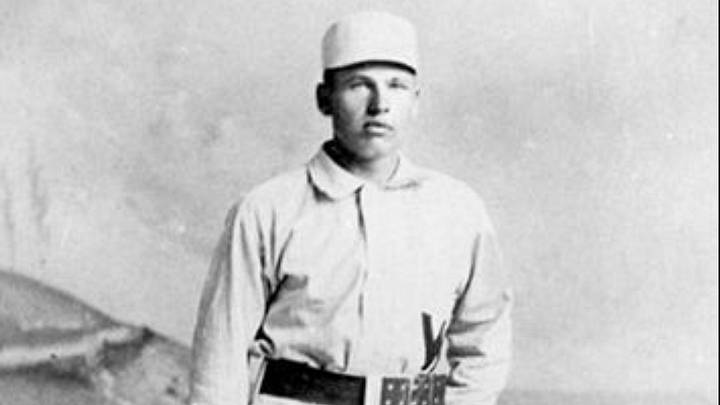
William Ellsworth “Dummy” Hoy was born on May 23, 1862, in the small town of Houcktown, Ohio. Rendered deaf and mute after contracting meningitis at age 3, he didn’t seem destined for a life of athletic excellence. Yet he defied the odds to become a star during baseball’s infancy in a time when the world was particularly harsh for those who were disabled—and he left an impact that’s lived on through today’s game.
Over a century before the passing of the Americans with Disabilities Act, Hoy was a shoe salesman, a common profession for the deaf in those days, who played baseball during weekends. As professional leagues began to take shape and form the basis for what would eventually become the Major League Baseball we know today, Hoy developed a knack for the game. A short but speedy center fielder, he signed his first professional contract in 1886 for a minor league team in Oshkosh, Wis., eventually making it to the Washington Nationals of the National League—the predominant professional baseball organization of the time.
There, Hoy developed into one of the best players of his era. He led the league with 82 stolen bases as a rookie, and went on to have a 14-year career that lasted until his age-40 season, featuring stints with the Nationals, Reds and White Sox. By the end of it, he had amassed over 2,000 hits, 1,000 walks, a .386 on-base percentage and 596 stolen bases.
And for many, that’s where the story ends: an interesting figure of the long ago past, reduced today to numbers on a Baseball Reference page, forgotten along with the tens of thousands of ballplayers from the days of black-and-white photos.
Today, though, there is a growing group of supporters trying to change that. Sign for Hoy is a campaign aimed at spreading the word of Hoy’s story, with the ultimate goal of getting him enshrined into the Baseball Hall of Fame. Its leadership includes luminaries from the deaf and baseball communities, including Albert Pujols, Academy Award-winning actor Troy Kotsur and Hall of Fame broadcaster Marty Brennaman, all of whom have come together to ensure that more people know Hoy’s name.
For those who have taken up the cause, Hoy’s story is much more than just a curious footnote from baseball’s past. It’s a foundational part of the game’s history, and an inspirational tale that’s tailormade for a wider audience.
“He was certainly a pioneer … Some people would say, ‘Calm down, now. You’re gonna compare Dummy Hoy to Jackie Robinson and Henry Aaron and people like that?’” says Brennaman, who was the Reds’ play-by-play announcer from 1974 to 2019. “And in his own special way, I don’t think that’s a stretch. I think that’s legitimate.”
Baseball’s early days
To best appreciate the era in which Hoy lived and played, it’s useful to have a broad picture of what professional baseball was in the late 19th century. Pro leagues came and went in those days, beginning with the National Association of Professional Base Ball Players in 1871. Many others sprung up in its wake—some folded, others consolidated. The National League eventually emerged as the standard bearer, later joined by the American League at the turn of the 20th century, and their union would ultimately form Major League Baseball.
But before that, the pro leagues that existed during Hoy’s day were far from the mainstream cultural force MLB is today. Baseball was popular, and gaining fans rapidly, but the people who played at the highest level back then did not necessarily come from the upper echelons of society.
“He played at a time when the scoundrels and the riff-raff and the outlaws were playing the game of baseball,” Brennaman says. “And I think this guy stood above all that. The fact that he did it with the handicap that he did made it even more impressive.”
As the story goes, Hoy’s peers had no qualms about using his disability to their advantage. Because Hoy was unable to hear anything—including the umpire’s calls—he would have to look backwards in between every pitch to see whether or not it was called a ball or strike. Opposing pitchers and catchers soon caught on to this tendency, and would resort to quick-pitching Hoy before he had the chance to turn his head back to the pitcher.
To combat this, the left-handed hitting Hoy enlisted his third base coach to signal with his hands whether the pitch was a ball or a strike, so Hoy could keep his eyes trained on the pitcher.
This is where Hoy’s story delves into folktale territory. While there are varying accounts, the prevailing belief among historians is that these hand signals provided the basis for the ball and strike calls umpires make to this day. Whether Hoy’s presence in professional baseball originated this practice, merely popularized it or somewhere in between, we might never know for certain.
But what’s beyond dispute is that, during a time when the world extended far less grace to those with disabilities, Hoy adapted to not only play the game by its rules, but excelled among peers who took every opportunity they could to exploit any perceived weakness.

Pioneer status
Hoy was not the first professional baseball player who was deaf. That distinction belongs to Ed “Dummy” Dundon, who played for the American Association’s Columbus Buckeyes from 1883 to ’84. Others followed, including Luther “Dummy” Taylor, a pitcher who actually faced off against Hoy in 1902, the last year of Hoy’s career. When Hoy stepped to the plate, he reportedly signed to Taylor, “I’m glad to see you!” before singling to center field.
(The repetition of the trio’s nicknames is no coincidence, but a sign of the times. In those days, the word “dumb” referred to people who could not speak. The degree to which this term was meant as a pejorative at the time is open to interpretation. Hoy, for his part, reportedly embraced the nickname, and would correct those who called him William or Billy throughout his life.)
While Hoy wasn’t the first, he was certainly the most accomplished. After baseball, he bought a farm, raised a family with his wife, Anna (who was also deaf), and remained in Ohio. By all accounts, he lived a quiet life and never sought praise. He died in 1961 at 99, just months after he made an appearance at Game 1 of that year’s World Series between the Yankees and Reds in which he threw out the ceremonial first pitch.
A lasting legacy
Because Hoy shirked the limelight, his story faded into relative obscurity. That’s why, when asked about Hoy nearly a century after his professional debut, Curtis Pride had no idea who he was.
“I never heard of Dummy Hoy until my first year of pro ball,” Pride says. “A reporter was interviewing me, and he mentioned [his name] and asked if I knew of him. I said, ‘Who is he?’ I was surprised I didn’t know about him.”
Pride and Hoy’s names are forever intertwined. Born deaf from rubella in 1968, Pride grew up in Maryland and was a multisport star at the College of William and Mary, eventually getting drafted in the 10th round by the Mets in ‘86.
He reached the majors with the Expos in 1993, becoming the first deaf player in MLB since Dick Sipek in ’45. Prior to Sipek, the last deaf player to appear in an MLB game was Herbert Murphy in ’14.
Both Sipek and Murphy’s major league careers were brief—Sipek appeared in 82 games, while Murphy managed only nine. Hoy, though, enjoyed sustained success, something Pride strived to emulate.
“When I was growing up, I never really had a deaf role model. Until I joined professional baseball, when that reporter first mentioned [Hoy]’s name, I thought, Wow, now I have a role model. … I figured, well, he made it, he had a great career, why not me?’”
Coming up through the minor leagues, Pride recalls, was challenging. At the lowest point of his career, he considered quitting midseason after he caught teammates mocking his disability.
“I was in Binghamton [in 1992], and that was the worst season ever. At that point, I thought my career was over,” Pride says. “My girlfriend broke up with me, I caught several of my teammates making fun of me. I was not doing well, it was all too much for me to handle at the time … My dad told me that he did not raise his son to be a quitter, and that I should honor my commitment to finish the season.”
Faced with a career crossroads, Pride spent part of the ensuing offseason working as an instructor at his old high school, working with students with disabilities in the special education program while he considered whether or not to move on from the game. The kids in the program didn’t know who Pride was, and were thrilled when a teacher informed them he was a professional baseball player.
Without trying, Pride became the role model that he never had.
“They were amazed. When I was little, I always had dreams to play Major League Baseball, just like these kids who had dreams and goals,” Pride says. “After that day, I went home, I talked to my mom, and told her, ‘What kind of a message would I be sending to them if I quit baseball?’ And so, these kids inspired me to keep going, and I decided to give baseball another try.”
Pride signed with the Expos that offseason, and made his MLB debut on Sept. 14, 1993. He spent 11 years in the majors, last appearing with the Angels in 2007.
In refusing to quit, Pride became an inspirational figure to an entirely new generation of people that Hoy could never reach. In doing so, Pride kept intact the contemporary world’s connection to a figure long overshawed, bringing a new audience to Hoy’s story in a meaningful way.

Path to Cooperstown
Getting the word out about Hoy’s story is the first step in the Sign for Hoy campaign. The journey, hopefully, ends in Cooperstown, where a growing many are advocating for Hoy to be inducted into the Baseball Hall of Fame.
“We want to work with Cooperstown, and we want to get in front of the Hall of Fame voters to understand that his stats alone should get him into the Hall of Fame, not just because he was a deaf player,” says Shawn Ullman, president of Sign for Hoy. “We 100% believe that if Jackie Robinson broke the color barrier, Dummy Hoy broke the sound barrier.”
It’s not the first time people have pushed for Hoy’s candidacy, but the hope is that it will be the last. Hoy’s pathway to enshrinement is via the Hall’s Classic Baseball Era Committee, which next convenes in December 2027.
The process is as follows: the Historical Overview Committee—a group of veteran baseball writers and historians—will consider players, managers, umpires and executives whose greatest contributions to baseball occurred prior to 1980. The committee is tasked with narrowing the pool of candidates down to eight names, which will appear on a ballot for the 16 members of the Classic Baseball Era Committee.
Once on the ballot, candidates need at least 12 votes to gain election into baseball’s most esteemed ground.
“While Hoy is not currently a member of the Hall of Fame, his historically significant life and career is represented in Cooperstown,” writes Jon Shestakofsky, vice president of communications and content of the Hall of Fame. “We hold an extensive assortment of files in our Library, which includes newspaper clippings and published information pertaining to Hoy’s life and career on and off the field, as well as deaf baseball players …
“While we are not involved in the process of selecting players for enshrinement, the Hall of Fame supports the legacy of Mr. Hoy’s career on and off the field.”
Given the thousands of baseball figures who fall under the Historical Overview Committee’s purview, the battle remains an uphill climb. The odds are long just to make it on the eight-person ballot, let alone gain enough votes for enshrinement. There are several hurdles still left to clear.
But in the bigger picture, getting more people to know who Dummy Hoy was is an accomplishment on its own. Baseball, more than any other sport, is where people can achieve mythical status. As time passes, memories fade into stories, then evolve into legends.
Hoy’s is a story that’s been waiting to reach a modern audience. On that front, by advocating for him to reach the Hall of Fame, the Sign for Hoy campaign has already succeeded.
“I look at Dummy Hoy, and I can imagine what he went through,” Pride says. “I’m sure he went through the same thing—probably much worse than me … I want people to know who he is, what he has done for the game of baseball. He not only was a great baseball player, but he changed the game for better.”
 Add us as a preferred source on Google
Nick Selbe is a programming editor at Sports Illustrated who frequently writes about baseball. Before joining SI in March 2020 as a Breaking and Trending News writer, he worked for the Orange County Register, MLB Advanced Media, Graphiq and Bleacher Report. Selbe received a bachelor’s in communication from the University of Southern California.
Follow NickSelbe