%20%20--%3E%0A%3Csvg%20version%3D%221.1%22%20id%3D%22Layer_1%22%20xmlns%3D%22http%3A%2F%2Fwww.w3.org%2F2000%2Fsvg%22%20xmlns%3Axlink%3D%22http%3A%2F%2Fwww.w3.org%2F1999%2Fxlink%22%20x%3D%220px%22%20y%3D%220px%22%0A%09%20width%3D%2239px%22%20height%3D%2240px%22%20viewBox%3D%220%200%2039%2040%22%20enable-background%3D%22new%200%200%2039%2040%22%20xml%3Aspace%3D%22preserve%22%3E%0A%3Cpath%20fill%3D%22%23FFFFFF%22%20d%3D%22M38.5%2C7H28.2v26h10.3V7z%22%2F%3E%0A%3Cpath%20fill-rule%3D%22evenodd%22%20clip-rule%3D%22evenodd%22%20fill%3D%22%23FFFFFF%22%20d%3D%22M26.1%2C25.5c0%2C5.8-4.1%2C7.5-12.9%2C7.5C3.9%2C33%2C0%2C31.2%2C0%2C25.2v-1.1h11.6%0A%09v2.4c0%2C0.7%2C0.1%2C1.4%2C1.2%2C1.4c1%2C0%2C1.2-0.4%2C1.2-1.3v-0.9c0-1.6-0.9-1.6-3.5-2.2C2.2%2C21.7%2C0%2C19.7%2C0%2C15.3v-0.9C0%2C9.3%2C5.5%2C7%2C12.9%2C7%0A%09c10.2%2C0%2C12.8%2C2.6%2C12.8%2C7.4v1.8h-11v-2.9c0-0.6-0.4-1.1-1.2-1.1c-0.6%2C0-1.2%2C0.4-1.2%2C1.1v0.9c0%2C1.5%2C0.9%2C2%2C3.3%2C2.5%0A%09c8%2C1.6%2C10.5%2C3.3%2C10.5%2C7.5V25.5z%22%2F%3E%0A%3C%2Fsvg%3E%0A)
Six Reasons Why the Giants' Season Is Likely Already Lost
In this story:
Like the foggiest of days in San Francisco, the Giants are defined by a low ceiling. Last in walks, last in stolen bases, next-to-last in home runs and, inevitably with those ominous vital signs, last in runs. They are bound to get better, especially with Rafael Devers awakening from his slumber, but progress will be limited because the lineup has too little power, speed and patience.
The Giants have played 44 games, more than a quarter of the season. They are on pace to score the fewest runs in a 162-game season in franchise history, a level below the rockbottom 1985 Giants, the only 100-loss team in franchise history. These Giants are historically bad at offensive baseball. San Francisco is the first team in 92 years and only the second in the live ball era, joining the 1934 Reds, with such meager totals of walks (92), stolen bases (12) and home runs (31) through 44 games.
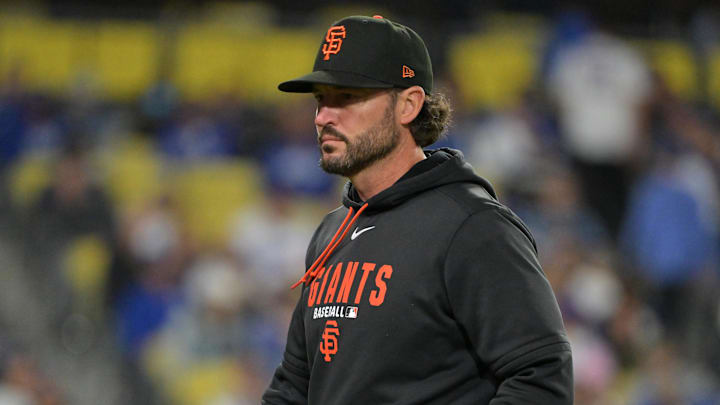
There is not much manager Tony Vitello can do beyond his constant tinkering with the batting order. Vitello was an unprecedented hire out of the college ranks with a sharp baseball mind and the kind of energy desperately needed by a franchise stuck in mediocrity and low-wattage star power. He has a tenacious rotation—“six guys who are ultra-competitive that overall do a good job of throwing strikes and logging innings,” he says—and has done well with a small-budget bullpen. But he is stuck with an everyday lineup without much flexibility or thump to it. The trade of catcher Patrick Bailey was a smart and necessary pivot, but Vitello can’t do much more with this collection than wait.
“We can hit,” he says. “We just haven’t it for a lot of power. I think that’s coming. We haven’t walked. We’re not going to catch the first-place team in the league [in walks], the Cubbies, but it’s coming. We can hit. So why is this team [14th] in batting average and not scoring? You’ve got to string hits together if that’s all you’ve got going for you. And when you have a black hole or two in the lineup it prevents that.”
The short answer to how it went this wrong for the Giants is that in their desperation to land star players, after frequently striking out at the top of the free agent market and losing a quarter of their paid customers from 2016, they took on or handed out 27 years’ worth of commitments covering $672.5 million to Devers, Willy Adames, Matt Chapman and Jung Hoo Lee. All of them this season are below 100 in OPS+ except Lee (103), a corner outfielder with 13 career homers and a .392 slugging percentage. It was an expensive Plan B that is not working.
“Everybody knows who those guys are,” Vitello says of his everyday lineup. “We definitely need to get better at the baserunning. The hitting was slow to stat. [But] the back of the baseball cards are starting to appear a little bit for most of those guys.”
In the meantime, the granular details of how this team is constructed and how it is performing are ominous. Here are a few.
1. There is little flexibility or bench strength.
The Giants have the fewest hits off the bench in baseball (five). Their hitters get the platoon advantage less often than all but two teams, which makes them easy to manage against. They don’t have the impact hitters or platoon pairings to force pitching decisions.
Their best prospect, 21-year-old Bryce Eldridge, is hitting .095 with irregular playing time.
Vitello has been criticized for underutilizing his bench, a narrative that stems from San Francisco getting four off days after among its first 16 games. Bailey, for instance, started each of the first six games and 10 of the first 11 while hitting .129 with no extra-base hits.
“It was going to happen anyway [that] something was going to be put on my plate. ‘Why are you doing this or that?’” Vitello says. “We got three scattered off days right out of the shoot, so why are we not going to play our best guys?”
Pressure mounted after the Yankees swept the Giants in the opening series by a combined score of 13-1.
“We’ve been chasing .500 since day one, so why are we not playing our best guys?” Vitello says.
2. Devers is not the impact hitter he was in Boston.

In 134 games with the Giants after a mutual exodus out of Boston, Devers is slugging .437, down from .510 with the Red Sox. His hitting has picked up in the past 14 games. When Devers struggles it is usually against fastballs when his stride and swing get too big.
“Raffy knows his swing better than anybody,” Vitello says. “In my opinion the effort has geared down a little bit. He’s always going to want to do damage. He’s looking to crush that thing. The strength of his swing is the conviction in his swing. But it does seem to be more of a loose aggressiveness instead of an effort-y aggressiveness.”
3. Adames and Chapman look lost.
Adames is a shortstop without much range whose value primarily comes from powering the ball to the pull side in the air. He has tried to force that power this year with opening his front side too early. He is hitting .111 against four-seam fastballs.
Chapman is stuck in a 4-for-47 rut with no home runs. His exit velocity this year has cratered by 5 mph, the third biggest drop in MLB. The attack angle of his swing has become too flat. He has tried opening his stance more, but now he can’t cover outside pitches (.177).

4. The Giants don’t walk.
This is endemic to the type of hitters they have assembled. They are on pace for the fewest walks ever in a 162-game season (339). They have been outwalked by opponents, 171–92.
5. The Giants don’t run.
San Francisco has attempted only 17 stolen bases despite ranking 14th in team sprint speed. Chapman, Lee, Adames, Harrison Bader and Heliot Ramos, who all have above average sprint speed, and Drew Gilbert, a center fielder with limited power, have one stolen base in four tries out of 298 opportunities.
6. Pivoting from Bailey, while the right move, may take time to yield dividends.
Vitello will split the position among rookies Daniel Susac and Jesus Rodriguez (whose receiving skills need work) and 33-year veteran Eric Haase. Vitello says he favored rotating catchers in college “almost like a hockey shift,” rather than relying on one main catcher. “You want a guy to play his ass off at full speed and then know he’s not going to get worn out on the back end,” he says.
San Francisco still has 118 games to play, which sounds like plenty of time to get itself right—until you understand how far it needs to go to recover from this start. This is only the 11th Giants team to lose at least 26 of its first 44 games. Only one of the previous 10 finished with a winning record, the 85-win 1990 team. None made the postseason.
More MLB from Sports Illustrated
 Add us as a preferred source on Google
Tom Verducci is a senior writer for Sports Illustrated who has covered Major League Baseball since 1981. He also serves as an analyst for FOX Sports and the MLB Network; is a New York Times best-selling author; and cohosts The Book of Joe podcast with Joe Maddon. A five-time Emmy Award winner across three categories (studio analyst, reporter, short form writing) and nominated in a fourth (game analyst), he is a three-time National Sportswriter of the Year winner, two-time National Magazine Award finalist, and a Penn State Distinguished Alumnus Award recipient. Verducci is a member of the National Sports Media Hall of Fame, Baseball Writers Association of America (including past New York chapter chairman) and a Baseball Hall of Fame voter since 1993. He also is the only writer to be a game analyst for World Series telecasts. He lives in New Jersey with his wife, with whom he has two children.