%20%20--%3E%0A%3Csvg%20version%3D%221.1%22%20id%3D%22Layer_1%22%20xmlns%3D%22http%3A%2F%2Fwww.w3.org%2F2000%2Fsvg%22%20xmlns%3Axlink%3D%22http%3A%2F%2Fwww.w3.org%2F1999%2Fxlink%22%20x%3D%220px%22%20y%3D%220px%22%0A%09%20width%3D%2239px%22%20height%3D%2240px%22%20viewBox%3D%220%200%2039%2040%22%20enable-background%3D%22new%200%200%2039%2040%22%20xml%3Aspace%3D%22preserve%22%3E%0A%3Cpath%20fill%3D%22%23FFFFFF%22%20d%3D%22M38.5%2C7H28.2v26h10.3V7z%22%2F%3E%0A%3Cpath%20fill-rule%3D%22evenodd%22%20clip-rule%3D%22evenodd%22%20fill%3D%22%23FFFFFF%22%20d%3D%22M26.1%2C25.5c0%2C5.8-4.1%2C7.5-12.9%2C7.5C3.9%2C33%2C0%2C31.2%2C0%2C25.2v-1.1h11.6%0A%09v2.4c0%2C0.7%2C0.1%2C1.4%2C1.2%2C1.4c1%2C0%2C1.2-0.4%2C1.2-1.3v-0.9c0-1.6-0.9-1.6-3.5-2.2C2.2%2C21.7%2C0%2C19.7%2C0%2C15.3v-0.9C0%2C9.3%2C5.5%2C7%2C12.9%2C7%0A%09c10.2%2C0%2C12.8%2C2.6%2C12.8%2C7.4v1.8h-11v-2.9c0-0.6-0.4-1.1-1.2-1.1c-0.6%2C0-1.2%2C0.4-1.2%2C1.1v0.9c0%2C1.5%2C0.9%2C2%2C3.3%2C2.5%0A%09c8%2C1.6%2C10.5%2C3.3%2C10.5%2C7.5V25.5z%22%2F%3E%0A%3C%2Fsvg%3E%0A)
How Each Last-Place MLB Team Can Go From Worst to First in 2026
In this story:
Last year’s Blue Jays were a marvel of a turnaround story. They were coming off a 74-win, last-place finish, eight years removed from their most recent playoff victory. Entering 2025, many pundits (ahem) looked at Toronto and saw an aging roster in need of a hard reset.
Instead, the Blue Jays doubled down. They inked homegrown superstar Vladimir Guerrero Jr. to a monster contract extension, were aggressive at the trade deadline and won the AL East en route to a World Series run. It’s a worst-to-first turn that every basement-dwelling team dreams of.
But did they provide a blueprint for other also-ran clubs?
That’s the question facing the six last-place teams from 2025: the Orioles, White Sox, Angels, Nationals, Pirates and Rockies. While it’s clear that not all of these organizations have brighter days ahead in ‘26, we can dream up some best-case scenarios that result in Cinderella runs next fall.
Given the eclectic statuses of these teams, suspension of disbelief varies from situation to situation. In order of most likely to most far-fetched, here’s how all six last-place teams can flip the script in 2026 and reach the postseason.
Team | Record | Run differential |
|---|---|---|
Orioles | 75–87 | -111 |
Angels | 72–90 | -164 |
Pirates | 71–91 | -62 |
Nationals | 66–96 | -212 |
White Sox | 60–102 | -95 |
Rockies | 43–119 | -424 |
Baltimore Orioles
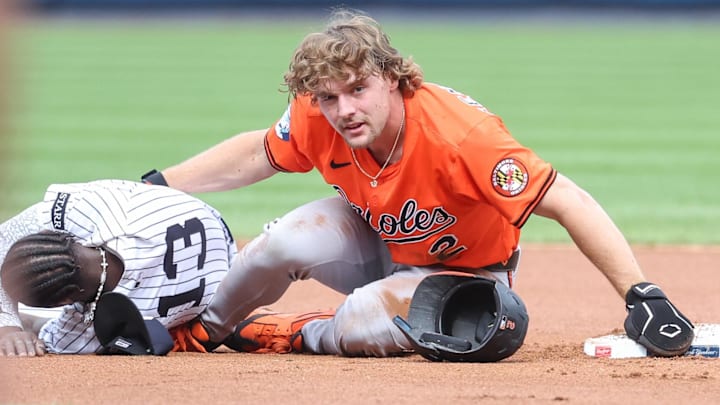
Imagining the Orioles in the 2026 playoffs is not all that difficult to do. This is a club that won 192 games from ‘23 to ‘24 and entered last season with championship aspirations before faceplanting in what was ultimately a snakebitten year. Given the organization's moves so far this winter, it’s clear that Baltimore is eyeing a swift return to the top.
Adding Pete Alonso and Taylor Ward to an already strong lineup should place the Orioles among the league leaders in runs scored. The starting rotation has been the team’s biggest bugaboo for years, and trading for Shane Baz was a significant step toward addressing it. It still looks like Baltimore could use another impact arm. But if Trevor Rogers comes close to replicating last year’s form over a full season, Baz makes 30 starts again and Kyle Bradish stays healthy, it’s easy to see the O’s being the best team in a loaded division.
For Baltimore, going from last place to the playoffs isn’t a pie-in-the-sky outcome. It’s the expectation.
Hope-O-Meter: 8/10
Pittsburgh Pirates
Any discussion about the Pirates making the playoffs begins with Paul Skenes taking the ball every fifth day. That’s a great place to begin—it’s just that there are 130-plus games where Skenes isn’t on the field.
Beyond Skenes, there are some promising arms that fill out what could be a productive rotation. Braxton Ashcraft and Bubba Chandler dazzled in their debuts, and should be in store for more innings in 2026 after tossing 118 and 131 1/3 frames, respectively, across the minors and the big leagues in ‘25. Jared Jones should return from elbow surgery at some point in the second half, and Mitch Keller—who over the past four seasons owns a 4.15 ERA across 124 starts—provides stability.

The offense, though, is where Pittsburgh really needs to show improvement. For as hard a time as the Pirates have had scoring runs over the years—they’ve ranked dead last in that category three times in the past six seasons, including 2025—there looks to be a decent accumulation of role players. That group includes holdovers Jared Triolo, Spencer Horwitz, Bryan Reynolds and Joey Bart, and welcomes offseason acquisitions Ryan O’Hearn and Brandon Lowe. It’s a lineup that could desperately use a breakout from Oneil Cruz, who regressed last season while adjusting to full-time center field duty, or a headliner from outside the organization. Pittsburgh has been linked to some big names in the rumor mill this offseason, but so far has only netted O’Hearn and Lowe to address its offense.
A star turn from Cruz would go a long way toward ending a decade-long playoff drought, as would the eventual arrival of Konnor Griffin, a tools-laden shortstop prospect who was the top high schooler taken in the 2024 draft. A year after the division rival Reds made the postseason with 83 wins, Pittsburgh could follow a similar path in ’26.
Hope-O-Meter: 5.5/10
Chicago White Sox
The White Sox have had three straight 100-loss seasons, which is usually around the time the complete teardown starts to turn into a rebuild. But Chicago doesn’t operate on what anybody would consider a reasonable plane of existence.
If we’re looking for positives, let’s start with the flashes of promise from last season. In Colson Montgomery and Kyle Teel, Chicago has a pair of up-the-middle young regulars who could be budding stars. Surrounding them is a cast of supporting position players—Chase Meidroth, Miguel Vargas, Lenyn Sosa and Luis Robert Jr., to name a few—that actually looks plenty intriguing. Then there’s Munetaka Murakami, who was thought to be in store for a nine-figure contract by multiple outlets upon his arrival from Japan. The market clearly cooled on him, as he had to settle for a two-year, $34 million deal with Chicago. Perhaps that means expectations might need to be tempered for the power-hitting corner infielder who has serious swing-and-miss concerns, but the potential is here for a monster debut season.
The team’s pitching staff has more competency than you’d expect. Shane Smith and Davis Martin, in particular, look like building blocks, while Anthony Kay comes over after two impressive seasons in Japan. There is good depth of back-of-the-rotation types, and if one of them levels up from there, this could be a pitching staff that exceeds expectations.
The White Sox won 19 more games last year than they did the year before. More importantly, they improved their year-over-year run differential by 211 runs, from -306 to -95. In 2025 terms, that’s basically the difference between the Dodgers and the Pirates. They’d need to improve by 90 runs next year to match the run differential of the defending AL Central champion Guardians (-6 in ‘25).
After losing a record 121 games two seasons ago, a 90-run improvement doesn’t seem like the steepest mountain to climb.
Hope-O-Meter: 3.5/10
Washington Nationals
It’s been tough sledding for the Nats since their World Series title in 2019. Coming off their fourth last-place finish in five years, the organization hit the reset button hard, handing the reins over to a brain trust in their early- to mid-30s in a dramatic series of moves meant to hard-pivot Washington in a new direction.
When assessing 2026’s prospects for a breakthrough, the optimism lies mostly on the offensive side. The Nationals don’t have a ton of spots that look particularly bleak, and there’s youth everywhere you look. James Wood and CJ Abrams have each made All-Star teams, while Daylen Lile, Luis Garcia Jr. and Dylan Crews should at least be serviceable with the potential for big jumps. MacKenzie Gore leads the way on the pitching side, and he looked like a bonafide ace for long stretches during his All-Star ‘25 campaign. Cade Cavalli and Foster Griffin, the latter signed after a successful stint in Japan, provide some intrigue behind Gore.

Washington’s new leadership was surely brought in to get the organization to a healthier place after half a decade of futility. But 2019 was a long time ago, and for a fan base that’s growing tired of losing, there’s at least some sense of urgency to turn things around quickly. And with the Braves taking a step back last year, the Phillies getting older, the Marlins’ perpetual wheel-spinning and the Mets being the Mets, the NL East looks fairly wide open.
The Nationals have more young talent than most of the teams on this list, and the time has come to translate those raw materials into more wins. Whether or not they’ll be able to will depend on those youngsters being able to maximize their potential quickly.
Hope-O-Meter: 3/10
Los Angeles Angels
Every year of their decade-long meandering through the baseball desert, the Angels’ plan (if you can call it that) seems to be roughly the same: throw some darts at the wall in the form of one-year contracts for reclamation projects and hope enough of them stick to form the shell of a roster that, when observed from the appropriate angles, resembles something close to a playoff team. Naturally, it never works, but it might work this time.
This time, the cast of additions plays all the hits: Grayson Rodriguez is the uber-talented but oft-injured former phenom. Alek Manoah, last effective in 2022, fits a similar description. Kirby Yates and Jordan Romano are former All-Star closers brought in to help a bullpen that had the worst ERA in the American League last season. And, given the roster holes at center field, third base and in the rotation, more reinforcement lottery tickets are sure to come.
On the incumbent side of the roster, Zach Neto took a huge step forward and is a budding star, while Jo Adell finally fulfilled some of his potential with a breakout 37-homer campaign. Nolan Schanuel has shown promise in his first two seasons, while Christian Moore and Logan O’Hoppe are both talented young players—the latter is coming off a dismal year but had a 105 wRC+ with 34 homers the previous two seasons, while the former is a 2024 first-round pick rushed to the majors in typical Angels fashion.
Gambling on low-cost, high-variance outcome players is the type of thing a team in this dire of a funk should do if the goal is to win now. There’s a larger discussion to be had about whether or not that’s a practical goal to have, but practicality and the Angels haven’t been on speaking terms for some time. With a manager and GM each on a one-year contract, they’ll need enough of these dart throws to connect with their intended targets to end the franchise’s 11-year playoff drought.
Hope-O-Meter: 1.5/10
Colorado Rockies
The Rockies lost a franchise-worst 119 games last year, their third consecutive 100-loss campaign. If Ezequiel Tovar can stay healthy, and Hunter Goodman takes a Cal Raleigh-sized leap, and Kris Bryant … oh, never mind, who are we kidding?
Colorado renders this exercise completely moot with its unrelenting dysfunction. This is a team that was outscored by 424 runs in 2025, the most in the modern era, and one that allowed 1,021 runs—122 more than the next-worst team (the Nationals). I could assign 90th percentile outcomes to half of Colorado’s 40-man roster and still not find a viable path to a wild-card spot, let alone first place in the NL West, for this group.
That’s not to say there are no noteworthy players to speak of. Tovar, Goodman and Brenton Doyle have put up productive seasons, while there are seedlings of competent role players elsewhere if you squint hard enough. Taking a generous look at most other pieces of the roster means speculating on their impact as big leaguers a few years from now, which won’t do much to improve Colorado’s chances in 2026.
Ownership shook things up by bringing in Paul DePodesta of Moneyball fame to run baseball operations after he spent a decade trying to revive the Cleveland Browns. It’s a move that’s simultaneously outside-the-box and outdated, given DePodesta’s 10-year removal from working in professional baseball. For a franchise this rudderless, grand experimentation is welcomed. Just don’t expect a quick fix for these Rockies, who face a long climb up baseball’s mountainside.
Hope-O-Meter: 0/10
More MLB on Sports Illustrated
 Add us as a preferred source on Google
Nick Selbe is a programming editor at Sports Illustrated who frequently writes about baseball. Before joining SI in March 2020 as a Breaking and Trending News writer, he worked for the Orange County Register, MLB Advanced Media, Graphiq and Bleacher Report. Selbe received a bachelor’s in communication from the University of Southern California.
Follow NickSelbe