
Kyle Seager Gave the Mariners 1,480 Games. He Can Miss Their 50 Seasons Celebration
In this story:
So, apparently we’re doing forensic work on Kyle Seager’s calendar now. The longtime Mariners third baseman will not attend the franchise’s 50 Seasons Celebration, where the 50 greatest players in team history will be honored on August 8. Seager reportedly cited a previous commitment coaching his son’s baseball team. That explanation produced questions about tournament dates, locations and whether he could theoretically make it to Seattle anyway.
Why? No thank you. We don’t need the dude’s flight itinerary. We certainly don’t need his hotel checkout time. And on top of that, an invitation to a celebration is not a subpoena.
If Seager says he has a coaching commitment, that should be enough. If there’s more behind his decision, that’s also fine too. The Mariners’ relationship with Seager belongs to Seager and the people running the Mariners. Fans can be disappointed that he won’t be there without turning his absence into a loyalty test. Besides, we’ve already received the part that mattered.
Kyle Seager Gave the Mariners Everything He Had
Seager played 1,480 games for the Mariners. All 11 seasons of his major-league career were spent here. He hit 242 home runs, drove in 807 runs, made an All-Star team, won a Gold Glove, and received MVP downvotes in 2014 and 2016.
MLB ranked him as the greatest third baseman in Mariners history, and there’s not much of a debate about that. He leads every Mariners third baseman by a mile in hits, doubles, home runs and RBI.
He also remained here through an era defined by disappointment. Seager never played in a postseason game. He spent his prime on teams that changed direction, changed personnel and repeatedly failed to build a winner around their most dependable players.
Then, in what everyone understood could be his final season, he only went on to hit a career-high 35 home runs and another career high 101 RBI. He played 159 games. He showed up because showing up was what the guy did.
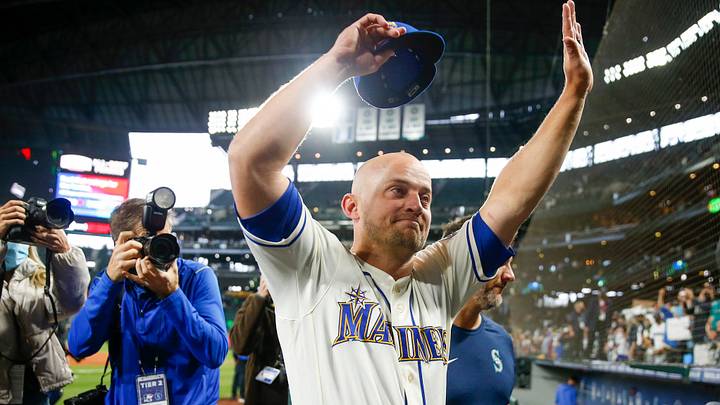
His final afternoon at T-Mobile Park told us more about his connection to Seattle than any alumni ceremony could. More than 44,000 fans chanted his name. His teammates surrounded him on the mound, many of them crying. J.P. Crawford called him a leader, mentor and friend. Before the game, Seager’s 7-year-old son, Crue, threw the ceremonial first pitch to his father.
Now Seager is reportedly coaching that son. For 11 years, baseball took Seager away from his family. Now baseball is something he gets to share with them. Who are we to tell him that posing for cameras with franchise officials should matter more?
The Mariners Made This Complicated Long Ago
Let’s also not forget Seager’s tenure didn’t end with warm handshakes all around. In February 2021, then-team president Kevin Mather publicly called Seager “overpaid” while simultaneously predicting that he would eventually enter the Mariners Hall of Fame. Mather had stirred up plenty of controversy before his disastrous Rotary Club appearance. That was the final straw, he created enough damage that he resigned shortly afterward.
Months later, the Mariners declined Seager’s $20 million option for 2022. The initial report said the official notification arrived through an email from assistant general manager Justin Hollander. Additional reporting established that Jerry Dipoto had attempted to reach Seager by telephone and text before the email was sent and that the organization had notified his representatives.
That can all be necessary context. But it also doesn’t magically make the breakup graceful. The organization had every contractual right to decline the option. And Seager had the right to remember how the entire process felt. Both things can be true without holding a trial over how it all went down.
Rather than search for another contract, Seager retired at 34. He didn’t go chase a ring elsewhere. He left baseball as a player whose entire major-league identity belongs to one franchise. That’s extremely rare nowadays.
Mariners Fans Have Seen This Movie Before
Randy Johnson’s No. 51 now hangs at T-Mobile Park. It’s a beautiful thing. But reaching that happy ending took nearly three decades.
Johnson was traded in 1998 after an ugly and deeply personal separation from the organization. In 2025, 27 years later, he joined a Mariners broadcast and bluntly explained that he felt his contributions had been “swept under the carpet” by former club leadership. He reminded everyone that he hadn’t abandoned Seattle. He was traded.
Johnson finally had his number retired in May 2026. Reporting from the ceremony described the moment as the completion of a long reconciliation between the Hall of Famer and the franchise.
If it took him almost 30 years to reach that point, why are we demanding that Seager smile through his feelings before five have passed?
These wounds can heal. Not sure how much they can if any fans question or shame a former player into appearing on the organization’s preferred schedule.
The Mariners should still honor Seager. The word is that they will, even if he’s not in attendance. He belongs among their 50 greatest players whether he stands on the field or watches from somewhere else. His number should eventually enter the team’s Hall of Fame, and the organization should keep the door open for whatever reunion might come later. But when he’s ready.
 Add us as a preferred source on Google
Tremayne Person is the Publisher for Mariners On SI and the Site Expert at Friars on Base, with additional bylines across FanSided’s MLB division. He founded the Keep It Electric podcast in 2023 and covers baseball with a blend of analysis, context, and a little well-timed side-eye just to keep things honest. Tremayne grew up a Mariners fan in Richmond, Va., and that passion ultimately led him to move to Seattle to cover the team closely and become a regular at home games. Through his writing, he connects with fans who want a deeper, more personal understanding of the game. When he’s not at T-Mobile Park, he’s with his dog, gaming, or finding the next storyline worth digging into.
Follow TremaynePerson