%20%20--%3E%0A%3Csvg%20version%3D%221.1%22%20id%3D%22Layer_1%22%20xmlns%3D%22http%3A%2F%2Fwww.w3.org%2F2000%2Fsvg%22%20xmlns%3Axlink%3D%22http%3A%2F%2Fwww.w3.org%2F1999%2Fxlink%22%20x%3D%220px%22%20y%3D%220px%22%0A%09%20width%3D%2239px%22%20height%3D%2240px%22%20viewBox%3D%220%200%2039%2040%22%20enable-background%3D%22new%200%200%2039%2040%22%20xml%3Aspace%3D%22preserve%22%3E%0A%3Cpath%20fill%3D%22%23FFFFFF%22%20d%3D%22M38.5%2C7H28.2v26h10.3V7z%22%2F%3E%0A%3Cpath%20fill-rule%3D%22evenodd%22%20clip-rule%3D%22evenodd%22%20fill%3D%22%23FFFFFF%22%20d%3D%22M26.1%2C25.5c0%2C5.8-4.1%2C7.5-12.9%2C7.5C3.9%2C33%2C0%2C31.2%2C0%2C25.2v-1.1h11.6%0A%09v2.4c0%2C0.7%2C0.1%2C1.4%2C1.2%2C1.4c1%2C0%2C1.2-0.4%2C1.2-1.3v-0.9c0-1.6-0.9-1.6-3.5-2.2C2.2%2C21.7%2C0%2C19.7%2C0%2C15.3v-0.9C0%2C9.3%2C5.5%2C7%2C12.9%2C7%0A%09c10.2%2C0%2C12.8%2C2.6%2C12.8%2C7.4v1.8h-11v-2.9c0-0.6-0.4-1.1-1.2-1.1c-0.6%2C0-1.2%2C0.4-1.2%2C1.1v0.9c0%2C1.5%2C0.9%2C2%2C3.3%2C2.5%0A%09c8%2C1.6%2C10.5%2C3.3%2C10.5%2C7.5V25.5z%22%2F%3E%0A%3C%2Fsvg%3E%0A)
Home Sweet Dome: The Rebuilt Tropicana Field Deserves Its Flowers
Tyler Wall has spent the better part of two decades working for the Rays. His job title is director of major league equipment and clubhouse operations. His work is anticipating problems and solving them. Last season, however, Wall encountered one problem that he thought he would never see with the Rays.
A player ran up in the middle of the third inning with an urgent request: “Dude, I’ve got to get my backup jersey, I’m soaked. I can’t even play.”
And that was the first sign that Wall and his team would have to completely overhaul their laundry routine. They always stocked backup uniforms at the Rays’ traditional home, Tropicana Field. They just rarely actually used them, not in their 72°, air-conditioned dome in St. Petersburg. But that was going to change for 2025. Temporarily evicted from the Trop after Hurricane Milton severely damaged the stadium when it rolled through Florida in October 2024, they were playing their home games out in the brutal local heat for the first time.

The Rays spent last season at Steinbrenner Field, the spring training park of the Yankees, across the bay in Tampa. (A one-year deal granted the club full-time use of the facility for roughly $15 million.) The players, coaching staff and front office all praised their new home and expressed gratitude for the opportunity to play locally. But even the nicest spring training stadium is not intended for the grind of the regular season. It is also not intended to house major leaguers in the suffocating heat and rolling afternoon thunderstorms of Florida in August.
Forget a single backup uniform. One Rays pitcher kept tabs on his personal record: In his sweatiest outing, he went through four jerseys, two pairs of pants and a second pair of cleats. Wall and his crew had their hands—and washing machines—full.
The experience of playing at a spring facility stretched every member of the organization in one way or another. Which means the Rays will have a new perspective when they return to a fixed-up Tropicana Field this season: They have a fresh appreciation for their historically beleaguered field. “When the Trop is the topic of conversation, it’s usually about what’s wrong with it,” says Rays president of baseball operations Erik Neander, who has been with the club for nearly 20 years. “That’s changed now. Now it’s about everything that’s right with it.”
They all know the quirks and flaws of their idiosyncratic old dome. (The organization is still aiming to build a new stadium after nearly two decades of failed deals and thwarted plans. There are new renderings for a Tampa ballpark—the anchor of a large development planned with both public and private funds—that would open in 2029.) But the Rays are thrilled for now at the chance to return somewhere familiar. Somewhere with a roof.

To see a place that you’ve worked so long turn into sort of a disaster area ... it really, really blows your mind how Mother Nature can do that to a building as big as the Trop. It’s just saddening.Tyler Wall, Rays director of equipment
There is perhaps no MLB stadium as perpetually tangled in criticism as Tropicana Field. It has been the subject of consternation since it was built. Before the Trop was known as the Trop, when it still carried its maiden name of the Florida Suncoast Dome, it picked up another moniker.
Some local media called it the Doom Dome.
The city of St. Petersburg began seriously planning for the stadium in 1984. (If they built it, a team would surely come, supporters argued.) They were anxious to beat out a rival group with its own sights on pro baseball just across the bay in Tampa. But there was little enthusiasm from MLB. Remarks leaked from a league committee on expansion: None other than Yankees owner George Steinbrenner supposedly declared St. Petersburg “nothing but a bunch of old folks over there and a rickety bridge to get there.”
MLB could not exactly demand that a city not build its own stadium. But it could reiterate that it had no immediate desire to bring a franchise to St. Petersburg, and it could remind the city council that there were 12 other markets with potentially compelling expansion cases, including several in Florida, and it could have league commissioner Peter Ueberroth send a telegram to St. Petersburg mayor Edward L. Cole Jr. before a key council vote in 1986. “Any current decision by St. Petersburg to undertake construction of a facility capable of housing major-league baseball will be made by your community without any encouragement whatsoever on the part of Major League Baseball,” it read.
The city broke ground on the stadium that year anyway. Construction finished in 1990. They had built it. And no one came. Or, at least, no one affiliated with professional baseball.
In 1991, MLB awarded its next expansion franchises to Miami and Denver instead of Tampa Bay. Several clubs that flirted with relocating ultimately stayed where they were. The dome hosted Arena football (the Storm of the AFL) and hockey (the Lightning of the NHL) before it saw baseball. But then came one more round of expansion. With a stadium already waiting and Florida politicians making noise about examining MLB’s antitrust exemption when another proposed relocation fell through, the league granted a team to the region, and the stadium got its long-awaited ball club when the Tampa Bay Devil Rays debuted in 1998.
Which meant the stadium felt somewhat anachronistic even from the day of its very first ball game. This was fundamentally a ballpark of the 1980s, with its roof and its turf. Even among other concrete domes, Tropicana Field was a bit unusual at best, inaesthetic at worst. “Traffic is a nightmare going in or out, parking is woeful, and the place itself makes the Kingdome look like Wrigley Field,” John Feinstein bemoaned in a 1992 column for The New York Times. Baseball was shifting back to neat brick recreations of jewel boxes. Here was an enormous, sloping, catwalk-supported dome that vaguely resembled a circus big top plopped down by the highway.
And so the story of the Rays became a story of a team angling to play anywhere but Tropicana Field. A stadium built in search of a team now housed a team in search of a different stadium. The following decades saw failed plans for (among others) a waterfront park in St. Petersburg, a shiny new stadium in Tampa, and one notably strange relocation scheme that would have seen the club splitting time between the Tampa Bay region and Montreal. But while those ideas sputtered, the Rays stayed in the Trop, and like any ballpark, it came to feel like home for those who played and worked and became fans there.
What outsiders saw as flaws could be charming idiosyncrasies to those viewing them under the colorful lights of the dome. If other ballparks were newer and nicer, well, many of those ballparks also looked awfully similar to one another: No one ever accused Tropicana Field of lacking a sense of place. (It is and has always been clearly, indubitably a product of Florida.) And while the most scorned feature of the stadium was generally its roof, those who loved the park would argue that a closed, air-conditioned environment was valuable enough to be worth compromising on aesthetics.
“Negative people are all, Oh, those catwalks are awful, the balls hit [them], it’s got an ugly roof,” says Rays director of special projects and field operations Dan Moeller, who has been a groundskeeper for the franchise since its earliest days. “Well, it’s a roof. There’s nothing better than having a roof over your head.”

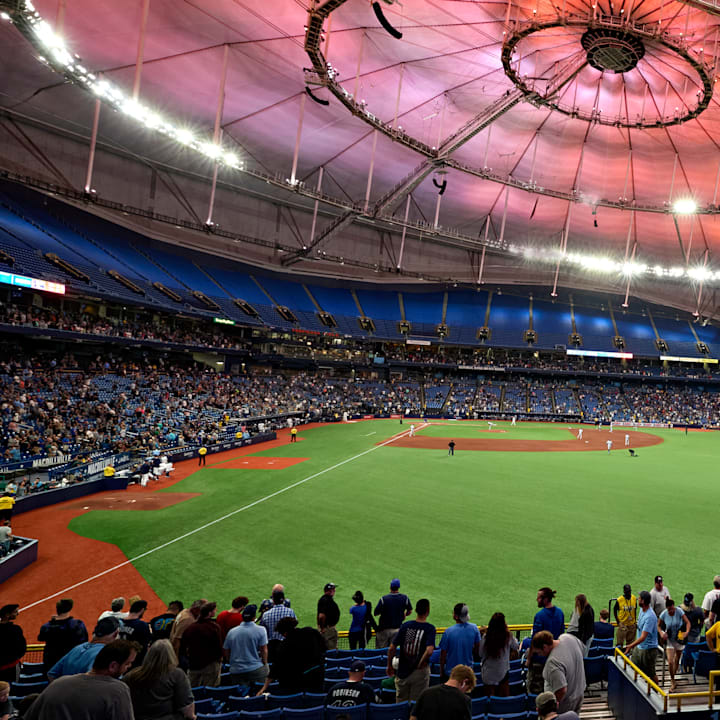
It was the roof that suffered the most damage from Hurricane Milton. The white expanse could look from a distance like great panels of cloth. It was actually Teflon-coated fiberglass woven into a material that could move like fabric. The 100-mph winds shredded it and flooded the stadium with debris.
“To see a place that you’ve worked for so long turn into sort of a disaster area … it really, really blows your mind how Mother Nature can do that to a building as big as the Trop,” Wall says. “You see something that looks like it’s indestructible just get crushed by the winds and the rains and it’s just saddening.”
With so much damage, there was no conversation about playing there in 2025. The deal for Steinbrenner Field was finalized in scarcely a month. After years of attempting to play in a different stadium, especially one across the bay in Tampa, the club would finally be doing exactly that—just not how anyone had ever imagined.
Countless adjustments were required. There were only four days to prepare the park between the Yankees finishing spring training and the Rays hosting Opening Day. (Although Moeller had arranged for several members of his groundskeeping crew to embed with the New York team there earlier in the spring: His unit needed a crash course in working an outdoor field.) Thousands of pieces of individual signage were hung to cover up New York logos with Tampa Bay ones. Mercifully, there was not much painting, as Yankees navy blue is a very similar Pantone shade to Rays navy blue. The clubhouse was cleaned out and changed over. Players got used to a park with new dimensions and less foul territory.
But the biggest adjustment, by far, was the weather, and there was little that could be done to prepare for that. Plenty of MLB teams play outdoors in cities that get hot in the summer. But those cities generally do not get Florida hot. (The Marlins got themselves under a roof in Miami as soon as they could.) MLB had adjusted the schedule to cluster most of the Rays’ home games away from the peak of summer. But that still left several homestands in July and August, when Moeller’s game-day temperature readings could reach 120° on the clay, 110° on the grass. And when it wasn’t miserably, oppressively hot, it was often raining or threatening to do so. The Rays had their first home rain delay in franchise history on May 10—the very first big-league, high-pressure, regular-season tarp pull for this groundskeeping crew—and went on to have 12 more.
When the Trop is the topic of conversation, it’s usually about what’s wrong with it. That’s changed now. Now it’s about everything that’s right with it.Erik Neander, president of baseball ops
Some aspects of the situation were pleasant. Many players and employees had shorter commutes due to playing in Tampa instead of St. Petersburg. It was nice to play outside in April and September. There were several features of Steinbrenner Field that were fancier than anything at the Trop. (Players especially loved the whirlpools.) Moeller was glad that his crew got experience with a full season of an outdoor field. And while the Rays’ overall record was a disappointing 77–85, they played better at home than on the road, going 41–40 at Steinbrenner.
Everything was perfectly manageable. But it wasn’t theirs.
“I’ve stayed in hotel rooms that are nicer than my house,” Neander says. “But home is still home.”

One of the first people inside Tropicana Field after the hurricane was St. Petersburg managing director of city development administration Beth Herendeen. She had worked her first job out of college at the stadium, back when it was called the ThunderDome in the 1990s and serving as the home of the Lightning, and it was unnerving to look up where the roof had always been and see only sky.
But she was also struck by just how much had held up. The roof was in tatters, and the field was covered in debris, but the concrete bowl and the concourses were untouched in many places. Herendeen passed a Coke bottle standing upright on a table. There was considerable work ahead. But it was all work that she believed they could do. “She may not be the prettiest stadium,” Herendeen says. “But she is tough.”
The city was legally obligated to repair the stadium while the lease with the Rays was still in effect. It ultimately cost nearly $60 million. One particular difficulty was keeping water out of the stadium every time it rained: “For every one inch of stormwater that fell from the sky onto that building without a roof, we were collecting a quarter million gallons of water inside of it,” says Catherine Corcoran, the city’s senior capital projects coordinator. Or in the eyes of Moeller, who kept close tabs on the old ballpark even as he worked every day at their temporary home: “The field would look like a lake,” he says. “It was just, Oh my, are we ever going to play here again?” There was a real anxiety in those early months that perhaps they had played their last game there without knowing.
But a new roof was placed last fall, an upgraded, stronger fiberglass fabric, and a new field came next. The Rays will be back at Tropicana Field on April 6 to host the Cubs. They cannot wait.
“We’ve talked enough about the challenges with playing at Steinbrenner,” says Rays manager Kevin Cash. “It was unique for all of us … But there’s genuine, authentic excitement to get back to the Trop.”
They all know that Tropicana Field is not exactly a conventional baseball dream home. It’s their home all the same.
“It doesn’t get a lot of love,” Wall says. “But we love it.”
More MLB from Sports Illustrated
 Add us as a preferred source on Google
Emma Baccellieri was a staff writer focused on women’s basketball for Sports Illustrated. She previously covered MLB. She has also written for Baseball Prospectus and has been honored with multiple awards from the Society of American Baseball Research. A graduate of Duke University, she lives in Washington, D.C.
Follow emmabaccellieri