%20%20--%3E%0A%3Csvg%20version%3D%221.1%22%20id%3D%22Layer_1%22%20xmlns%3D%22http%3A%2F%2Fwww.w3.org%2F2000%2Fsvg%22%20xmlns%3Axlink%3D%22http%3A%2F%2Fwww.w3.org%2F1999%2Fxlink%22%20x%3D%220px%22%20y%3D%220px%22%0A%09%20width%3D%2239px%22%20height%3D%2240px%22%20viewBox%3D%220%200%2039%2040%22%20enable-background%3D%22new%200%200%2039%2040%22%20xml%3Aspace%3D%22preserve%22%3E%0A%3Cpath%20fill%3D%22%23FFFFFF%22%20d%3D%22M38.5%2C7H28.2v26h10.3V7z%22%2F%3E%0A%3Cpath%20fill-rule%3D%22evenodd%22%20clip-rule%3D%22evenodd%22%20fill%3D%22%23FFFFFF%22%20d%3D%22M26.1%2C25.5c0%2C5.8-4.1%2C7.5-12.9%2C7.5C3.9%2C33%2C0%2C31.2%2C0%2C25.2v-1.1h11.6%0A%09v2.4c0%2C0.7%2C0.1%2C1.4%2C1.2%2C1.4c1%2C0%2C1.2-0.4%2C1.2-1.3v-0.9c0-1.6-0.9-1.6-3.5-2.2C2.2%2C21.7%2C0%2C19.7%2C0%2C15.3v-0.9C0%2C9.3%2C5.5%2C7%2C12.9%2C7%0A%09c10.2%2C0%2C12.8%2C2.6%2C12.8%2C7.4v1.8h-11v-2.9c0-0.6-0.4-1.1-1.2-1.1c-0.6%2C0-1.2%2C0.4-1.2%2C1.1v0.9c0%2C1.5%2C0.9%2C2%2C3.3%2C2.5%0A%09c8%2C1.6%2C10.5%2C3.3%2C10.5%2C7.5V25.5z%22%2F%3E%0A%3C%2Fsvg%3E%0A)
Craig Breslow's Eight Biggest Mistakes With the Red Sox
In this story:
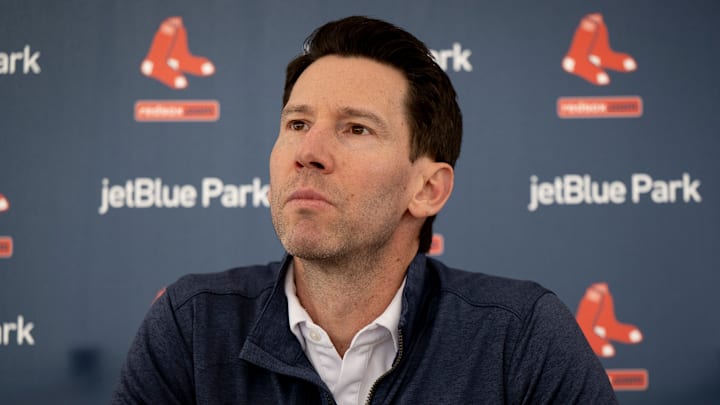
When he fired Alex Cora last weekend, Red Sox chief baseball officer Craig Breslow used a move struggling executives have fallen back on for generations: Find someone else to blame.
After a 10–17 start to the season, Breslow cleaned house in the dugout, firing Cora and most of his coaching staff. It was a shocking move that ousted a World Series-winning manager with a solid track record of success. And the decision totally ignored the personnel issues Cora had to contend with.
The Red Sox hired Breslow on Oct. 25, 2023. While every executive makes personnel mistakes, it's alarming just how poorly the results have borne out under Breslow. It's worth reviewing his eight biggest mistakes, in chronological order below.
1. The Chris Sale trade
A few weeks after being hired, Breslow made what turned out to be one of the worst moves of his tenure. On Dec. 30, 2023, he shipped Chris Sale to the Braves in exchange for infielder Vaughn Grissom. He even included cash to entice Atlanta to do the deal. All Sale did in his first season with the Braves was win the NL Cy Young after notching a Triple Crown.
The veteran lefty had dealt with health issues for much of his Red Sox tenure, but he made 20 starts in 2023 and looked like he was on his way back. Breslow felt that was the time to move on. Since arriving in Atlanta, Sale is 30–9 in 56 games with a 2.45 ERA and ranks second among qualified pitchers in strikeout rate (31.7%), third in xFIP (2.86) and sixth in fWAR.
Meanwhile, Grissom played 31 games for the Red Sox in 2024, slashed .190/.246/.219 and produced -0.7 fWAR. He spent 2025 at Triple A Worcester, and the Red Sox traded him to the Angels over the winter.
2. The Walker Buehler contract

While trying to rebuild his rotation before the 2025 season, Breslow signed former All-Star Walker Buehler to a one-year deal worth $21.05 million. After returning from Tommy John surgery in '24, Buehler helped the Dodgers close out the Yankees in Game 5 of the World Series, picking up a save as L.A. clinched a championship. He rode that momentum into a big contract despite going 1–6 with a 5.38 ERA and 1.56 WHIP in 75 1/3 innings during the regular season. He'd only made 16 starts that year after missing most of ‘22 and all of ‘23.
It didn't work. Buehler made 23 appearances for the Red Sox (22 starts) and went 7–7 with a 5.45 ERA and 1.56 WHIP, struck out 84 and walked 55 in 112 1/3 innings. Boston released him in late August, and the Phillies picked him up for the stretch run, but he wasn't much better there. He finished the year at -0.3 fWAR.
Breslow’s big gamble on Buehler came up snake eyes.
3. Trading Quinn Priester
At the 2024 trade deadline, the Red Sox landed former first-rounder Quinn Priester from the Pirates for Nick Yorke, a fellow former first-round pick who didn’t appear to have a path to playing time in Boston. Priester was a righty with four solid pitches who could touch 97 and had already debuted in Pittsburgh. In his one start with the franchise, he allowed one run on four hits over five innings. He looked like a future rotation fixture.
He wasn't in Boston long enough to find out. On April 7, 2025, Breslow shipped him to the Brewers for minor league outfielder Yophery Rodriguez, a player to be named later (John Holobetz) and the 33rd pick in the 2025 draft. Rodriguez isn't ranked among Boston's top 30 prospects by MLB Pipeline, while Holobetz is a low-ceiling pitcher (No. 13 Red Sox prospect by MLB Pipeline) and the 33rd pick became righty Marcus Phillips, whom MLB Pipeline ranks 8th in their system. That's not a great return for a 24-year-old starter with upside.
Priester went 13–3 with a 3.32 ERA and 1.24 WHIP in 29 appearances (24 starts) for Milwaukee and is still improving. He’s currently on the shelf with a shoulder injury, but is making rehab starts. The Red Sox are trying to compete now. This trade was a bad one.
4. The Rafael Devers trade

This is the one everyone will talk about when Breslow’s time in Boston is over. It’s not just the move itself—it's everything that led to it, and everything that followed.
Entering 2025, Rafael Devers was a franchise cornerstone about to begin the second season of a 10-year, $313.5 million contract. He was a three-time All-Star, two-time Silver Slugger and World Series champion. Despite his pedigree, Breslow signed Alex Bregman to a three-year, $120 million deal to play third base—Devers’s position—and asked Devers to move to DH. He wasn't happy about it, but agreed.
Devers opened the season 0-for-21 with 15 strikeouts. Then, a few weeks in, the Red Sox asked him to move to first base due to an injury to incumbent Triston Casas. He refused, and the ensuing back-and-forth ended the relationship. On June 15, Boston shocked baseball by sending Devers to the Giants for Kyle Harrison, James Tibbs III, Jordan Hicks and Jose Bello—a return that felt light for a perennial All-Star slugger. The story only got worse from there.
Harrison was the centerpiece. He made two starts after the trade, posting a 3.00 ERA with 13 strikeouts over 12 innings. A few months later, Breslow flipped the 24-year-old lefty—along with David Hamilton and Shane Drohan— to the Brewers for Caleb Durbin, Andruw Monasterio, Anthony Seigler and a 2026 compensation pick. Durbin, the headliner, is slashing .172/.261/.263 with a 46 wRC+ this year. Harrison is in Milwaukee's rotation and has looked great. He's 2–1 with a 2.28 ERA and a 1.06 WHIP in five starts.
Tibbs lasted six weeks in the organization before Boston shipped him to the Dodgers as part of a deal for Dustin May. The former first-round pick is currently raking at Triple A Oklahoma City. He's hitting .321 with 11 home runs, 24 RBIs and an OPS of 1.153. May went 1–4 with a 5.40 ERA in six appearances (five starts) for the Red Sox before signing with the Cardinals in free agency. That deal was nothing short of brutal for Boston.
Hicks made 21 relief appearances for the Red Sox and posted an 8.20 ERA and a 1.98 WHIP and signed with the White Sox this winter.
Breslow destabilized his relationship with a franchise cornerstone to sign Bregman, then traded Devers for a return he methodically dismantled to end up with Caleb Durbin. Some will point to Devers's struggles in San Francisco as justification for the move. That argument can be made. But Boston could have extracted a bigger return, and Breslow should have done a better job evaluating the talent he was getting back.
It was all made worse by his next mistake.
5. Letting Alex Bregman walk
He couldn’t even keep the guy he replaced Devers with.
The three-year, $120 million deal Bregman signed allowed him to opt out after the first season. That's exactly what he did. He played 114 games, slashed .273/.360/.462 with 18 home runs, 62 RBIs, a wRC+ of 125 and 3.5 fWAR, then went looking for the long-term contract he didn't get the first time around.
Breslow needed to go all-in to get him back. Bregman was a legitimate veteran presence in a young lineup, and given the chaos his signing caused for the organization, losing him only compounded everything. Nevertheless, Breslow shopped around the market, left Bregman waiting and the Cubs pounced with a five-year, $175 million deal.
He cost himself Devers to get Bregman, then lost Bregman, too.
6. Holding onto Jarren Duran

Jarren Duran was brilliant in 2024. The outfielder slashed .285/.342/.492 with 21 home runs, 48 doubles, 14 triples and 34 stolen bases, posting a 131 wRC+ and 6.8 fWAR. It was a career year—and it was always going to be a career year. He significantly outperformed his underlying metrics and was never going to reach those highs again.
The Red Sox weren't going to trade Duran coming off that season. But by last July, he had come back down to earth at the same time teams were desperate for left-handed bats at the trade deadline. The then-28-year-old was a useful player, but half the one he was in 2024. Boston had an outfield logjam. Wilyer Abreu and Ceddanne Rafaela are Gold Glovers with offensive upside. Roman Anthony is a franchise cornerstone in the making. There was no room for Duran, and the market was there. Breslow held onto him anyway.
Now the window for a big return appears to be gone. Through 26 games this season, Duran’s value has cratered. He’s slashing .170/.231/.250 with a wRC+ of 31, which ranks 177th out of 180 qualified batters. The massive haul Breslow could have landed last July is no longer a possibility.
7. Missing on a big bat this winter
Breslow entered the offseason needing to retool his rotation and find a middle-of-the-order bat to replace Devers and Bregman. He pursued everything and wound up with nothing.
The Red Sox were heavily linked to free agents Kyle Schwarber, Pete Alonso and Bo Bichette, as well as potential a trade for second basemen Ketel Marte of the Diamondbacks or Brendan Donovan, then with the Cardinals. Alonso went to Baltimore for five years and $155 million, Schwarber re-signed with the Phillies for five years and $150 million and Bichette signed with the Mets for three years and $126 million. Arizona held onto Marte and the Cardinals traded Donovan to the Mariners.
The only addition of note was a different trade with St. Louis for Willson Contreras. Contreras has been performing better than expected in Boston, but considering the Red Sox rank last in the AL with an 83 wRC+, Breslow needed to do more.
8. Firing Alex Cora
Breslow has made a lot of bad decisions. Over the weekend, he tried to blame someone else for the fallout.
After opening the season 10–17, Breslow fired Cora and pinned Boston’s struggles on its manager and coaching staff. The team’s players weren’t going along with it. Several publicly criticized the move, and it’s not hard to understand why. Last year, Cora led a young roster to 89 wins and a playoff berth before losing to the Yankees in the wild-card round. He led the Red Sox to a World Series title in 2018 and had a championship pedigree the roster trusted.
Despite all of the mistakes Breslow had made to hamstring Cora, he put the blame squarely on the team’s coaching staff. The players knew better.
More MLB from Sports Illustrated
 Add us as a preferred source on Google
Ryan Phillips is a senior writer on the Breaking and Trending News team at Sports Illustrated. He has worked in digital media since 2009, spending eight years at The Big Lead before joining SI in 2024. Phillips also co-hosts The Assembly Call Podcast about Indiana Hoosiers basketball and previously worked at Bleacher Report. He is a proud San Diego native and a graduate of Indiana University’s journalism program.
Follow rumorsandrants