
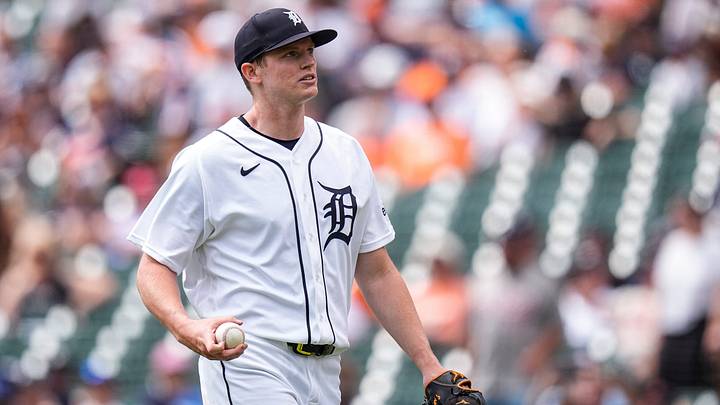
After an Electrifying Start, Troy Melton Faces Questions in His Second Season
In this story:
“It doesn’t seem like the moment is too big for him. He simply focuses on doing what he does: throwing strikes, going directly at hitters, getting into advantageous situations and doing all the things that pitching involves.”
That’s how Tarik Skubal, a two-time Cy Young Award winner and Triple Crown winner in 2024, described his former teammate, Troy Melton, after speaking with Evan Petzold of Detroit Free Press about the way Melton had handled those moments in the 2025 postseason.
Months later, Melton’s 2026 season was once again making headlines thanks to his ability to dominate and become an almost certain starter in the Detroit Tigers’ rotation. Something I have loved about Melton throughout the entire season is his philosophy on the mound: how he thinks, what he looks for against each opponent and his way of establishing his strike zone without focusing only on generating swings and misses. At times, he seems like an old-school pitcher to me, trying to locate his pitches where he can avoid hard contact and make his pitches generate as many ground balls as possible.
Troy Melton, 81mph Hammer. 🔨 pic.twitter.com/VA0etVMA7H
— Rob Friedman (@PitchingNinja) August 15, 2026
Then, the durability results speak for themselves. In 17 of his 20 starts this season, he has guaranteed at least five innings; in 15, more than five and in nine, at least six. His highest strikeout total in a game has been just nine, and that was in five innings. In truth, that is not a trend that often receives praise in this era, when the act of striking hitters out is sometimes overrated. I mean, we see a lot of pitchers with high strikeout rates, but who end up handing the ball over after 100 pitches without being able to get beyond five innings.
I love metrics and everything analysis has brought to the game, especially because of the way it can contribute to making baseball better. And, to be honest, I don’t think it is better with starting pitchers who cannot provide durability.
Instead, every four or five days, Melton has taken one or two innings of workload off the bullpen compared to other Detroit pitchers, and he has done it while allowing three or fewer runs in 16 of his 20 starts, with fewer than two in 13 of them.
The Tigers are 13-7 when he starts and, by far, he has been the most stable pitcher since the departure of Tarik Skubal and Casey Mize at the trade deadline. Behind Melton, the inconsistency of the starters has been one of the reasons the Tigers could not arrive in a better position to this final month of the season to battle for a spot in the playoffs.
The big offseason signing, Framber Valdez, has been a total disappointment. Detroit is 13-17 in his starts, and 7-12 when Jack Flaherty started, another experienced pitcher who, before going to the injured list, could not sustain himself.
The Recent Questions Surrounding Melton’s Regression

When something happens with the fastball, I think it is inevitable to think about velocity, but that has not been Melton’s recent problem. In fact, the velocity of his fastball is at the best point of his career since last September, averaging 97.1 mph this month.
However, hitters are crushing the fastball throughout almost the entire strike zone, even when Melton has the advantage in the count. On this, there is an interesting point I would not like to overlook: hitters are also finding the slider. This seems key to me amid Melton’s drop to a 6.30 ERA over his last six starts after posting a 1.46 ERA in his first 13 outings of the season.

The fastball is staying too high in the strike zone and Melton’s slider has lost some vertical break, staying within the hitters’ reach for longer. Of course, the fact that he has accumulated 114 1/3 innings in his second year, after throwing only 45 2/3 in his debut last season, shows the heavy workload he has been subjected to.
The weight of the innings is unavoidable, and part of the inconsistencies are reflected above all in the decline of his command. The fastball has gone from generating an 18.9% whiff rate to 5.1%, even with greater velocity, and the slider is allowing 13% fewer ground balls.
Melton has one regular-season start remaining and, whatever his performance is, there will be no other outing to continue watching how his arm evolves and whether he can regain his dominance. That leaves us with certain questions surrounding his repertoire for 2027, but surprisingly, he is throwing with more velocity right now. Melton still maintains his dominance against both hitter profiles, left-handed and right-handed, although during this latest stretch he has had to face more lineups with elite left-handed hitters.

On Sunday, he allowed four runs in 3 2/3 innings against the White Sox, and all of them were driven in by left-handed hitters: a pair of doubles by Braden Montgomery and Sam Antonacci, and a single by Kyle Teel. As the league has gotten to know Melton, teams have prepared better and hitters have more information about his pitches and his strategy.
For now, we can say with enough arguments that Melton has been a revelation, but we will not know how good he could be until he enters his next season as a rotation starter and once again faces the problems that have appeared during this recent stretch.
 Add us as a preferred source on Google
Yirsandy is a baseball writer specializing in MLB coverage with experience across multiple teams and storylines. He currently writes for Diamond Centric, where he covers the New York Mets, San Diego Padres, Chicago Cubs, Milwaukee Brewers, and Kansas City Royals. My work focuses on game coverage, player analysis, and storytelling that connects performance with context. My Substack has also been an important part of my writing development, where I’ve built much of my baseball coverage and storytelling voice over time. I’m passionate about combining reporting, research, and thoughtful analysis to produce engaging baseball content for readers.
Follow Yirsandy