
The Kevin McGonigle Mystery: How is Tigers 21-Year-Old Doing This?
In this story:
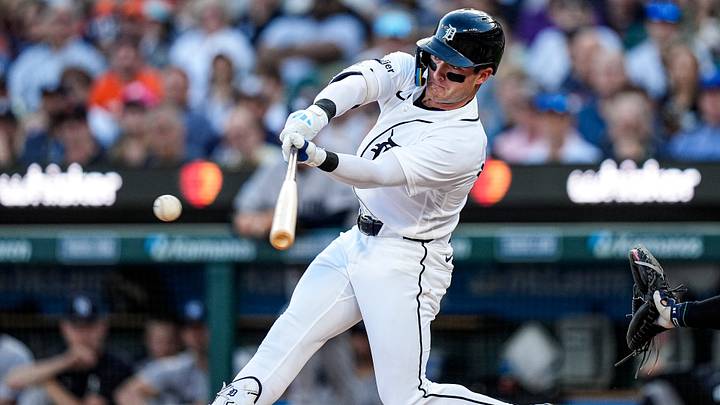
At 21 years old, Kevin McGonigle does not look like the type of hitter who should be putting Major League pitchers under this kind of pressure.
He stands 5-foot-9 and weighs 187 pounds, and his average exit velocity is 88.0 mph. His 109.5 mph maximum does not explain a .289/.395/.434 season by itself, either.
And yet, through 112 games, McGonigle has reached base 199 times. That puts him in historic company, alongside names such as Ted Williams and Joe DiMaggio.
The explanation is not that he hits the ball harder than everyone else. It is that he eliminates better than almost everyone else.
The Detroit rookie is turning every plate appearance into a test of patience for the pitcher. If a pitch finishes outside the zone, he can let it go. If it enters the zone, he has enough control of his swing to attack it.
That detail is changing the battle before contact ever happens.
The Pitcher Has to Play His Game

McGonigle’s best skill shows up in the pitches he decides not to attack. Per Statcast, His chase rate is just 18.4%, which ranks in the 99th percentile in the majors. At the same time, he swings at 67.8% of pitches in the zone.
That combination forces the pitcher to be precise. Pitches that could knock him off balance stop being a solution when McGonigle refuses to chase them. The pitcher has to find the zone more often, and every hittable strike becomes an opportunity for the hitter.
When that precision disappears, the walk follows.
McGonigle has drawn 73 walks, a 14.4% walk rate, while striking out in just 13.6% of his plate appearances. His on-base percentage is .395.
He does not have to win every plate appearance with a hit. He can win it by forcing the pitcher away from his best location.
That also helps explain his production against right-handers. McGonigle is hitting .305/.423/.461 against them, with a .388 wOBA, an 11.5% strikeout rate and a 16.3% walk rate.
Pitchers are not finding an easy answer with their secondary offerings, either. McGonigle chases just 15.8% of breaking pitches outside the zone and 17.5% of offspeed pitches.
For him, patience is not passivity.
It is a way of taking options away from the pitcher.
The Swing Comes After the Decision

McGonigle is not surviving by simply taking strikes and drawing walks. When he decides to attack, he makes contact.
His in-zone contact rate is 88.4%, while his whiff rate is just 16.2%. His swing length is 6.9 feet, and only 17.6% of his swings fall into the fast-swing category.
That combination helps explain why his production does not depend on extraordinary strength. McGonigle identifies the pitch, arrives prepared for contact and keeps the at-bat under control longer than most hitters his age.
Left-handers, however, have found a difference.
Against them, he is hitting .256/.336/.360 and striking out in 18.9% of his plate appearances. His chase rate remains low at 19.2%, but his in-zone contact rate drops to 87.0%. The discipline remains; what changes is his ability to turn the pitches he chooses to attack into favorable results.
That is the biggest challenge he will face for the rest of the season. Pitchers already know that getting him to chase is not an easy solution. The alternative is finding better locations in the zone and forcing him to win those battles with the bat.
So far, McGonigle has produced at a level that is difficult to dismiss as a hot streak. He is hitting .289/.395/.434 with a .365 wOBA. His power is not what drives the conversation, but his ability to reach base and limit unproductive plate appearances is.
That is what makes his season so unusual.
A pitcher can bring an elite fastball, a devastating slider or a changeup capable of getting the bat out of the way. Before any of those pitches becomes a problem, McGonigle has to decide whether it is worth attacking.
At 21, he is already playing that part of the at-bat like a veteran.
The difference is not how long it took him to reach this level. It is that he appears to have understood earlier than many hitters which pitches can win an at-bat and which ones are better left alone.
That advantage does not show up on the radar gun.
It shows up in every plate appearance.
 Add us as a preferred source on Google
Yirsandy is a baseball writer specializing in MLB coverage with experience across multiple teams and storylines. He currently writes for Diamond Centric, where he covers the New York Mets, San Diego Padres, Chicago Cubs, Milwaukee Brewers, and Kansas City Royals. My work focuses on game coverage, player analysis, and storytelling that connects performance with context. My Substack has also been an important part of my writing development, where I’ve built much of my baseball coverage and storytelling voice over time. I’m passionate about combining reporting, research, and thoughtful analysis to produce engaging baseball content for readers.
Follow Yirsandy