%20%20--%3E%0A%3Csvg%20version%3D%221.1%22%20id%3D%22Layer_1%22%20xmlns%3D%22http%3A%2F%2Fwww.w3.org%2F2000%2Fsvg%22%20xmlns%3Axlink%3D%22http%3A%2F%2Fwww.w3.org%2F1999%2Fxlink%22%20x%3D%220px%22%20y%3D%220px%22%0A%09%20width%3D%2239px%22%20height%3D%2240px%22%20viewBox%3D%220%200%2039%2040%22%20enable-background%3D%22new%200%200%2039%2040%22%20xml%3Aspace%3D%22preserve%22%3E%0A%3Cpath%20fill%3D%22%23FFFFFF%22%20d%3D%22M38.5%2C7H28.2v26h10.3V7z%22%2F%3E%0A%3Cpath%20fill-rule%3D%22evenodd%22%20clip-rule%3D%22evenodd%22%20fill%3D%22%23FFFFFF%22%20d%3D%22M26.1%2C25.5c0%2C5.8-4.1%2C7.5-12.9%2C7.5C3.9%2C33%2C0%2C31.2%2C0%2C25.2v-1.1h11.6%0A%09v2.4c0%2C0.7%2C0.1%2C1.4%2C1.2%2C1.4c1%2C0%2C1.2-0.4%2C1.2-1.3v-0.9c0-1.6-0.9-1.6-3.5-2.2C2.2%2C21.7%2C0%2C19.7%2C0%2C15.3v-0.9C0%2C9.3%2C5.5%2C7%2C12.9%2C7%0A%09c10.2%2C0%2C12.8%2C2.6%2C12.8%2C7.4v1.8h-11v-2.9c0-0.6-0.4-1.1-1.2-1.1c-0.6%2C0-1.2%2C0.4-1.2%2C1.1v0.9c0%2C1.5%2C0.9%2C2%2C3.3%2C2.5%0A%09c8%2C1.6%2C10.5%2C3.3%2C10.5%2C7.5V25.5z%22%2F%3E%0A%3C%2Fsvg%3E%0A)
Tom Verducci: Ten Lessons We Learned From Brewers’ Cliffhanging NLCS Game 1 Win Over Dodgers
In this story:
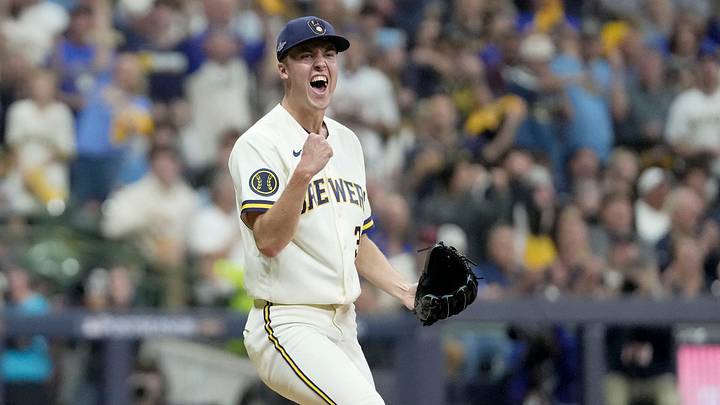
MILWAUKEE — Great directors often become famed for killing it in a certain genre. Hitchcock with mystery, Cameron with action flicks and Fellini with, well, Fellini. So it is with manager Pat Murphy and his Brewers with how they play baseball. They have mastered the cliffhanger.
Milwaukee has played five games this postseason. All 1,440 pitches in all 45 innings have been contested with the tying run no further away than on deck. Forty-five innings of playoff baseball with two teams never separated by more than two runs.
And yet the Brewers have won four of those five games, including a very familiar looking 2–1 win over the Dodgers in Game 1 of the National League Championship Series. They scored the winning run with the tongue-and-groove perfection of building a Lego set: walk, bunt, single.
Get your popcorn ready. Yes, it figures to be a long series, but this latest Brewers cliffhanger was a needed win for Milwaukee if only because 1) Jacob Misiorowski started (the Brewers are 24–8 when he starts, including 1–0 over the past two months, and 2) Milwaukee had lost seven straight postseason games to their nemesis who has ended three of their past eight seasons.
While it may have looked formulaic, this latest Brewers cliffhanger provided a few new truths. Here is what we learned from Game 1:
1. The hardest-throwing staff in postseason history is overwhelming hitters.
The Brewers’ pitchers average 97.7 mph on their fastballs. With elite stuff, they have allowed just three extra-base hits in five games.
In Game 1, the five Milwaukee pitchers all hit at least 97.1 mph. They hit 99 mph 65 times. There have been 11 games in the pitch tracking era (since 2008) in which a team threw 60 or more pitches at 99 mph or faster. Every one of those games has been thrown by the 2026 Brewers.
Jacob Misiorowski in Game 1:
— MLB (@MLB) October 12, 2026
4.1 IP, 5 H, 1 ER, 3 BB, 5 Ks pic.twitter.com/utVnPvBvQC
The Brewers depressed their opponent's slug better than any team in the regular season. It has gone next level in October. They have allowed three extra-base hits in five postseason games. That is absolute bonkers.
“I just think that another year of experience for this entire staff is proving so valuable,” Milwaukee reliever Aaron Ashby said. “We’ve put such an emphasis on dying with your best pitch. And so, it seems like maybe we're in that situation a lot more often throughout these last couple games.’
2. The Milwaukee bullpen is leaning heavily on elite velocity sinkers.
The Brewers’ pen has allowed one earned run this postseason. The boatload of firm sinkers means keeping the ball in the yard.
Brewers Pitching Innings 7–9, 2026 Postseason
AB | H | HR | Avg. |
|---|---|---|---|
48 | 7 | 0 | .145 |
“It feels good to be in crunch time all the time,” Ashby said. “For the bullpen, everyone down there throws a sinker. So, getting the ball on the ground certainly helps limiting damage.
“And everyone’s got a swing-and-miss pitch to offer. It helps when you have swing-and-miss stuff. In the postseason, it plays like soft contact, because everyone’s so good. And so, just a lot of sinkers from our guys and all the starters throw four-seams. I think we have a great combination and variety.”

3. Aaron Ashby is a weapon.
Just five games into the postseason, Ashby has three appearances of more than one inning with no hits and no runs allowed, just one short of the record shared by Ron Davis, Héctor Neris and Luke Weaver.
Reporter: Is your arm gonna fall off? You’re just gonna be able to pitch two or three innings a game here?
Ashby: “Uh, that would be awesome. I would love that—to go out there and contribute as much as I possibly can. That’s why we play the season, you know. It’s to pitch as much as and as long as we can in the postseason. So, yeah, it feels good right now.”
4. Shohei Ohtani isn’t right.
Murphy removed lefty DL Hall after the fifth inning and brought in righty Abner Uribe, even though Ohtani was due to hit second. If Ohtani is right, the lefty stays in. But when Ohtani has not hit a home run for two months and can’t get his body underneath his swing, Murphy prioritizes any right-handed hitter over Ohtani.

5. Jacob Misiorowski can fight his way through a game.
We have not seen the dominant version of Misiorowski in October. He has not made it through the fifth inning in two starts. In Game 1, he issued his first four-pitch walk to start an inning this year and it came back to burn him. But he has limited damage and kept his team in the game.
Hitters have adjusted to his high fastball. They are not swinging at the one just above the top rail and they are getting on top of the one in the zone. Misiorowski’s two worst whiff rates on his fastball this year have come in his past two starts: 13% against San Diego in the NLDS and 18% against Los Angeles in the NLCS. He typically is at 39%.
6. The Brewers play such selfless baseball all season that doing so in October is instinctual.
Captain Christian Yelich was benched against Tarik Skubal in Game 1. It wasn’t an issue.
Murphy asked his seventh hitter, Cooper Pratt, to bunt ahead of the bottom of the lineup. Luis Lara immediately stroked a first-pitch single to knock in the go-ahead run.
7. The Dodgers got out-maneuvered.
Los Angeles is supposed to win these games. Over these past three postseasons, the Dodgers had been 15–2 in postseason games decided by one or two runs.
The Dodgers lost a nine-inning postseason game by one run with no extra-base hits, no sacrifices and no stolen bases for only the second time Sunday. The other game filled with nothingness was Game 4 of the 1966 World Series.
8. Brice Turang is dangerous again.
After a slow start to his postseason, Turang worked between the NLDS and NLCS on a better bat path. He hit a most impressive solo homer off a 2-and-0 sinker from Skubal, taking an inside fastball and pounding it to left-center.
Turang became only the 10th lefty to homer off Skubal—and only the second lefty to go yard off of a Skubal sinker.
BRICE TURANG!
— MLB (@MLB) October 12, 2026
WE ARE TIED! pic.twitter.com/DnvfcRjLd2
9. Robert Gasser will start Game 3 for the Brewers.
With Logan Henderson starting Game 2, that will make it 87 straight games Milwaukee has given the ball to a starting pitcher in his 20s.
10. Garrett Mitchell is unpredictable.
The Brewers centerfielder is loaded with tools. Only Mitchell, Fernando Tatis Jr. and Jordan Walker rank in the 90th percentile in sprint, arm and bat speed. It was a walk by Mitchell that led to the deciding run.
“I don’t pay attention to these things,” Mitchell says, “but my wife tells me my Baseball Savant page is loaded with reds [good] and blue [bad]. There’s like no in between.”
 Add us as a preferred source on Google
Tom Verducci is a senior writer for Sports Illustrated who has covered Major League Baseball since 1981. He also serves as an analyst for FOX Sports and the MLB Network; is a New York Times best-selling author; and cohosts The Book of Joe podcast with Joe Maddon. A five-time Emmy Award winner across three categories (studio analyst, reporter, short form writing) and nominated in a fourth (game analyst), he is a three-time National Sportswriter of the Year winner, two-time National Magazine Award finalist, and a Penn State Distinguished Alumnus Award recipient. Verducci is a member of the National Sports Media Hall of Fame, Baseball Writers Association of America (including past New York chapter chairman) and a Baseball Hall of Fame voter since 1993. He also is the only writer to be a game analyst for World Series telecasts. He lives in New Jersey with his wife, with whom he has two children.