%20%20--%3E%0A%3Csvg%20version%3D%221.1%22%20id%3D%22Layer_1%22%20xmlns%3D%22http%3A%2F%2Fwww.w3.org%2F2000%2Fsvg%22%20xmlns%3Axlink%3D%22http%3A%2F%2Fwww.w3.org%2F1999%2Fxlink%22%20x%3D%220px%22%20y%3D%220px%22%0A%09%20width%3D%2239px%22%20height%3D%2240px%22%20viewBox%3D%220%200%2039%2040%22%20enable-background%3D%22new%200%200%2039%2040%22%20xml%3Aspace%3D%22preserve%22%3E%0A%3Cpath%20fill%3D%22%23FFFFFF%22%20d%3D%22M38.5%2C7H28.2v26h10.3V7z%22%2F%3E%0A%3Cpath%20fill-rule%3D%22evenodd%22%20clip-rule%3D%22evenodd%22%20fill%3D%22%23FFFFFF%22%20d%3D%22M26.1%2C25.5c0%2C5.8-4.1%2C7.5-12.9%2C7.5C3.9%2C33%2C0%2C31.2%2C0%2C25.2v-1.1h11.6%0A%09v2.4c0%2C0.7%2C0.1%2C1.4%2C1.2%2C1.4c1%2C0%2C1.2-0.4%2C1.2-1.3v-0.9c0-1.6-0.9-1.6-3.5-2.2C2.2%2C21.7%2C0%2C19.7%2C0%2C15.3v-0.9C0%2C9.3%2C5.5%2C7%2C12.9%2C7%0A%09c10.2%2C0%2C12.8%2C2.6%2C12.8%2C7.4v1.8h-11v-2.9c0-0.6-0.4-1.1-1.2-1.1c-0.6%2C0-1.2%2C0.4-1.2%2C1.1v0.9c0%2C1.5%2C0.9%2C2%2C3.3%2C2.5%0A%09c8%2C1.6%2C10.5%2C3.3%2C10.5%2C7.5V25.5z%22%2F%3E%0A%3C%2Fsvg%3E%0A)
Running on Sheer Joy, Venezuela Dances Into WBC Semifinal by Stunning Japan
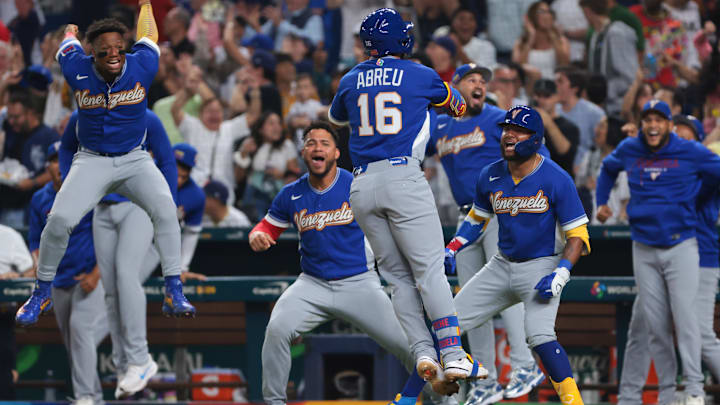
MIAMI — What is joy? How does such a little word convey such a big idea? The answers could be found in how Venezuela bounced Japan from the World Baseball Classic earlier than the three-time champions ever knew.
There was joy in the beat of the dugout djembe drums, the ones that belong to pitcher Eduardo Rodriguez and are at the heart of the one of the most joyful pregame celebrations you will ever find. Players call upon one another to dance in the middle of their circle while keeping the rhythm of the drums with their clapping hands and shouts.
IT'S GAME TIME 🇻🇪🕺#WorldBaseballClassic pic.twitter.com/5aizQToiTa
— World Baseball Classic (@WBCBaseball) March 15, 2026
There was joy, unrestrained, on the face of Wilyer Abreu as he floated around the bases upon a sixth-inning home run that turned a 5–4 deficit into a 7–5 lead, a swing that with live forever in the great baseball history of Venezuela.
There was joy in a number: 58. Why 58?
“It’s the international code in Venezuela,” manager Omar Lopez said. “If you have someone in Venezuela, call them and tell them Venezuela is in the Olympics and is in the semifinals of the WBC.”
And maybe the richest joy of all is what you can’t see but exists in what you can imagine. Lopez imagined people in the midnight hour out and about on the streets of Caracas and Maracaibo and Puerto Cabello and all places in between. In his mind’s eye he could see them dancing and drinking and celebrating, and that gave him incredible joy, especially for a country ravaged by political uncertainty, inflation and a world superpower only weeks ago assembling an armada off its shores.
“They’re dancing right now,” Lopez said, “and that makes me happy. Twenty years from now I can say at least I made my country happy for one or two days.”
Venezuela advanced to a semifinal matchup Monday against Italy. Their ferocious lineup roared back from down 5–2 to an 8–5 win. Two other factors made the win possible: an airtight job by the Venezuela bullpen and a disaster of a night for Japan and its manager Hirokazu Ibata.
Where do we start? Bunting in the third inning to take the bat out of Shohei Ohtani’s hands is as good a place as any. Sure, Japan did score four runs that inning. But the process was poor. Why take the bat out of your best hitter’s hands that early?
In the fifth, Venezuela had a pocket due up made for a righthander: Six of its next seven batters were right-handed. Ibata went with a soft-tossing lefty. Maikel Garcia blasted a two-run homer to get Venezuela within one. Uh-oh.
The next inning, a soft-tossing righthander, Hiromi Itoh, tried to throw a high fastball at 92 mph past Abreu. The left-handed Abreu was on time but fouled it back. It was a terrible pitch, if only because with first and third and no outs a hitter is looking for an elevated pitch he can hit in the air. Two pitches later, Itoh tried the same pitch, only this time at 91 mph. Given a second cookie, Abreu did not miss. Ballgame.
WILYER ABREU
— World Baseball Classic (@WBCBaseball) March 15, 2026
THREE-RUN HOME RUN
TEAM VENEZUELA TAKES THE LEAD 🇻🇪 pic.twitter.com/9ovv3fluF6
Japan simply didn’t have enough firepower to hold down this lineup. Four of Venezuela’s run-scoring hits came on fastballs. All of them were below major league average velocity except the 96.5 mph one Ronald Acuna Jr. pounded for a leadoff homer.
Fittingly, Japan topped it off with one of the ugliest ways imaginable—an RTI (Run Thrown In), a wild pickoff throw from the pitcher to second base that sent Ezequiel Tovar sprinting 180 feet for the capper.

Japan had been the WBC kings. This will be the first WBC semifinal without Japan. They had won 11 straight WBC games. They had been 33–0 in the WBC when they scored more than three runs. It all came crashing down inelegantly.
Truthfully, they had not been challenged in this edition. The average four-seam velocity their hitters had seen in the WBC was 90.9 mph. The MLB average four-seam velocity is 94.5. Only Australia saw less velo among the 20 teams in pool play. They had no answers against the powerful Venezuela bullpen.
But this night was about Venezuela and the meaning of joy. In Spanish, joy requires more syllables: alegría. For one night, Venezuela swelled with alegría, all because of a little baseball game in March deep with meaning.
More MLB on Sports Illustrated
 Add us as a preferred source on Google
Tom Verducci is a senior writer for Sports Illustrated who has covered Major League Baseball since 1981. He also serves as an analyst for FOX Sports and the MLB Network; is a New York Times best-selling author; and cohosts The Book of Joe podcast with Joe Maddon. A five-time Emmy Award winner across three categories (studio analyst, reporter, short form writing) and nominated in a fourth (game analyst), he is a three-time National Sportswriter of the Year winner, two-time National Magazine Award finalist, and a Penn State Distinguished Alumnus Award recipient. Verducci is a member of the National Sports Media Hall of Fame, Baseball Writers Association of America (including past New York chapter chairman) and a Baseball Hall of Fame voter since 1993. He also is the only writer to be a game analyst for World Series telecasts. He lives in New Jersey with his wife, with whom he has two children.