%20%20--%3E%0A%3Csvg%20version%3D%221.1%22%20id%3D%22Layer_1%22%20xmlns%3D%22http%3A%2F%2Fwww.w3.org%2F2000%2Fsvg%22%20xmlns%3Axlink%3D%22http%3A%2F%2Fwww.w3.org%2F1999%2Fxlink%22%20x%3D%220px%22%20y%3D%220px%22%0A%09%20width%3D%2239px%22%20height%3D%2240px%22%20viewBox%3D%220%200%2039%2040%22%20enable-background%3D%22new%200%200%2039%2040%22%20xml%3Aspace%3D%22preserve%22%3E%0A%3Cpath%20fill%3D%22%23FFFFFF%22%20d%3D%22M38.5%2C7H28.2v26h10.3V7z%22%2F%3E%0A%3Cpath%20fill-rule%3D%22evenodd%22%20clip-rule%3D%22evenodd%22%20fill%3D%22%23FFFFFF%22%20d%3D%22M26.1%2C25.5c0%2C5.8-4.1%2C7.5-12.9%2C7.5C3.9%2C33%2C0%2C31.2%2C0%2C25.2v-1.1h11.6%0A%09v2.4c0%2C0.7%2C0.1%2C1.4%2C1.2%2C1.4c1%2C0%2C1.2-0.4%2C1.2-1.3v-0.9c0-1.6-0.9-1.6-3.5-2.2C2.2%2C21.7%2C0%2C19.7%2C0%2C15.3v-0.9C0%2C9.3%2C5.5%2C7%2C12.9%2C7%0A%09c10.2%2C0%2C12.8%2C2.6%2C12.8%2C7.4v1.8h-11v-2.9c0-0.6-0.4-1.1-1.2-1.1c-0.6%2C0-1.2%2C0.4-1.2%2C1.1v0.9c0%2C1.5%2C0.9%2C2%2C3.3%2C2.5%0A%09c8%2C1.6%2C10.5%2C3.3%2C10.5%2C7.5V25.5z%22%2F%3E%0A%3C%2Fsvg%3E%0A)
Gerrit Cole’s ABS Excuse Falls Flat
In this story:
This article is a part of Verducci’s View, a new weekly baseball newsletter from Sports Illustrated senior writer Tom Verducci. Every Monday, Tom empties out his notebook over email and covers MLB’s hottest topics, provides in-depth analysis through both text and video breakdowns, looks forward to what’s worth watching during the week and more. If you want to be featured in his new mailbag, please email newsletters@si.com with any questions about MLB or his decades in the sport.
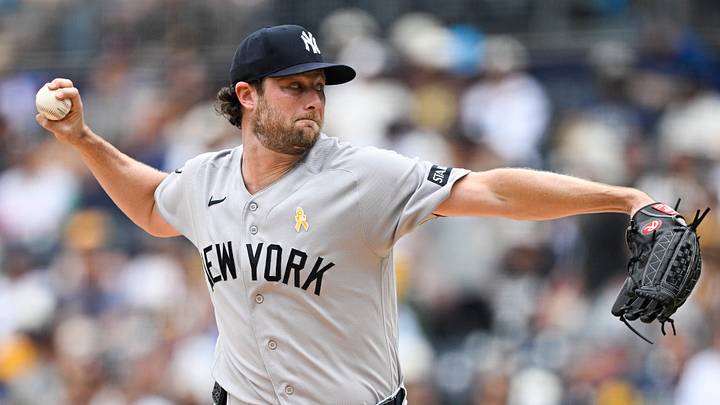
The Yankees have a Gerrit Cole problem because Cole has a swing-and-miss problem. Is the ABS challenge system to blame?
Cole alluded to ABS’s effect on pitching this season after the Mets on Saturday hit him harder than any team did in his 296 career starts tracked by Statcast. They whacked 14 of his pitches 95 mph or harder. Until this month, Cole had never allowed more than 11 hard-hit balls in a start. In three consecutive September starts, Cole set a new high for hard-hit balls (12), matched his old high (11) and set another new high (14).
The Mets swung 40 times at his pitches and missed only three of them, tying a career low for Cole. He threw 39 four-seamers without getting a swing and miss — only the fourth time he threw so many four-seamers without a whiff and the first time in nine years.
Gerrit Cole vs the Mets highlights pic.twitter.com/mdiUmZgPzf
— jack (@Jolly_Olive) September 13, 2026
Searching far and wide for answers, Cole opined about the difficulty of getting hitters to swing and miss in the age of ABS.
“I think just in general, yeah, it’s been a little bit of a challenge,” Cole told reporters after the game. “I think it’s hard to compare to previous years without pitching with the ABS. I think maybe chase and swing-and-miss across the board is down. So, trying to find where those numbers would be relative to this environment is something that we need to navigate.”
Has ABS changed the game? Based on years of minor league trials, we knew that ABS might increase walks and reduce strikeouts. Those expectations have held partially true. Walks are up 6.7 percent to their highest full-season rate in 15 years. The strikeout rate has remained flat.
Is Cole right that chase rate and swing and miss rate are down? He’s half right.
- Chase: He’s wrong here. MLB hitters are chasing more this year than at any time in the past decade. The chase rate jumped from 31.5% last year to 32.9% this year. It’s the first time in four years the chase rate has increased. Twenty-eight of the 30 teams are chasing more this year than last. The only exceptions are the Tigers and Guardians.
- Swing and miss: Here he is right—barely. The whiff rate has declined slightly from 25.3% last year to 25.0% this year. It’s the lowest whiff rate in eight years.
ABS is not the game-changer Cole thinks it might be. Despite the few dramatic overturns in high leverage spots, its effects have been more subtle. Here are the ways that ABS has influenced baseball this year:
- The defined, universal strike zone, which doesn’t care about framing or counts (the strike zone at 3-and-0 used to get way bigger) has led to the highest walk rate in 15 years.
- More pitchers are clipping the top of the strike zone with non-fastballs. Umpires tended to dismiss such pitches as mistakes. And umpires tended to call an oval-shaped zone rather than honoring the four corners of the rectangle. ABS does not care. Pitchers and pitching coaches figured out there are free strikes with elevated spin. Non-fastballs at the top of the zone are at a 15-year high. Called strikes on elevated non-fastballs are at an all-time, pitch-tracking high. If you included elevated cutters, a lesser version of a slider, both the total pitches and called strikes at the top of the zone are at record levels.
- Pitchers are in the strike zone a lot less. People speculated that offense would go up because ABS would force pitchers into the zone more. The opposite has resulted. Pitchers are throwing 47.5% of their pitches in the strike zone. That’s down from 50.6% last season and a six-year low. The net effect on offense has been negligible. Runs per game are up less than one percent—due mostly to the increase in walks because hits, home runs and slugging are down ever so slightly.
What is the Deal with Cole?
As of today, Cole would not be on the Yankees’ wild-card roster. Cam Schlittler, Max Fried and Carlos Rodon are all throwing the ball better than Cole right now—subject to change with two more starts. A fourth starter is not needed. Cole is not a bullpen option.
In his past four starts, Cole is 1–3 with a 5.92 ERA. He has only 17 strikeouts in those four starts while allowing eight home runs and a career-worst 45 hard-hit balls in the span.
His velocity is fine (96.9 on his four-seamer). He has a career-low walk rate and career-best rates in strike percentage and first-pitch strike percentage. So why is his stuff getting hit so hard?
- Cole is throwing too many strikes. Yes, that’s a thing. In a year in which pitches in the zone have declined, Cole throws more pitches in the zone (53.6%) than any pitcher in baseball (min. 1,500 pitches). Hitters are in attack mode against him.
- Too many of his pitches are in the middle of the plate. Hitters are like chess grandmasters. They want to control the center of the board. Imagine dividing the strike zone into three vertical lanes of equal width. MLB hitters bat .239 and slug .423 on the outer lanes but hit .307 and slug .547 in the middle lane. Cole is throwing 21.5% of his pitches in the middle lane, a career high, including 24.3% this month. On Saturday, he allowed seven hits on center cut pitches, tying a career high from 2017. He had repeated trouble moving the ball to the edges of the plate.
- His breaking stuff is below average. Cole’s breaking pitches (slider and curve) have plummeted from the 93rd percentile in 2024 to 23rd percentile this season. The batting average against his spin (.273) and the whiff rate against his spin (24.7%) are career worsts. This is not unusual for Year One for post-Tommy John surgery recovery. Velocity is the first thing that comes back. Touch and command need a year to develop.
- He has less firepower to put away hitters. A fastball that has more run than his signature ride and the mediocrity of his breaking stuff leave Cole short when it comes to putting away hitters. In two-strike counts, the batting average (.198) and slug (.358) against Cole are career worsts.
- Cole needs a two-seamer. The state of pitching today includes the family of three fastballs: four-seam, cutter and sinker. You need to move the ball with velocity both into and away from hitters. Cole has abandoned his sinker experiment. He hasn’t thrown one since July 22. He has nothing to ride into right-handed hitters. They are too comfortable—and hitting .268 against him, a career high. His 2026 pitch heat map against right-handed hitters illustrates how they can look out over the plate without fear of being crowded.

 Add us as a preferred source on Google
Tom Verducci is a senior writer for Sports Illustrated who has covered Major League Baseball since 1981. He also serves as an analyst for FOX Sports and the MLB Network; is a New York Times best-selling author; and cohosts The Book of Joe podcast with Joe Maddon. A five-time Emmy Award winner across three categories (studio analyst, reporter, short form writing) and nominated in a fourth (game analyst), he is a three-time National Sportswriter of the Year winner, two-time National Magazine Award finalist, and a Penn State Distinguished Alumnus Award recipient. Verducci is a member of the National Sports Media Hall of Fame, Baseball Writers Association of America (including past New York chapter chairman) and a Baseball Hall of Fame voter since 1993. He also is the only writer to be a game analyst for World Series telecasts. He lives in New Jersey with his wife, with whom he has two children.