%20%20--%3E%0A%3Csvg%20version%3D%221.1%22%20id%3D%22Layer_1%22%20xmlns%3D%22http%3A%2F%2Fwww.w3.org%2F2000%2Fsvg%22%20xmlns%3Axlink%3D%22http%3A%2F%2Fwww.w3.org%2F1999%2Fxlink%22%20x%3D%220px%22%20y%3D%220px%22%0A%09%20width%3D%2239px%22%20height%3D%2240px%22%20viewBox%3D%220%200%2039%2040%22%20enable-background%3D%22new%200%200%2039%2040%22%20xml%3Aspace%3D%22preserve%22%3E%0A%3Cpath%20fill%3D%22%23FFFFFF%22%20d%3D%22M38.5%2C7H28.2v26h10.3V7z%22%2F%3E%0A%3Cpath%20fill-rule%3D%22evenodd%22%20clip-rule%3D%22evenodd%22%20fill%3D%22%23FFFFFF%22%20d%3D%22M26.1%2C25.5c0%2C5.8-4.1%2C7.5-12.9%2C7.5C3.9%2C33%2C0%2C31.2%2C0%2C25.2v-1.1h11.6%0A%09v2.4c0%2C0.7%2C0.1%2C1.4%2C1.2%2C1.4c1%2C0%2C1.2-0.4%2C1.2-1.3v-0.9c0-1.6-0.9-1.6-3.5-2.2C2.2%2C21.7%2C0%2C19.7%2C0%2C15.3v-0.9C0%2C9.3%2C5.5%2C7%2C12.9%2C7%0A%09c10.2%2C0%2C12.8%2C2.6%2C12.8%2C7.4v1.8h-11v-2.9c0-0.6-0.4-1.1-1.2-1.1c-0.6%2C0-1.2%2C0.4-1.2%2C1.1v0.9c0%2C1.5%2C0.9%2C2%2C3.3%2C2.5%0A%09c8%2C1.6%2C10.5%2C3.3%2C10.5%2C7.5V25.5z%22%2F%3E%0A%3C%2Fsvg%3E%0A)
‘This Is for Me’: Kayla Harrison Returns to the Octagon on Her Own Terms
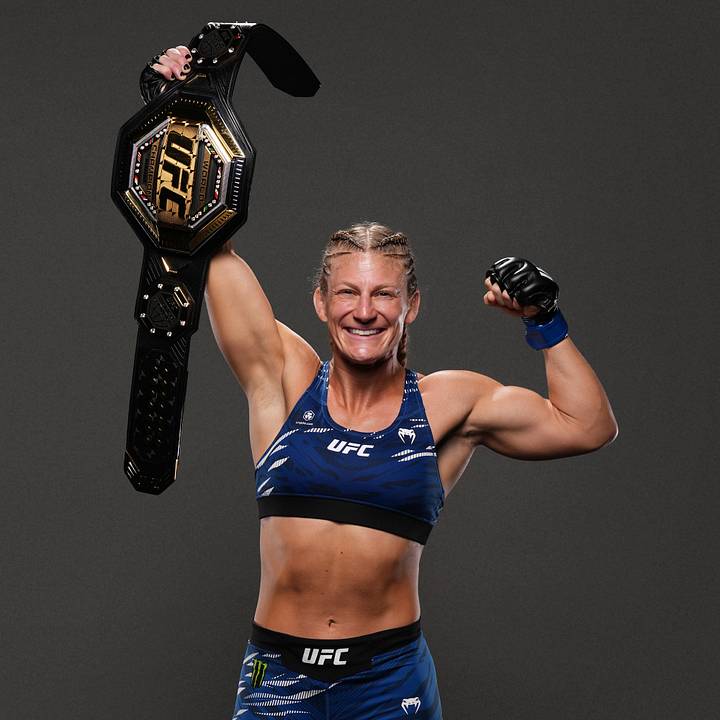
Kayla Harrison has a helluva battle on her hands. Her son, Emery, is about to turn 8, and he’s misplaced the plastic key to the synthetic handcuffs that are part of his policeman Halloween costume. Down the hall, Harrison’s daughter, Kyla, 13, is a dazzling artistic talent, but she needs a different eraser for her current project: a drawing of a conch shell. There is a chicken that got stuck in the fencing out back, died in the night, and now someone needs to remove the carcass. Nobody gives a straight answer about what they want for dinner on this late October Wednesday in South Florida. The family golf cart, adorned with Ohio State decals, sits in the garage but is low on gas. Now it’s past noon, and Mom has yet to eat today.
It’s enough to make you forget that—oh yeah, right—Mom has a big fight coming up. She is barely three weeks removed from a larger pending battle. In the co-main event of UFC 334, staged Nov. 14 at Madison Square Garden, Harrison is set to take on Amanda Nunes in both a bantamweight and an incalculable-weight fight, as it may be the most significant bout in the history of women’s MMA—two decorated champions, both deep into their 30s, who once trained together, fighting for GOAT status.
But more pressing: Where is that damn handcuff key?

You love MMA. You hate MMA. Whatever. But on this point, we all must agree: No sport offers more colorful figures and richer backstories. When your job entails fighting barefoot in a cage, odds are good you’re not into nuance and scripted talking points. And when you fight in a cage, odds are good you’ve done some hard living, too. Still, even by MMA standards, Harrison’s backstory and level of candor are singular.
Born in 1990 in small-town Ohio, she lived a childhood that she describes as “rough.” Her mother was a judo black belt, and Harrison found her calling at a local gym. Quickly, she became a prodigy, equally agile and strategic. Tragically, one of her coaches spent years grooming and then sexually assaulting her. In typically unsparing terms, she told her story to Sports Illustrated in 2012, shortly after becoming the first American to win an Olympic gold medal in judo. The account landed her on the cover and made for one of the more memorable stories in the magazine’s history.
Two years later, Harrison’s father died by suicide, a tragedy she recounted publicly. Meanwhile, her sister fell into the throes of addiction, and Harrison’s mother and stepfather raised her sister’s children. But when Harrison’s stepfather died suddenly in 2020, she formally adopted her niece and nephew. So it is that Harrison who is now an unmarried single mother raising two children in Florida. During this time, she also transitioned from being the most accomplished American judoka to becoming perhaps the most accomplished female MMA fighter.
After recovering from a neck surgery that caused the cancellation of their fight in January, she is now set to square off against Nunes. And it’s entirely possible both fighters could retire after the belt. A little over three weeks before the fight, SI spent a late-October day in Florida with Harrison.
This interview has been edited for brevity and clarity.
Sports Illustrated: When did you get the MMA bug?
Kayla Harrison: It was after my second Olympics in 2016. I was pretty depressed. For the last six months of 2016, I just didn’t really do anything except go to a bunch of parties after Rio. So early 2017, I was like, All right, I need to get off the couch. And so I went to a striking class, and I really liked it. And then I kept going. And maybe a month or two in, I went to my first sparring session, and this little girl—like 115 pounds—she wasn’t a girl, she’s a woman, but she front-kicked me in the face, and I was like, Oh my God, I got to do this.
SI: What gym was it?
KH: Sityodtong [Muay Thai training academy]. It’s Mark DellaGrotte’s gym in Boston.
SI: Now it’s like every college wrestler has in the back of his head maybe there’s an MMA career—
KH: Yeah. I actually was at the Olympics pretty adamantly saying, ‘I’ll never do MMA. It’s not for me.’ Like there was a press conference after I won, and I was talking s---. I was like, ‘I come from the Olympic background. I’m cultured.’ And yeah, I was wrong.

SI: What was the hardest part of the transition?
KH: Letting the beginner and the expert live alongside each other inside of me. Like I’m an expert in what I do. I’m the best judo player in the world, and I have some of the best grappling in the world. But I was a white belt when it came to striking. And so letting those two live inside together, and being humble enough to take my beatings, but also confident enough to know that I belong. It’s basically starting all over.
SI: That must be such a weird mix of elite level. You understand balance and training, and all that comes with being a dedicated athlete [in the] business. And then you’ve never trained at striking—
KH: That’s what I loved about it! I loved the challenge of, like, Oh my gosh, this is a whole new mountain to climb. Because I do understand how to train properly. I do understand the mental aspect of competing at a high level. I do understand grappling. It’s been a blast. I mean, this last 10 years has flown by. I feel like I just started.
SI: Leading question: Are you kind of playing with house money at this point?
KH: Yeah, for sure. No, this is all for fun. This is for me. You know, I’m satisfied with my career.
SI: How long have you been here [in South Florida]?
KH: Maybe five years. Yeah, yeah, yeah. I moved here to train with Amanda [Nunes, her forthcoming opponent]!
SI: Do you like beef or no beef? Do you want friction before a fight?
KH: I don’t care either way.
SI: How bad is your [weight] cut?
KH: Yeah. I still have 20 pounds to go … yeah, 135 is not a natural right weight class for me, but I’ve got a good headspace.
SI: Physically you feel good? It’s been a year—
KH: It’s been a long road. I had neck surgery in January, and that’s been tough. But yeah, all part of God’s plan, and I think that I’m right where I need to be. And the longer layoff has helped me grow inside the cage and outside the cage.
SI: How?
KH: You know, when I’m not fighting, doesn’t mean I’m not training. I’ve been training the whole time. Just what could I do? What couldn’t I do? This forced me to focus on my striking quite a bit because I couldn’t put weight on my neck, and so I feel like my striking has evolved.

SI: What has to go right for you to be, like, peak?
KH: That’s an interesting question. I think that nothing has to happen in order for me to be at my happiest. I think I am at peace. I am at the age—and I’ve gained enough wisdom through the years—to understand that it’s not necessarily about the result. It’s about the journey, and it’s about who I’ve become along the journey. And yeah, my peace doesn’t come from accolades or rewards. My peace, my peace comes from God. And I think that I give my best. I do my best. I prepare as well as I can. I leave it all out there, and whatever happens, I have peace with that. And I don’t know that anyone is ever happy, but I have peace.
SI: You appreciate how extraordinary your story is, outside looking in—
KH: I think it’s hard to call it extraordinary. Because to me it’s just my life. Yeah, I guess if I stood back and if it was one of my friends or something too, I would be very impressed for sure. But it also is just one of those things that feels like it is meant to be, you know. I feel like this is my true calling is to be their mother, and so it doesn’t feel extraordinary to me, it feels like every day. I wake up and we gotta brush our teeth!
I think that being a mother has made me a better fighter, but that wasn’t a goal of mine—to become a better fighter because I’m a mom. I think that it just naturally changed my perspective on fighting and gave me a purpose outside of myself that I didn’t have before that I needed. You know, same life.
SI: How specifically?
KH: When I was younger, especially given my trauma, I looked for validation. I looked to be enough. If I win, they’ll love me. When I win, they’ll love me. If I am [an] Olympic champion, then I’ll be enough. If I’m an MMA champion, then I’ll be enough. If I have a million dollars, then I’ll be enough. I was constantly kind of operating from a place of fear and unworthiness. Again, I think in large part due to my childhood trauma.
And when I became a mother, that changed. I tell this story. There was a pivotal moment. I lost my first MMA fight, and my daughter [was] in therapy, and so we came home, and she had therapy, and I talked to the therapist afterwards.
I say, ‘How’s she? How’s she doing? Is she O.K.?’ I’m thinking she must be devastated because I was devastated. I was like, ‘Oh my God, I’m a worthless piece of s---. I lost.’ And so I’m thinking in my head that my daughter must be so untethered by this loss. So I’m asking the therapist: ‘Is she O.K.? Is she gonna be all right? Is she worried? Is she scared?’
And the therapist was like, ‘What are you talking about?’
I was like, ‘I lost. I'm worthless.’
And she was like, ‘Kayla, I asked her about the fight. I asked her about the trip to New York. She said, Yeah, we got to go to New York for Thanksgiving. We had pizza. We went to a show. We did this. My mom had a fight. She lost. Then we went to Central Park and we had ice cream.’
And I was like, ‘Really?’
And she says, ‘Yeah. She doesn’t care if you win or lose. She cares that you come home. She cares that you’re her mom. She cares that you show up for her.’
And that changed my life. It had never occurred to me that someone could love me regardless of my accomplishments. My kids love me for being their mom, and that’s it … like I just have to show up, and that showing up as myself is enough for them. And if it’s enough for them, then it can be enough for me too.

SI: How are you dealing with everything that comes with fighting at your level, that isn’t the fighting. Social media, sponsors—
KH: Talking to you?
SI: Sure, since you brought it up, yes, media would be in that basket—
KH: I think that every athlete probably goes through a very similar arc, where in your early 20s, you’re like, Oh god, I can’t wait to be rich, and Oh god, I can’t wait to be famous. And then you sort of get older and wiser, and you realize that money is actually not everything, and it’s not what actually makes me happy. And being famous is really more of a headache than anything. And I didn’t actually want to be famous. And I’m at that stage where, like, I don’t really care if anybody knows.
SI: Knows what?
KH: Like, I could fight Amanda at the gym with the doors locked, I don’t care if I’m famous. In fact, I am and it’s a bummer. I’m tired of talking about myself. Like, I just want to be left alone.
SI: Now you’re just making me feel bad.
KH: No, that it’s part of the job. It’s my responsibility, and for anyone who reads this or hears this … maybe they’re a victim of sexual abuse and maybe then they go to the Fearless Foundation website, and maybe it helps them.
SI: How to ask this delicately, everyone at home’s healthy, everyone’s happy?
KH: Yes, they’ve been through a lot. I would say that there’s definitely, like, residual trauma [but] they’re both really thriving. I think we healed each other. You know? Like I’ve gotten to be a parent that I would want for my 13-year-old self—
SI: I was going to say, that’s the age [at which Harrison was sexually abused]—
KH: Sometimes it’s wicked triggering. We are just having very different experiences. Which is good; which is an amazing thing. And it’s hard for me in the sense that it’s like, Oh s---, that’s all that was? I wish someone had paid attention and … I’m not blaming anyone. It just is what it is. But yeah, I think that they’re doing really well.
SI: Week of fight: Are you even, like, looking at your phone?
KH: No, not really. I don’t really look at my phone now.
SI: What is your relationship with this horrible device?
KH: Social media? I don’t run it anymore. I don’t. I don’t have social media on my phone. The reality is that once I’m in camp and I’m training two to three times a day and I have two kids, like a lot of s--- slips through the cracks. If someone really needs me, they’ll call me. But I have hundreds of unread text messages right now, and that’s just how it has to be.
SI: You’re past this.
KH: Past what?
SI: You don’t need social media.
KH: I don’t care about it. I understand that it’s a part of the business and making money, but that’s why I hired people to handle it because, for me, it’s a headache and it’s actually a time suck and a negative thing.
MMA fans are the worst when it comes [to loyalty]. You cover other sports, right? Like you would never hear of a Yankees fan cheering for the Red Sox.
SI: It’s all the gambling s---.
KH: Yeah, but my point is in MMA, you’ll be at a fight, a live event, and fans will switch sides in the middle of a fight. You know, they’ll be booing a guy, and then they’ll be, ‘Yeah!’ There’s no loyalty in MMA. I heard this quote one time, ‘Fans of WWE are like fans of Shakespeare. They go and they have a favorite character. They enjoy the show. They’re there for the theater. MMA fans are like fans of the Colosseum. They don’t care if it’s the Tiger or the Gladiator. They just want to see blood.’
 Add us as a preferred source on Google

Jon Wertheim is a senior writer for Sports Illustrated and has been part of the full-time SI writing staff since 1997, largely focusing on the tennis beat, sports business and social issues, and enterprise journalism. In addition to his work at SI, he is a correspondent for “60 Minutes” and a commentator for The Tennis Channel. He has authored 11 books and has been honored with two Emmys, numerous writing and investigative journalism awards, and the Eugene Scott Award from the International Tennis Hall of Fame. Wertheim is a longtime member of the New York Bar Association (retired), the International Tennis Writers Association and the Writers Guild of America. He has a bachelor’s in history from Yale University and received a law degree from the University of Pennsylvania. He resides in New York City and Paris with his wife, who is a divorce mediator and adjunct law professor. They have two children.
Follow jon_wertheim