%20%20--%3E%0A%3Csvg%20version%3D%221.1%22%20id%3D%22Layer_1%22%20xmlns%3D%22http%3A%2F%2Fwww.w3.org%2F2000%2Fsvg%22%20xmlns%3Axlink%3D%22http%3A%2F%2Fwww.w3.org%2F1999%2Fxlink%22%20x%3D%220px%22%20y%3D%220px%22%0A%09%20width%3D%2239px%22%20height%3D%2240px%22%20viewBox%3D%220%200%2039%2040%22%20enable-background%3D%22new%200%200%2039%2040%22%20xml%3Aspace%3D%22preserve%22%3E%0A%3Cpath%20fill%3D%22%23FFFFFF%22%20d%3D%22M38.5%2C7H28.2v26h10.3V7z%22%2F%3E%0A%3Cpath%20fill-rule%3D%22evenodd%22%20clip-rule%3D%22evenodd%22%20fill%3D%22%23FFFFFF%22%20d%3D%22M26.1%2C25.5c0%2C5.8-4.1%2C7.5-12.9%2C7.5C3.9%2C33%2C0%2C31.2%2C0%2C25.2v-1.1h11.6%0A%09v2.4c0%2C0.7%2C0.1%2C1.4%2C1.2%2C1.4c1%2C0%2C1.2-0.4%2C1.2-1.3v-0.9c0-1.6-0.9-1.6-3.5-2.2C2.2%2C21.7%2C0%2C19.7%2C0%2C15.3v-0.9C0%2C9.3%2C5.5%2C7%2C12.9%2C7%0A%09c10.2%2C0%2C12.8%2C2.6%2C12.8%2C7.4v1.8h-11v-2.9c0-0.6-0.4-1.1-1.2-1.1c-0.6%2C0-1.2%2C0.4-1.2%2C1.1v0.9c0%2C1.5%2C0.9%2C2%2C3.3%2C2.5%0A%09c8%2C1.6%2C10.5%2C3.3%2C10.5%2C7.5V25.5z%22%2F%3E%0A%3C%2Fsvg%3E%0A)
Peace prevails at Russia vs. Georgia volleyball showdown
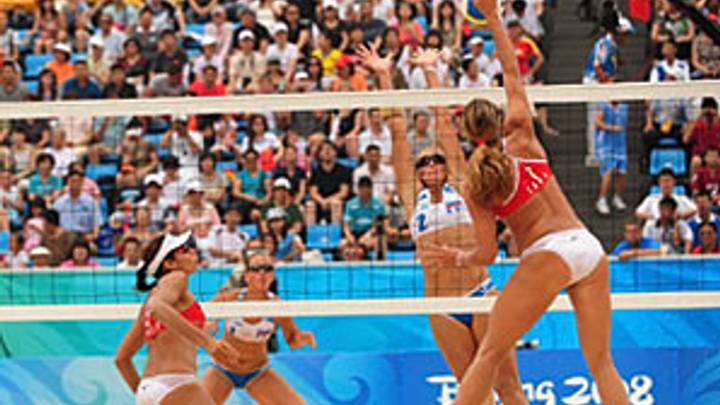
BEIJING -- I went to a beach volleyball match, and a truce broke out.
There was no blood on the sand at Chaoyang Park Beach Volleyball Ground. Unlike the infamous "Blood in the Water" water polo match in the 1956 Olympics between Hungary and the Soviet Union that played out against the backdrop of the Hungarian Revolution and 20,000 Soviet troops rolling into the country, the beach volleyball match between Georgia and Russia -- contested hours after the warring countries had agreed to a cease-fire in a conflict that began about the time the nations were marching at the opening ceremonies -- was an absurdist exercise in sport and the nationalism of convenience and rock 'n roll.
There was more tension when Harry met Sally than when Georgia met Russia. In lieu of blood there were pre-match hugs, a dance team in blue bikinis, snippets of Billy Joel's Uptown Girl, Bon Jovi's It's My Life and Everybody Wang Chung Tonight, a dearth of national flags in the sold-out stadium (two Russian, no Georgian), and a nifty third-set comeback by the Georgian pair, whose stage names are Saka and Rtvelo, which, when combined, Sakartvelo, spell the Georgian name for that country. Cute.
The only even remotely hostile acts were the three military helicopters that flew high over the stadium at 14-14 in the second set, and Saka's violent retching on the sidelines late in the match. If diplomacy is war by another name, then beach volleyball is the Olympics designed by a Dada-ist.
Anyway, the surface story of Wednesday's preliminary-round match might have carried more emotional heft -- Moscow's invasion of Georgia to help the ethnic Russian rebels in South Ossetia, with its faint echoes of Germany in the Sudetenland in 1938 -- if Saka and Rtvelo, born Cristine Santanna and Andrezza Martins das Chagas respectively, weren't more girls from Ipanema than Tblisi Twins.
"Of course, they're Brazilian," Alexandra Shiryaeva, one of the Russian players, said over her shoulder as she exited the mixed zone after losing 10-21, 22-20, 15-12 to the 22nd-seeded team in the 24-nation field. "I don't think they know who is president of Georgia. I am sure."
That is a canard. Mikheil Saakashvili, president of the beleaguered country, personally signed Saka's passport. But in a Games with a glut of passport juggling -- including Becky Hammon, a slick guard who would have had trouble making the U.S. basketball team but is here representing Russia --Shiryaeva's snarky assessment resonates.
Saka and Rtvelo are less Georgian than Chipper Jones. Despite their dual citizenship and the red-and-white Georgian flag on their skimpy uniforms, the Accidental Georgians are second-tier Brazilian beachies who didn't begin competing for their new homeland until the end of the 2006 FIVB season. The pair was recruited because Georgia already had two Brazilian men representing the country on international sand. Their victory over the Russians, which eased them into the next round, might inspire multitudes to try the sport in a country they have visited twice.
Still, the tumultuous and tragic events of the past few days -- as weighty as beach volleyball is sporting gossamer -- have truly touched Saka and Rtvelo. Like most of the world, almost everyone this week was Georgian. Why should they be different? The forces of geopolitics and world history have made two Brazilians more profoundly Georgian than they ever could have imagined.
"I really felt I was representing Georgia," Saka said. "I don't want to get political because this is a game. But in my heart, I wanted to beat Russia for sure."
Two days earlier, she and Rtvelo had returned to the village from the volleyball venue and found most of the 35 Georgian athletes outside their rooms. Many were in tears. The athletes were preparing to bolt Beijing, to throw away their Olympic dreams and return home.
"If I had my family [there] and know they'd be bombed or something, I don't think I could concentrate on the Games," Saka said. "I could be like, 'Why I should go home because I would go to Brazil?' but my first thought was, 'Let's go,' because I felt bad because I knew they had family back there. My first thought was supporting them."
With the bags all but packed, the Georgians received a message from their president: stay.
"I am president of the [volleyball] federation and I know it's better to stay here," said Levan Akhvlediani, "but many athletes want to go. Then President Saakashvili asked [us] to stay here ...We have to compete. Many other countries are also having problems, but they stay and compete here. So we have to respect the principles of Olympics participation. I did not sleep since war. I sleep two, three, four hours. Every morning, calling the family and asking what's going [on]. But as president of the federation I don't want this game [against Russia to be] for politicians. Of course, Georgia [is] now happy [with the victory]. Of course Russia go home. Finally."
He was speaking about the Russian duo of Shiryaeva and Natalya Uryadova being eliminated. Maybe.
"I have one message to everyone: to make a war, to make a battle, on the sporting fields, not outside the sporting fields," he said. "It is very important. I send this message to everyone who is involved in this -- believe me -- crazy war. Once again, [beach volleyball] is a sport. Today we win. We was close to lose, [but] fortunately God help us. And I think in the future God help Georgia."
 Add us as a preferred source on Google
Along with the pages of Sports Illustrated, you'll find senior writer Michael Farber in the Hockey Hall of Fame. Farber joined the staff of Sports Illustrated in January 1994 and now stands as one of the magazine's top journalists, covering primarily ice hockey and Olympic sports. He is also a regular contributor to SI.com. In 2003 Farber was honored with the Elmer Ferguson Award from the Hockey Hall of Fame for distinguished hockey writing. "Michael Farber represents the best in our business," said the New York Post's Larry Brooks, past president of the Professional Hockey Writers' Association. "He is a witty and stylish writer, who has the ability to tell a story with charm and intelligence." Farber says his Feb. 2, 1998 piece on the use and abuse of Sudafed among NHL players was his most memorable story for SI. He also cites a feature on the personal problems of Kevin Stevens, Life of the Party. His most memorable sports moment as a journalist came in 1988 when Canadian Ben Johnson set his controversial world record by running the 100 meters in 9.79 seconds at the Summer Olympic Games, in Seoul. Before coming to Sports Illustrated, Farber spent 15 years as an award-winning sports columnist and writer for the Montreal Gazette, three years at the Bergen Record, and one year at the Sun Bulletin in Binghamton, NY. He has won many honors for his writing, including the "outstanding sports writing award" in 2007 from Sports Media Canada, and the Prix Jacques-Beauchamp (Quebec sportswriter of the year) in 1993. While at the Gazette, he won a National Newspaper award in 1982 and 1990. Sometimes Life Gets in the Way, a compendium of his best Gazette columns, was published during his time in newspapers. Farber says hockey is his favorite sport to cover. "The most down-to-earth athletes play the most demanding game," he says. Away from Sports Illustrated, Farber is a commentator for CJAD-AM in Montreal and a panelist on TSN's The Reporters (the Canadian equivalent of ESPN's The Sports Reporters in the United States, except more dignified). Farber is also one of the 18 members on the Hockey Hall of Fame selection committee. Born and raised in New Jersey, Farber is a 1973 graduate of Rutgers University where he was Phi Beta Kappa. He now resides in Montreal with his wife, Danielle Tétrault, son Jérémy and daughter Gabrielle.