%20%20--%3E%0A%3Csvg%20version%3D%221.1%22%20id%3D%22Layer_1%22%20xmlns%3D%22http%3A%2F%2Fwww.w3.org%2F2000%2Fsvg%22%20xmlns%3Axlink%3D%22http%3A%2F%2Fwww.w3.org%2F1999%2Fxlink%22%20x%3D%220px%22%20y%3D%220px%22%0A%09%20width%3D%2239px%22%20height%3D%2240px%22%20viewBox%3D%220%200%2039%2040%22%20enable-background%3D%22new%200%200%2039%2040%22%20xml%3Aspace%3D%22preserve%22%3E%0A%3Cpath%20fill%3D%22%23FFFFFF%22%20d%3D%22M38.5%2C7H28.2v26h10.3V7z%22%2F%3E%0A%3Cpath%20fill-rule%3D%22evenodd%22%20clip-rule%3D%22evenodd%22%20fill%3D%22%23FFFFFF%22%20d%3D%22M26.1%2C25.5c0%2C5.8-4.1%2C7.5-12.9%2C7.5C3.9%2C33%2C0%2C31.2%2C0%2C25.2v-1.1h11.6%0A%09v2.4c0%2C0.7%2C0.1%2C1.4%2C1.2%2C1.4c1%2C0%2C1.2-0.4%2C1.2-1.3v-0.9c0-1.6-0.9-1.6-3.5-2.2C2.2%2C21.7%2C0%2C19.7%2C0%2C15.3v-0.9C0%2C9.3%2C5.5%2C7%2C12.9%2C7%0A%09c10.2%2C0%2C12.8%2C2.6%2C12.8%2C7.4v1.8h-11v-2.9c0-0.6-0.4-1.1-1.2-1.1c-0.6%2C0-1.2%2C0.4-1.2%2C1.1v0.9c0%2C1.5%2C0.9%2C2%2C3.3%2C2.5%0A%09c8%2C1.6%2C10.5%2C3.3%2C10.5%2C7.5V25.5z%22%2F%3E%0A%3C%2Fsvg%3E%0A)
NHL too late, as usual, heading off possible Bruins-Penguins mayhem
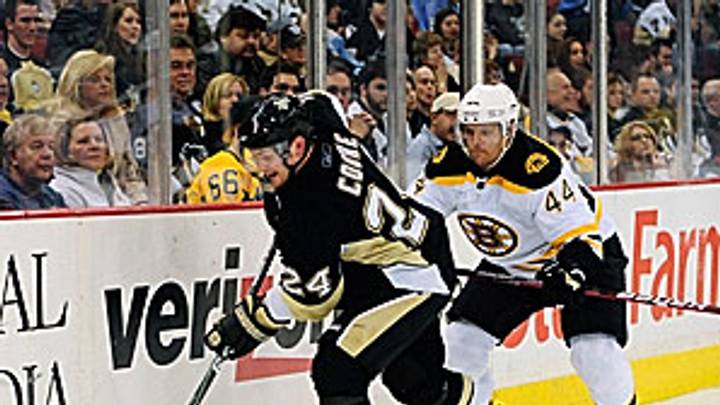
This match, of course, is the reprise of the last Bruins-Penguins game in which Marc Savard was separated from his senses by a high and almost certainly late hit by Penguins' pot-stirrer Matt Cooke, resulting in a Grade 2 concussion that surely eliminated Boston as a Stanley Cup dark horse and perhaps even as a playoff team.
Now, the current iteration of the Bruins is not especially big (with the exceptions of Zdeno Chara and Milan Lucic) and only sporadically bad. If they were truly bad, their immediate response to Cooke's high hit on their most gifted offensive player would have been something other than tepid. Indeed general manager Peter Chiarelli initially said he had been "disappointed" in how the Bruins had twiddled their thumbs. Presumably those thumbs should have been balled into fists.
There were, however, extenuating circumstances regarding Boston's, um, measured response that have not received enough attention.
For one thing, the only Bruins player on the ice who even got a half-look at the predatory play was winger Michael Ryder. Most of the others were pursuing the puck that had left Savard's stick some two Mississippis earlier. Ryder is not exactly an avenging angel; according to hockeyfights.com, he had not had a fight in 455 NHL games entering this week. (He is, however, apparently beating himself up over the incident and his failure to launch, sort of a case of a misplaced survivor's guilt.)
Another factor is that the hit came at 14:23 of the third period, and the ensuing shift extended into the final five minutes. Any ruckus the Bruins might have started would have carried a suspension for an instigator and fines for the coach.
Instead of playing the vigilante, the Bruins reacted mostly like adults and trusted the NHL justice system. To borrow from Sarah Palin, how'd that hope-y thing work out for you? Cooke went unpunished.
So what to do on Thursday with those sandpaper-tough old Bruins in the house looking on?
The intelligent answer, of course, is: nothing crazy.
Boston is trying to fend off the New York Rangers for eighth in the East, a loftier ambition than applying after-the-fact frontier justice aimed at Cooke or, more tellingly, at a Penguins star like Sidney Crosby. The truth: that ship has sailed.
The Bruins already had lost their identity this season as a tough team to play against, and defenseman Mark Stuart's pair of fights last week against Philadelphia, his fisticuffs Monday against New Jersey, or some rough stuff Thursday is not going to bring that back. The NHL had selected its referees for the game as of late last week -- Mike Murphy of NHL hockey ops declined to pass them on to On the Fly -- but the guess here is it will be Bill McCreary, or someone of his stature, paired with Wyatt Earp. The NHL can ill afford to let this scrutinized game devolve into a Gong Show. And chances are excellent it won't, not that Cooke's hit will fade in Boston's elephantine memory.
Pittsburgh could help defuse the matter by not dressing Cooke in Boston, but then a self-imposed time-out should never have been necessary. NHL vice-president for violence Colin Campbell could have ended the matter smartly by issuing a five-game suspension that would have extended through Thursday instead of letting Cooke, a prior offender, walk.
Campbell's decision to give Cooke a pass was not an example of dartboard justice. An honorable man, Campbell leaned on precedent to make his non-ruling on Cooke. If he hadn't suspended Philadelphia's Mike Richards for his hit that sheared the axons inDavid Booth's brain, costing the Florida forward 45 games and the Panthers a possible playoff berth, then Campbell believed that he could not suspend Cooke.
The problem: Campbell chose to invoke the wrong precedent on the very day that NHL GMs agreed to a rule that will punish blindside hits.
In November, Campbell suspended Calgary's Curtis Glencross for three games for a hit that the NHL, in a press release, described as a high hit on an unsuspecting opponent:Chris Drury of the Rangers. There you go. Unlike Cooke, Glencross had no priors. Campbell didn't have to go all Avatar-into-the-future to come up with something that would have obviated all the noise about this Bruins-Penguins rematch. He had one right in his files.
Timing is everything, and the NHL hockey operations department was at least a stride behind the play. The Richards hit on Booth finally turned enough GMs' minds, and maybe stomachs, that they finally addressed at least one element of head shots, however open-ended and timorously. The Cooke hit seemed to have had the same kind of effect on hockey fans, who were as sickened by seeing Savard wheeled off on a stretcher as they were by Campbell's ruling.
The NHL had one chance to make a first impression, and now everything else is catch-up because of an unwillingness to punish Cooke and rush through the proposed rule change instantly.
Yes, there are procedures. The proposed rule change has to go to the competition committee and on to the Board of Governors before it can be implemented. (Last season, the players on the competition committee, who did not think the GMs were taking the issues of headshots seriously, balked at their proposal about so-called staged fights.) But there was an opening for NHL Commissioner Gary Bettman to step in a week ago and make sure the proposed rule was fast-tracked, run through emergency conference calls of both bodies, and installed immediately, rather than allow the rest of 2009-10 to be open season on heads -- at least if you go by Campbell's decision on Cooke.
On the subject of precedents, well, Bettman could have found those. In late August 2008, Bud Selig, not the very model of a modern commissioner, declared that Major League Baseball would henceforth use instant replay on disputed home run calls. Not next season. Right away. And if the NHL's commissioner needed something closer to home, he had Campbell's own Avery Rule that essentially sprouted overnight earlier that year. It was not an actual rule change, but an interpretation of an existing rule that was aimed at Sean Avery's cheeky and now suddenly illegal stick-waving in the face of Devils goalie Martin Brodeur. Theoretically, blindside hits could also have been slipped in as part of the intent to injure rule, circumventing the normal process.
The truth is, the NHL always has lagged behind the play on the issue of head injuries. Some 15 years ago, a senior NHL official argued that baseline neuropsychological testing -- tests measuring cognitive function that initially establish a baseline for each player and allow medical personnel to help determine whether he is fit to return to the ice after a concussion -- was too expensive to make obligatory. The cost to a team: an extra $150 to $200 per player per test. A few years and who knows how many concussions later, baseline neuro-psych tests became an NHL fixture.
If the NFL finally could sort out hits to the head, the NHL can. The first thing it needs is a more steely will and a functioning Players Association to dig deeper on safety issues.
The second is a deadline -- say before the puck drops in Boston a little after seven o'clock Thursday night.
 Add us as a preferred source on Google
Along with the pages of Sports Illustrated, you'll find senior writer Michael Farber in the Hockey Hall of Fame. Farber joined the staff of Sports Illustrated in January 1994 and now stands as one of the magazine's top journalists, covering primarily ice hockey and Olympic sports. He is also a regular contributor to SI.com. In 2003 Farber was honored with the Elmer Ferguson Award from the Hockey Hall of Fame for distinguished hockey writing. "Michael Farber represents the best in our business," said the New York Post's Larry Brooks, past president of the Professional Hockey Writers' Association. "He is a witty and stylish writer, who has the ability to tell a story with charm and intelligence." Farber says his Feb. 2, 1998 piece on the use and abuse of Sudafed among NHL players was his most memorable story for SI. He also cites a feature on the personal problems of Kevin Stevens, Life of the Party. His most memorable sports moment as a journalist came in 1988 when Canadian Ben Johnson set his controversial world record by running the 100 meters in 9.79 seconds at the Summer Olympic Games, in Seoul. Before coming to Sports Illustrated, Farber spent 15 years as an award-winning sports columnist and writer for the Montreal Gazette, three years at the Bergen Record, and one year at the Sun Bulletin in Binghamton, NY. He has won many honors for his writing, including the "outstanding sports writing award" in 2007 from Sports Media Canada, and the Prix Jacques-Beauchamp (Quebec sportswriter of the year) in 1993. While at the Gazette, he won a National Newspaper award in 1982 and 1990. Sometimes Life Gets in the Way, a compendium of his best Gazette columns, was published during his time in newspapers. Farber says hockey is his favorite sport to cover. "The most down-to-earth athletes play the most demanding game," he says. Away from Sports Illustrated, Farber is a commentator for CJAD-AM in Montreal and a panelist on TSN's The Reporters (the Canadian equivalent of ESPN's The Sports Reporters in the United States, except more dignified). Farber is also one of the 18 members on the Hockey Hall of Fame selection committee. Born and raised in New Jersey, Farber is a 1973 graduate of Rutgers University where he was Phi Beta Kappa. He now resides in Montreal with his wife, Danielle Tétrault, son Jérémy and daughter Gabrielle.