%20%20--%3E%0A%3Csvg%20version%3D%221.1%22%20id%3D%22Layer_1%22%20xmlns%3D%22http%3A%2F%2Fwww.w3.org%2F2000%2Fsvg%22%20xmlns%3Axlink%3D%22http%3A%2F%2Fwww.w3.org%2F1999%2Fxlink%22%20x%3D%220px%22%20y%3D%220px%22%0A%09%20width%3D%2239px%22%20height%3D%2240px%22%20viewBox%3D%220%200%2039%2040%22%20enable-background%3D%22new%200%200%2039%2040%22%20xml%3Aspace%3D%22preserve%22%3E%0A%3Cpath%20fill%3D%22%23FFFFFF%22%20d%3D%22M38.5%2C7H28.2v26h10.3V7z%22%2F%3E%0A%3Cpath%20fill-rule%3D%22evenodd%22%20clip-rule%3D%22evenodd%22%20fill%3D%22%23FFFFFF%22%20d%3D%22M26.1%2C25.5c0%2C5.8-4.1%2C7.5-12.9%2C7.5C3.9%2C33%2C0%2C31.2%2C0%2C25.2v-1.1h11.6%0A%09v2.4c0%2C0.7%2C0.1%2C1.4%2C1.2%2C1.4c1%2C0%2C1.2-0.4%2C1.2-1.3v-0.9c0-1.6-0.9-1.6-3.5-2.2C2.2%2C21.7%2C0%2C19.7%2C0%2C15.3v-0.9C0%2C9.3%2C5.5%2C7%2C12.9%2C7%0A%09c10.2%2C0%2C12.8%2C2.6%2C12.8%2C7.4v1.8h-11v-2.9c0-0.6-0.4-1.1-1.2-1.1c-0.6%2C0-1.2%2C0.4-1.2%2C1.1v0.9c0%2C1.5%2C0.9%2C2%2C3.3%2C2.5%0A%09c8%2C1.6%2C10.5%2C3.3%2C10.5%2C7.5V25.5z%22%2F%3E%0A%3C%2Fsvg%3E%0A)
NHL loses its moral compass in the Chara-Pacioretty incident
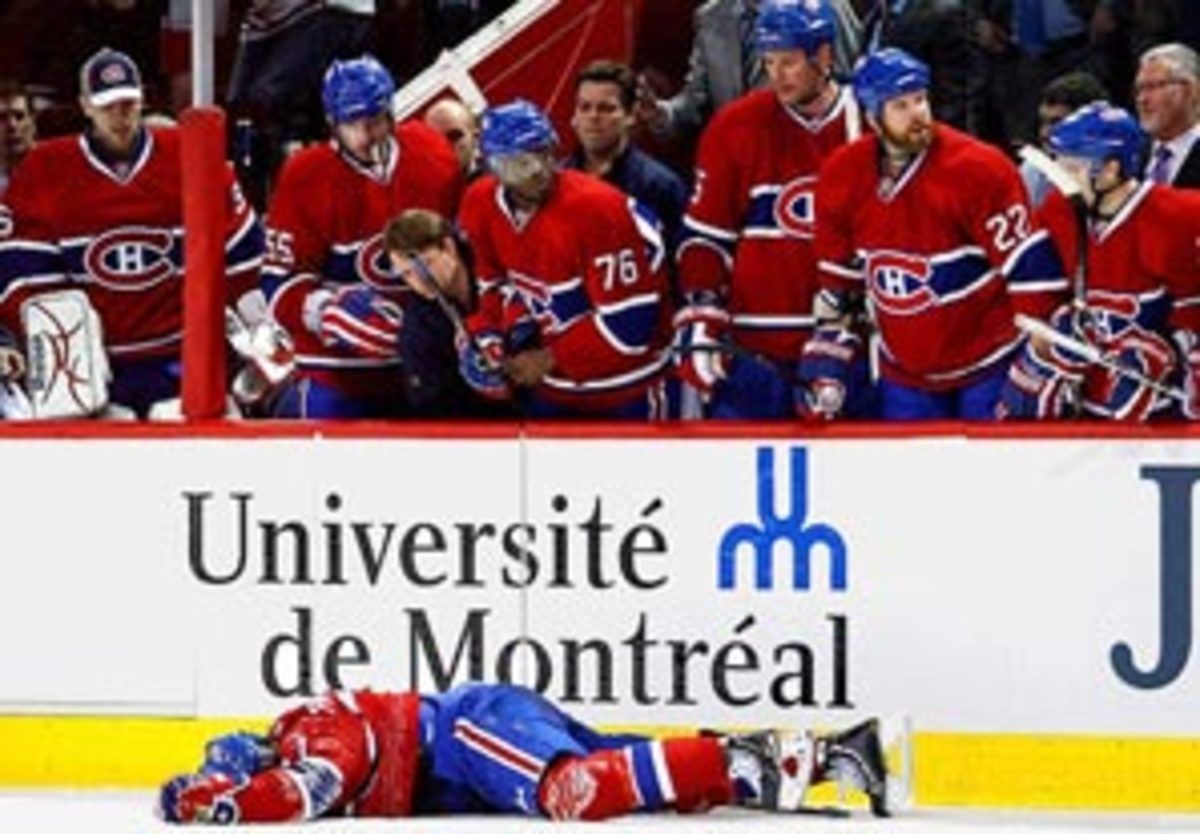
MONTREAL -- A push in January came to a shove in March. And for a few minutes on Tuesday night, there were some in the stunned crowd of 21,273 that thought Montreal Canadiens forward Max Pacioretty might be dead.
The result is that the 22-year-old is in the hospital with a severe concussion and a non-displaced cervical fracture of the fourth vertebra. In this glum 2010-11 NHL season, there is a concussion that actually represents good news.
On the seventh anniversary of Todd Bertuzzi's criminal assault on Steve Moore -- if you are of fan of symmetry, you will recall that Moore, who never played hockey again, sustained a concussion and non-displaced fractures of the third and fourth cervical vertebrae -- Boston Bruins defenseman Zdeno Chara shoved Pacioretty into the padded stanchion that separates the benches in the Bell Centre. Pacioretty's head hit what Canadiens goalie Carey Price would later call "the turnbuckle," and Pacioretty snapped backward, falling to the ice like a Raggedy Ann doll. The puck was not even in the same postal code at this particularly horrifying moment, having skittered 60 feet ahead of the play into the Montreal offensive zone with about 16 seconds left in the second period.
This was exactly the kind of play that occurs in every game -- a defenseman, beaten by a stride, trying to ride a forward off the puck -- but it doesn't occur in the same place on the ice nor have the same back story. Chara later explained that he was finishing his check although in truth, from my vantage point on the eighth level of the cavernous arena, it looked like he merely was starting it. Chara correctly received a five-minute major for interference, a match penalty and, in a signal that the NHL has lost its moral compass, no suspension.
HACKEL blog:NHL's leniency breeds repeat offenders
The NHL's vice-president of violence, Colin Campbell, sat this one out. He recuses himself from all decisions regarding the Bruins because his son, Gregory, plays there. (In an ideal world, the dean of discipline would not have a son playing in the league -- almost any decision affecting a team indirectly affects the others -- but this is the best compromise available.) In any event, the task of judge and jury fell to Mike Murphy, Campbell's top aide. Given the optics -- Pacioretty lay on the ice for at least seven minutes before being wheeled off on a gurney -- you would hope that Commissioner Gary Bettman, in Arizona on Tuesday to deal with the fate of a league-owned franchise, might venture an opinion.
Chara is a stand-up guy. And up. And up. The 6'-'9" Norris Trophy-winner spoke after the game and said, and we'll paraphrase here, that he would be the last person to do something like that. In fact, he was the last person to do something like that. He is generally well liked and well respected. He does not have a rap sheet. He never has been a headhunter. He is the NHL's strongest player, but he is not an especially violent one. Of course, none of this exonerates him. He made a distinctly reckless, illegal play that resulted in an injury that could have been catastrophic. Two games, five games, 10 games. Zero was not on the answer sheet.
HACKEL blog:Chara's hit raises character questions
Of course, there was another kind of history for Murphy to consider.
When Pacioretty scored the overtime winner against the Bruins in January, he gave Chara a pointed, albeit harmless, shove in the back during his celebration that further soured the already bad mood that exists between these Original 6 teams. Chara reacted, a scrum ensued, and maybe a seed was planted. The result was the Beat Down in Beantown the next time the teams met, which you might recall as part of the fun-filled February in which the New York Islanders and Pittsburgh Penguins got all medieval. (College football has so-called Rivalry Week. The NHL had Caveman Week.) On Tuesday morning, minutes after Boston coach Claude Julien was doing all he could in a media scrum to tamp down passions, Bruins rookie Brad Marchand was ridiculing the Canadiens as divers while he held court in the dressing room.
(Column question: when Montreal rookie P.K. Subban sounds off on the ice, he is being disrespectful. When Marchand yaps in the room to reporters, it is ... what, exactly?)
Anyway, when referees Bill McCreary and Eric Furlatt alertly responded to early first-period trouble by giving Montreal's Ryan White an instigator penalty -- White jumped Boston's Johnny Boychuk after Boychuk took a run at Subban -- it appeared they would be able to keep a lid on things. The scoreboard didn't cooperate. Montreal put two goals past Tuukka Rask in the first period and another two in the second, an incipient blowout in the making that made the press-box typists uneasy. This was exactly the kind of situation in which ugly things happen, although no one was anticipating this kind of harrowing moment for a man and his sport.
Murphy gave a pass to Chara, the franchise and league cornerstone. OK. But the next time you just hope you get to write another column and not an obituary.
 Add us as a preferred source on Google
Along with the pages of Sports Illustrated, you'll find senior writer Michael Farber in the Hockey Hall of Fame. Farber joined the staff of Sports Illustrated in January 1994 and now stands as one of the magazine's top journalists, covering primarily ice hockey and Olympic sports. He is also a regular contributor to SI.com. In 2003 Farber was honored with the Elmer Ferguson Award from the Hockey Hall of Fame for distinguished hockey writing. "Michael Farber represents the best in our business," said the New York Post's Larry Brooks, past president of the Professional Hockey Writers' Association. "He is a witty and stylish writer, who has the ability to tell a story with charm and intelligence." Farber says his Feb. 2, 1998 piece on the use and abuse of Sudafed among NHL players was his most memorable story for SI. He also cites a feature on the personal problems of Kevin Stevens, Life of the Party. His most memorable sports moment as a journalist came in 1988 when Canadian Ben Johnson set his controversial world record by running the 100 meters in 9.79 seconds at the Summer Olympic Games, in Seoul. Before coming to Sports Illustrated, Farber spent 15 years as an award-winning sports columnist and writer for the Montreal Gazette, three years at the Bergen Record, and one year at the Sun Bulletin in Binghamton, NY. He has won many honors for his writing, including the "outstanding sports writing award" in 2007 from Sports Media Canada, and the Prix Jacques-Beauchamp (Quebec sportswriter of the year) in 1993. While at the Gazette, he won a National Newspaper award in 1982 and 1990. Sometimes Life Gets in the Way, a compendium of his best Gazette columns, was published during his time in newspapers. Farber says hockey is his favorite sport to cover. "The most down-to-earth athletes play the most demanding game," he says. Away from Sports Illustrated, Farber is a commentator for CJAD-AM in Montreal and a panelist on TSN's The Reporters (the Canadian equivalent of ESPN's The Sports Reporters in the United States, except more dignified). Farber is also one of the 18 members on the Hockey Hall of Fame selection committee. Born and raised in New Jersey, Farber is a 1973 graduate of Rutgers University where he was Phi Beta Kappa. He now resides in Montreal with his wife, Danielle Tétrault, son Jérémy and daughter Gabrielle.