%20%20--%3E%0A%3Csvg%20version%3D%221.1%22%20id%3D%22Layer_1%22%20xmlns%3D%22http%3A%2F%2Fwww.w3.org%2F2000%2Fsvg%22%20xmlns%3Axlink%3D%22http%3A%2F%2Fwww.w3.org%2F1999%2Fxlink%22%20x%3D%220px%22%20y%3D%220px%22%0A%09%20width%3D%2239px%22%20height%3D%2240px%22%20viewBox%3D%220%200%2039%2040%22%20enable-background%3D%22new%200%200%2039%2040%22%20xml%3Aspace%3D%22preserve%22%3E%0A%3Cpath%20fill%3D%22%23FFFFFF%22%20d%3D%22M38.5%2C7H28.2v26h10.3V7z%22%2F%3E%0A%3Cpath%20fill-rule%3D%22evenodd%22%20clip-rule%3D%22evenodd%22%20fill%3D%22%23FFFFFF%22%20d%3D%22M26.1%2C25.5c0%2C5.8-4.1%2C7.5-12.9%2C7.5C3.9%2C33%2C0%2C31.2%2C0%2C25.2v-1.1h11.6%0A%09v2.4c0%2C0.7%2C0.1%2C1.4%2C1.2%2C1.4c1%2C0%2C1.2-0.4%2C1.2-1.3v-0.9c0-1.6-0.9-1.6-3.5-2.2C2.2%2C21.7%2C0%2C19.7%2C0%2C15.3v-0.9C0%2C9.3%2C5.5%2C7%2C12.9%2C7%0A%09c10.2%2C0%2C12.8%2C2.6%2C12.8%2C7.4v1.8h-11v-2.9c0-0.6-0.4-1.1-1.2-1.1c-0.6%2C0-1.2%2C0.4-1.2%2C1.1v0.9c0%2C1.5%2C0.9%2C2%2C3.3%2C2.5%0A%09c8%2C1.6%2C10.5%2C3.3%2C10.5%2C7.5V25.5z%22%2F%3E%0A%3C%2Fsvg%3E%0A)
Commissioners take significant step by reaching consensus on playoff
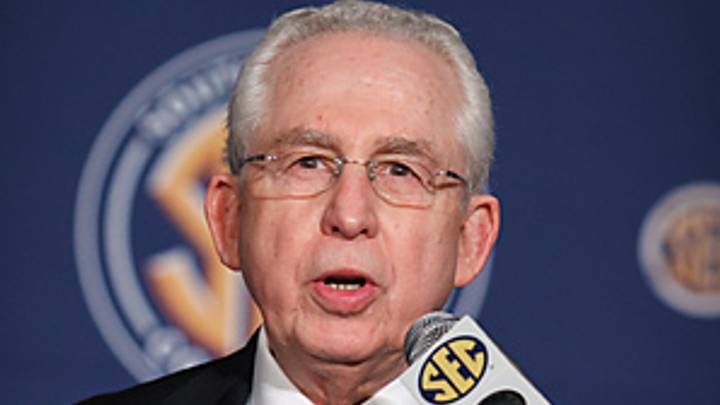
"We have developed a consensus behind a four-team, seeded playoff," Notre Dame AD Jack Swarbrick announced on behalf of the group.
If you've been casually following the commissioners' interminable discussions over the past five months, you may be saying to yourself: Didn't they already decide that? If not, what took them so long? And: I'll believe it when I see it.
But Wednesday's news was unquestionably significant. After months of posturing, the heads of the SEC, Big Ten, Big 12, Pac-12, et al., finally found a playoff model they can all live with for 2014 and beyond.
The semifinal games, as expected, will be played at existing bowls, most likely on a predetermined rotation. As for the never-ending selection debate, multiple participants told SI.com the commissioners would prefer using a selection committee that picks the "best four" teams, with an emphasis on conference championships, strength of schedule and other criteria.
"The model we have come away with is a consensus," said SEC commissioner Mike Slive. "... I am delighted."
Before we get ahead of ourselves, keep in mind this still isn't an endpoint in the discussions. The commissioners will present their model June 26 in Washington, D.C., to the BCS Presidential Oversight Committee, which retains final approval. That group will also discuss the less radical plus-one (a Nos. 1 vs. 2 game played after the traditional bowls), to this point the preference of Pac-12 and Big Ten presidents. Nebraska chancellor Harvey Perlman, the most outspoken of his colleagues against a playoff, sits on that committee.
But looking up at the ring-around-the-podium Wednesday, there was a collective sense of relief on the faces of the men who have held at least six rounds of meetings since January, comprising more than 100 hours of discussion. Their playoff will come to fruition, though maybe not as soon as next week.
"I'm confident as we brief [the presidents] over the next week or so, give them an understanding of the evolution of the ideas -- what's been put off to the side, why it's been put off to the side, how we were able to manage the things that seemed to be irreconcilable for a long time -- that they will give our advice appropriate weight," said Big Ten commissioner Jim Delany.
"... Could there be a present with a bow on it and everything wrapped up [on Tuesday]?" Delany continued. "It could happen, if you're real optimistic. But I would think we'll probably need to spend some more time together, and probably resolve some outstanding issues."
They had to resolve myriad issues just to get to this point. Over the past couple of months, it became apparent that the group had split into two seemingly disparate power factions: the Big Ten/Pac-12 and the SEC/Big 12.
After a series of compromises, the SEC -- owner of six straight national championships -- can be declared the victor. Again.
Three months ago, Delany and his Big Ten athletic directors were the leading proponents of playing semifinal games on campus sites. Slive and the SEC didn't like that idea. That idea isn't happening.
The Big Ten and Pac-12 have continually prioritized preserving their unique partnership with the Rose Bowl. While it's unknown at this point how exactly the semifinal rotation will work (and even which or how many bowls will be involved), the Rose Bowl is going to have to accept the occasional LSU-Oklahoma game if it wants in. The SEC of course will be fine with that, seeing as two of the four current BCS bowls are played in the South.
But the issue that caused by far the most hand-wringing was deciding which four teams should make the playoff.
The SEC was adamant about preserving something as close to the status quo as possible -- the top four teams, period. The Big 12 joined in that cause shortly after announcing the joint "Champions Bowl" between the two leagues.
Pac-12 commissioner Larry Scott, on the other hand, had been vocal about emphasizing conference champions, with the ACC, Big East and others joining in. Delany also aligned with that stance, though, "I was never a champions-only advocate," he said Wednesday. "It's been reported that I was. I was never that." Indeed, he'd long been pushing for some sort of hybrid model, so long as it included a more transparent selection process than the current BCS rankings.
On that issue, he got what he wanted.
In the end, the commissioners realized what many of us have been writing for some time: that they were never that far apart, and that a selection committee -- endorsed recently by the Big Ten and Big 12 -- best bridges their interests.
"There's a tendency to say if it's '1, 2, 3, 4,' then it's not conference champions," said ACC commissioner John Swofford. "I think you can reasonably mesh those two issues, whether it's a committee or otherwise, if you have as a strong part of the criteria that has to be considered, winning conference championships. They don't have to be exclusive."
At the time of the South Florida meetings in late April, the Pac-12's Scott was notably dubious about the committee idea. On Wednesday, he said his opinion had "evolved," which may well have been the final concession the group needed.
"There's a positive impression about the role that the basketball committee has played for basketball, and I think there's been a consensus that the current system is pretty flawed in a lot of ways," said Scott. "I've tried to stay open-minded about that. ... And as I've heard that discussion, I've gotten a lot more comfortable about how a committee would work."
Slive did not specifically discuss a committee, but remember, he's "delighted" with the outcome -- as he should be. In 2008, he and Swofford could not even convince their colleagues to discuss a four-team model, much less spend half the year jetting to Dallas, South Florida and Chicago to hash out every meticulous detail.
"I think the significance [of Wednesday] is seeing all of us together," said Swofford. "We've certainly come a long way from four years ago, when the conversation lasted about 10 minutes."
They know theirs isn't an all-curing panacea. "I'm sure it won't satisfy everyone," said Scott. "Until you have an eight-team or 16-team seeded playoff, there will be folks out there that aren't completely satisfied." Their more modest goal is simply to produce a postseason that's both more exciting and more credible than the current.
It remains to be seen whether fans will embrace a selection committee. We don't even know yet who will serve on it (former coaches? current administrators?) or what exactly their marching orders will be.
However, one highly encouraging buzzword kept making the rounds Wednesday: transparency.
"Whatever model it is, I really hope people can rally around it and support it rather than criticize it every time someone's not in," said Delany. "I know that may be overly optimistic, but I do think we inflicted some of our own damage on ourselves [with the BCS]. It's our responsibility to come up with a system that's a little more transparent, a little more rational.
"There will always be some controversy, but at least it will be more embraced by the football fan and the participants."
The presidents hold the final say, but based on the smiles and chuckles emanating from behind the podium Wednesday, the commissioners believe they've arrived at just that.
 Add us as a preferred source on Google
Senior Writer, Sports Illustrated Stewart Mandel first caught the college football bug as a sophomore at Northwestern University in 1995. "The thrill of that '95 Rose Bowl season energized the entire campus, and I quickly became aware of how the national media covered that story," he says. "I knew right then that I wanted to be one of those people, covering those types of stories." Mandel joined SI.com (formerly CNNSI.com) in 1999. A senior writer for the website, his coverage areas include the national college football beat and college basketball. He also contributes features to Sports Illustrated. "College football is my favorite sport to cover," says Mandel. "The stakes are so high week in and week out, and the level of emotion it elicits from both the fans and the participants is unrivaled." Mandel's most popular features on SI.com include his College Football Mailbag and College Football Overtime. He has covered 14 BCS national championship games and eight Final Fours. Mandel's first book, Bowls, Polls and Tattered Souls: Tackling the Chaos and Controversy That Reign Over College Football, was published in 2007. In 2008 he took first place (enterprise category) and second place (game story) in the Football Writers Association of America's annual writing contest. He also placed first in the 2005 contest (columns). Mandel says covering George Mason's run to the Final Four was the most enjoyable story of his SI tenure. "It was thrilling to be courtside for the historic Elite Eight upset of UConn," Mandel says. "Being inside the locker room and around the team during that time allowed me to get to know the coaches and players behind that captivating story." Before SI.com Mandel worked at ESPN the Magazine, ABC Sports Online and The Cincinnati Enquirer. He graduated from Northwestern University in 1998 with a B.S. in journalism. A Cincinnati native, Mandel and his wife, Emily, live in Santa Clara, Calif.