%20%20--%3E%0A%3Csvg%20version%3D%221.1%22%20id%3D%22Layer_1%22%20xmlns%3D%22http%3A%2F%2Fwww.w3.org%2F2000%2Fsvg%22%20xmlns%3Axlink%3D%22http%3A%2F%2Fwww.w3.org%2F1999%2Fxlink%22%20x%3D%220px%22%20y%3D%220px%22%0A%09%20width%3D%2239px%22%20height%3D%2240px%22%20viewBox%3D%220%200%2039%2040%22%20enable-background%3D%22new%200%200%2039%2040%22%20xml%3Aspace%3D%22preserve%22%3E%0A%3Cpath%20fill%3D%22%23FFFFFF%22%20d%3D%22M38.5%2C7H28.2v26h10.3V7z%22%2F%3E%0A%3Cpath%20fill-rule%3D%22evenodd%22%20clip-rule%3D%22evenodd%22%20fill%3D%22%23FFFFFF%22%20d%3D%22M26.1%2C25.5c0%2C5.8-4.1%2C7.5-12.9%2C7.5C3.9%2C33%2C0%2C31.2%2C0%2C25.2v-1.1h11.6%0A%09v2.4c0%2C0.7%2C0.1%2C1.4%2C1.2%2C1.4c1%2C0%2C1.2-0.4%2C1.2-1.3v-0.9c0-1.6-0.9-1.6-3.5-2.2C2.2%2C21.7%2C0%2C19.7%2C0%2C15.3v-0.9C0%2C9.3%2C5.5%2C7%2C12.9%2C7%0A%09c10.2%2C0%2C12.8%2C2.6%2C12.8%2C7.4v1.8h-11v-2.9c0-0.6-0.4-1.1-1.2-1.1c-0.6%2C0-1.2%2C0.4-1.2%2C1.1v0.9c0%2C1.5%2C0.9%2C2%2C3.3%2C2.5%0A%09c8%2C1.6%2C10.5%2C3.3%2C10.5%2C7.5V25.5z%22%2F%3E%0A%3C%2Fsvg%3E%0A)
Great goals, heroes ... beautiful game on display at Euro 2012
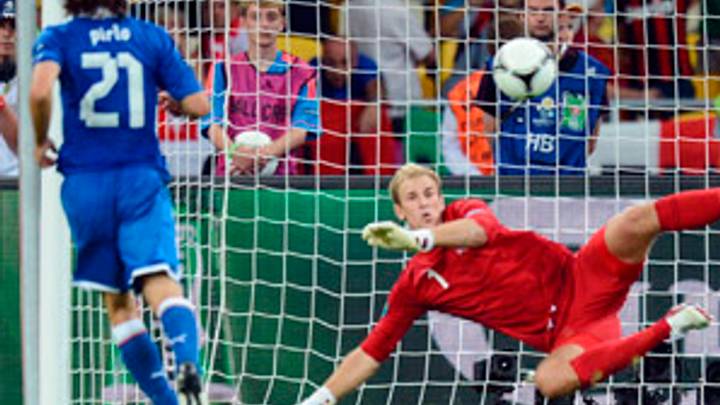
Because he's everything I'm not -- short, Italian, athletically gifted, possessed of magnificent hair and Bon Jovian good looks, with the resting pulse of a safecracker -- Andrea Pirlo had captured my attention long before he won my heart on Sunday in Italy's penalty shootout against England in the quarterfinals of Pirlo 2012.
Sorry, make that Euro 2012, which has been many different tournaments, all of them entertaining. When Germany took a 1-0 lead on Greece on Saturday on a strike by Philipp Lahm, and Greece abruptly and surprisingly equalized, Euro 2012 briefly threatened to become Gyro 2012 -- Greeks taking leg of Lahm and turning it into something wonderful.
But that was before the peerless Pirlo took his penalty against England on Sunday, with Italy needing a goal to have any hope to advance to Thursday's semifinal against Germany. It was not his first penalty in the most highly pressurized circumstances possible: The 2005 Champions League final ended on penalties, too, and Pirlo's miss for AC Milan helped Liverpool win the shootout. A year later, in the 2006 World Cup final, his made penalty helped Italy beat France in a shootout. Pirlo was named third best player of that World Cup, for which FIFA awarded him a Bronze Ball, giving him three in total, if you count the pair he was born with.
No other act in sport is fraught with tension in quite the same way as a soccer penalty kick, which offers little metaphorical subtlety: The taker is literally put on the spot. Pirlo, for his part, walked to that spot on Sunday in Kiev slow and bored and impassive, like a husband at the mall.
That was in sharp contrast to the man in goal, adrenalized England keeper Joe Hart, who was bouncing around on his line in the manner of Tom Arnold on a double espresso. "I saw that the goalkeeper was really fired up," is how Pirlo put it later, and so he decided to do something audacious.
Pirlo stepped to the ball, came nearly to a full stop, then chipped it softly toward the center of the goal, as if gently kicking off a slipper before bed. The ball was traveling just fast enough to cross the goal line, but not so slow that Hart -- splayed on the grass, having dived explosively to his own right -- could have any hope of stopping it. The keeper watched the ball's agonizing approach -- slow, inevitable, like death itself.
The Pirlo penno was so slow in real time that slow motion replay reduced it to Zapruderesque speed, giving it greater gravitas, as Pirlo's Prell-commercial hair flounced and shone beneath the stadium lights. The ball, making barely perceptible progress toward goal, begged for its own NFL Films close-up and John Facenda voiceover.
Chipping the keeper from the penalty spot is hardly a Pirlo invention, though he might have perfected the art of the "panenka," named for Antonin Panenka, who did it for Czechoslovakia to beat West Germany in the Euro final of 1976. Panenka's panenka was the walk-off penalty in a penalty-kick shootout, though of course Panenka didn't walk off at all, but was buried in a pigpile of ecstatic teammates.
For Germany, it was a rare reversal. It's usually the Germans that give their names to familiar phenomena (Harry Heimlich, Alois Alzheimer, Robert Bunsen, Rudolf Diesel), but here it was Panenka achieving immortality against the Germans, giving his name to the panenka that would bring so much joy, 36 years later, to Pirlo's countrymen.
One of those countrymen -- Italy's captain and keeper, Gianluigi (Gigi) Buffon -- earned my everlasting affection when he (and I) was young, 14 years ago, again in the crucible of a penalty kick. I was in Italy to write about the Brazilian great Ronaldo, then playing for Inter Milan in a match at Parma, for whom Buffon was a 20-year-old keeper already in his third season.
Inter earned a late penalty that would have won the game. Ronaldo took it, Buffon saved it, Parma took the ball into Inter's half and Buffon promptly ran from the pitch, leaping onto a chicken-wire fence behind his own goal to whip the home crowd into a delirium. After the game -- Parma won, 1-0 -- he ripped off his jersey to reveal the blue Superman shirt underneath. I have, it almost goes without saying, loved the guy ever since. I could listen to Bob Ley say "Gigi Buffon" all day. It always sounds to my ears like "Zhizhi Bouffant", a Cruella De Ville-style Disney villainess.
So yes, I suppose my heart leans toward Italy in their match against Germany on Thursday, when many of us will be watching in the middle of the workday. To viewers in America, Euro 2012 is a monthlong excuse to play hooky, from hoejke, a word of Dutch invention -- the final act of Dutch invention, to judge by Holland's uninspired (and unexpected) exit from Euro 2012, before what is always called "the knockout stage" of the tournament.
But then the whole tournament's been a knockout -- knocked me out, anyway -- and all I'm really rooting for is Euro 2012 not to end.
 Add us as a preferred source on Google
Special Contributor, Sports Illustrated Steve Rushin was born in Elmhurst, Ill. on September 22, 1966 and raised in Bloomington, Minn. After graduating from Bloomington Kennedy High School in 1984 and Marquette University in 1988, Rushin joined the staff of Sports Illustrated. He is a Special Contributor to the magazine, for which he writes columns and features. In 25 years at SI, he has filed stories from Greenland, India, Indonesia, Antarctica, the Arctic Circle and other farflung locales, as well as the usual locales to which sportswriters are routinely posted. His first novel, The Pint Man, was published by Doubleday in 2010. The Los Angeles Times called the book "Engaging, clever and often wipe-your-eyes funny." His next book, a work of nonfiction, The 34-Ton Bat, will be published by Little, Brown in 2013. Rushin gave the commencement address at Marquette in 2007 and was awarded an honorary Doctor of Letters for "his unique gift of documenting the human condition through his writing." In 2006 he was named the National Sportswriter of the Year by the National Sportswriters and Sportscasters Association. A collection of his sports and travel writing—The Caddie Was a Reindeer—was published by Grove Atlantic in 2005 and was a semifinalist for the Thurber Prize for American Humor. The Denver Post suggested, "If you don't end up dropping The Caddie Was a Reindeerduring fits of uncontrollable merriment, it is likely you need immediate medical attention." A four-time finalist for the National Magazine Award, Rushin has had his work anthologized in The Best American Sports Writing, The Best American Travel Writing and The Best American Magazine Writing collections. His essays have appeared in Time magazine andThe New York Times. He also writes a weekly column for SI.com. His first book, Road Swing, published in 1998, was named one of the "Best Books of the Year" by Publishers Weekly and one of the "Top 100 Sports Books of All Time" by SI. He and his wife, Rebecca Lobo, have four children and live in Connecticut.