%20%20--%3E%0A%3Csvg%20version%3D%221.1%22%20id%3D%22Layer_1%22%20xmlns%3D%22http%3A%2F%2Fwww.w3.org%2F2000%2Fsvg%22%20xmlns%3Axlink%3D%22http%3A%2F%2Fwww.w3.org%2F1999%2Fxlink%22%20x%3D%220px%22%20y%3D%220px%22%0A%09%20width%3D%2239px%22%20height%3D%2240px%22%20viewBox%3D%220%200%2039%2040%22%20enable-background%3D%22new%200%200%2039%2040%22%20xml%3Aspace%3D%22preserve%22%3E%0A%3Cpath%20fill%3D%22%23FFFFFF%22%20d%3D%22M38.5%2C7H28.2v26h10.3V7z%22%2F%3E%0A%3Cpath%20fill-rule%3D%22evenodd%22%20clip-rule%3D%22evenodd%22%20fill%3D%22%23FFFFFF%22%20d%3D%22M26.1%2C25.5c0%2C5.8-4.1%2C7.5-12.9%2C7.5C3.9%2C33%2C0%2C31.2%2C0%2C25.2v-1.1h11.6%0A%09v2.4c0%2C0.7%2C0.1%2C1.4%2C1.2%2C1.4c1%2C0%2C1.2-0.4%2C1.2-1.3v-0.9c0-1.6-0.9-1.6-3.5-2.2C2.2%2C21.7%2C0%2C19.7%2C0%2C15.3v-0.9C0%2C9.3%2C5.5%2C7%2C12.9%2C7%0A%09c10.2%2C0%2C12.8%2C2.6%2C12.8%2C7.4v1.8h-11v-2.9c0-0.6-0.4-1.1-1.2-1.1c-0.6%2C0-1.2%2C0.4-1.2%2C1.1v0.9c0%2C1.5%2C0.9%2C2%2C3.3%2C2.5%0A%09c8%2C1.6%2C10.5%2C3.3%2C10.5%2C7.5V25.5z%22%2F%3E%0A%3C%2Fsvg%3E%0A)
The Cavs Are All-In for a Championship. The Thrill Could Be Disastrous.
In this story:
No matter what else you can say about the Cleveland Cavaliers—they are freaking going for it.
Undeterred by their crushing Eastern Conference finals defeat at the hands of the eventual champion Knicks, undeterred by the sight of LeBron James turning down the chance to come home and instead heading to a conference rival in Philadelphia, the Cavs refused to sit still. The front office, helmed by Koby Altman, has expended nearly every last resource it has to put a contending team on the floor. They’ve worked to address the weaknesses that sunk last year’s roster while adding talent where possible.
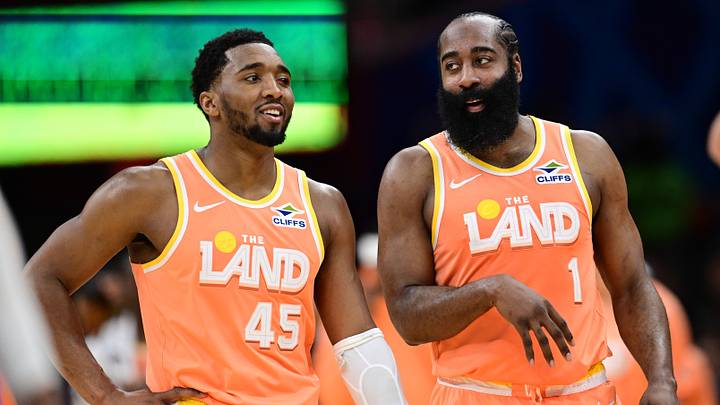
Cleveland’s last big moves for the offseason came within a 24-hour span this week. The team traded for Peyton Watson from the Nuggets and signed the 24-year-old wing to a four-year deal worth $88 million in total on Wednesday night. Then, on Thursday afternoon, James Harden agreed to return to the Cavs on a three-year, $97 million pact that includes a player option for the final season and a trade kicker.
There will be some minor moves made on the margins, but the core of Cleveland’s 2026–27 team is complete. The starting lineup will feature Harden, Watson, Donovan Mitchell, Evan Mobley and Jarrett Allen. The bench mob will be led by Sam Merrill, Jaylon Tyson and the newly signed Mario Hezonja. Will it work? Who knows! The games must be played before most hard conclusions are drawn, and the Cavs profile as one of the most interesting teams to watch in that regard this season.
NEXT: The Top 25 Must-Watch Games of the 2026–27 NBA Season, and Why They Matter
One conclusion that can be drawn, however: Cleveland is all-in on a title this year. As is the case for every team that decides to push all their chips to the middle of the table, the reward is astronomical—as are the consequences for failure.
The Cavs drained their asset well to put this team together

When I said above that the front office used nearly every last resource available to assemble this roster ... I was not exaggerating.
After sending out a 2031 first-rounder in the Watson trade, the Cavaliers do not have outright control over any of their picks in the next six drafts. Three they already owe to another team via a swap or straight-up trade and one (the 2033 selection) is frozen due to the team’s time spent over the second apron. They only have two picks (in 2030 and 2032) that can be moved now, and only in pick swaps rather than outright trades thanks to the Stepien Rule. In regards to second-round picks, which teams use to push deals across the finish line, they have only their 2033 pick to offer. Otherwise that chest is completely empty.
Financially, Cleveland pushed itself to the brink in terms of what the franchise was legally allowed to do. By trading for Watson, the Cavs hard-capped themselves at the first apron, meaning the total salary of the roster cannot exceed $209 million once the season begins. After the Watson trade they were about $30 million underneath the first apron—and then signed Harden to a deal worth... about $30 million per year. The exact dollar amounts of the two players’ salaries are still to be revealed so Cleveland might have to do some further maneuvering to ensure the final salary number doesn’t go over $209 million. But the overall point is that the margins are extremely thin in this regard.
NEXT: Predicting Landing Spots for the Top 10 NBA Free Agents Still Available
All that money and all those draft picks certainly went a long way. The Cavs have a well-rounded roster on paper: two elite backcourt scorers flanked by a chaos agent of a defender, all backed by two top-tier rim protectors. The bench isn’t a strong point but with that level of overwhelming talent in the starting five it’s not nearly the concern it might’ve been otherwise.
Above all, to do all this without going over the second apron, which would have incurred enormous financial penalties after Cleveland spent last season over that apron? It’s about as good a job a front office can do.
But that’s only half the battle. Now things must play out on the court. And if the Cavaliers disappoint once more, disaster awaits.
The Cavaliers are championship or bust this season

The consequence of burning all flexibility to put one loaded team on the floor is what happens if it doesn’t work.
Should the Cavs suffer another disappointing playoff exit, they have zero recourse to make changes. There are no picks to use to find more talent, no cap space to utilize to add to the team. All of that currency has been spent. More problematically, there’s no real reason to think things will get better year-over-year. Harden will be 37 by the time this upcoming season starts; Mitchell will be 30. Mobley and Watson are the young guns who could take leaps but neither profile to be game-changing offensive players even if they do improve.
At large, this Cavs core has gotten plenty of chances to prove its worth. Harden and Watson are recent additions, of course, but Mitchell/Mobley/Allen have been together since 2022; in that stretch they’ve won four playoff series and lost four, never once making a serious Finals run. Cleveland has slowly added around them over the last few years but this season makes for the final push, with no assets left over. Even if injuries or bad luck come into play, asking owner Dan Gilbert to run it back with a $200 million roster that has shown time and time again a propensity to fall short is an impossible sell.
In short: if they can’t get it done next year, will they ever get it done? The NBA doesn’t have the patience to find out the answer to that question.
Should the Cavaliers stumble in the postseason, trades will be on the way. Those trades will be hard to make without many draft assets to utilize and the contracts at hand. Not many teams will be falling over themselves to take on Harden’s contact as he nears 40 years old. Mitchell just signed a four-year, $272 million extension that will pay him north of $60 million when it begins in his age-31 season; he’ll earn a whopping $75 million in the final year as a 34-year-old. For as talented a scorer Mitchell is, that contract will be a negative asset if he doesn’t prove himself a championship-caliber first option.
If nobody wants that pair of stars, who will be next on the move? Allen seems the easiest but is also entering the first year of a pricy three-year extension. The Cavs just got Watson and he’s the most irreplacable of all the players on the roster due to his particular skillset. Will Mobley, then, have to wind up on the move? Cleveland would want to avoid that at all costs given he’s 25 years old and already has a DPOY award in his trophy case. It’ll be tough to move him for a worthwhile return, too, since the Cavs will have no incentive to tank (see: lack of draft control above).
It’s fair to say we’re putting the horse before the cart when asking these questions. But those questions will be asked if the Cavaliers fall short in their pursuit of a title. It’s an expensive, aging roster that the front office used every asset available to build out.
The upside of such a move is clear—chasing championships is what it’s all about, anyway—but the downside should make everyone in Cleveland nervous.
Listen to SI’s NBA podcast, Open Floor, below or on Apple and Spotify. Watch the show on SI’s YouTube channel.
 Add us as a preferred source on Google
Liam McKeone is a senior news writer for the NBA team at Sports Illustrated. He has been in the industry covering the NBA and other sports as a content creator starting in 2017. Prior to joining SI, McKeone worked for NBC Sports Boston and The Big Lead. In addition to his work as a writer, he has hosted the Press Pass Podcast covering sports media and The Big Stream covering pop culture. A graduate of Fordham University, he is always up for a good debate and enjoys loudly arguing about sports, rap music, books and video games. McKeone has been a member of the National Sports Media Association since 2020.
Follow liam_mckeone