
The Trait Jayson Tatum Was Criticized For is Now Why the Celtics are Thriving
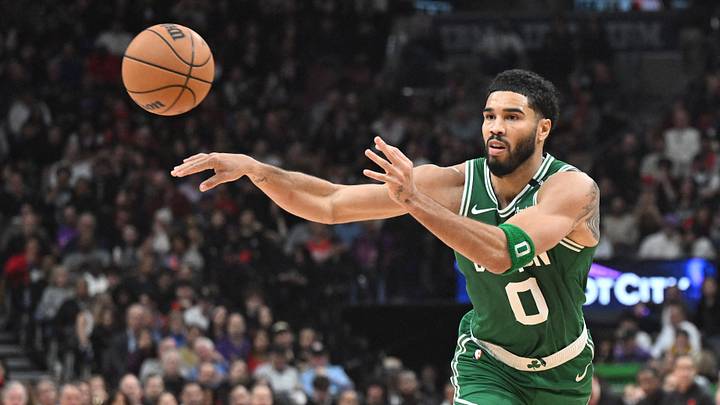
For all of Jayson Tatum’s success with the Boston Celtics, how he carries himself has remained a constant criticism.
“His quietness comes off as if he's aloof or doesn't pay attention or doesn't care,” Joe Mazzulla said after the Celtics’ big win over the Philadelphia 76ers. “But it's the opposite.”
Tatum is not a big rah-rah guy. He’s not one for big speeches or fiery rhetoric. He’s always been the calm one.
“I've kind of been this way since I was a kid,” Tatum said. “Never too high, never too low.”
That was on display against the Toronto Raptors Wednesday night. As Toronto’s lead grew from three to nine at the end of the first quarter, and then from 15 to 22 after he returned in the second quarter, Tatum never panicked. He wasn’t trying to match the Raptors shot-for-shot. He just stayed the course, and the Celtics followed his lead.
In the second quarter, he answered with 11 straight points, six off three-pointers, three off free throws, and two off a give-and-go dunk with Neemias Queta. In the fourth, he closed the game with a jumper, a foul on a drive, and an assist to Queta for a dunk. It highlights Tatum’s shifting scoring profile this season, which has taken a more aggressive turn.
His three-point attempt rate has dropped noticeably from 49.7% to 40% compared to his last full season in 2024-25. His free throw attempt rate is up from 27.5% to 46%. According to Synergy, his shooting foul rate has jumped from 9.5% to 13.7%.
So he’s giving up threes in favor of attacking, and the extra free throw volume is keeping his True Shooting (56.0%) afloat despite an eFG% drop from 53.7% to 47.4%.
In the raw numbers, it’s showing up as 7.7 three-point attempts per game, down from 10.1 in 2024-25, and 8.9 free throw attempts per game. When he isn’t scoring, he’s setting his teammates up.
His pull-up three-pointers aren’t quite falling yet, but Boston is still thriving in Jayson Tatum pick-and-rolls. The Celtics are scoring 1.286 points per possession according to Synergy, because Tatum’s passes are leading to 52.2% shooting on spot-up threes. The percentage of plays Tatum assists on has jumped from 18.6% in 2024-25 to 22.3% this season.
In 2024-25, nearly 60% of Tatum's assists were kick-outs for three-pointers. This season, 52.4% of his assists are generating two-pointers. Almost half of those assists are coming in the halfcourt, a jump of nearly 10 percentage points from two seasons ago. But even though the distribution of the passes has changed, the total points he’s generating is up. He’s generating 19.3 points per game off his assists, up from 15.6 two seasons ago.
“I think it's been a lot of fun,” Tatum said. “Joe always challenges me to essentially be the best player on the floor, and it can look different every single night. How can I impact winning? How can I positively impact my teammates every possession?”
The Sixers spent a lot of time sending hard doubles at Tatum, which on the surface might seem like a sound strategy, but that hasn’t worked so far, either. The sample sizes are clearly very different, but the Celtics are scoring 1.212 points per possession every time a second defender commits to Tatum, up from 1.004 PPP two seasons ago. Teammates are currently shooting 57.1% overall and 48.9% from three, when Tatum draws a crowd.
When you combine post-up hard doubles and pick-and-roll traps, Tatum has pushed Boston’s efficiency from 0.882 PPP in 2024-25 up to 1.143 PPP this season while cutting his turnover rate by more than half. Instead of fighting through two defenders, he’s hitting pocket passes to short-rolling bigs and finding cutters. The timing of those passes often triggers the ball-movement that leads to buckets, even when he’s not directly assisting.
The pace of play looks different, too. The Celtics aren’t playing any faster, generally, with Tatum this season. Their pace number is still essentially the same as it’s been over the years, hanging around 96 possessions per 48 minutes. But the tempo of the offense has changed. Even if the Celtics aren’t sprinting up and down the floor, the ball isn’t sticking as much.
That shows up in the team’s average time per touch. Tatum’s was 6.76 seconds in his last full season, but is 4.23 seconds now. Payton Pritchard has the team’s highest mark at 4.88 seconds per touch, and if that holds it’ll be the first time in three seasons everyone has been under five seconds. The tempo of the halfcourt offense is in a good place.
And there's Tatum’s work as a screener, which has been a big part of Boston’s focus on freeing players up with off-ball actions. One of the reasons everyone’s time per touch is down is that screens are opening things up so the ball can move. Go back and watch the breakdown of Boston’s big run to pull away from the Sixers and watch how many actions involved Tatum screening. It’s hard to capture with currently available data, but it’s obvious when you watch closely.
“[He's] special. He can just kind of control the game in a lot of different ways,” Derrick White said after beating the Raptors. “[Whether] he's making shots, missing shots … he just impacts winning in a lot of different ways.”
Through all the evolution, both his and the team’s, Tatum’s demeanor remains the constant. People have questioned it in the past, myself included, but that steadiness is becoming more valuable as the NBA gets more chaotic. Games are more volatile than ever, with big runs and wild swings in almost every game. Tatum’s ability to stay centered can be seen as a big reason why he’s thriving in this environment.
“To me, he doesn't get enough credit for his emotional stability, his emotional intelligence, and his maturity,” Mazzulla said. “His mental toughness is underrated. His emotional intelligence is underrated, and his ability to just stay focused on what matters most is one of his best gifts.”
 Add us as a preferred source on Google

John Karalis is a 20-year veteran of Celtics coverage and was nominated for NSMA's Massachusetts Sportswriter of the Year in 2019. He has hosted the Locked On Celtics podcast since 2016 and has written two books about the Celtics. John was born and raised in Pawtucket, RI. He graduated from Shea High School in Pawtucket, where he played football, soccer, baseball, and basketball and was captain of the baseball and basketball teams. John graduated from Emerson College in Boston with a Bachelor of Science degree in Broadcast Journalism and was a member of their Gold Key Honor Society. He was a four-year starter and two-year captain of the Men’s Basketball team, and remains one of the school's top all-time scorers, and Emerson's all-time leading rebounder. He is also the first Emerson College player to play professional basketball (Greece). John started his career in television, producing and creating shows since 1997. He spent nine years at WBZ, launching two different news and lifestyle shows before ascending to Executive Producer and Managing Editor. He then went to New York, where he was a producer and reporter until 2018. John is one of Boston’s original Celtics bloggers, creating RedsArmy.com in 2006. In 2018, John joined the Celtics beat full-time for MassLive.com and then went to Boston Sports Journal in 2021, where he covered the Celtics for five years. He has hosted the Locked On Celtics podcast since 2016, and it currently ranks as the #1 Boston Celtics podcast on iTunes and Spotify rankings. He is also one of the co-hosts of the Locked on NBA podcast.
Follow John_Karalis