%20%20--%3E%0A%3Csvg%20version%3D%221.1%22%20id%3D%22Layer_1%22%20xmlns%3D%22http%3A%2F%2Fwww.w3.org%2F2000%2Fsvg%22%20xmlns%3Axlink%3D%22http%3A%2F%2Fwww.w3.org%2F1999%2Fxlink%22%20x%3D%220px%22%20y%3D%220px%22%0A%09%20width%3D%2239px%22%20height%3D%2240px%22%20viewBox%3D%220%200%2039%2040%22%20enable-background%3D%22new%200%200%2039%2040%22%20xml%3Aspace%3D%22preserve%22%3E%0A%3Cpath%20fill%3D%22%23FFFFFF%22%20d%3D%22M38.5%2C7H28.2v26h10.3V7z%22%2F%3E%0A%3Cpath%20fill-rule%3D%22evenodd%22%20clip-rule%3D%22evenodd%22%20fill%3D%22%23FFFFFF%22%20d%3D%22M26.1%2C25.5c0%2C5.8-4.1%2C7.5-12.9%2C7.5C3.9%2C33%2C0%2C31.2%2C0%2C25.2v-1.1h11.6%0A%09v2.4c0%2C0.7%2C0.1%2C1.4%2C1.2%2C1.4c1%2C0%2C1.2-0.4%2C1.2-1.3v-0.9c0-1.6-0.9-1.6-3.5-2.2C2.2%2C21.7%2C0%2C19.7%2C0%2C15.3v-0.9C0%2C9.3%2C5.5%2C7%2C12.9%2C7%0A%09c10.2%2C0%2C12.8%2C2.6%2C12.8%2C7.4v1.8h-11v-2.9c0-0.6-0.4-1.1-1.2-1.1c-0.6%2C0-1.2%2C0.4-1.2%2C1.1v0.9c0%2C1.5%2C0.9%2C2%2C3.3%2C2.5%0A%09c8%2C1.6%2C10.5%2C3.3%2C10.5%2C7.5V25.5z%22%2F%3E%0A%3C%2Fsvg%3E%0A)
Five Trends That Could Decide 2026 NBA Playoffs: How Wembanyama’s Minutes, Nuggets Defense Impact Title Chase
In this story:
The NBA regular season runs from October to April. Every team plays at least 82 games (and two lucky squads play 83 if they qualify for the in-season tournament finals). Every season there are those who loudly proclaim that is far too many games, and you may agree with them. But it is undeniable those games offer plenty of significant data points. Trends that occur over the course of a game or even a week’s worth of games can be mirages. But trends that exist over an 82-game sample size? Those are real. Those define what each team is good at and where their weak spots are. They separate the good players from the great ones.
Above all, those trends tell us ahead of time which team has the best chance to survive the NBA playoff gauntlet and emerge victorious in June. The obvious numbers (like wins, of course) make for a good surface-level gauge of each team’s quality and ability to beat their opponents. But the numbers that lay below the surface—more subtle trends from the lengthy season—are often just as indicative, if not more.
Last year we looked at the five regular season trends that could define the 2025 playoffs, and some ended up quite meaningful. The Celtics weren’t able to shake their starting lineup struggles and it put them in a hole against the Knicks before Jayson Tatum’s torn Achilles sealed their fate. After shooting the lights out all season long the Cavaliers’ rotation went ice-cold against the Pacers and bowed out early after a 64-win regular season. The Nuggets were unable to change their season-long habit of cratering with Nikola Jokić off the floor and it cost them dearly in a seven-game slugfest against the eventual champion Thunder.
Those are the trends we seek to uncover; the habits established over a long season that make up a team’s identity and how it could lead to postseason success. Or failure.
As the playoffs begin in earnest on Saturday, let’s examine the five trends from the 2025–26 regular season that could wind up defining this year’s postseason.
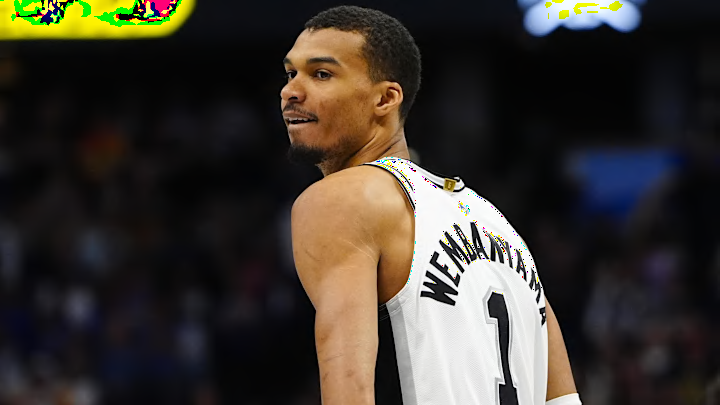
Victor Wembanyama’s low minutes count

Victor Wembanyama came into his own way ahead of schedule this season, cementing his place as the NBA’s most dominant and impactful defender while learning just how greatly his offense can warp the court for his Spurs teammates. He figures to be a top-three finisher in MVP voting and few will dispute his reputation as one of the most impactful players in the NBA this year for a 60-win San Antonio team. It should be exciting for neutral observers and otherwise that Wemby will be making his playoff debut in short order.
But the one knock against his MVP candidacy doubles as a potential worry for Wembanyama’s first foray into the physical play of postseason basketball—his low minutes count.
In the playoffs, every team’s superstars play close to 40 minutes per night. There are exceptions in the case of blowouts and easy first-round opponents but there are no long-term worries this time of year. No restrictions to adhere to. No load management. It’s do or die. Thus, when it really matters, the best players don’t come off the court.
How will Wembanyama handle that? The 22-year-old averaged fewer than 30 minutes per game this season and didn’t play north of 40 minutes in a single contest. There are plenty of reasons for this, from the Spurs being good enough to blow teams out to a calf injury that put a ceiling on his minutes for a long stretch of the year. But regardless of why the reality is the same—Wemby’s endurance hasn’t been put to the test the way it will in these playoffs, and he’s never before gone through the physicality of an NBA playoff gauntlet.
It’s worth wondering how the tall Frenchman’s body will hold up under those circumstances. It wouldn’t be a surprise to see him thrive anyway, but even the slightest bit of fatigue can be the difference between heartbreak and triumph.
Jalen Williams’s output after an injury-riddled season

Last year’s playoffs marked Jalen Williams’s coming out party and it felt safe to believe he’d take a big leap this year. Instead the 25-year-old was limited to only 33 games thanks to a recurring hamstring issue that plagued him all season long. Thanks to more MVP-caliber play from Shai Gilgeous-Alexander and the ridiculous depth of the Thunder’s bench, OKC didn’t miss a beat. But this team will need Williams at his best to emerge victorious from the West.
The star wing earned the benefit of the doubt by shining en route to his first title—but his output this year was well below those numbers and mark one of the few true concerns for the defending champs. Williams averaged only 17.1 points per game, his lowest number since his rookie year, and shot a putrid 29.9% from three on only 2.3 attempts per game. Those are bad numbers for a player who is supposed to be the No. 2 option on a title team.
Would it be a shock to see Williams look like his 2025 self the moment the Thunder step on the floor this weekend? No, it would not. If the fourth-year scorer is healthy he is entirely capable of punishing defenses for focusing on SGA, and the extra attention he’ll demand will open the floor for the various other contributors dotting the roster. But for title teams the regular season is about establishing a rhythm of excellence that carries over to postseason play. Williams wasn’t able to do that and it could be a possible weak point for a Thunder team that doesn’t suffer from many.
Pistons’ offensive success without Cade Cunningham

The Pistons were one of the NBA’s most joyful stories this year but their title case was always a bit leaky for one main reason: Cade Cunningham. Specifically, how reliant Detroit was on Cunningham to score. The superstar point guard took an MVP leap this season and figures to be one of the top players in these playoffs. There is no doubting his ability to deliver. There were plenty of doubts, however, that the Pistons would be able to win the minutes he’ll have to spend on the bench—a critical factor in any championship contender’s chances.
But Cunningham’s collapsed lung forced his team to figure it out without him for a three-week span. And it may end up paying big dividends.
On the season the Pistons have cratered offensively without Cunningham as the conductor of the offense; his pick-and-rolls with Jalen Duren make up the foundation of everything Detroit wants to do on that end of the court. When Cunningham was suddenly sidelined it seemed not just possible but likely the team’s offense would fall into the gutter and they’d have to gut out wins with intense defense.
The latter proved true because that’s how the Pistons have gone about their business all season. But they managed to keep the ship afloat without Cunningham thanks to a team-wide effort from Duren, Daniss Jenkins, Kevin Huerter and the rest of the supporting cast. From March 17, when Cunningham went down, to his return on April 8 the Pistons posted an offensive rating of 116.7—17th in the NBA in that span. That isn’t “good” offensive production per se but it’s a lot better than Detroit’s 113.3 rating posted over the course of the year in Cunningham’s minutes on the bench.
Put more simply: for most of the season the Pistons scored like the Pelicans without Cunningham on the floor to make things happen. But when he was out for an extended period, they scored like the Cilppers. It’s marginal but the difference between playing badly and playing O.K. in non-superstar minutes is often what separates pretenders from contenders. Detroit proved capable of that in the final weeks of the regular season and if it carries over into postseason play the Pistons’ title case is much stronger.
Jayson Tatum’s three-point percentage

Tatum’s return from injury has been a massive success no matter which way you slice it. He’s racking up numbers across the board and the Celtics finished their season winning at an even better clip than before. But their hopes for a deep postseason run might hinge on one of the few areas Tatum has struggled since coming back—shooting from deep.
Over the last few seasons Tatum has morphed into one of the league’s most voluminous three-point shooters. He doesn’t hit them at an elite clip but can catch fire in an instant and defenses know it; as such opponents are always glued to the Boston star once he crosses halfcourt. However, Tatum has been ice-cold from beyond the arc since returning; he finished the year with a 32.9% mark from three-point range while launching 8.9 attempts per game. It's the worst mark of his career—in only 16 games, admittedly, so it’s a much smaller sample size than the other numbers on this list. But in light of his deep shot’s value to his team and a tendency to go through long cold stretches, it’s notable.
Given he’s a lifetime 36.8% three-point shooter there’s no reason to believe his shot abandoned him completely. But can it return these playoffs? It wouldn’t be unreasonable if the 28-year-old needed a full offseason to fully round back into form, but the postseason is here. His threat from that range is a big part of the Celtics’ offense in terms of creating opportunities for his teammates but if Tatum continues to chuck up threes in great quantity and miss many of them, it will cost his team.
Every possession matters in the playoffs. Defenses won’t hesitate to squeeze the floor if they sense Tatum isn’t the same threat from deep. Boston needs him to hit those shots, and if he doesn’t it becomes a lot harder to win against the best teams.
Nuggets’ below-average defense

Of all the possible title teams the Nuggets have the simplest list of pros and cons.
Pros: they employ Nikola Jokić and have him surrounded with a very well-structured supporting cast, including proven playoff performer Jamal Murray.
Cons: the defense is not very good.
It really is as basic as that. Jokić put forth another historically great campaign and, when everyone is healthy, the talent around him is even better than last year’s team that pushed the Thunder to the brink in the second round. They very much boast the capability to beat anyone, anytime, anywhere.
But their defense effort just hasn’t been there this season. Denver lands in the bottom third of the league in every relevant defensive stat, including points allowed per game and defensive rating (both rank 21st in the NBA). That’s a significant problem for two reasons.
First, basically every title team in NBA history owns a top-10 defense at worst. The “defense wins championships” mantra is well-worn for a reason. A tightened playoff whistle and the strategic advantages of playing the same team over and over again means scoring is much more difficult in postseason play; teams that can’t guard their yard are at an automatic disadvantage as a result even if they employ generational offensive talents.
Second, the Nuggets haven’t given anybody much reason to believe they’ll be able to lock in on that end in the playoffs. Injuries definitely hindered the roster’s defensive effort during the regular season but from what we can see as viewers there just hasn’t been a lot of interest relative to their opponents. It doesn’t matter how many points Jokić creates if he and his teammates give it all back on the other end.
Through every lens, Denver’s defense isn’t up to task based on what we’ve seen out of championship teams before. Whether the Nuggets can change that is at the core of their hopes to make a run.
More NBA from Sports Illustrated
Listen to SI’s NBA podcast, Open Floor, below or on Apple and Spotify. Watch the show on SI’s YouTube channel.
 Add us as a preferred source on Google
Liam McKeone is a senior news writer for the NBA team at Sports Illustrated. He has been in the industry covering the NBA and other sports as a content creator starting in 2017. Prior to joining SI, McKeone worked for NBC Sports Boston and The Big Lead. In addition to his work as a writer, he has hosted the Press Pass Podcast covering sports media and The Big Stream covering pop culture. A graduate of Fordham University, he is always up for a good debate and enjoys loudly arguing about sports, rap music, books and video games. McKeone has been a member of the National Sports Media Association since 2020.
Follow liam_mckeone