%20%20--%3E%0A%3Csvg%20version%3D%221.1%22%20id%3D%22Layer_1%22%20xmlns%3D%22http%3A%2F%2Fwww.w3.org%2F2000%2Fsvg%22%20xmlns%3Axlink%3D%22http%3A%2F%2Fwww.w3.org%2F1999%2Fxlink%22%20x%3D%220px%22%20y%3D%220px%22%0A%09%20width%3D%2239px%22%20height%3D%2240px%22%20viewBox%3D%220%200%2039%2040%22%20enable-background%3D%22new%200%200%2039%2040%22%20xml%3Aspace%3D%22preserve%22%3E%0A%3Cpath%20fill%3D%22%23FFFFFF%22%20d%3D%22M38.5%2C7H28.2v26h10.3V7z%22%2F%3E%0A%3Cpath%20fill-rule%3D%22evenodd%22%20clip-rule%3D%22evenodd%22%20fill%3D%22%23FFFFFF%22%20d%3D%22M26.1%2C25.5c0%2C5.8-4.1%2C7.5-12.9%2C7.5C3.9%2C33%2C0%2C31.2%2C0%2C25.2v-1.1h11.6%0A%09v2.4c0%2C0.7%2C0.1%2C1.4%2C1.2%2C1.4c1%2C0%2C1.2-0.4%2C1.2-1.3v-0.9c0-1.6-0.9-1.6-3.5-2.2C2.2%2C21.7%2C0%2C19.7%2C0%2C15.3v-0.9C0%2C9.3%2C5.5%2C7%2C12.9%2C7%0A%09c10.2%2C0%2C12.8%2C2.6%2C12.8%2C7.4v1.8h-11v-2.9c0-0.6-0.4-1.1-1.2-1.1c-0.6%2C0-1.2%2C0.4-1.2%2C1.1v0.9c0%2C1.5%2C0.9%2C2%2C3.3%2C2.5%0A%09c8%2C1.6%2C10.5%2C3.3%2C10.5%2C7.5V25.5z%22%2F%3E%0A%3C%2Fsvg%3E%0A)
Four NBA Players Facing the Most Pressure to Deliver After Trade Deadline
In this story:
This year’s NBA trade deadline was an absolute whirlwind. Numerous deals were struck in the lead-up to the final bell on Thursday at 3 p.m. ET, from blockbusters like the Anthony Davis trade to smaller yet still impactful deals like the Anfernee Simons-Nikola Vučević swap. The landscape of the league rarely shifts so dramatically in the middle of the season, yet here we are—a second consecutive deadline that will lead to dramatic ramifications all over the NBA.
All the big moves also means there’s pressure to deliver for certain players. Some teams, like the Bulls, traded for players like Simons or Collin Sexton without the need for them to come in and perform at a high level immediately; the team’s goals are more big-picture than winning the next game. That isn’t the case across the board, though. Other players were acquired with the expectation they would be able to play well immediately. In some cases their new team needs them to do so. It isn’t ideal to bank the season’s hopes largely on a trade acquisition but sometimes it cannot be avoided.
Here we’ll examine the four players who are under the most pressure to deliver immediately in their new homes with the deadline dust settling.
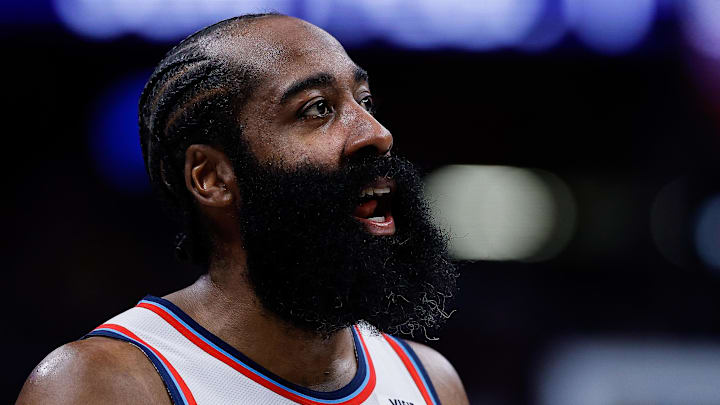
James Harden, Cavaliers
No player traded at the deadline is under as much pressure as Harden.
The Cavaliers likely traded for the superstar guard with larger machinations in mind; his player option for next offseason is only partially guaranteed and they got off a long-term commitment to Darius Garland by landing Harden. But in the immediate it was a win-now trade. Cleveland was tabbed as a contender entering this season but has struggled and are fifth in the East. Given Garland’s injury issues have kept him off the court for most of this season after the same thing happened in the playoffs last year, all signs were pointing to another early postseason exit for the Cavs. That’s a disastrous outcome for a number of reasons, the biggest being the possibility it results in Donovan Mitchell wanting to play elsewhere.
So the Cavs went out and got Harden. His iffy playoff record makes it an interesting move, to say the least, if the goal is a deep run. But as an on-court fit he does what Garland did, but better. Harden is still an offensive system unto himself and averages 25.4 points and 8.1 assists per game. He’s very capable of giving Mitchell much-needed rest given how often the Cavs have relied on him without Garland this year. Should Harden seamlessly integrate into Cleveland’s offense the team will definitely be better and offer a puncher’s chance at coming out of an Eastern Conference without a prohibitive favorite.
But if he doesn’t... consequences will come, and not just for Harden. If the Cavaliers flame out again it will lead to massive changes and the destruction of the core as it is currently put together. Maybe there’s a place for Harden in that new reality but the chances of him gettting the extension he reportedly desires is much lower than if he shows out. If he doesn’t and Cleveland moves in a different direction, there are few teams that would offer the 36-year-old big money in free agency.
The Cavaliers have put all their hopes onto Harden with this trade. How he performs will dictate the road the franchise will take next offseason.
Jaren Jackson Jr., Jazz
After years of tanking, the Jazz finally went all-in on a star to complement its current core, acquiring Jackson for the high price of three first-round picks, Walter Clayton, Taylor Hendricks, Kyle Anderson and Georges Niang. Utah had to make a move eventually with all the assets the front office accumulated from the Mitchell and Rudy Gobert trades, but nobody thought the Jazz would go after Jackson. Reception of the move has been mixed. It’s on JJJ to prove them wrong.
How often the Jazz will rely on Jackson down the stretch of this season in particular is murky given Utah needs to land in the top eight of the draft lottery to keep its first-round pick this year. But the team will be asking a lot of him regardless. Jackson’s fit next to fellow forward Lauri Markkanen isn’t squeaky-clean and he’ll be asked to adjust. The Jazz are also betting that Jackson’s down year in Memphis is an aberration; he’s averaging three fewer points per game this year and his defense hasn’t been at the same DPOY-caliber it’s been the last few years.
More than anything, Jackson is going to feel the heat because Utah decided he’s the guy who will help the Jazz pivot from a rebuild to contention. It won’t be entirely on him. But if the new core fails to coalesce, the blame usually falls on the new guy. And in Jackson’s case there will be plenty of discussion about the high cost Utah paid to bring him to town quickly if he doesn’t perform. It’s not a deep playoff run or bust like with Harden in Cleveland but high expectations await Jackson in his new home.
Ayo Dosunmu, Timberwolves
The Timberwolves didn’t send out their best trade assets to land Dosunmu. But given Minnesota’s status as contenders with a desperate need for a competent point guard, there’s quite a bit riding on his ability to seamlessly integrate alongside Anthony Edwards and the rest of the Wolves’ core.
Minnesota landed the 26-year-old Dosunmu (as well as Julian Phillips) in a trade with the Bulls that saw Rob Dillingham, Leonard Miller, and four second-round picks leave the Twin Cities. It’s a tough pill to swallow for the Wolves to acknowledge Dillingham’s status as a draft bust after trading multiple future first-round picks to select him in the 2024 draft lottery. But GM Tim Connelly has a well-earned reputation as a ruthless player on the trade market. He recognized Minnesota has a legit chance to contend this season and Dillingham wasn’t getting the job done at point guard with Mike Conley declining in his late 30s. They’re now both out (with a chance to return in the case of Conley) and Dosunmu is in.
Unlike the two players named above the Timberwolves do not need Dosunmu to come in and be a star to consider the trade a success. He just needs to offer up solid minutes off the bench and play good defense while hitting his shots. This year he proved very capable of that in Chicago, averaging 15 points per game while shooting 45% from three along with rock-solid point of attack defense.
It's not a huge role—but it’s an important one. Keeping the ship afloat while de facto point guards Anthony Edwards and Donte DiVincenzo sit has proven to be a challenge for this year’s Wolves team. It’s enough of a weakness to sink them in a playoff series against a top-flight opponent. If Dosunmu’s shot abandons him or he struggles in coach Chris Finch’s defensive scheme, the Timberwolves have no other options to turn to. It’s all on him.
Luke Kennard, Lakers
Like Dosunmu above, Kennard was acquired to address a very specific need. In the Lakers’ case, it was perimeter shooting. Los Angeles’ role players have had a very tough time hitting the open shots created by LeBron James, Luka Dončić, and Austin Reaves this year; of the top seven players in the Lakers’ rotation by minutes per game, only Rui Hachimura shoots above 36% from deep. So president Rob Pelinka shipped out Gabe Vincent and a second-rounder for the sharpshooting Kennard, who shot a whopping 49% on 3.2 three-point shots per game for the Hawks in the first half of the year.
The Lakers are in a bit of a weird spot because they have three All-Star players but aren’t going all-in on this season in order to position themselves to best build around Dončić. However, the lights are always bright in Los Angeles and especially in what could be James’s final year wearing purple and gold. Kennard will be under a microscope the likes of which he hasn’t experienced since the last time he was in L.A. coming off the bench for the Clippers.
Really, though, he faces pressure because his new team is relying entirely upon him being the best shooter on the floor at any given moment. Opposing defenses feel comfortable leaving every other player in the rotation open to throw extra bodies at the Lakers’ three stars. And even those three stars are not deadeye shooters; Reaves is the best at 36%. Nobody is going to leave Dončić or James wide-open beyond the arc, of course, but Kennard is simply at a different level as a shooter. What’s more, the Lakers’ inability to add defense at the deadline means their offense must be elite to contend with the best of the best.
Los Angeles didn’t burn serious assets to land the guard so it’s not the end of the world big-picutre if he doesn’t work out. But as it pertains to the Lakers’ ability to seriously contend this season Kennard’s play will be a significant factor.
More NBA on Sports Illustrated
 Add us as a preferred source on Google
Liam McKeone is a senior news writer for the NBA team at Sports Illustrated. He has been in the industry covering the NBA and other sports as a content creator starting in 2017. Prior to joining SI, McKeone worked for NBC Sports Boston and The Big Lead. In addition to his work as a writer, he has hosted the Press Pass Podcast covering sports media and The Big Stream covering pop culture. A graduate of Fordham University, he is always up for a good debate and enjoys loudly arguing about sports, rap music, books and video games. McKeone has been a member of the National Sports Media Association since 2020.
Follow liam_mckeone