%20%20--%3E%0A%3Csvg%20version%3D%221.1%22%20id%3D%22Layer_1%22%20xmlns%3D%22http%3A%2F%2Fwww.w3.org%2F2000%2Fsvg%22%20xmlns%3Axlink%3D%22http%3A%2F%2Fwww.w3.org%2F1999%2Fxlink%22%20x%3D%220px%22%20y%3D%220px%22%0A%09%20width%3D%2239px%22%20height%3D%2240px%22%20viewBox%3D%220%200%2039%2040%22%20enable-background%3D%22new%200%200%2039%2040%22%20xml%3Aspace%3D%22preserve%22%3E%0A%3Cpath%20fill%3D%22%23FFFFFF%22%20d%3D%22M38.5%2C7H28.2v26h10.3V7z%22%2F%3E%0A%3Cpath%20fill-rule%3D%22evenodd%22%20clip-rule%3D%22evenodd%22%20fill%3D%22%23FFFFFF%22%20d%3D%22M26.1%2C25.5c0%2C5.8-4.1%2C7.5-12.9%2C7.5C3.9%2C33%2C0%2C31.2%2C0%2C25.2v-1.1h11.6%0A%09v2.4c0%2C0.7%2C0.1%2C1.4%2C1.2%2C1.4c1%2C0%2C1.2-0.4%2C1.2-1.3v-0.9c0-1.6-0.9-1.6-3.5-2.2C2.2%2C21.7%2C0%2C19.7%2C0%2C15.3v-0.9C0%2C9.3%2C5.5%2C7%2C12.9%2C7%0A%09c10.2%2C0%2C12.8%2C2.6%2C12.8%2C7.4v1.8h-11v-2.9c0-0.6-0.4-1.1-1.2-1.1c-0.6%2C0-1.2%2C0.4-1.2%2C1.1v0.9c0%2C1.5%2C0.9%2C2%2C3.3%2C2.5%0A%09c8%2C1.6%2C10.5%2C3.3%2C10.5%2C7.5V25.5z%22%2F%3E%0A%3C%2Fsvg%3E%0A)
Suns-Hornets Trade Grades: Evaluating Miles Bridges Deal As Charlotte Overhaul Continues
In this story:
Sunday brought yet another trade in what has been a very busy NBA offseason so far. And the Hornets, once again, surprised everybody by being in the middle of it.
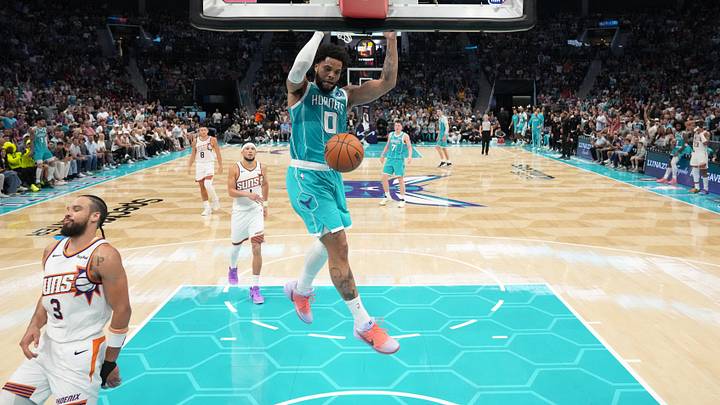
ESPN’s Shams Charania reported Charlotte would be shipping out veteran forward Miles Bridges to the Suns, along with a 2029 first-round pick and a 2027 second-rounder. In return, Phoenix is trading Grayson Allen, Royce O’Neale and a 2033 first-round pick to the Hornets.
Bridges, 28, is set to make $22.8 million in the final year of his contract in 2026–27; he averaged 17.1 points in 31 minutes per game for Charlotte this past campaign. Allen and O’Neale were both featured rotation players for the No. 8 seed Suns last year, with Allen coming off the bench most of the time and O’Neale recording 67 starts in 78 games played. The former is a gifted three-point shooter while the latter is a dependable three-and-D wing with playoff experience.
It’s an interesting trade featuring two teams likely to battle in the middle of the pack in next year’s standings. Let’s break down the deal for both sides and offer up grades to determine who won this latest big transaction involving multiple moving parts.
Hornets: B

On the surface this trade looks like another bizarre move from Charlotte’s GM, Jeff Peterson, as he sends another starter from the Hornets’ best team in a decade out of town. But under the hood, this makes a lot of sense—and the assets he got in return are really helpful.
Bridges was a homegrown talent but one who absolutely would have expected an extension this offseason. If the Hornets did not give it to him, it would have likely been a problem. And the chances of Bridges getting an extension were low. There are the significant off-court issues from earlier in Bridges’s career. There’s also the reality that, at 28 years old, he is not on the same timeline as 20-year-old Kon Kneuppel or 23-year-old Brandon Miller. If Charlotte was trying to compete for something next season Bridges would have been valuable, but trading LaMelo Ball clearly indicates the organization is planning for the next five years—not just the upcoming season. Bridges doesn’t fit into that picture. Trading him now eliminates any headaches about the extension and ensured the Hornets got actual value in return.
It was, indeed, actual value too. Allen and O’Neale are both solid fits in coach Charles Lee’s system. Allen in particular could shine as an elite three-point shooter in terms of make percentage and volume historically. He shot 34.9% from deep last year, but that was the lowest since his rookie season and the first since the ‘22–‘23 campaign he shot less than 40% from beyond the arc. The veteran shooting guard should also offer much-needed backup ball handling (and may even end up starting for those skills). O’Neale is a professional who should provide a good locker room presence and offer his usual combination of steady defense and good-but-not-great shooting.
The draft asset could end up a very good one, too. Charania reported the Suns agreed to trade their own 2033 first-round pick unprotected to get the deal done. The Hornets had to give up a 2029 first-round pick on their end but Charania described that as a “lesser value” selection so it seems safe to presume there are some protections on it. The ‘33 pick will be theirs no matter what.
Charlotte probably got a little bit worse in this swap. But Bridges isn’t some All-Star talent who will be the difference between making and missing the playoffs. He’s a perfectly fine player who probably wasn’t going to be on the roster in two years. In return for moving him and two decent (but not great) draft assets, the Hornets got a high-value pick and two rotation-level, proven NBA players. We aren’t eager to fall over ourselves about accumulating assets seven years down the road but it is undeniably smart business.
Suns: C-

Phoenix just keeps digging itself a deeper hole.
The Suns already most of their draft assets to other teams from various reckless trades executed under owner Mat Ishbia. All those trades led to the dramatic flameout of the Kevin Durant era last summer. This year’s roster finished seventh in the West before squeaking into the playoffs as a No. 8 seed after going 1–1 in the play-in tournament, where they were summarily swept without much trouble by the Thunder. There were some feel-good stories, like the breakout play of Collin Gillespie, but make no mistake—Phoenix was a mediocre team last season and there is nothing to suggest that was going to change in the near future. Devin Booker doesn’t seem like he’ll be making another leap and Dillon Brooks is more likely to regress than put forth another career season. A near-total lack of draft picks means no help will be coming from a blue-chip rookie prospect.
It seems the organization’s front office felt the same way and so they added Bridges—who, as stated above, is a fine player! He’ll definitely offer the Suns more scoring creation than Allen from the perimeter, and pairing him with Brooks will make for a physical, switchable tandem on the wing. His addition makes Phoenix a touch more explosive. It’s not hard to see why they thought he’d make a good addition to the team.
But Bridges isn’t going to turn the Suns into a contender. So why did they offer up the last unprotected draft pick they can trade? That’s the sort of thing a team does when they think they’re going all-in on their current roster due to a belief they can compete for a title. Or if there’s a strongly-held view that Bridges is the sort of player who can completely change their fortunes. Both mindsets could kindly be described as deluded. This was a play-in team last year several tiers below the level of talent that the true contenders of the West boast. Bridges is useful but his presence might be the difference between 40 and 42 wins, not 40 and 50 wins.
Swapping Allen and O’Neale for Bridges is an entirely defensible move for a team looking to switch up the roster without many avenues to dramatically do so. Throwing in the ‘33 pick makes it a bad move. Getting the ‘29 pick back (with whatever protections) doesn’t make up for that. Neither do the tax savings Phoenix will receive by getting off the Allen and O’Neale contracts.
The Suns keep operating like the future will never come by trading away all these draft picks down the road for extremely short-term gains. It’s been awful process throughout and this trade is no different.
More NBA on Sports Illustrated
Listen to SI’s NBA podcast, Open Floor, below or on Apple and Spotify. Watch the show on SI’s YouTube channel.
 Add us as a preferred source on Google
Liam McKeone is a senior news writer for the NBA team at Sports Illustrated. He has been in the industry covering the NBA and other sports as a content creator starting in 2017. Prior to joining SI, McKeone worked for NBC Sports Boston and The Big Lead. In addition to his work as a writer, he has hosted the Press Pass Podcast covering sports media and The Big Stream covering pop culture. A graduate of Fordham University, he is always up for a good debate and enjoys loudly arguing about sports, rap music, books and video games. McKeone has been a member of the National Sports Media Association since 2020.
Follow liam_mckeone