%20%20--%3E%0A%3Csvg%20version%3D%221.1%22%20id%3D%22Layer_1%22%20xmlns%3D%22http%3A%2F%2Fwww.w3.org%2F2000%2Fsvg%22%20xmlns%3Axlink%3D%22http%3A%2F%2Fwww.w3.org%2F1999%2Fxlink%22%20x%3D%220px%22%20y%3D%220px%22%0A%09%20width%3D%2239px%22%20height%3D%2240px%22%20viewBox%3D%220%200%2039%2040%22%20enable-background%3D%22new%200%200%2039%2040%22%20xml%3Aspace%3D%22preserve%22%3E%0A%3Cpath%20fill%3D%22%23FFFFFF%22%20d%3D%22M38.5%2C7H28.2v26h10.3V7z%22%2F%3E%0A%3Cpath%20fill-rule%3D%22evenodd%22%20clip-rule%3D%22evenodd%22%20fill%3D%22%23FFFFFF%22%20d%3D%22M26.1%2C25.5c0%2C5.8-4.1%2C7.5-12.9%2C7.5C3.9%2C33%2C0%2C31.2%2C0%2C25.2v-1.1h11.6%0A%09v2.4c0%2C0.7%2C0.1%2C1.4%2C1.2%2C1.4c1%2C0%2C1.2-0.4%2C1.2-1.3v-0.9c0-1.6-0.9-1.6-3.5-2.2C2.2%2C21.7%2C0%2C19.7%2C0%2C15.3v-0.9C0%2C9.3%2C5.5%2C7%2C12.9%2C7%0A%09c10.2%2C0%2C12.8%2C2.6%2C12.8%2C7.4v1.8h-11v-2.9c0-0.6-0.4-1.1-1.2-1.1c-0.6%2C0-1.2%2C0.4-1.2%2C1.1v0.9c0%2C1.5%2C0.9%2C2%2C3.3%2C2.5%0A%09c8%2C1.6%2C10.5%2C3.3%2C10.5%2C7.5V25.5z%22%2F%3E%0A%3C%2Fsvg%3E%0A)
The Cavaliers Have a James Harden Problem—Here’s How They Can Fix It
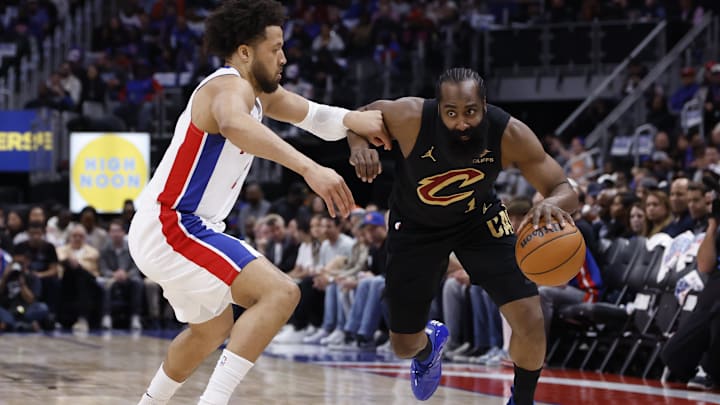
The Cavaliers are in a hole with their season on the line, down 0–2 to the Pistons in the second round of the Eastern Conference playoffs with the series heading back to Cleveland. It takes a team effort to lose the opening two games of a postseason series and nobody should escape blame, from superstar scorer Donovan Mitchell to former DPOY Evan Mobley to even coach Kenny Atkinson on the sideline.
But the Cavs’ biggest problem is their midseason trade acquisition, James Harden. His play on both ends of the court has killed Cleveland during his minutes and it’s an issue Atkinson has to figure out—quickly—before the season slips away.
Harden isn’t having a very good postseason in general. The 11-time All-Star averaged 23.6 points and 8.0 assists during the regular season but those numbers have dropped to 19.6 points and 5.9 assists per night through nine playoff games. The most worrying number for Harden, though? His 5.2 turnovers per game. The longtime superstar ranks second in total turnovers this postseason with 47, behind his second-round opponent Cade Cunningham.
Most of those struggles came against a very good Raptors defense that pushed the Cavs to seven games in Round 1; many stars would have equally as tough a time scoring on Toronto’s thorny perimeter defense. Harden hasn’t bounced back against Detroit in the second round, however, and it’s a huge problem for his team even acknowledging the Pistons are no slouch on that end either.
Through two games of the conference semifinals Harden is shooting 32.1% from the floor to score 16 points per game. His three-point percentage, remarkably, is in single digits at 9.1% despite taking 5.5 shots from beyond the arc per game. He is averaging more turnovers (5.5) than assists (5.0). All that only begins to scratch the surface of his offensive troubles. The defense has been even worse.
Detroit is making sure Harden is involved in the action every second he’s on the floor and the combination of Cunningham and Tobias Harris are absolutely feasting on the 36-year-old’s subpar defense. That’s obvious just watching the game. Individual defensive numbers are inconsistent, but those stats match the eye test this time. Per PBP Stats, the Cavs’ defensive rating is five points worse per 100 possessions with Harden on the court. Per the NBA’s stats, Harden’s individual defensive rating of 120.9 against Detroit is second-worst on Cleveland’s roster among players averaging more than 10 minutes per game.
In many ways, it is as it always has been with Harden in the playoffs—he’s inefficient, dominates the ball while turning it over and is the favored target of opposing offenses every single trip down the floor. At his peak, that last part wasn’t as big a problem because he was one of the greatest offensive players we've ever seen. But this version of Harden can’t lift the Cavs’ offense the way the Harden of yesteryear might’ve, which makes his defensive shortcomings significantly more problematic.
Again—Cleveland is not down 0–2 solely because of those issues. But they are absolutely playing a role, and in the playoffs the margins are very slim. In Game 1 the Cavs were outscored by seven in Harden’s 35 minutes before losing by 11. In Game 2 he was -15 in 37 minutes and the team lost by 10; no other member of the starting lineup was worse than -6.
As the coach it’s on Atkinson to figure out how to mitigate Harden’s weaknesses and maximize his strengths. So far he’s done a bad job of that and Cleveland is in a hole as a result. But the series is far from over. There’s time to address the Harden problem and turn everything.
How the Cavaliers can fix their James Harden problem
There are two obvious minor ways Cleveland can help Harden get going offensively, which will go a long way towards offsetting his poor defensive tendencies.
First, the Cavs have to avoid Harden isolation possessions. Once upon a time he was far and away the most dangerous one-on-one player in the NBA. That is no longer the case. Yet when left to his own devices Harden defaults to backing out to set up an iso on his defender, no matter who it is. It killed Cleveland at the end of Game 2 and at large just isn’t working—Harden leads all players in the playoffs with 54 iso possessions so far and has earned only 49 points for his trouble while shooting 35.9% from the field.
If you need visual evidence, look no further than the below two isolations in crunch time of Thursday night’s loss. He got a step on Tobias Harris with the Cavs down by six and 45 seconds to go, but bailed out of trying to finish around Jalen Duren to dump it off to Jarrett Allen, who fumbled the pass. Harden then backed out to take on Harris again, but danced for too long and turned the ball over. It more or less sealed the loss for Cleveland.
james harden; cavs vs pistons pic.twitter.com/zgsIZGqtt7
— ◇ (@F0RGIAT0) May 8, 2026
So if Harden isn’t to be tasked with breaking down the defense off the dribble, as he’s made a lucrative living doing, what should his role be in the offense? The answer is simple: a spot-up shooter.
Harden has always been dangerous shooting the three and shot 43.5% from beyond the arc after getting traded to the Cavs at the deadline. His shooting threat is particularly useful for this roster given two of Cleveland’s starting five are non-shooting bigs. And he’s been extremely effective shooting off the catch these playoffs; Harden is shooting 52.9% off catch-and-shoot opportunities this postseason. But he’s only taken 22 such shots, per the NBA’s tracking data, which averages out to just over two per game. The Cavaliers are leaving money on the table by not leaning into that part of Harden’s game. That doesn’t mean they should just stick him in the corner every time down the floor, but there are ways to create those chances with set plays and in transition; if they can replace his iso possessions with those plays, all the better.
Then there’s always the big red button: pulling Harden out of the starting lineup and bringing him off the bench instead. That would be a very risky manuever for numerous reasons. Superstar NBA players rarely take kindly to getting benched and the wheels could come flying off if Harden takes that poorly. Plus, for all of Cleveland’s issues, the starting five has held up alright against Detroit—they’ve only been outscored by four points in 26 minutes and have shot over 50% from the field.
But there is merit to it. Replacing Harden with Jaylon Tyson or even Dennis Schroeder ensures there’s still shooting and improves the defense, even if marginally. It would also allow Atkinson to pick and choose his spots in terms of when to sub in Harden and get him a few possessions against a Pistons bench player like Caris LeVert instead of the top-flight defenders that dot the starting lineup.
It would be extreme. But the Cavaliers are at the point where extreme may be necessary. Going down 2–0 isn’t reason to panic but it has to lead to change, because whatever they’ve been doing so far hasn’t been working.
More NBA playoffs from Sports Illustrated
Listen to SI’s NBA podcast, Open Floor, below or on Apple and Spotify. Watch the show on SI’s YouTube channel.
 Add us as a preferred source on Google
Liam McKeone is a senior news writer for the NBA team at Sports Illustrated. He has been in the industry covering the NBA and other sports as a content creator starting in 2017. Prior to joining SI, McKeone worked for NBC Sports Boston and The Big Lead. In addition to his work as a writer, he has hosted the Press Pass Podcast covering sports media and The Big Stream covering pop culture. A graduate of Fordham University, he is always up for a good debate and enjoys loudly arguing about sports, rap music, books and video games. McKeone has been a member of the National Sports Media Association since 2020.
Follow liam_mckeone