%20%20--%3E%0A%3Csvg%20version%3D%221.1%22%20id%3D%22Layer_1%22%20xmlns%3D%22http%3A%2F%2Fwww.w3.org%2F2000%2Fsvg%22%20xmlns%3Axlink%3D%22http%3A%2F%2Fwww.w3.org%2F1999%2Fxlink%22%20x%3D%220px%22%20y%3D%220px%22%0A%09%20width%3D%2239px%22%20height%3D%2240px%22%20viewBox%3D%220%200%2039%2040%22%20enable-background%3D%22new%200%200%2039%2040%22%20xml%3Aspace%3D%22preserve%22%3E%0A%3Cpath%20fill%3D%22%23FFFFFF%22%20d%3D%22M38.5%2C7H28.2v26h10.3V7z%22%2F%3E%0A%3Cpath%20fill-rule%3D%22evenodd%22%20clip-rule%3D%22evenodd%22%20fill%3D%22%23FFFFFF%22%20d%3D%22M26.1%2C25.5c0%2C5.8-4.1%2C7.5-12.9%2C7.5C3.9%2C33%2C0%2C31.2%2C0%2C25.2v-1.1h11.6%0A%09v2.4c0%2C0.7%2C0.1%2C1.4%2C1.2%2C1.4c1%2C0%2C1.2-0.4%2C1.2-1.3v-0.9c0-1.6-0.9-1.6-3.5-2.2C2.2%2C21.7%2C0%2C19.7%2C0%2C15.3v-0.9C0%2C9.3%2C5.5%2C7%2C12.9%2C7%0A%09c10.2%2C0%2C12.8%2C2.6%2C12.8%2C7.4v1.8h-11v-2.9c0-0.6-0.4-1.1-1.2-1.1c-0.6%2C0-1.2%2C0.4-1.2%2C1.1v0.9c0%2C1.5%2C0.9%2C2%2C3.3%2C2.5%0A%09c8%2C1.6%2C10.5%2C3.3%2C10.5%2C7.5V25.5z%22%2F%3E%0A%3C%2Fsvg%3E%0A)
Remembering the ABA, a Vibrant Basketball Fever Dream That Transformed the NBA
At 8:04 p.m. on a cool October night in Philadelphia in 1976, longtime 76ers P.A. man Dave Zinkoff took the mic inside the Spectrum, the city’s venerable sports arena. With the house lights dimmed, a message appeared on the scoreboard: is there a doctor in the house?
By the time Zinkoff got around to officially introducing Julius Erving in this, his first NBA game, the din was so loud that, as a young sportswriter named Tony Kornheiser wrote in the next day’s New York Times, “There’s no telling exactly how Zinkoff pronounced the name, because his voice was swallowed by a tidal wave of cheers.” By Kornheiser’s reckoning, Erving stood there more than two minutes. Eventually, a fan handed him a doctor’s bag and, not knowing what else to do, Erving waved it around, triggering more cheers.
And thus began the first game of a new era of the NBA, ushered in by the biggest star of the ABA—Dr. J, who looked rusty while scoring 17 points—facing what would become the most successful ABA holdover, the San Antonio Spurs, who featured their own big-name transplant, George Gervin.

That was 50 years ago this fall. The merger’s golden anniversary is a good time for a reappraisal of what was gained through the merger—and what was lost. Much of what people remember about the old ABA is the style and flair, and rightfully so. Against the backdrop of a staid NBA, the ABA felt like a fever dream, full of larger-than-life characters and high-paced shootouts.
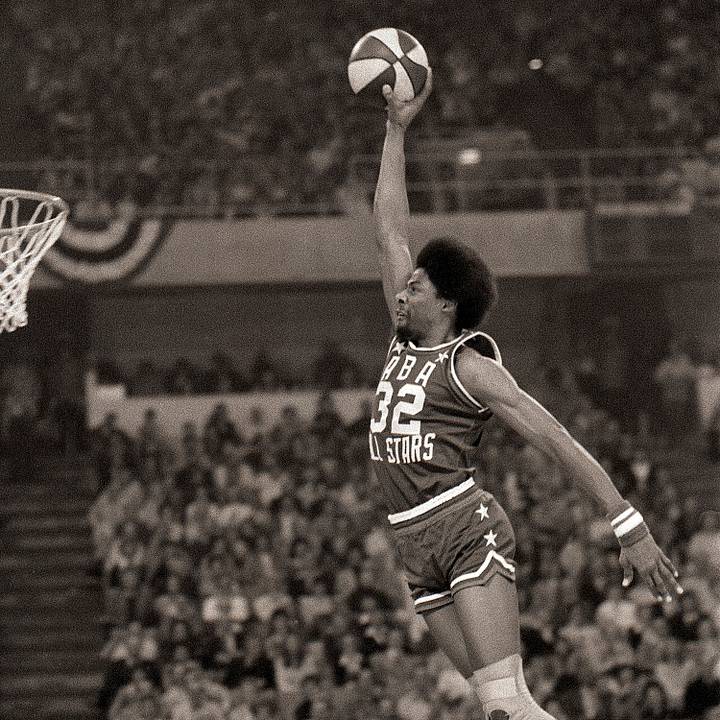
To a boy growing up in that era (especially a white kid in the suburbs), it is hard to overstate just how cool Julius Erving was, with the nickname, the Afro, his impeccably manicured goatee and, of course, his ability to fly. When we launched off the couch to throw down dunks on our Nerf hoop, it was Erving we imitated, not Bill Walton or Kareem.
Indeed, everything about the ABA was more, and more exciting. The red-white-and-blue ball, the flared pants and the parade of leapers and their nicknames. Dr. Dunk, The Iceman, Skywalker. Teams scored, then scored some more. They launched deep bombs. Guys like the 5' 9" Larry Brown—who set the ABA assists record as a player, then won three ABA Coach of the Year awards—weaponized speed, proving you could full-court press and trap in pro ball.

In an era before both the internet and SportsCenter, however, casual fans knew little about the actual mechanics of the merger. Why did the Nets, Nuggets, Pacers and Spurs make the cut while the Kentucky Colonels and Spirits of St. Louis did not? Why did the NBA take only four teams? (The short answer: NBA owners had no interest in splitting the pie another two ways.)
Likewise, few understood just how thoroughly the NBA debilitated the New York Nets, the ABA’s marquee franchise. At the time, they boasted the biggest star (Erving), played in one of the biggest markets and drew throngs of fans. The merger forced the franchise to pay both an entry fee to the NBA and a territorial fee to the Knicks. To afford the cost, the Nets had to sell Erving to Philadelphia and were later exiled to Piscataway, N.J. It would take decades for the franchise to recover—if, that is, you think it ever did.

ABA fans no doubt hoped the NBA would preserve the spirit and legacy of the league. Instead, the NBA would go on to brilliantly strip-mine the upstart league for its best parts—not just players and teams, but concepts. Those that didn’t work, the league discarded. Those that did, the NBA installed and optimized.
So in went the three-point line (adopted in 1979). And, five years later, the dunk contest. The final ABA All-Star Game had featured one; Erving won it with an iconic free throw line jam, taking home the princely sum of $1,000 and a stereo system. In 1984, with the All-Star Game in Denver, the NBA resurrected the contest in a nod to the Nuggets’ ABA heritage. Larry Nance may have taken the crown but the signature image would be Erving, at age 33, once again taking flight from the free throw line.
The deeper impact came culturally, though. Historically, NBA execs and coaches had tried to tamp down outsized personalities like Wilt Chamberlain. The ABA? It leaned into the glorious, messy humanity. Whatever filled seats, the ABA was down with it. The Utah Stars held a cow-milking contest. Meanwhile, the Miami Floridians introduced ball girls in bikinis while the Denver Rockets advertised “Halter Top Night.” In April 1975, at a Pacers game, sportscaster Chet Coppock wrestled an Alaskan brown bear named Victor (a stunt that inspired a similar scene in Semi-Pro, the 2008 ABA send-up, one of the only times when real life was arguably more absurd than a Will Ferrell movie).

The ABA signed playground legends like Fly Williams and Connie Hawkins. Stars arrived at games in floor-length mink coats and platform shoes. Some, like Marvin “Bad News” Barnes, showed up however and whenever they wanted. In Loose Balls, Terry Pluto’s definitive 1990 oral history of the league, Steve Jones recalls Barnes showing up 20 minutes before the opening tip, toting steak, gravy and black-eyed peas, which he ate while trainers taped his ankles. “I got women coming in tonight,” he told the ball boy. “I need five tickets—and get me some body lotion too.” Another time Barnes sat in the stands and talked to a girl during the pregame layup drill. Furious, the coach brought Barnes off the bench. After entering the game, said Jones: “Marvin went for 40 points and 20-some rebounds.”
It was an unabashedly Black league, too. The music, the fashion, the vibe, the ABA embraced it all, marketing the style alongside the game itself. No Fu Manchu was too thick, no ’fro too big, no leather coat too swaggy. As Charlie Scott, who played two years with the Virginia Squires, once put it: “In the ABA, there was no protocol … we all did what we wanted to do.”
In the end, the ABA’s instability—its joyful chaos—was both a weakness and the source of much of its creativity. The same creativity that David Stern, a New York lawyer, later recognized and monetized after becoming NBA commissioner in 1984. After all, basketball’s greatest advantages over football and baseball in the war for American sports supremacy were the very two traits the ABA embodied: pace and personality. No huddles, no helmets, no balks, no endless visits to the mound.

Stern learned from, and leaned into, the popularity of players like Erving, spotlighting individuals as much as teams. No wonder he modeled the league after Disney. “They have theme parks,’’ Stern said in 1991. ‘’And we have theme parks. Only we call them arenas. They have characters: Mickey Mouse, Goofy. Our characters are named Magic and Michael. Disney sells apparel; we sell apparel. They make home videos; we make home videos.’’
The show translated; so did the game. The post-merger NBA became a place for experimentation. Coaches like Don Nelson proved the viability of a looser, freestyle game, leveraging the three-point line, shuffling positions and overseeing Run TMC’s siege-like offense in Golden State. Fans, it turned out, enjoyed watching players score. The same went for individual brilliance and a game expanded beyond giants in the paint, a game where, as Erving put it, “The little man would have an opportunity to play.”
- NBA Championship Power Rankings: Where Does Your Favorite Team Stack Up?
Indeed, to watch the modern NBA is to witness the near-total tactical victory of the ABA style. When the three-point line came into the league, traditionalists scoffed at it as a late-game “gimmick.” Boston GM Red Auerbach complained that “we don’t need it,” while Suns coach John MacLeod deemed it “very boring basketball.” It took nearly a decade for an NBA player to hit more than 100 in a season (ironically, it was a Celtic, Danny Ainge); last season, four players over seven feet tall hit more than 100. Indeed, some teams launch 40-plus threes a night—to the point where we are having the opposite argument, about whether the league has become too dependent on the shot it once scorned.
What did the ABA pioneers receive for all this? Well, it depends on what kind of pioneer you were—and the deal you cut. On one end of the spectrum sit the owners of the Spirits of St. Louis, the Silna brothers, a pair of textile magnates who, fittingly, were some of the first to manufacture polyester for clothing. The Silnas famously negotiated one of the most favorable deals in sports history. Rather than accept a lump-sum buyout, they negotiated $2.2 million in cash in addition to a full one-seventh of the surviving four ABA teams’ annual television revenue. Not for a year or a decade—in perpetuity. They would spend 37 years collecting checks, totaling roughly $300 million, before negotiating another settlement of $500 million.

The players didn’t fare so well. Those who made the leap to the NBA found a mixed bag. Some, like Erving, did just fine. The ABA was in no way a junior league, so talent translated. A bevy of household names came over, both players and future coaches, from Moses Malone and Artis Gilmore to Larry Brown and Dan Issel. Players who didn’t make the transition to the NBA remained outside the NBA pension system, leaving many ABA pioneers with far more modest retirement benefits. So while the NBA grew in stature and value, some of the pioneers found themselves struggling. Stories circulated, like that of George Carter, an ABA star with the Nets who ended up driving a limo in Vegas and, hit with throat cancer, couldn’t pay his bills.
By 2014, a nonprofit called Dropping Dimes had formed, led by an Indianapolis attorney and supported by ABA alums, including Erving and Bob Costas (who launched his career as a 22-year-old announcer for the Spirits). The group advocated for better treatment of ABA veterans and, in 2022, the NBA and the NBA Players Association agreed on a “recognition payment” for the 115 former ABA players who played at least three seasons and didn’t qualify for the NBA pension. The payout: roughly $3,800 a year for each year of ABA service to those who, as Dropping Dimes puts it, “gave the game its style, speed, and swagger.” Considering that the NBA recently signed a $76 billion media rights deal, the payment is not exactly overwhelming.
Adding insult to injury, ABA stats aren’t recognized by the NBA. If you combine ABA and NBA numbers, Erving is the ninth-leading scorer of all time, a rank befitting a player of his stature. But to find Dr. J on the official all-time list you need to keep going down the names, past Cliff Robinson and Tom Chambers and Jason Terry—Jason Terry!—until you finally reach Erving, at No. 79.

Even worse is the case of Mel Daniels. One of the best rebounders of his era, he won two MVPs for the ABA Pacers, but you’ll find none of his marks in the NBA record book. Instead, official stats count only his lone NBA season, with the Nets, when he averaged 3.1 rebounds in 11 games. At this point, little is likely to change. Fewer than 150 ABA players are still alive, and most of them are now in their 70s and 80s. To paraphrase Barnes, we aren’t getting into any time machines. But while their individual legacies may fade in the years to come, there’s no erasing their collective impact. It’s baked into the very game, evident in every 35-foot pull-up, hammer dunk and pregame tunnel walk.
Fifty years ago, the Sixers asked if there was a doctor in the house. Now the whole house bears his imprint.
PODCAST 🎧: Listen to SI’s NBA podcast, Open Floor, below or on Apple and Spotify. Watch the show on SI’s YouTube channel.
 Add us as a preferred source on Google
Chris Ballard is a senior writer at Sports Illustrated, where he covers the NBA and specializes in long-form stories. Ballard, who joined SI in 2000, is the author of four books.