%20%20--%3E%0A%3Csvg%20version%3D%221.1%22%20id%3D%22Layer_1%22%20xmlns%3D%22http%3A%2F%2Fwww.w3.org%2F2000%2Fsvg%22%20xmlns%3Axlink%3D%22http%3A%2F%2Fwww.w3.org%2F1999%2Fxlink%22%20x%3D%220px%22%20y%3D%220px%22%0A%09%20width%3D%2239px%22%20height%3D%2240px%22%20viewBox%3D%220%200%2039%2040%22%20enable-background%3D%22new%200%200%2039%2040%22%20xml%3Aspace%3D%22preserve%22%3E%0A%3Cpath%20fill%3D%22%23FFFFFF%22%20d%3D%22M38.5%2C7H28.2v26h10.3V7z%22%2F%3E%0A%3Cpath%20fill-rule%3D%22evenodd%22%20clip-rule%3D%22evenodd%22%20fill%3D%22%23FFFFFF%22%20d%3D%22M26.1%2C25.5c0%2C5.8-4.1%2C7.5-12.9%2C7.5C3.9%2C33%2C0%2C31.2%2C0%2C25.2v-1.1h11.6%0A%09v2.4c0%2C0.7%2C0.1%2C1.4%2C1.2%2C1.4c1%2C0%2C1.2-0.4%2C1.2-1.3v-0.9c0-1.6-0.9-1.6-3.5-2.2C2.2%2C21.7%2C0%2C19.7%2C0%2C15.3v-0.9C0%2C9.3%2C5.5%2C7%2C12.9%2C7%0A%09c10.2%2C0%2C12.8%2C2.6%2C12.8%2C7.4v1.8h-11v-2.9c0-0.6-0.4-1.1-1.2-1.1c-0.6%2C0-1.2%2C0.4-1.2%2C1.1v0.9c0%2C1.5%2C0.9%2C2%2C3.3%2C2.5%0A%09c8%2C1.6%2C10.5%2C3.3%2C10.5%2C7.5V25.5z%22%2F%3E%0A%3C%2Fsvg%3E%0A)
Inside the Mind (and Roots) of Luka Dončić, the New Face of the Lakers
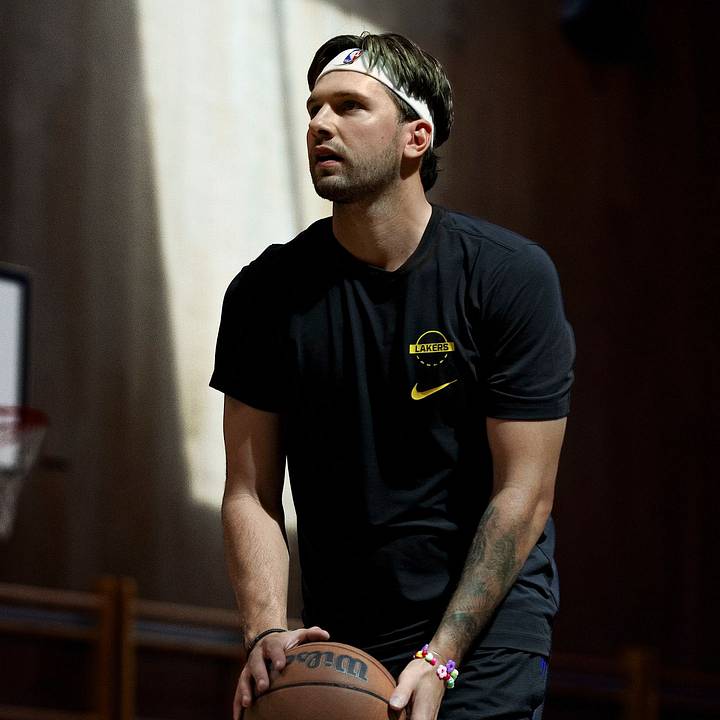
The heavy rain had just let up in Ljubljana when Luka Dončić’s e-bike zipped around a corner, splashing through a puddle deep enough to make any Lakers fan wince.
Standard NBA contracts prohibit players from off-court activities—motorcycling, skydiving, even skiing—that might put a team’s nine-figure investment at “substantial risk.” Dončić has had a few of those vices. He snowboarded until he was 13, hitching rides to Krvavec Mountain nearly every winter weekend. He dabbled as a skateboarder for a few weeks. “Took too many falls,” he says. Gymnastics lasted a couple of months before Dončić grew tired of it. Biking scratches that outdoorsy itch. In Los Angeles, early risers might catch sight of a 6' 7" Slovenian riding between Manhattan Beach and Hermosa.
In late August, Dončić skids his bike to a stop on an empty blacktop. He had been here before. Or had he? These days Dončić doesn’t venture into the city center too often. “Too many tourists,” Dončić says. Slovenia, a lush, green country that looks like it was pulled from a van Gogh painting, has a population of around two million. Seven million tourists flow through each year, most to the capital, Ljubljana. Great for business, Dončić acknowledges. Less so for locals.

And Dončić is a local. His father, Saša, is Slovenian basketball royalty, a high scoring, 6' 7" wing (sound familiar?) who won a pair of national championships. “Eh, he was O.K.,” Dončić says, smiling. Dončić grew up in an eight-floor apartment building that had one very important amenity: It overlooked a pair of battered basketball courts. It was there as a young boy that he fell in love with the game, polishing his step-back jumper against boys several years older, playing pickup games until dark. Years later, Dončić refurbished the courts and installed lights so neighborhood kids could play all night. Dončić doesn’t return to his home country at Nikola Jokić-esque speed, but he’s back every summer. A house he is building on the outskirts of the city is nearly finished.
But this court? Dončić isn’t sure. His eyes dart between the graffiti-covered walls. Accordion music pours through the windows of a nearby restaurant. Customers do double takes on their way out, eyeballing the slender NBA superstar. Dončić underwent a well-documented body transformation last summer. He cut out carbs, embraced intermittent fasting and leaned into a high-protein diet. This summer he stuck with it. He skipped work with the national team and took a full month off from playing. Dončić is cagey about his weight—the Lakers listed him at 230 pounds—but says the energy he felt towards the end of last season made the sacrifice worth it.
About last season: Dončić’s feelings on it are mixed. After a mediocre—by his standards at least—2024–25, a year highlighted by his shocking midseason trade from Dallas, Dončić reestablished himself as one of the league’s top stars. He led the NBA in scoring (33.5 points per game), field goals per game, three-pointers per game. He was an All-Star, earned his sixth All-NBA first-team spot and finished fourth in the MVP voting—and may have finished higher had he not missed 18 games.
Those last few DNPs were haunting. On April 2, almost two weeks before the start of the postseason, Dončić suited up against Oklahoma City. Late in the first half, he tweaked his left hamstring. At halftime, the Lakers trailed by 31. Dončić could have called it a night. “I should have,” he says. He didn’t. Five minutes into the third quarter, Dončić pulled up with a Grade 2 hamstring strain. His season was over. Effectively, Los Angeles’s was finished, too. Lakers coach JJ Redick took heat for the decision to leave Dončić out there. Dončić says any finger-pointing should be directed at him.
“When it comes to my spirit of trying to win, I am just stubborn,” says Dončić. “I felt a little bit in the first half that I should have just stopped. I should have come out. I think we had a team that could compete for the championship. I definitely regret it.”
- NBA Championship Power Rankings: Where Does Your Favorite Team Stack Up?
Scrutiny is nothing new. On the court, at least. Last season, Dončić’s personal life fell under the spotlight. Last December, he returned to Slovenia for the birth of his second child, Olivia. While there, he asked his fiancé, Anamaria Goltes, if he could bring their older daughter, 2-year-old Gabriela, back to the United States with him. A verbal argument ensued. After Dončić left, police were called to Kranj Maternity Hospital. Along with ESPN, Dončić was now being covered by TMZ. Dončić returned to the U.S. and rejoined the Lakers. He didn’t see his daughters again until April.
Asked about it, Dončić lowers his head. “It made everything about last season so hard,” he says. “You want to be around your kids every day. I saw mine, what, four or five days? It’s impossible to do.” (He and Goltes have since separated.) Asked if the situation has been resolved, Dončić pauses. “Hopefully,” he says. “We still don’t know, but hopefully. I can’t go through another season like that.”
In August, Dončić arranged for his Lakers teammates to join him in Ljubljana for an offseason minicamp. The reason was twofold: LeBron James’s decision to sign with the 76ers left a Hall of Fame-sized hole in L.A.’s roster, which the Lakers filled with 10 new players. Chemistry needed a kick start. Over four days, Dončić organized hours-long pickup games. He threw lobs to Walker Kessler, played drive-and-kick with Sandro Mamukelashvili, ran fast breaks with Quentin Grimes. In between there were dinners, golf games, a Balkan barbecue and tours of local castles. Dončić covered the costs of everything. When it was over, teammates thanked him with handwritten notes. “It was important,” says Dončić, “to get to know each other.”

Really, though, Dončić wanted his teammates to get to know him. Ask a teammate to describe his game and you get a quick answer. “He is incredibly strong,” says guard Austin Reaves. Reaves recalled an early practice together where he defended Dončić in the mid-post. Reaves started talking trash. Dončić dipped his shoulder. “Almost broke my rib,” says Reaves. “I didn’t want to do that anymore.”
Ask a teammate to describe Dončić and the answers are less direct. Reaves counts Dončić among his closer friends. But getting there took time. Dončić kept to himself in the months after joining the Lakers. “He was kind of sheltered,” says Reaves. On the court he connected immediately. Off the court, he was a stranger. “For basically most of the rest of that year, we didn’t really speak to each other that much,” says Reaves. “I know he was going through stuff as far as the trade and being disappointed. I was never going to be the type of guy to force a friendship, so I let that build naturally.” And it did. Reaves is a regular at the bowling alley in Dončić’s Manhattan Beach house. The Odd Couple routine the two developed last season routinely went viral.
These are the relationships Dončić wants to build. With good reason. James’s exit didn’t just create a statistical void, but a leadership one. In the aftermath of his departure, the Lakers went on a spending spree. They splurged on scoring guards Grimes and Collin Sexton as well as power forward Mamukelashvili. They traded two first-round picks and two swaps to the Jazz for Kessler, whom they inked to a four-year, $130 million deal. Asked what parts of L.A.’s roster had his fingerprints on it, Dončić smiles. “Probably everything,” he says. Indeed, these are Luka’s Lakers now. And they will go as far as he can take them.
The rooftop bar at the InterContinental offers panoramic views of Ljubljana, which is among the reasons Dončić is a regular customer. “Good coffee, too,” says Dončić, before mumbling his usual order—macchiato, no sugar—in Slovenian. Dončić speaks four languages, including Slovenian (his native tongue) and Serbian (which he picked up from his grandparents). He learned English as he grew up and got a crash course in Spanish after he signed with Real Madrid as a 13-year-old in 2012. “Learned it fluently in three months,” he says. “Had to know what everyone was saying.”
Extracting personal information from Dončić requires an excavator. “He would rather play in seven Game 7s than do this [interview] stuff,” says Lara Beth Seager, his longtime manager. Ask a question he isn’t interested in and you will get a version of “they made shots” or “both teams played hard.” It isn’t a defense mechanism or a reaction to being burned. The aftermath of the trade from the Mavs got nasty but most (uh, all) of the Dallas-area vitriol was reserved for Nico Harrison, the now ex-Mavs exec who traded him.

No, this is just him. “He has a personality that is incredible once you get to know him,” says Magic coach Sean Sweeney, “but he doesn’t showcase it right away.” As an assistant under Jason Kidd in Dallas, Sweeney coached Dončić for four seasons. Early interactions were strictly business. In their first postseason, Dallas faced Phoenix in the second round. The Mavericks quickly fell into a 0–2 hole. On the bench late in Game 2, Dončić was frustrated. This is on us, Sweeney told him. We’ll fix it. Dallas adjusted. The Mavs rallied to win the series in seven. Soon, Sweeney became a regular at Dončić’s offseason workouts.
There are things Dončić does like to talk about. Team ownership, for example. Dončić loves European basketball. At home the EuroLeague is on more than the NBA. Last year, Donnie Nelson, the former Mavs exec who engineered the draft-night trade for Dončić in 2018, approached him with an offer: How would you feel about investing in an Italian basketball team? “I said yes immediately,” says Dončić. The Nelson-led group purchased Vanoli Cremona, moved it to Rome and rebranded it BC Roma. Dončić has had several conversations with NBA commissioner Adam Silver about getting the team into the planned NBA Europe. “He’s very excited for it,” says Dončić. “I can’t tell you everything. But he’s excited.”
Pausing, Dončić offers more. The NBA is excited about European expansion—and the revenue that comes with it. But there will be obstacles getting it off the ground. The EuroLeague most notably, Dončić says. The decades-old competition won’t surrender its position as the continent’s top basketball platform. “There’s EuroLeague, EuroCup and then NBA Europe,” says Dončić. “It is going to be three leagues. That’s kind of hard to work. There should be one league. That’s how it works.”
Another topic Dončić is comfortable with: golf. Last February, Dončić’s longtime physiotherapist, Javier Barrio, took him to a Topgolf. After muffing his first few shots, Dončić whacked a clean one. Then another. “The feeling was amazing,” Dončić says. Anything like basketball? “When you hit a good shot, you feel like you can hit any shot,” says Dončić. “And maybe the same way you feel in basketball, you hit one amazing shot and you feel, Oh, I can make a lot of shots now.”

Dončić was hooked. A few days later, the Lakers were in Phoenix to play the Suns. The hotel, The Phoenician, had a course. Dončić called Reaves, the team’s best golfer. Reaves was preparing to get treatment. “Cancel it,” Dončić said. Reaves was confused. “He had never golfed a day in his life,” Reaves said. What followed, Reaves recalls, was “utter chaos.” Dončić sprayed the ball all over the Sonoran Desert. “Probably the most fun I have ever had playing,” says Reaves. Soon after, a golf simulator was installed in Dončić’s Manhattan Beach pad. The confidence he has on the court quickly transferred to the course. “He really thinks that if I give him 18 shots, he will beat me,” says Reaves. “Which is insane. But that’s just him.”
Dončić approaches other topics more cautiously. James, for one. The trade from Dallas put Dončić in an awkward position. The Lakers were anointing him as the franchise’s future … while the present was still around.
Of James, Dončić speaks glowingly. Sure, the post-trade transition was awkward. Dončić likens it to the 2022–23 season in Dallas, when the Mavericks traded for Kyrie Irving at midseason. “We didn’t really get time to practice or get to know each other or how we wanted to play,” says Dončić. And the constant speculation about James’s future last season, when L.A. went 53–29 but got swept by OKC in the second round, had to be uncomfortable. Dončić, though, insists it never translated to any tension between them.
“He just let me be me, and I really respect that,” says Dončić. “And the way he approached the game with us, it was unbelievable. It was very respectable. I had so much fun playing with him. And, like I said, I think we could have made some noise in the playoffs if me and AR don’t get injured. I think we had a chance.”
And this season? The Lakers spent the first few weeks of the summer collecting Luka-friendly talent. “He likes guys that really think the game at a high level,” says team president Rob Pelinka. Dončić calls his type of guys ones that “can really guard and can really shoot and can put the ball on the floor.”

Kessler, a 7' 2", 245-pound rebound gobbling pivot, has been on Dončić’s radar for years. Dončić loves playing alongside an active big man. And they thrive with him: DeAndre Jordan and Dwight Powell in his early years in Dallas, Dereck Lively and Daniel Gafford later. Jaxson Hayes enjoyed his two seasons with Dončić in L.A. so much that he became a naturalized Slovenian citizen to be able to play with him during the summer. Jarred Vanderbilt, a springy, lob-catching wing, has suggested he may do the same. “No Vando,” says Dončić, chuckling. “Just, no.”
In Kessler, Dončić envisions a dynamic pick-and-roll partner. In Grimes and Mamukelashvili, mid-30% three-point shooters who join holdover Jake LaRavia, Dončić sees floor spacers who will thrive off the shots he creates. In Reaves, whom the Lakers re-signed to a four-year, $185 million deal, Dončić sees the kind of second scorer he needs to absorb some of the load. Dončić is quick to squash comparisons between Reaves and Irving (“Two different players,” he says) but the value is the same. “I know when I play pick-and-roll, when I play one-on-one, they’re not going to help off him and same way around,” says Dončić. So, I think when we’re both together on the floor, we have a lot more space.”
Is it enough? There are clear tiers in the Western Conference. San Antonio, led by MVP-in-waiting Victor Wembanyama, is at the top, with Oklahoma City nipping at its heels. The Lakers, even after an offseason transformation, are projected somewhere in the middle, sandwiched among would-be contenders Denver, Houston and Minnesota. Even Pelinka admits the roster “is not 100% a finished product.” It’s perhaps why Dončić is cautiously optimistic. “I think we’re very deep, which is very important, especially going to the playoffs,” says Dončić. “And we have guys that are not afraid. Some of the new guys, I’ve played against. They are not afraid.”
The car Dončić calls the Rocket is the Brabus Rocket 1000, a limited-production Mercedes-AMG GT 63 S E Performance. It’s a 1,000-horsepower, 4.5-liter twin-turbo V8/hybrid system that goes from zero to 60 in 2.6 seconds. “Never tried that,” Dončić says, unconvincingly. Only 25 exist. Dončić picked up one of them in Germany and had it shipped to Slovenia, where it stays. The specs, he says, aren’t street legal for the U.S. He’s got an SUV for when he drives his daughters. He uses the Rocket for most everything else.
The two cars are a metaphor, of sorts, for the two Lukas. The shy, quiet family man, whose ideal Saturday night includes the golf simulator. That Luka makes an awkward fit for a celebrity-fueled Lakers town. And with James gone Dončić is the king of it. “I just want to play basketball,” says Dončić. “Fame, that comes with it.”
Contrast that with the person Dončić becomes on the court. The snarling, headstrong scorer who barks at opponents of all sizes. Dončić can’t explain what comes over him when he hits the floor. “My friends always ask me,” he says. “I don’t know, I just love basketball.”

Whatever Jekyll-like transformation Dončić undergoes, his teammates encourage it. Reaves says he goes into games hoping someone—opposing players, coaches, even fans—engage with him. “I’ve thought about paying people in the stands to just talk crazy to him,” says Reaves, “because he goes to that different level.”
Sometimes too far. Dončić has well-chronicled issues with referees. He picked up his 16th technical foul in March, which triggered a one-game suspension. Dončić has tried to curb his emotions. Seager suggested he sing a song in his head when he gets frustrated. “Tried that,” says Dončić. “Didn’t work.” Redick’s advice has been, essentially, to remember that basketball is a game. “There has to be a level of joy and playfulness mixed with just a psychotic edge,” says Redick. “Those two things have to be in balance for him to be at his best.”
Which the Lakers need, of course. Last season Dončić was a binge scorer who stormed his way into the MVP conversation down the stretch. Does L.A. need more than that? “Good question,” says Redick. The Lakers will look different. They will play different. Defensively, they will funnel play to Kessler. They want to be physical on the wings, causing “a lot of disruption without gambling,” said Redick. Added Kessler, “We’re going to be nasty defensively.”
They want to pick up the pace, get into more early offense. Redick and Dončić have discussed playing him off the ball more. “I think last year was really, really helpful to go through all the different iterations of our team,” says Redick. “I think we will get the best version of him.”
But … more? “[That] means the best version of him as a leader,” says Redick. Adds Pelinka, “This is a big platform, and it requires big shoulders.” A week before the team trip, Redick made his own journey to Slovenia to visit Dončić. They ate, drank, golfed. Redick remembers the excitement in Dončić’s eyes when he talked about his teammates coming over. Indeed, the Lakers believe there is more to unlock with Dončić. And, hopefully, more wins that come from it.
PODCAST 🎧: Listen to SI’s NBA podcast, Open Floor, below or on Apple and Spotify. Watch the show on SI’s YouTube channel.
 Add us as a preferred source on Google
Chris Mannix is a senior writer at Sports Illustrated covering the NBA and boxing beats. He joined the SI staff in 2003 following his graduation from Boston College. Mannix is the host of SI’s “Open Floor” podcast and serves as a ringside analyst and reporter for DAZN Boxing. He is also a frequent contributor to NBC Sports Boston as an NBA analyst. A nominee for National Sportswriter of the Year in 2022, Mannix has won writing awards from the Boxing Writers Association of America and the Pro Basketball Writers Association, and is a longtime member of both organizations.
Follow sichrismannix