%20%20--%3E%0A%3Csvg%20version%3D%221.1%22%20id%3D%22Layer_1%22%20xmlns%3D%22http%3A%2F%2Fwww.w3.org%2F2000%2Fsvg%22%20xmlns%3Axlink%3D%22http%3A%2F%2Fwww.w3.org%2F1999%2Fxlink%22%20x%3D%220px%22%20y%3D%220px%22%0A%09%20width%3D%2239px%22%20height%3D%2240px%22%20viewBox%3D%220%200%2039%2040%22%20enable-background%3D%22new%200%200%2039%2040%22%20xml%3Aspace%3D%22preserve%22%3E%0A%3Cpath%20fill%3D%22%23FFFFFF%22%20d%3D%22M38.5%2C7H28.2v26h10.3V7z%22%2F%3E%0A%3Cpath%20fill-rule%3D%22evenodd%22%20clip-rule%3D%22evenodd%22%20fill%3D%22%23FFFFFF%22%20d%3D%22M26.1%2C25.5c0%2C5.8-4.1%2C7.5-12.9%2C7.5C3.9%2C33%2C0%2C31.2%2C0%2C25.2v-1.1h11.6%0A%09v2.4c0%2C0.7%2C0.1%2C1.4%2C1.2%2C1.4c1%2C0%2C1.2-0.4%2C1.2-1.3v-0.9c0-1.6-0.9-1.6-3.5-2.2C2.2%2C21.7%2C0%2C19.7%2C0%2C15.3v-0.9C0%2C9.3%2C5.5%2C7%2C12.9%2C7%0A%09c10.2%2C0%2C12.8%2C2.6%2C12.8%2C7.4v1.8h-11v-2.9c0-0.6-0.4-1.1-1.2-1.1c-0.6%2C0-1.2%2C0.4-1.2%2C1.1v0.9c0%2C1.5%2C0.9%2C2%2C3.3%2C2.5%0A%09c8%2C1.6%2C10.5%2C3.3%2C10.5%2C7.5V25.5z%22%2F%3E%0A%3C%2Fsvg%3E%0A)
Albert Breer’s Takeaways: Drama, Unpredictability on Tap at the NFL Combine
In this story:
Jump to a topic
- Fernando Mendoza
- Combine: Quarterback outlook
- Combine: Running back
- Combine: Wide receiver
- Combine: Pass rusher
- Combine: Linebacker
- Combine: Safety
- Combine: Offensive tackle
- Combine: Other positions to watch
- Quick-hitters
I’m probably like a lot of folks right now, stranded on the East Coast and not able to get to the NFL combine. Most players don’t train in the Northeast, so getting prospects to Indianapolis for the combine won’t be as much of an issue. But many team personnel and agents live in the I-95 corridor, getting drilled by the Blizzard of 2026.
For that reason, the NFL’s annual underwear Olympics could have a different feel in 2026.
But that won’t stop us from giving you our annual pre-combine extravaganza in this week’s takeaways. And, I hope anyway, it won’t keep me out of Indy for too long.
In the meantime, there’s plenty to dig into when it comes to this year’s draft class. What it may lack in star power, or freakish prototypes at the top, it should make up for in drama and unpredictability. It also brings plenty of depth, and some at premium positions. This year, as we’ll explain, is a good year to be looking for a receiver or edge rusher in the draft. However, you’re not going to find Calvin Johnson or Julius Peppers at the top.
So to break all that down, I leaned on Daniel Jeremiah of NFL Network and Todd McShay of the Ringer. I worked with D.J. for years at NFLN, and McShay lives down the street from me (relatively). I’ve felt, for a long time, that those guys grade and discuss the prospects like GMs, scouts and coaches, which is why, annually, I sit down with them before the combine to go through the whole class, and mix their conclusions in with what I know about the class from my own talks with teams.
My hope is you will feel smarter as you wade through the mountain of information that’s coming this week.
Here, then, are my takeaways from assessing things with Jeremiah and McShay, with one bonus section at the bottom to help you navigate all the non-draft topics that we will be diving into over the course of the next seven days.
Fernando Mendoza
Fernando Mendoza’s a worthy No. 1 pick, but not the kind that would be the first pick in any draft. Indiana’s Heisman-winning, national championship-capturing star isn’t Josh Allen or Patrick Mahomes, and that’s what holds some folks back on anointing him the kind of slam-dunk top pick Andrew Luck was in 2012, or Trevor Lawrence was in ’21. But, yes, there is a lot to like in the 22-year-old.
“Physically and mentally tough, that’s the first thing you notice—he hangs in there and doesn’t get rattled,” Jeremiah said. “He has poise to go along with that. He’s got quick hands. You’ll see with that, with all the RPO stuff they do. Obviously, the size, 6' 4", 225, was from the spring. So that’s all good. And then the challenge that you got to into is that there are so many RPOs that you have to find the other stuff.
“So I went through and, you watch all the third-and-7-plus throws, you watch all the red-zone throws, all the late-game stuff, and he’s really, really good in those scenarios. So good decisions, accurate, can drive the ball, all the stuff that you need. He can do all that stuff.”
With that in mind, Jeremiah said that if you grouped the past five draft classes, from 2022 to ’26, Mendoza’s grade coming out of school versus the other would put him fourth of 12 first-round guys, behind only ’24 prospects Caleb Williams, Jayden Daniels and Drake Maye. McShay, in that group, had him fifth, behind the three from ’24 and Cam Ward.
That said, there are imperfections. Jeremiah saw Mendoza as a bit robotic and said his Cal tape showed he was a bit “frenetic” in chaotic situations. Curt Cignetti coached some of that out of him. But Mendoza also had better teammates, a better scheme, and more advantageous game situations in 2025, so it’s fair to ask what’ll happen when he’s on a more level playing field again. Then, there’s the question of his ceiling.
“If I’m the Raiders, I take him at No. 1, and I truly believe they will take him at No. 1,” McShay said. “I think you only get so many opportunities this high up. I think he’s a quarterback who is absolutely deserving, and he’s got a chance to be a good starter in the NFL. I really do. And I think if it all works out and you support him well, he could be a top-10 starter in the league. I also haven’t talked to a single person who thinks [he’s elite]. And this is the conversation: He can be a guy, but I don’t have him as one of the guys.”
McShay then added that, as he sees it, Mendoza will appeal to Raiders limited partner, Tom Brady. “Slighted, wasn’t even allowed to walk on at Miami, had to bounce around to get to where he is, chip on his shoulder, super football nerd, competitive juices, lives the game, tall, sees the field, accurate, works within the system,” McShay said. “He probably sees a lot of himself, a young Tom Brady in Mendoza.”
Combine: Quarterback outlook
Assuming the Raiders take Mendoza at No. 1, every other quarterback-hungry team will likely eye 2027. In making a point on that, McShay rattled off no fewer than 11 names: Oregon’s Dante Moore, Texas’s Arch Manning, Texas Tech’s Brendan Sorsby, South Carolina’s LaNorris Sellers, Ole Miss’s Trinidad Chambliss, Miami’s Darian Mensah, Ohio State’s Julian Sayin, Notre Dame’s C.J. Carr, LSU’s Sam Leavitt, UCLA’s Nico Iamaleava and Oklahoma’s John Mateer. Now, they won’t all be first-rounders, but all are on his radar a year early.
And to further the discussion, I asked both Jeremiah and McShay if Moore might’ve made a run at going first if he’d declared. Both had Mendoza graded higher. But each said that Moore might’ve made a move in the process, and the Raiders were looking at him hard before he stayed in school.
So where does that leave the rest of the 2026 class? Past Mendoza, there’s not another surefire first-rounder. Past Alabama’s Ty Simpson, there may not be a quarterback taken until the third day of the draft. And Simpson, who turned down lucrative offers to transfer to Tennessee and Miami, has some work to do if he’s going to avoid falling to Day 2.
“He’s undersized,” McShay said. “He’s more athletic than people want to give him credit. And he’s got a better arm in terms of like energy on the ball, velocity. But there’s no elite physical trait with Ty Simpson. He’s also fit squarely in that really ugly group of inexperienced quarterbacks going to the NFL [in terms of college starts]—the Trubiskys, the Anthony Richardsons. … But the most important thing I’ll say, I promise you nine games into the year, Ty Simpson was the best quarterback in college football.”
After that, Alabama’s pass protection evaporated, he got nicked up, and the run game vanished. So there is reason to believe that what folks got excited about in September and October could resurface. There’s also, to the experience piece of this, the fact that Simpson spent two years playing against Nick Saban’s defense in practice. But he’s no consensus first-round pick, not at this point, anyway.
Beyond those two, you’re taking a risk. Jeremiah liked the idea of someone potentially taking one on Miami’s Carson Beck, who had a star-crossed college career before finishing strong: “He reminds me as a thrower like Carson Palmer, but he doesn’t play the position as well as [Palmer] played it.” McShay, on the other hand, likes LSU’s Garrett Nussmeier, whose difficult final college season shook his preseason first-round projection out of the conversation. He said, “There’s a lot of similarities” between him and Simpson.
Combine: Running back
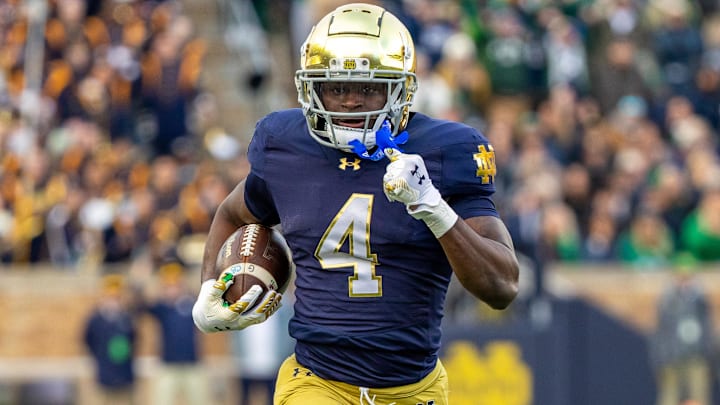
The best player in the draft may be a running back. Notre Dame’s Jeremiyah Love is second in Jeremiah’s rankings. Both McShay and Jeremiah view Love as the type of back we’ve seen get picked in the top 10 over the past decade-plus: a true three-down guy with the bulk and power to be a workhorse. Love draws comparisons to Atlanta’s Bijan Robinson when he was coming out. Jeremiah said his grade on the Irish star was higher than his pre-draft grade on Zeke Elliott, lower than Saquon Barkley’s and similar to Christian McCaffrey’s.
“This guy’s more Bijan in that he’s silkier, smooth, quicker feet, more athletic than you think,” McShay said. “I think the thing with Love is when he hits a crease— and obviously everyone has the mental image of the CFP game a year ago, the 98-yard run—you see a lot of it on tape, he accelerates and gets two, three steps, and he turns those eight-, 12-yard gains into 25 or a house call.”
Jeremiah added that what he sees as unique in Love, to create the big plays, is an “ability to make people miss without gearing down, which is very rare.” That is a trait, Jeremiah continued, that’s there in Lions star Jahmyr Gibbs, who doesn’t have the same sort of size/punch as Love. And in the passing game, Jeremiah said, “He’s so fluid and smooth, and he’s got great hands.”
The other thing that helps Love’s value: His position is one of the weaker spots in the draft. McShay and Jeremiah both agreed that his Notre Dame teammate, Jadarian Price, an instinctive, sturdy, strong runner, is the clear-cut second guy. “I have Love, a dropoff, Price, and then it’s a pretty decent gap, then I get to [Nebraska’s] Emmett Johnson and [Arkansas’s] Mike Washington Jr. “ McShay had Penn State backs Nicholas Singleton and Kaytron Allen, who had disappointing years after coming back as seniors, in that next group as well.

Combine: Wide receiver
Conversely, receiver doesn’t have a single standout like Love, but there are a lot of top-shelf guys. McShay has Ohio State’s Carnell Tate, USC’s Makai Lemon, Arizona State’s Jordyn Tyson and Washington’s Denzel Boston solidly in the first round. Jeremiah has those four, plus Indiana’s Omar Cooper Jr., all inside his top 20. And, again, while there’s no A.J. Green, Julio Jones or Ja’Marr Chase in the group, there’s a little something different with each guy.
“It’s just totally different flavors with those top guys,” Jeremiah said. “I had Lemon initially and then Tate. I just flipped them. I mean, they’re the same grade. It’s just one’s purely a slot who can play outside, and one’s more of an outside, vertical guy. I just thought, with Carnell Tate and his size, I gave him a little bump there. But he’s up there, then Lemon. I have separated those two guys a little bit. And then I’ve got a clump with three different guys, with Jordyn Tyson, Denzel Boston, Omar Cooper.”
That’s hardly the end of it. After that, Tennessee’s Chris Brazzell II, Georgia’s Zachariah Branch and Texas A&M’s KC Concepcion have a shot at cracking the first round. Then you have the supersized guys: Virginia’s Malachi Fields, Indiana’s Elijah Sarratt, Alabama’s Germie Bernard, Louisville’s Chris Bell and Oklahoma’s Deion Burks. There are a lot of them, making this a year you might dig a star out of Day 2.
McShay noted that only two classes have landed a dozen receivers in the first two rounds over the last 30 years—both 2020 and ’22 had 13 in that range. And he believes this class has a real shot to match that number (he said 12 should be locks, based on grades, to go in the first two rounds). Jeremiah added that the number of receivers to go in the first three rounds has hovered around 15 per year over the past five drafts. As it stands now, he has 19 receivers with grades that would have them selected in that area.
For Jeremiah, Cooper stands out as a tough, physical receiver he likes more than others, who fits into the more recent mold set by guys like Cooper Kupp, Amon-Ra St. Brown, Puka Nacua and Jaxon Smith-Njigba. “I wrote down that he’s the Rams-iest receiver in the draft,” D.J. said. And Burks is another one he likes, as someone who could develop into a better pro than he was a college player (a la Stefon Diggs or Nico Collins).
Combine: Pass rusher
Similarly, among the edge rushers, there are different types all the way to the top of the board. Up there, you have Ohio State’s Arvell Reese, alongside a traditional type of rusher in Texas Tech’s David Bailey. Reese’s common comp, a hybrid off-ball linebacker/edge rusher, is Micah Parsons, with those types becoming more common (Abdul Carter, Jihaad Campbell, Jalon Walker last year). Bailey, meanwhile, drew a Brian Burns comp from Jeremiah, and Nik Bonitto and less-stout-Khalil Mack comps from McShay.
“Someone I talk to in the league, a GM said, We don’t deal in the currency of hope,” McShay said. “We all hope Arvell Reese has the career arc of a Micah Parsons, right? But there’s not enough evidence right now. I know he’s going to be a great player. He’s going to be, worst case, he’s Devin Lloyd. And that’s still an awesome player. Versus David Bailey, I know what he is as a pass rusher. Some are debating, like if we truly need an edge rusher, are we better off taking a Bailey versus the development of a Reese into one?”
“There’s no Nick Bosa,” Jeremiah added. “But they all translate well. It’s like the receivers, it’s flavors. I think a lot of it’s going to be how you wanna use them in your scheme. Bailey’s a fricking fastball, who’s got all this production. And I think he’s got some polish to him. And then Arvell Reese has just got so much in his body, so much explosiveness and power. And you have to figure out how exactly you want to use them. But he’s got some rare qualities.”
Neither of those guys will last long—both very easily could go in the top five—and there’ll be plenty of talent left long after they’re gone. Miami edge rushers Rueben Bain Jr., who reminded Jeremiah of Trent Cole and Brandon Graham from his Eagles days, and Akheem Mesidor are next up. Jeremiah grouped Bain with Reese and Bailey, albeit below them, while McShay has come around on the 24-year-old Mesidor (“Teams want a pass rusher like Mesidor more”) as the superior player to his teammate.
Jeremiah has Mesidor in the next group, with guys such as Texas A&M’s Cashius Howell, Auburn’s Keldric Faulk and Clemson’s T.J. Parker, all of whom could be gone in the first round. In the mix right around there are prospects like Oklahoma’s R Mason Thomas and Missouri’s Zion Young, depending on what you’re looking for, and the depth should keep the edge rusher options stocked for teams into the third round. And Michigan’s Derrick Moore, and Auburn’s Keyron Crawford, and Illinois’s Gabe Jacas, and so on and so on.
“The edge and linebackers can get a little bit wonky there, how they list them,” Jeremiah said. “But five D-ends, four linebackers, you have on average over the last five years in the top 50. So even if you were to assume all four of those linebackers were edges, which they aren’t, right now I have nine edge rushers in my top 50 players with literally two more knocking on the door. It’s going to be a bunch of these guys rolling.”

Combine: Linebacker
Of the non-premium positions, linebacker is one to watch. Jeremiah raised the question of how teams will approach the position: Of the four starting linebackers in the Super Bowl, three were undrafted free agents, and the other was a former third-rounder who’s been traded twice. The point: It’s not a position that you necessarily need premium talent in this day and age.
Still, there’s a lot to like at the position, starting with Ohio State’s Sonny Styles, a converted safety who has grown into a brick wall in the run game.
“He’s a freak,” Jeremiah said. “I think he’s better than Tremaine Edmunds coming out, and he went wherever he went (16th in 2018). He reminds me a lot of Fred Warner just because of the length and the athleticism—all that stuff’s really good.”
After that, Georgia’s C.J. Allen is another potential first-rounder, while Texas’s Anthony Hill Jr. and Cincinnati’s Jake Golday (“He’s gonna run super fast,” Jeremiah said) probably land in the second round, and Pitt’s Kyle Louis, Texas Tech’s Jacob Rodriguez and Alabama’s Justin Jefferson look like potential top 100 picks.
“Those guys are all going to start and have roles right away,” Jeremiah said. “And then, you have Bryce Boettcher, Owen Heinecke, those guys are solid players. Josiah Trotter’s up in there in that mix. I’ve got 10 guys that I have with top-three-round-type grades. So that’s good.”
Combine: Safety
There are three high-end safeties, and the top one might be the draft’s safest player. And it starts with Thorpe Award winner Caleb Downs, who started as a true freshman at Alabama, then transferred and won a national title at Ohio State while becoming America’s most decorated defensive player over his two years in Columbus. There seems to be very little doubt about Downs becoming a good pro. The question, moreso, is just how good.
“I like him; he’s a better version of Brian Branch for me,” Jeremiah said. “I don’t put him in the Derwin James, Kyle Hamilton class. It’s not as freaky as those guys. There aren’t as many splashy plays. But Brian Branch is freaking really, really, really good. This guy, the way I would describe him, is the sum is greater than the parts. And he’s someone who’s just going to make everybody else right around him. And he’s dependable, reliable and tough.”
He’s just not 6' 3", and probably won’t run a 4.3. Toledo’s Emmanuel McNeil-Warren might be a little closer to that Nick Emmanwori type, and has a shot, as Jeremiah sees it, to sneak into the first round. Then, there’s Oregon’s Dillon Thieneman, who’s just solid all the way around, likely goes second round somewhere, and probably starts right away in the league.
Combine: Offensive tackle
Interestingly, the top tackles this year are right tackles. And so I wanted to kick the tires on that a little bit, diving in on Utah’s Spencer Fano and Miami’s Francis Mauigoa. Part of it, in each case, is that the team has a pretty reasonable option to man the left side (More on that in a second). But these guys are separate cases, rather than part of some larger trend.
“They’re kind of opposite players,” McShay said. “Mauigoa is a massive right tackle. He’s been a right tackle. He projects as a right tackle, even if he’d played left in college, at 6' 6", 325. Fano, off the bus, looks like a left tackle. He’s 6’ 5”, 300, a really good athlete, moves well, quick out of his stance. He plays with balance. But he’s not overpowering like Mauigoa. They’re opposites. And Fano, who looks like a left tackle, has a career at right tackle because [Caleb] Lomu, who’s also extremely athletic, just more raw than Fano, played left tackle.”
Neither of these guys is Joe Alt, Rashawn Slater or Penei Sewell. But it’s hard to find those, and this class doesn’t have one.
But both Fano and Mauigoa have the flexibility, potentially, to go inside to guard if tackle doesn’t work out, which helps mitigate bust potential with either of them. Lomu is interesting in that he’s raw, and has the measurables and athleticism to develop into a real starter at left tackle in the NFL. After that, Bama’s Kadyn Proctor has a lot of ability, but the question is where it’s best used (he’s probably a right tackle or a guard in the NFL).
And for what it’s worth, Jeremiah actually thinks the draft’s best linemen isn’t one of those college tackles, but rather a guard—Penn State’s Olaivavega Ioane.

Combine: Other positions to watch
Tight end isn’t great this year, but the top guy is worth paying attention to. Oregon’s Kenyon Sadiq is fascinating—he’s got a shot to put on a real show in Indy. At 6' 3" (or maybe a touch less) and 240-or-so pounds, the 20-year-old could put up a real receiver number in the 40, and jump like a basketball player.
“He’ll be a discussion, and he’s definitely an old-school tweener,” Jeremiah said. “He’s built like an old-school fullback. He’s got muscles on muscles. He blocks his rear end off. But he’s going to be an H/move. He’s not as fluid as [Brock] Bowers, but that’s going to be the menu for how you try to use him. And the other thing with him is he just dropped some balls this year. Bowers has better hands, but this kid’s super dynamic and tough.”
After that, the position flattens out a bit, with Ohio State’s Max Klare (a Purdue transfer, like Burks and Thieneman) and Vanderbilt’s Eli Stowers jockeying to go somewhere on the second day. There are couple other spots, too, that are a little like that, just in that they lack the easy answer, but have potential:
• There’s not a standout defensive tackle, where Texas Tech’s Lee Hunter is the upside guy, Ohio State’s Kayden McDonald is the steady run-stuffer, and Florida’s Caleb Banks is the boom-or-bust gamble. Clemson’s Peter Woods, who actually drew a Mason Graham comp from McShay, came into the year as the top guy, and a potential top-10 pick, and it’ll be interesting to see how much he’s slipped after a bit of a down year.
• Corner is another spot where you have numbers, not stars. Tennessee’s Jermod McCoy missed the 2025 season, but put up a good fight against Ohio State star Jeremiah Smith at the end of a really strong ’24 season. He’ll be right there with Mansoor Delane (evaluators want to see how fast he runs) in battling to be the first one to go. Tennessee’s Colton Hood and South Carolina’s Brandon Cisse should be next, and there’s a deep well of nickel corners (Indiana’s D’Angelo Ponds, Miami’s Keionte Scott, South Carolina’s Jalon Kilgore) to mine.
Quick-hitters
And, of course, as always, there’s plenty of non-draft business to discuss in Indy. It’ll get done, even if the weather delays it a bit. But that doesn’t mean there won’t be bumps along the way (perhaps the blizzard makes people ornery going in, or maybe that’s just me). Let’s dive in.
• The Raiders will sit down with Maxx Crosby’s reps. I do think everyone will work toward a decision on how to handle the coming weeks, whether that’s Vegas renewing its vows with its biggest star or not. His contract, for what it’s worth, is very tradeable. And while it does feel like hard feelings linger, the Raiders did promote his old position coach, Rob Leonard, to be their new defensive coordinator.
• Contracts will be worked on, and it’d be smart for some teams to get ahead on those with their biggest stars, like the Texans did last year with Derek Stingley Jr. Among those in line for big second deals would be Robinson in Atlanta; Gibbs, Branch, Jack Campbell and Sam LaPorta in Detroit; Smith-Njigba and Devon Witherspoon in Seattle; and Christian Gonzalez in New England, among others.
• Aaron Rodgers’s decision on returning to Pittsburgh to reunite with Mike McCarthy or retiring will be a topic of conversation.
• So, too, will be Travis Kelce’s future in Kansas City.
• Trade names will be thrown around. The questions will circle on Eagles WR A.J. Brown again. I don’t know that Philly would be able to find the value for him that would justify walking away at this point. We’ll see.
• Re: The Rams’ rule change proposal on the Seattle two-pointer … I have to give the idea some thought but there’s no question about the impact it had. If the Seahawks don’t get those two points, and lose by that margin, the NFC title game is in Los Angeles. And given that the game was decided by four points in Seattle, there’s a chance that leads Matthew Stafford and Sean McVay to their second title together, at the end of Stafford’s fifth season as a Ram.
• Speaking of big contracts, Lamar Jackson’s impending one will merit discussion, as well, with a new Ravens coaching staff in place.
• It sure feels like the Dolphins moving on from Tyreek Hill and Bradley Chubb is a precursor to the team building up a warchest of draft capital, and they do have a few veterans that would be of interest to contenders.
• Malik Willis’s name will be in the news, I’d bet.
• And, finally, we should get news on the NFL’s final cap number, as it crosses the $300 million mark for the first time.
More NFL on Sports Illustrated
 Add us as a preferred source on Google
Albert Breer is a senior writer covering the NFL for Sports Illustrated, delivering the biggest stories and breaking news from across the league. He has been on the NFL beat since 2005 and joined SI in 2016. Breer began his career covering the New England Patriots for the MetroWest Daily News and the Boston Herald from 2005 to ’07, then covered the Dallas Cowboys for the Dallas Morning News from 2007 to ’08. He worked for The Sporting News from 2008 to ’09 before returning to Massachusetts as The Boston Globe’s national NFL writer in 2009. From 2010 to 2016, Breer served as a national reporter for NFL Network. In addition to his work at Sports Illustrated, Breer regularly appears on NBC Sports Boston, 98.5 The Sports Hub in Boston, FS1 with Colin Cowherd, The Rich Eisen Show and The Dan Patrick Show. A 2002 graduate of Ohio State, Breer lives near Boston with his wife, a cardiac ICU nurse at Boston Children’s Hospital, and their three children.