%20%20--%3E%0A%3Csvg%20version%3D%221.1%22%20id%3D%22Layer_1%22%20xmlns%3D%22http%3A%2F%2Fwww.w3.org%2F2000%2Fsvg%22%20xmlns%3Axlink%3D%22http%3A%2F%2Fwww.w3.org%2F1999%2Fxlink%22%20x%3D%220px%22%20y%3D%220px%22%0A%09%20width%3D%2239px%22%20height%3D%2240px%22%20viewBox%3D%220%200%2039%2040%22%20enable-background%3D%22new%200%200%2039%2040%22%20xml%3Aspace%3D%22preserve%22%3E%0A%3Cpath%20fill%3D%22%23FFFFFF%22%20d%3D%22M38.5%2C7H28.2v26h10.3V7z%22%2F%3E%0A%3Cpath%20fill-rule%3D%22evenodd%22%20clip-rule%3D%22evenodd%22%20fill%3D%22%23FFFFFF%22%20d%3D%22M26.1%2C25.5c0%2C5.8-4.1%2C7.5-12.9%2C7.5C3.9%2C33%2C0%2C31.2%2C0%2C25.2v-1.1h11.6%0A%09v2.4c0%2C0.7%2C0.1%2C1.4%2C1.2%2C1.4c1%2C0%2C1.2-0.4%2C1.2-1.3v-0.9c0-1.6-0.9-1.6-3.5-2.2C2.2%2C21.7%2C0%2C19.7%2C0%2C15.3v-0.9C0%2C9.3%2C5.5%2C7%2C12.9%2C7%0A%09c10.2%2C0%2C12.8%2C2.6%2C12.8%2C7.4v1.8h-11v-2.9c0-0.6-0.4-1.1-1.2-1.1c-0.6%2C0-1.2%2C0.4-1.2%2C1.1v0.9c0%2C1.5%2C0.9%2C2%2C3.3%2C2.5%0A%09c8%2C1.6%2C10.5%2C3.3%2C10.5%2C7.5V25.5z%22%2F%3E%0A%3C%2Fsvg%3E%0A)
Albert Breer’s Takeaways: Raiders Have Done Their Homework on Fernando Mendoza
In this story:
PHOENIX — The owners meetings are underway, and so are the final takeaways of March. Let’s roll …
Las Vegas Raiders
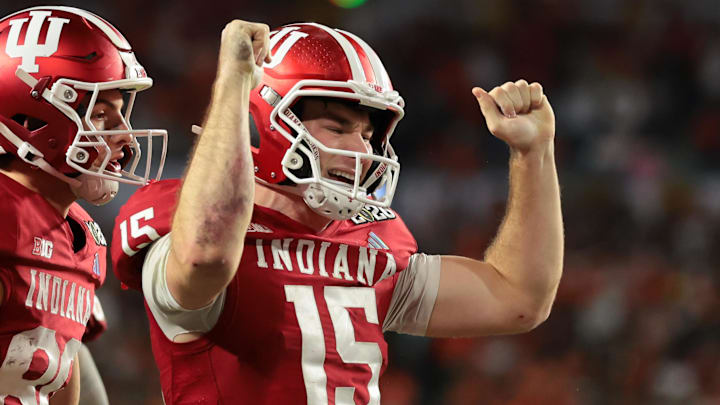
Everything’s been pretty quiet on the Raiders and how they’ll spend the No. 1 pick. That’s for good reason. Most people assume that it’s a foregone conclusion that they’ll select Indiana’s Heisman Trophy–winning national champion Fernando Mendoza. And I certainly wouldn’t dispute the idea that his wait on April 23 to determine his next football destination will be very, very short (as in less than 10 minutes).
But I also wouldn’t mistake that lack of buzz for any lack of work done.
Because while Mendoza will almost certainly be a Raider, this hasn’t been some coronation.
What it has been, with three weeks and three days to go until draft day, is a deep and thorough vetting, and one that a bunch of other quarterbacks have been a part of over the past six months, too. With his play in the fall and through January, Mendoza has earned his spot atop the general public’s hypothetical 2026 draft board. With what’s happened since, he’s in the process of working to confirm his place atop the Raiders’ actual draft board.
So to kick off the column this morning, here’s a look at how he’s gotten there:
• Going into the 2025 season, and after dealing for Geno Smith as a bridge quarterback, the Raiders had a pretty good idea that ’26 might be the draft where they find their triggerman of the future. So they got eyes on those guys early. Assistant GM Brian Stark was in Oregon to see Ducks star Dante Moore square off against Mendoza in October. GM John Spytek saw Oklahoma’s John Mateer live against Auburn in September. He and Stark saw Cincinnati’s Brendan Sorsby against TCU in November. Senior personnel executive Anthony Patch and college director Brandon Yeargan saw guys like Alabama’s Ty Simpson, too.
And as the season wound down, Spytek himself got shots to hone in on Mendoza, seeing him live on a frigid night at Purdue on Nov. 28 (the night before the Cincinnati-TCU game), then again against Oregon in the Peach Bowl on Jan. 9 (where he saw Moore, too), and a third time in the national title game (with minority owner Tom Brady alongside him) against Miami.
• During Indiana’s run, the Raiders moved on from Pete Carroll and hired Klint Kubiak, who dove right into the quarterback-vetting process, one that would have Spytek, his scouts and Kubiak and his coaches at the point now, two months later, where those in the inner circle have all watched every snap Mendoza played both at Cal and Indiana. What they saw was a player who consistently got better—maybe best evidenced this past year by the drop in his sack numbers, a result of being on a better team, yes, but also a quarterback playing faster.
And as that study intensified, the door opened to get to know Mendoza personally, too.
The first shot the Raiders had to do that was with a formal meeting at the combine, where they saw an authentic (if different) and driven kid with a maniacal work ethic, which basically confirmed what Las Vegas had already gathered from the coaches at both of Mendoza’s schools.
• The next step actually comes this week. After wrapping up here at the owners meetings on Tuesday, Spytek and Kubiak will fly to Indiana for Mendoza’s pro day on Wednesday, with Stark, Yeargan, VP of player personnel Brandon Hunt, offensive coordinator Andrew Janocko and quarterbacks coach Mike Sullivan meeting them there. They’ll watch his workout, with the rest of the team, then have a whiteboard meeting and a dinner with him.
In going through these things, when a team and player are this far down the line, these sorts of get-togethers can double as de facto offensive installations, to give the rookie-to-be a better shot to hit the ground running when he reports in May.
That work can also be done through the three one-hour Zooms the Raiders are allowed with Mendoza. They’ve already done one. The plan is to do the other two in April.
• Then, next week, the Raiders will bring Mendoza to Vegas on his 30 visit, when they’ll be able to introduce him to those in and around the team, and build off the other meetings, in trying to dot every i and cross every t.
And that, of course, is the whole idea here—every stone needs to be turned over.
The decision to take a quarterback that high in the draft generally means tying your job security to a guy, and having the level of confidence to do that with a player takes a lot of time.
Rest assured, the Raiders are putting plenty of time into it.
Wide receiver contracts
My last thought on Jaxon Smith-Njigba’s monster contract: What will this do to the market at other positions? I think it’s safe to say, and obvious, that Smith-Njigba’s four-year, $168.6 million extension will materially affect Puka Nacua’s contract situation with the Rams, the same way Myles Garrett’s deal did for T.J. Watt last year, or Micah Parsons did for Aidan Hutchinson, or Ja’Marr Chase did for JSN himself.
But what’s interesting to me here is how this could change the mindset of players and their agents at premium positions that haven’t quite kept the pace.
Different teams have different viewpoints on this, but I’d say the general feeling among NFL decision-makers is that there are five real premium positions: quarterback, offensive tackle (and specifically left tackle), receiver, pass rusher (usually an edge, but sometimes DTs like Aaron Donald and Chris Jones are grouped in) and corner.
At this point, there are four edge rushers and two receivers with deals carrying a new-money APY (average per year) topping $40 million. Meanwhile, Laremy Tunsil is the only offensive tackle topping $30 million per year, and he’s just above it, and the top corner, new Ram Trent McDuffie, is “only” making $31 million per year, with just two other guys at the position, Sauce Gardner and Derek Stingley Jr., joining him in the 30s.
So if you’re, say, Devon Witherspoon in Seattle or Christian Gonzalez in New England—two 2023 first-rounders who’ve become top-shelf corners, and balled out in the Super Bowl—are you asking for $32 million to get past McDuffie? Or are you asking for a leap that gets the position closer to the other top nonquarterbacks? If you’re Paris Johnson Jr. in Arizona, or Joe Alt next year with the Chargers, are you O.K. with getting a tick over Tunsil, or are you going for the bigger bag? And how about Trent Williams this offseason in San Francisco?
A lot of this, of course, is going to come down to what the players are really looking for. Some, understandably, are willing to give a little to get to the payday. But if there’s a Darrelle Revis (the businessman, not the player) in the group … some of these could get messy.
NFL-NFLRA negotiation
Recapping the NFL-NFLRA tit-for-tat this week reveals they’re a ways off. The two sides were scheduled to have a two-day meeting last week, starting Thursday in the Fort Lauderdale area. How did that go? Well, everyone was gone by noon the first day, with the NFL Referees Association saying that it presented the league with a counter-offer, asked for a response and had NFL negotiator/executive Larry Ferazani tell them he wasn’t authorized to give them one.
The NFL’s claims have been that the NFLRA is pushing back on quality-control measures to hold officials accountable for their performance, and that the referee’s union wants salary increases at a percentage basis that doubles what players have gotten over their past two CBAs. The NFLRA vehemently denies that. Usually, the truth is somewhere in the middle.
Anyway, there are a few things that we know to be of issue other than just economics.
One is that the NFL wants to shorten the offseason dead period, and have it end in April, rather than mid-May (this year, it’s May 15), so they can do more work in the offseason to train and equip the officials for the fall. The NFLRA has asked for detail on what the plan would be for that extra time, given that players don’t go into OTAs, when officials start working practices, until the end of May.
The NFLRA has also asked why the NFL has gone from having three in-season seminars to only one—a decision they suspect was budgetary. And perhaps an example of the NFL not prioritizing the training of and communication with officials.
The NFL, meanwhile, claims that the NFLRA has been stubborn and stuck in the areas where it’s looking to enhance performance.
And, of course, the money’s an issue.
Anyway, the NFL has now reached out to Division II and III college conferences it has relationships with, to tell them to have officials ready to replace the NFLRA guys if a deal can’t be hammered out by the August kickoff to the preseason. The NFL, for a bunch of reasons, can’t just dip into the Big 10 or SEC pool. The league’s also voting on a proposal that is purely for the contingency of a lockout, where they can use expanded replay power from New York to correct calls made by replacement officials.
That’s important beyond just the obvious reasons because part of the NFLRA’s leverage is the embarrassment the league suffered in 2012 in a similar fight, which means the owners are essentially voting to give themselves more leverage in the negotiations this week.
Still, you’d think that everyone would be doing all they can to avoid a repeat of 2012.
We’ll see if that’s actually how they operate in this case.
Cleveland Browns
My buddy Conor Orr wrote this week that the Browns should trade Myles Garrett, and, as wild as it sounds, I wholeheartedly agree with him. I actually wrote at the trade deadline that they should do it—I know they disagreed with me at that point—and my overarching reason for it remains the same as it was then.
The Browns’ timeline doesn’t really match up with Garrett’s.
If you presume the quarterback of the future isn’t on the roster right now—and that’s with all due respect to Deshaun Watson, Shedeur Sanders and Dillon Gabriel—then we’re talking about it being 2027 before that guy arrives, and that guy potentially being a rookie then. On top of that, next year, they’d also be dealing with nearly $90 million in dead money assigned to the position, with the cap debt the Browns pushed forward coming due.
On the flip side, the Browns have two first-round picks, giving them three picks in the top 40 in April, which gives them a real chance to build on last year’s rock-solid class, headed by DROY Carson Schwesinger, Mason Graham, Quinshon Judkins, Harold Fannin Jr. and Dylan Sampson. If they can do that, they’ll have a nice, young core, with lean contracts, going into 2027, playing around whoever the quarterback is.
So that would mean the target for all this to really take flight would be 2028. Garrett will start that season at 32 years old and finish it at 33. And that begs the question: Is it best for everyone if Garrett is traded, the Browns grab even more capital to pour into their young core, and really lean into the rebuild, and the reigning Defensive Player of the Year can go chase a championship somewhere else?
I know the Browns’ answer, at this point, would be no, understandably.
But I think I’d lean toward saying yes.
Baltimore Ravens
I caught an ESPN story on the Ravens’ 2022 draft class earning $300 million, and it’s a great example of what it looks like when a personnel department is really executing at a high level. The story of how the whole thing came together actually starts before the draft, with the player development and maneuvering that set up the class.
That started with comp picks. The Ravens got a third-round comp pick after losing assistant head coach David Culley to the Texans, and fourth-rounders for losing free-agents Matthew Judon and Yannick Ngakoue—Judon was a guy they drafted and developed, while they traded for Ngakoue at the 2020 deadline.
So those three were in the bag, as was a fourth fourth-rounder they got the previous summer in a deal sending one more player they’d drafted and developed, Ben Bredeson, to the Giants. The Ravens then took the Culley pick and packaged it with another homegrown guy, Marquise “Hollywood” Brown, to land the No. 23 pick. Which left them, at that point, with two first-rounders, second- and third-rounders, and the four fourth-rounders.
From there …
• The Ravens selected safety Kyle Hamilton with their slotted No. 14 pick.
• Baltimore traded down two spots, from 23 to 25, picking up a fifth fourth-round pick to select center Tyler Linderbaum.
• The Ravens drafted edge David Ojabo and nose tackle Travis Jones in Rounds 2 and 3.
• And in the fourth round, with those five picks, they landed guard David Faalele, corner Jalyn Armour-Davis, tight ends Charlie Kolar and Isaiah Likely, and punter Jordan Stout.
Four years later, Hamilton and Jones were signed to extensions. Linderbaum received a $27 million-per-year record-setting deal as a free-agent center (the highest-paid center had been at $18 million per year). Likely got $13.33 million per year to follow John Harbaugh to the Giants, and Stout signed for over $4 million per year to do the same. Meanwhile, Kolar received north of $8 million from Chargers GM (and former Ravens exec) Joe Hortiz.
Conversely, Ojabo is on a low-money, one-year deal in Miami and Faalele is still a free agent. But both made it through their rookie deals and played a lot of meaningful snaps, leaving Armour-Davis as the only guy who hasn’t stuck (he was cut at the end of camp last year).
In the end, all of this shows strategy, talent development and asset management, and why good teams stay good.
Hamilton is a cornerstone. Jones is an important piece. The others gave the Ravens four good years (and in the case of Linderbaum, elite play at a pivotal position) and now will be responsible for setting Baltimore up for a similar haul of comp picks in 2027.
Of course, because of the Maxx Crosby fiasco, this hasn’t been the offseason that the Ravens would circle as their best. But it’s still one that shows they know what they’re doing.
Seattle Seahawks
The Seahawks’ sale is one you’re going to want to pay attention to. We know where the prices are going. The Broncos were sold to the Walton-Penner group in 2022 for $4.65 billion. The Commanders were sold to Josh Harris and his team for $6.05 billion a year after that.
Now, you have the Super Bowl champions for sale in a market stocked with billionaires.
So here are a few things to consider, as the owners get set to discuss where all of this goes next over the next couple of days in Arizona:
• Would the NFL love to have Amazon founder Jeff Bezos or former Microsoft CEO Steve Ballmer as owners? Sure. But it’ll take two to tango on that, and it’s still uncertain whether either would bid. Also, Bezos, with Prime’s streaming deal with the league, is already a partner, so there is the question about whether it’d make sense for him to buy a team at this point, particularly with the broadcast rights bid approaching.
• Because of the escalating cost of teams, if it’s not Bezos or Ballmer, it’d seem more likely that you’d be talking about a group like Harris’s coming in, rather than it being an individual. The NFL’s rule is that there must be a designated controlling owner who acquires more than 30% of the team, so a Dodgers-style consortium can’t happen without a rules change.
• As for the price, it’s worth considering that the NBA just launched a study regarding bringing expansion teams to Seattle and Las Vegas, with an expansion fee of $7 billion to $10 billion expected (primarily because that’s what it would take to make it worth it to the other owners to split their national revenue 32 ways, rather than 30, as it is now). So let’s say Seattle gets an NBA team at $8.5 billion. It’d stand to reason that the Seahawks would then almost have to go for something in the 11-figure range, which would make the franchise the first to crack that barrier.
• Add the potential for a Seattle NBA team to the Trail Blazers, having just sold for $4.25 billion, and you have three Pacific Northwest teams changing hands in a pretty short timeframe, which is a lot of money for one region, even one as wealthy as that one.
So how fast will this happen? The fastest timeline from here would seem to be the one in Denver in 2022 and Washington in ’23. The Walton-Penner group had an agreement in place to buy the Broncos in early June and was approved in early August at a special league meeting. The next year, Harris agreed to buy the Commanders in mid-May and was approved on July 20.
We’ll probably know more at the close of this meeting on whether fast-tracking Seattle’s sale is possible, which would mean a new owner being in place when the Seahawks raise their second Super Bowl banner on Sept. 9.
New York Jets
Jets coach Aaron Glenn affirming Geno Smith as the team’s starter—as he did as part of the NFL’s annual car wash for coaches, in an interview with Judy Battista—makes more sense than you think. The reality of the Jets’ situation is that, in all likelihood, they’re not getting their quarterback of the future in this year’s draft, and that means spending the four picks they have within the top 44, starting with the second pick, elsewhere.
This goes back to the team’s decisions last year to offload Sauce Gardner and Quinnen Williams. Add the trade of Jermaine Johnson and the departure of Ali Vera-Tucker this month to the mix, and that leaves only Garrett Wilson among the seven first-round picks the Jets had between 2019 and ’22, with six of those seven being top-14 picks.
Which only underscores the rebuild ahead, with those four picks this year, and the three first-rounders coming next year, almost certainly deciding the fate of the current regime.
So if you’re in that spot, where you have to build the guts of the team, bringing in an experienced, steady hand at quarterback, who’ll at least give you a chance to develop the talent around him, is a good play. Smith, despite what happened last year in Vegas, can very easily be that guy, especially with Frank Reich as the architect of the offense.
Of course, this is all going to take some patience from Woody Johnson, and whether he proves to have that is a serious wild card. But if the Jets can hit on those picks, then Smith is a fine caretaker, while they put eyes on potential long-term answers in April 2027.
Pittsburgh Steelers
The Aaron Rodgers timeline from last year is hard to avoid at this point, as is the Steelers’ quiet approach at quarterback. It’ll be interesting to hear from Mike McCarthy in Arizona, given that it sure doesn’t look like his first starting quarterback back home in Pittsburgh is currently on his roster.
At this point, he has Mason Rudolph and 2025 sixth-round pick Will Howard.
That, again, is exactly how the depth chart looked last May, before Rodgers signed in June.
And if you remember, the Steelers seemed awfully unbothered by the whole thing, mostly because coach Mike Tomlin and offensive coordinator Arthur Smith had communicated with Rodgers—Tomlin on a weekly basis and Smith sporadically—so they knew where he was and whom they were building for. Of course, they didn’t know for sure until he finally made the call in June, but they were hardly in the dark.
Which brings me to the other piece of this: While some have speculated that Rodgers is building drama by waiting, no one inside the Pittsburgh organization ever felt that way last year. There’s a level of trust there as a result, and my guess would be that McCarthy’s presence has only added to that.
Maybe that means a decision will come in June. Maybe it will happen sooner. If the answer is no, then the Steelers could turn to Kirk Cousins.
But for now, their inaction is a decent signal that they’re comfortable with where things stand.
A.J. Brown
The A.J. Brown thing is going to keep being a story. Tie this one to Rodgers as the two that won’t go away with this offseason. We’ve hit the lull between free agency and the draft, so anything lingering (as these two stories are) will be beaten into the ground.
That said, Eagles GM Howie Roseman didn’t do much to end speculation on Sunday.
“I understand that there’s interest in the A.J. Brown story,” Roseman told Philly reporters in their meeting with the GM in Phoenix. “Unfortunately, I don’t have a home under a rock. But my answer to any question on A.J. Brown is that A.J. Brown is a member of the Eagles. From my perspective, anything you ask me about A.J. Brown, I’m going to go right back to that answer. But I understand the interest. I turn on the TV, and I see there’s interest. But my answer is A.J. Brown is a member of the Philadelphia Eagles.”
That, of course, is true.
It’s also true that he didn’t say he would be a member of the team in September. And I’d assume if you ask him, he’d tell you he doesn’t have a crystal ball.
That’s fine. But what we don’t know right now is exactly where Brown—whose camp has investigated its options—stands on returning to play with Jalen Hurts in 2026, nor can we say for certain what suitors will remain after a deep class of receivers is mined in April.
Meanwhile, June 1 remains a key date. My sense is the Eagles were never married to the idea of acquiring 2026 picks in a trade package for Brown. Always thinking ahead, I’d guess Roseman would be amenable to taking an offer that included 2027 and ’28 picks, which opens the door to wait past this year’s draft, and beyond June 1, when the cap damage of trading Brown would be spread over two years, rather than one.
I’d guess the Patriots will be part of the picture, if and when the trade talks intensify again. The draft will likely determine who else is in it with them.
But this certainly doesn’t feel like it’s over. And Roseman is right to believe, as such, the interest in it won’t die down anytime soon.
Quick-hitters
Some quick-hitters for you to wrap up an eventful March …
• There is a vote on the agenda for the Super Bowl LXIII site to be scheduled, so I’d expect the game, slated for February 2029, to be officially awarded to Las Vegas this week. There are rumblings, too, that Super Bowl LXIV could be ticketed for Nashville. The Titans’ new stadium is set to open in 2027, so the game would be in the venue’s third season.
• Credit to Broncos special teams coach Darren Rizzi, who’s become a regular at league meetings as the NFL has incorporated the new kickoff rule. He’s in Phoenix this week to explain some tweaks to rule changes. Those changes are expected to be voted through.
• The owners will also vote on the Jaguars’ lease in Orlando for the 2027 season, as the stadium overhaul in Jacksonville marches along toward its 2028 completion.
• Another voting matter will concern scheduling on whether a Friday game is counted as a short-week game, like a Thursday game. As it stands now, the league can only schedule teams for two such short weeks. So would playing on Friday count as one of those two? It’s a big question this year because Christmas is on a Friday, and the NFL could look to put two games on Black Friday, meaning they’d need somewhere between six and 10 teams available. The vote on the agenda is to treat Friday like Saturday, Sunday or Monday, and not Thursday.
• San Francisco GM John Lynch said he’s optimistic that a deal will get worked out with Trent Williams, and I would be, too. Williams is too important for the 49ers not to find a solution (and between Duane Brown, Williams, Joe Thomas, Jake Matthews, Joe Staley and then Williams again, Kyle Shanahan has always had a top-shelf left tackle anchoring his line).
• There’s been a lot of buzz around Rueben Bain Jr. of late, and there should be; he’s a really good prospect. But he isn’t a fit for every team, and I have run into some NFL folks who think his Hurricane bookend, Akheem Mesidor, is better. The catch: Mesidor will turn 25 on Sunday.
• It’s at least interesting that the NFL prioritized the American broadcast window over the Australian start time in scheduling the 49ers-Rams game in Melbourne. It’ll kick off at 10:35 a.m. local time on a Friday to facilitate an 8:35 p.m. ET Thursday broadcast window in the States.
• I appreciate this about Joe Flacco: He’s still playing because he genuinely loves it. He’ll be good for Joe Burrow’s quarterback room, that much I’m confident of.
• It’s not spelled out on the agenda, but I’d guess in the owners’ privileged session, which is only the owners, they’ll discuss the election of new NFLPA executive director JC Tretter.
• Finally, all the best to retiring Buccaneer Lavonte David. We paid tribute to him in the Tuesday notes last week. Great guy. Great player. And he has a great future ahead, I’m sure, with whatever he chooses to do next.
More NFL from Sports Illustrated
 Add us as a preferred source on Google
Albert Breer is a senior writer covering the NFL for Sports Illustrated, delivering the biggest stories and breaking news from across the league. He has been on the NFL beat since 2005 and joined SI in 2016. Breer began his career covering the New England Patriots for the MetroWest Daily News and the Boston Herald from 2005 to ’07, then covered the Dallas Cowboys for the Dallas Morning News from 2007 to ’08. He worked for The Sporting News from 2008 to ’09 before returning to Massachusetts as The Boston Globe’s national NFL writer in 2009. From 2010 to 2016, Breer served as a national reporter for NFL Network. In addition to his work at Sports Illustrated, Breer regularly appears on NBC Sports Boston, 98.5 The Sports Hub in Boston, FS1 with Colin Cowherd, The Rich Eisen Show and The Dan Patrick Show. A 2002 graduate of Ohio State, Breer lives near Boston with his wife, a cardiac ICU nurse at Boston Children’s Hospital, and their three children.
Follow AlbertBreer