%20%20--%3E%0A%3Csvg%20version%3D%221.1%22%20id%3D%22Layer_1%22%20xmlns%3D%22http%3A%2F%2Fwww.w3.org%2F2000%2Fsvg%22%20xmlns%3Axlink%3D%22http%3A%2F%2Fwww.w3.org%2F1999%2Fxlink%22%20x%3D%220px%22%20y%3D%220px%22%0A%09%20width%3D%2239px%22%20height%3D%2240px%22%20viewBox%3D%220%200%2039%2040%22%20enable-background%3D%22new%200%200%2039%2040%22%20xml%3Aspace%3D%22preserve%22%3E%0A%3Cpath%20fill%3D%22%23FFFFFF%22%20d%3D%22M38.5%2C7H28.2v26h10.3V7z%22%2F%3E%0A%3Cpath%20fill-rule%3D%22evenodd%22%20clip-rule%3D%22evenodd%22%20fill%3D%22%23FFFFFF%22%20d%3D%22M26.1%2C25.5c0%2C5.8-4.1%2C7.5-12.9%2C7.5C3.9%2C33%2C0%2C31.2%2C0%2C25.2v-1.1h11.6%0A%09v2.4c0%2C0.7%2C0.1%2C1.4%2C1.2%2C1.4c1%2C0%2C1.2-0.4%2C1.2-1.3v-0.9c0-1.6-0.9-1.6-3.5-2.2C2.2%2C21.7%2C0%2C19.7%2C0%2C15.3v-0.9C0%2C9.3%2C5.5%2C7%2C12.9%2C7%0A%09c10.2%2C0%2C12.8%2C2.6%2C12.8%2C7.4v1.8h-11v-2.9c0-0.6-0.4-1.1-1.2-1.1c-0.6%2C0-1.2%2C0.4-1.2%2C1.1v0.9c0%2C1.5%2C0.9%2C2%2C3.3%2C2.5%0A%09c8%2C1.6%2C10.5%2C3.3%2C10.5%2C7.5V25.5z%22%2F%3E%0A%3C%2Fsvg%3E%0A)
Albert Breer’s Takeaways: What’s at Stake in the NFL’s Standoff With Officials
In this story:
Jump to a topic
- Referee negotiations
- Malik Willis signing
- Las Vegas Raiders
- Mike Evans
- Maxx Crosby
- NFL rules
- Flag football
- Justin Fields
- Quick-hitters
The NFL owners meetings are next week, and then we’re into the thick of draft season. So, here come the takeaways to look forward to what’s next on the offseason calendar. And you can check out my separate piece going a little longer on the Jaylen Waddle deal here.
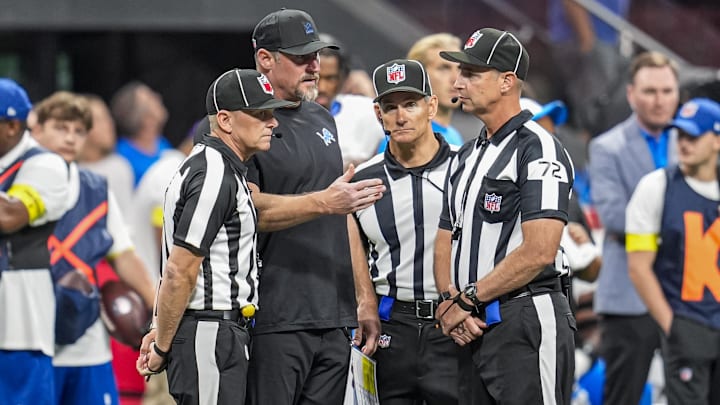
Referee negotiations
The situation between the league and its referees isn’t great. Last week, the NFLRA sent out a memo informing its membership that the NFL had begun to reach out to Division II and Division III conference supervisors, who get funding from the NFL, asking them to notify their officials that opportunities to work NFL games could be on the horizon in the event of a lockout.
If that gives you the shakes, that’s understandable. Anyone who remembers 2012 knows what it was like when the league last locked out the referees. Of the more than 100 replacement officials who worked those games, not one ever worked an NFL game again, which is a pretty good reflection of how that went.
There was the official pulled from a Saints-Panthers game, after internet sleuths found his Facebook page, full of signs of his New Orleans fandom. There were the two “bonus” challenges that 49ers coach Jim Harbaugh got. And there was the Fail Mary.
Surely, the NFL would want to avoid that again, and the NFLRA said as much in its memo, telling its members, “It is difficult to imagine the league wanting to repeat that experience.”
Then, the NFLRA added, “but we must be prepared.”
Here’s what’s at issue …
• Economics. Obviously. The league isn’t asking officials to take less, but pay for NFL referees remains behind that of other sports. It’s fair to point out that there are fewer games, but the officials would argue these are basically full-time jobs throughout the season.
• The NFL wants to extend the probation period for new officials from three to four years. The NFLRA has countered that if the NFL doesn’t think a guy is adequate after 50 games, they probably never will. It would be sufficient to raise suspicion that the league wants the extra year, since those in the probationary window are not protected by the grievance process.
• The NFL wants to shorten the offseason dead period. As it stands now, it’s over on May 15. The league wants to move it to April. The NFLRA is still seeking answers on what the NFL plans to do with the extra time.
• The NFL’s also seeking more performance standards, while the NFLRA is pointing to the fact that the league just cut the number of in-season clinics from three to one as proof that the owners aren’t putting their money where their mouth is.
The sides are going to meet again in Florida on Thursday to try to hammer out a deal. Of course, what any fan would be worried about comes with a deadline that’s not close—that being at the beginning of the season. But by May and into training camp, these guys’ normal ramp-up toward the season will begin, and the pressure to get a deal will rise on everyone.
“Our hope is we get a deal,” said Scott Green, the NFLRA’s longtime executive director. “And, hopefully, this week we continue to move forward toward a fair deal. We think that’s definitely possible within the next two months. But now there’s this distraction from that, with the idea of hiring scabs.”
And with that, and rightfully so, the dredging back up of bad memories for everyone.
Malik Willis signing
The more I’ve dug into the Malik Willis signing, the more the context makes sense to me. Jeff Hafley and the new coaching staff in Miami have a lot of work to do over the next 10 months. Their roster has been stripped down, and will be very, very young, with the new regime holding 11 draft picks, including seven in the first three rounds, in April’s draft.
So, as much as anything, Hafley’s going to need torchbearers for his program, and he and Jon-Eric Sullivan feel confident they have one in Willis.
Of course, the first part of that is going to ride on how Willis plays, and Hafley and Sullivan wouldn’t have acquired the former Packers backup in free agency if they didn’t think what he showed in 11 games, and three starts, over the past two years was more than flashes. The numbers, at least in a vacuum, are outstanding. Willis threw for 972 yards, six touchdowns and no picks, completing 68% of his throws, with a 134.6 rating as a Packer, with another 261 yards and three touchdowns on the ground. He was also, for what it’s worth, 3–0 as a starter.
Hafley, over the past two years, had the benefit of working against Willis in practice, so he saw the quarterback’s accuracy, both down the field and on the run, and could feel what the 225-pounder looked like running in the open field. He also saw Willis adapt.
And that brings us to the second piece of the equation: the intangible piece. As a backup, Willis ran the scout team, meaning he met with the former Packers defensive coordinator weekly to go through the looks the coach needed, based on who was playing quarterback for the opponent. Through that process, Hafley got to see how seriously Willis took the role and how easily he could run another team’s offense.
They even joked with each other, after the Green Bay defense held J.J. McCarthy and the Vikings to 52 passing yards in a Week 12 win, that Willis did more to Micah Parsons & Co. on Wednesday than Minnesota did on Sunday. But there was a reality to that, beyond any sort of messing around—Willis was doing a ton to get Hafley’s group ready to roll.
He was steady. He could toggle, with little reminders, between being a pocket guy and a scrambler based on what Hafley needed. And Hafley saw what Matt LaFleur, OC Adam Stenavich and QBs coach Sean Mannion thought of their backup.
So now he’s Hafley’s starter.
Maybe it’ll work out long-term. Maybe, with a stripped-down roster, Willis will be a bridge to some quarterback in what’s expected to be a loaded 2027 draft class. Either way, Hafley and Sullivan aren’t guessing on what they’re getting in Willis, which makes signing him to the deal a worthwhile swing.
Las Vegas Raiders
You may not know the name Egon Durban, but his emergence is another sign of the power of Tom Brady’s influence on the Raiders. To me, this goes back a year, to the courtship of Ben Johnson ahead of the 2025 hiring cycle, when he told the Raiders, as a courtesy, that he wasn’t planning to take an interview with them. Vegas put a slip in for him anyway; Johnson’s camp wasn’t happy—they were trying not to embarrass the Raiders.
Johnson was told to hang on, and soon enough Brady was on the phone with the soon-to-be Bears coach. Brady informed him that the old Raiders were gone, and that the big-money partners the legendary quarterback helped bring in were going to change everything. Brady’s partner in ownership of the British soccer club Birmingham City, Tom Wagner III, was one. Discovery Land founder Michael Meldman, who built the Yellowstone Club at Big Sky, where Brady has a residence, was another.
And at the center of it was Durban, the Bay Area co-CEO of Silver Lake Capital.
Durban brought with him serious financial might, with a net worth reported to be as high as $4.6 billion, and sports know-how, as part-owner and member of the board of the Premier League and world soccer powerhouse Manchester City. With Durban behind them and world-class facilities already in place, Brady promised Johnson that the Raiders were embarking on a reimagination of a very proud football brand.
It was enough to convince Johnson to take an interview with the Raiders, but ultimately not enough to get him to take the job. In the time since, to be sure, there have been bumps, with the Raiders firing Pete Carroll after a very messy 2025 season.
But I don’t really think the vision for all this, now with Klint Kubiak as coach and almost certainly Fernando Mendoza as the quarterback, has shifted much. Durban being entrenched as the likely successor to Mark Davis only cements him as the pivotman in reviving the once-proud franchise, and getting them back on the NFL’s main stage, after so many years of operating, to steal Bill Parcells’s analogy, as a lounge act.
As I see it, that should give Raiders fans plenty to be excited about.
Mike Evans
The Mike Evans contract shows you where the NFL was on him all along. And to be clear, I don’t think his decision to leave the Buccaneers was about money. My belief is that Tampa Bay would’ve done the deal that the 49ers did. It was just time, in Evans’s mind, to move on.
It’s fair to say teams, his new one included, see him as a complementary piece, not the coverage-drawing No. 1 he was for most of his career. The contract details:
• His total pay is $14.3 million this year, including a $12 million signing bonus, $1.3 million base salary, $850,000 in per-game roster bonuses and a $150,000 workout bonus.
• In 2027, it’s a tick more, with $14.55 million in base pay, with a $12.05 million option bonus fronting a $1.5 million base salary, and the same per-game roster bonuses and workout bonus attached. In 2028, it’s a tick less, at $13.65 million, with a $10.95 million option bonus, $1.7 million in base salary, plus per-game roster and workout bonuses.
• The incentive package is the same in all three years. There are three playoff triggers at $1.5 million each, which Evans earns if the 49ers make the playoffs and he finishes in the top 10 in catches, receptions and/or receiving touchdowns. And there’s another trigger for a $500,000 payout for each playoff win, if he plays 75% of the regular-season snaps, and then 75% of the snaps in the win in question (with that one capped at $1.5 million).
So that adds up to a base package of $42.5 million over three years, with upside to take the deal to $60.5 million. On the low end, that’s $14.17 million per year, which is between what Cooper Kupp and Khalil Shakir are making. On the high end, it’s $20.17 million per year, which is a touch past what Jakobi Meyers got in Jacksonville. With nothing fully guaranteed beyond this year, it’s a year-to-year deal, which signals the uncertainty of signing a 32-year-old.
In the end, Evans gets his fresh start, and the Buccaneers move on with a clear runway for Emeka Egbuka to take off—his production actually waned last year when Tampa got healthier at the position, with a logjam of options for Baker Mayfield. And, I think, what the Niners will get is not the old Evans, but an interesting piece to a larger puzzle.
Maxx Crosby
I believe Maxx Crosby will start the 2026 season as a Raider. Yes, he said it. The Raiders have implied they’re comfortable with him, too. But I’ve sensed an undercurrent of doubt on the idea that Crosby won’t be traded before the opener.
You can believe or not believe Crosby and the Raiders.
I can give you five reasons why it makes sense for both to stay together, at least for now:
1. Crosby is fiercely protective of his Raider legacy and didn’t really want to leave in the first place. The dustup over his knee, which we’ve chronicled over the past few months, led to broken trust and the door opening on his departure. But Crosby’s always loyal to the Davis family and the Raiders, to the point where at the beginning of this, he told them he wanted a trade that would benefit them, too.
2. The guys running the day-to-day football operation, GM John Spytek and new coach Klint Kubiak, had nothing to do with breaking the trust, but they were integral to rebuilding it. As the agreement with the Ravens was falling through, Spytek and Kubiak reached out to Crosby and showed that they had his back, even as all hell was breaking loose for the team. My sense is that it was very much appreciated.
3. The Ravens’ decision to back out cratered Crosby’s trade value. Imagine being a GM who’s interested in Crosby. Your owner saw that Baltimore failed him on the physical, so can you take the risk of trading for him, knowing that if the knee’s a problem this year or next, then that’s on you? The optics of the situation changed completely, materially diminishing what Vegas could get for him.
4. The Raiders might not be good next year, but Kubiak still has to build a program, and now has the ultimate flagbearer for his program. Getting an all-in Crosby should be a big asset as the new staff tries to set a high standard. And interestingly enough, this might have been the only way to get that, since Crosby already had a foot out the door when Kubiak was hired.
5. If there’s a window to trade Crosby, it’s probably closer to the trade deadline. As we’ve established, it wouldn’t make sense for Vegas to sell low here. But if Crosby plays well, and the Raiders are struggling through a rebuild in late October, then all of this can be revisited. It’s not like there wouldn’t be a market then, if things play out that way.
Also, from my point of view, we don’t have enough guys who play their whole career for one team, so I’d love to see it with Crosby.
NFL rules
I like the Browns’ proposal to allow teams to trade first-round picks five years into the future. The current rule restricts moving picks more than three drafts into the future, and that rule is in place for the obvious reason: to prevent a desperate, hot-seat coach or GM from selling off assets irrationally in an effort to save his own job. I do get that.
Most NFL rules governing competitive balance are in place to have 16 teams at 9–8 and 16 at 8–9, and the pick limits prevent a regime from mortgaging a franchise’s future, which could create a massive hole for that franchise to dig out from, and a bad team.
The Browns’ argument: Put the responsibility on the individual teams, and on the owners to stop a coach or GM from doing something irresponsible. The result, they reason, will be greater flexibility for teams to move players for picks, more player movement to follow, and more entertainment and intrigue for the league as a whole.
You’ll remember: Cleveland made similar arguments in proposing the NFL move the trade deadline back in 2024, and that passed (it’s now after Week 9, rather than Week 8).
Back then, they used standards in other leagues as the foundation of their argument, and so it’s instructive to look, in this case, at what the rules restricting draft pick movement are in North America’s other major sports leagues. So let’s do that now:
• The NBA allows teams to trade picks seven years into the future, but you have to have a first-round pick in alternating years—in other words, if a team trades its picks in 2026 and ’28, it has to have a pick in 2027. Teams have circumvented the rule with pick-swaps in years; they can’t outright trade their first-rounders (but it’s still a bit restrictive).
• The NHL has no rules on trading picks into the future.
• MLB does not allow teams to trade draft picks. But because there’s a more developed minor league system and a longer process in players making it to the big leagues, trades include prospects (which is baseball’s closest equivalent to what happens in other sports).
And as for the rule’s origins and reasoning, Cleveland would also argue that this sort of future mortgaging is already happening, with coaches and GMs restructuring contracts to push cap dollars into the future. Rams president Kevin Demoff echoed the point on X last week, tweeting, “We are one week into the NFL league year, and teams already have $1.1 billion in dead money on their books! I’m not sure allowing teams an extra two years of picks to trade is any more irresponsible in mortgaging the future.”
The Rams, as you’d expect, are strong backers of what the Browns are doing.
I like it, too. It may take a year or two for Cleveland to get it through. But it’s a good idea, and I hope we eventually see it come to pass.
Flag football
The flag football event on Saturday made one thing very clear: It is not the same sport as tackle football. The visual was stark and jarring, with the smaller, shifty, quick and explosive guys routinely running around, between and through the bigger, stronger and in a lot of cases faster athletes. For the same reasons most soccer players would be a tough fit on a football field, the NFL players in Los Angeles were a tough fit on the flag field.
The fact that Team USA—the American national flag team—posted 39–14, 43–16 and 24–14 wins over the NFL-laden Wildcats and Founders wasn’t a referendum on anything. More so, for those who didn’t know, it was a revelation that this very different sport favors different body types, skill sets and training than its rougher, tougher big brother.
What’ll be interesting now is what all this means for the 2028 Olympics.
To understand why, you have to understand the logic behind the NFL pushing flag football so hard and backing the effort to make it an Olympic sport. The league’s biggest growth opportunity now is overseas. Since 2007, its International Series has been focused on mainstreaming the sport first in Europe and now across the globe. But what was always obvious, and the NFL has found, is that growth can only go so far if people aren’t raised playing the game.
The trouble with that is that tackle football is a very difficult sport to export. It’s expensive. It takes a lot of people to play real games. Its physicality makes insurance a hurdle, and people who don’t grow up with it are hesitant to play. Conversely, basketball is relatively easy to export as a participatory sport—like soccer, you need a couple of goals (hoops in this case), a playing surface and a bag of balls.
Flag football is now the NFL trying to bridge that gap.
“It’s undeniable that flag [football] for girls and boys, women and men, is the scalable opportunity to grow the game around the world,” NFL EVP Peter O’Reilly told me last year. “Doing that, not just the aspirational Olympic piece of it, but at the grassroots youth level, yes. Obviously, we’re very focused on academies and the tackle level, identifying talent around the world. But in terms of the top of the funnel, broadest reach, getting a football in a young girl or boy’s hands, this is that model where there’s low cost, low barrier to entry, patch of grass, with a ball and belts and some cones.”
So, behind the push to get flag football in the Olympics was an effort to get more kids playing some form of football, and what would give Olympic flag football the biggest platform is having the most recognizable stars playing. Which is where Saturday’s results might bring conflict.
The NFL, surely, would love to see its stars playing in the Olympics as part of this effort. But, clearly, the competition Saturday showed that a different type of athlete, and one wholly committed to this particular sport, might be the best one to put on the field in an international competition. So is the selection of Team USA a meritocracy? Or, like the NFL’s decision to shoehorn YouTubers onto the NFL teams Saturday, will business interests creep in?
It’ll be interesting to see.
Justin Fields
For what it’s worth, I love Justin Fields’s decision to go to Kansas City. No, he didn’t engineer the trade. But he did have to agree to the restructure that allowing the Jets to eat $8 million of his $10 million guarantee, and then wiping out $9 million of the $10 million in nonguaranteed money off his contract, with the Chiefs taking on $3 million in base salary (he gets the $1 million above the guarantee as a sweetener). So he had some control, and going along with this was a wise move by him and his camp.
The move is similar to Sam Darnold’s decision, after five years, to go to San Francisco to back up Brock Purdy, and the two quarterbacks’ numbers through five years aren’t dissimilar.
• Darnold: 55 starts (21-34), 1,054-of-1,765, 11,767 yards, 61 TDs, 55 INTs, 78.6 rating.
• Fields: 53 starts (16-37), 812-of-1,323, 9,039 yards, 52 TDs, 32 INTs, 84.7 rating.
They are different, stylistically. But one thing both had in common coming out of college is that they hadn’t put all their athletic gifts together as quarterbacks, and needed to come to a place where they’d see the game, and play, a little faster from the pocket.
By Christmas of 2024, with a full season of Kyle Shanahan’s coaching and a chance to see Purdy operating a Super Bowl–bound offense at a high level, Darnold’s ability to operate a system more efficiently and with better rhythm was obvious when he entered that night’s game in garbage time against the Ravens. Most people had tuned out by then, and both other teams saw his progress. And the past two years have proven that progress is real.
So now, Fields gets a chance to do the same. As Patrick Mahomes rehabs from a torn ACL, he’ll get first-team reps through OTAs and minicamp, and maybe into training camp, which will get him a lot of time on task with Andy Reid. Then, whenever Mahomes returns, he’ll have the shot to learn to see the three-time champ run a system that’s as tried-and-true as any in the NFL. And you see where it goes from there.
That’s not, to be clear, to say that Fields will win the Super Bowl in three years.
But the move he made this week gives him a better shot at things like that.
Quick-hitters
The quick-hitting takeaways are coming for you right now …
• If the Jaguars wind up with Jake Bobo, and we’ll see if Seattle matches the two-year, $5.5 million offer sheet, then Liam Coen will be working with some serious depth at wideout. Jakobi Meyers and Parker Washington finished strong last year, Brian Thomas Jr. still has all the talent in the world and Travis Hunter, even as he focused more on defense, remains a really interesting piece. And Bobo can do some things, too.
• While we’re there, the Jaguars, like the Seahawks did with Rashid Shaheed and Kenneth Walker III, clearly prioritized receiver over running back—in forking over $20 million per year in new money to Meyers in December, then letting Travis Etienne Jr. go at $10 million per.
• Of course, we saw the first pieces of why Seattle had to make such choices this week, with fifth-year options for Jaxon Smith-Njigba and Devon Witherspoon officially exercised. We expected both to command monster money on extensions, and Smith-Njigba got his with an extension announced Monday morning. Having been through this before a decade ago, GM John Schneider knows tough decisions have to be made coming off a championship.
• The Texans made a couple of really nice under-the-radar signings in bringing in Wyatt Teller and Braden Smith for their offensive line. That room has had its issues, so bringing in a couple of pros like these guys will go a long way, and also should be great for the development of younger guys like Aireontae Ersery (and whichever linemen they draft, too).
• The Eagles landing Andy Dalton doesn’t mean they’re going to turn around and trade Tanner McKee this offseason. But they’ve had interest in the past, McKee is in a contract year and Dalton’s presence at least gives them more flexibility to consider it.
• We have more coming on new NFLPA executive director JC Tretter in the coming weeks, but he’ll certainly have plenty to get to right away—and my guess is NFL owners will be eager to talk 18 games with him. As we’ve mentioned a few times, Super Bowl LXII in Atlanta, set for February 2028, still doesn’t have a date, which has been an issue for planners having to set aside a whole month of hotel rooms, convention space, etc. The NFL wouldn’t be doing that for no reason, so …
• Under-the-radar re-signing that got my attention: Trey Lance staying with the Chargers. I’ll be interested to see how he looks in the preseason, after a full season working under Jim Harbaugh, and, by then, a few months working together with Mike McDaniel.
• I like Cam Skattebo, but his comments on CTE weren’t good for anyone, the NFL included, because they create an impression that people in pro football don’t take the issue of head injuries seriously (which can have a cascading effect, as far as participation in the sport). It’s good that he at least figured that out fast, and cleaned them up later in the week.
• Happy trails to Adam Thielen and C.J. Ham. Thielen remains one of the coolest underdog stories I’ve seen in two-plus decades covering the league, a local tryout player from Minnesota State Mankato, who won a 90-man roster spot, then a place on the team, then developed into a Pro Bowl receiver for his hometown team.
• It’s March 23, and there’s still no word on Aaron Rodgers. My guess would be that the Steelers are being kept up to date, with whatever the update is at this point.
More NFL from Sports Illustrated
 Add us as a preferred source on Google
Albert Breer is a senior writer covering the NFL for Sports Illustrated, delivering the biggest stories and breaking news from across the league. He has been on the NFL beat since 2005 and joined SI in 2016. Breer began his career covering the New England Patriots for the MetroWest Daily News and the Boston Herald from 2005 to ’07, then covered the Dallas Cowboys for the Dallas Morning News from 2007 to ’08. He worked for The Sporting News from 2008 to ’09 before returning to Massachusetts as The Boston Globe’s national NFL writer in 2009. From 2010 to 2016, Breer served as a national reporter for NFL Network. In addition to his work at Sports Illustrated, Breer regularly appears on NBC Sports Boston, 98.5 The Sports Hub in Boston, FS1 with Colin Cowherd, The Rich Eisen Show and The Dan Patrick Show. A 2002 graduate of Ohio State, Breer lives near Boston with his wife, a cardiac ICU nurse at Boston Children’s Hospital, and their three children.
Follow AlbertBreer