%20%20--%3E%0A%3Csvg%20version%3D%221.1%22%20id%3D%22Layer_1%22%20xmlns%3D%22http%3A%2F%2Fwww.w3.org%2F2000%2Fsvg%22%20xmlns%3Axlink%3D%22http%3A%2F%2Fwww.w3.org%2F1999%2Fxlink%22%20x%3D%220px%22%20y%3D%220px%22%0A%09%20width%3D%2239px%22%20height%3D%2240px%22%20viewBox%3D%220%200%2039%2040%22%20enable-background%3D%22new%200%200%2039%2040%22%20xml%3Aspace%3D%22preserve%22%3E%0A%3Cpath%20fill%3D%22%23FFFFFF%22%20d%3D%22M38.5%2C7H28.2v26h10.3V7z%22%2F%3E%0A%3Cpath%20fill-rule%3D%22evenodd%22%20clip-rule%3D%22evenodd%22%20fill%3D%22%23FFFFFF%22%20d%3D%22M26.1%2C25.5c0%2C5.8-4.1%2C7.5-12.9%2C7.5C3.9%2C33%2C0%2C31.2%2C0%2C25.2v-1.1h11.6%0A%09v2.4c0%2C0.7%2C0.1%2C1.4%2C1.2%2C1.4c1%2C0%2C1.2-0.4%2C1.2-1.3v-0.9c0-1.6-0.9-1.6-3.5-2.2C2.2%2C21.7%2C0%2C19.7%2C0%2C15.3v-0.9C0%2C9.3%2C5.5%2C7%2C12.9%2C7%0A%09c10.2%2C0%2C12.8%2C2.6%2C12.8%2C7.4v1.8h-11v-2.9c0-0.6-0.4-1.1-1.2-1.1c-0.6%2C0-1.2%2C0.4-1.2%2C1.1v0.9c0%2C1.5%2C0.9%2C2%2C3.3%2C2.5%0A%09c8%2C1.6%2C10.5%2C3.3%2C10.5%2C7.5V25.5z%22%2F%3E%0A%3C%2Fsvg%3E%0A)
The Evidence Of Mike Ditka’s NFL Legacy: ’85 Bears Reflect on Legendary Coach
In this story:
Training camp was longer and harder and tougher in the 1980s than it is now, and so it was that a beat-up, worn-out group of Chicago Bears, one night near the end of their summer in Platteville, Wis., some three hours from home, decided to cut loose a little.
Ron Rivera and a small group of young players were playing cards in a dorm room when Dan Hampton, Richard Dent and Steve McMichael stopped in to see if they wanted to come.
“They say, Hey boys, let’s go,” Rivera, now GM of the Cal football program, recalls. “I look at the dude, it’s like, man, this is after curfew. He says, That’s all right, let’s go.”
The players piled into cars, and headed to the American Legion to drink beers and shoot pool. And after they’d settled in, the waitress brought another pitcher over. Rivera reached into his pocket to pay for it. The waitress told him he didn’t have to, it was from “the coach.” She pointed to the bar—He’s right over there. Mike Ditka was on a stool.
Rivera went to Hampton and said, “I think we’re in trouble, man.” Hampton flatly responded, “No we aren’t.” Hampton waved Ditka over.
At 1 a.m., after a few games of pool with Hampton and Dent, Ditka looked at his watch, and said, “Well, boys, we got practice tomorrow. I’ll see you on the field.” And he left. And Rivera was dreading the next morning, thinking Ditka would run them into the ground. Again.
“So we get out there,” Rivera said. “Coach calls everybody up just before we start practice, like he always did, he says, Hey, boys, if you're going to go out at night and hoot with the owls, you better soar with the eagles during the day. I will tell you, it was one of the best practices we've ever had. It was phenomenal.”
Ditka’s family announced Friday that the American icon passed away at 86.
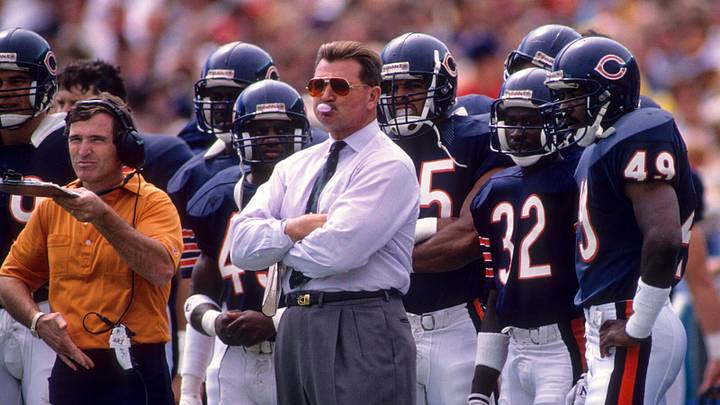
Over the years, Ditka had become so many things. A true symbol of his hard-scrabble Aliquippa, Pa., roots, and Yinzer to the core. A transformative tight end, Hall of Fame player, and both an embodiment of the original Monsters of Midway Bears and the Tom Landry Era Cowboys. A Hall of Fame coach, and leader of a Monsters rebirth, punctuated by one of the best singular teams of all time, the 1985 Bears.
MORE ON DITKA: Before Mike Ditka Became an NFL Legend, He Began to Transform the Tight End Position at Pitt
But if you want to roll it all into one, he was the ultimate badass, so much so that Saturday Night Live created a skit to fully flesh that out.
“It's funny,” Seahawks senior assistant Leslie Frazier, starting defensive back for the ’85 Bears, says. “He would put that cigar in his mouth and be puffing smoke at people when they challenged him on how we're doing things or who he is. None of that stuff bothered him. He just had that bravado about him, and it rubbed off on us. I mean, we're a bold, brash group of guys who had a lot of success, but we embodied his attitude and his approach.
“It was like, You can't touch us. That's the way he came across.”
Ditka always knew who he was, and that was reflected directly in how he envisioned his team looking when he returned to the team that drafted him in 1961, arriving as the Bears’ new head coach in 1982, and walking into what would be a complicated situation.
Labor strife was brewing and would lead to a strike that year that cut that season's schedule to nine games. The Bears defensive players had famously written a letter to team owner George Halas, Ditka’s coach from 1961-66, pleading that he keep Buddy Ryan as coordinator, after head coach Neill Armstrong was let go in January 1982, a request that Halas acquiesced to.
And Ditka, the antithesis of the mild-mannered Armstrong, cut right through all of that with a clarity in what the team would value going forward.
“It didn't matter what your reputation was, how many accolades you had, if you didn't fit what he thought was the image of a Chicago Bear, he made it very clear you weren't going to survive,” Frazier says. “And he'd tell you that the guys that did survive, they were going to be champions. He really believed that. And he began to change that roster. We went out to Arizona his first year to practice in the spring, because we couldn't have practice at home in the spring. I think it was our first mini-camp. We ran and we ran and we ran.
“I was like, Man, he's going to kill us all. But he was finding out right away who his guys were and who was going to fit his mold of what a Chicago Bear was going to be. He was going to challenge your mental toughness. He was going to challenge your physical toughness. He was going to challenge you in every way possible to see how competitive you were and if you fit what he was looking for.”
Slowly, surely, the guys who had their names on that message backing Ryan—guys like McMichael, Hampton, Frazier, Jeff Fisher and the letter’s organizer, Gary Fencik—became Ditka’s guys, too, and part of a story that grew to be, like the coach himself, larger than life.
Their memories of Ditka as a Bear, Eagle and Cowboy tight end—he actually held the NFL’s rookie receiving yards record for a tight end until two years ago, and for 60 years was the only rookie tight end ever to go for 1,000 yards—were understandably vague. But they knew what he was. And if they didn’t, Ditka would bring guys like Dick Butkus around to remind them of what his era of football player was, and of what he wanted them to be.
After the strike year, the Bears started ascending, getting to 8-8 in 1983, then 10-6 and the NFC title game, where they’d fell to the Joe Montana 49ers in 1984. By then, they already had the best defense in football, and were quickly becoming the NFL’s most feared team.
The hard-edged work he’d subjected them to, and hard-edged vision he held, was alive.
“He was that way,” says Fisher, the former Titans and Rams coach, and a safety and punt returner on those teams. “He liked smart, tough players. If you weren't smart and you weren't tough, then he wasn't going to have anything to do with you. That's how he was. And back then, you just had weeks of padded, full-contact training camp twice a day, sometimes three times a day. And at the end, he would tell you to line up on the goal line—We're going to run 10 100s. And you just went to the goal line and you ran 10 100s.
“And if you had to limp through them, you limped through them. If you had to jog them, because you were hurt, you jogged them. But you ran 10 100s and nobody said anything. In this day and age, you tell a team to line up on a goal and we're going to run 10 hundreds. They stand there and look at you and ask why.”
The Bears who made it through never did, and the rewards soon were abundant.
Of course, any coach can be demanding.
The trick, for Ditka, in getting his guys to buy in was they knew he had their back.
Just because those Bears were tough, smart and edgy didn’t mean they weren’t flashy. In fact, there were few teams stocked with more personalities than the ’80s Bears. McMichael would become a professional wrestler. Hall of Fame linebacker Mike Singletary’s on-field persona was NFL Films fodder for decades. They had the Fridge, William Perry, and the team’s quiet man, Walter Payton, wound up becoming the league’s all-time leading rusher.
Even the quarterback, maybe especially the quarterback, Jim McMahon, was a character. And, Fisher implored Friday, “Don’t leave Dan Hampton out of that!”
So just as there were tough, hard-working guys, there were egos to manage.
Ditka could make it happen, first and foremost, because he understood a pro football player, having been one, and second because those players knew he had their back.

“It goes back to his letting people show their personalities to a point,” Frazier says. “Now, there were some contentious moments between he and some of my teammates where, I mean, he was going to challenge you. He was going to challenge you every day you came to practice. If you dropped the ball or you busted a coverage, you're probably going to hear from him. But what I think we all appreciated was his forthrightness and his not saying one thing to the press and then saying something different to you.
“I mean, he was going to shoot straight. And I think that's part of being a good leader.”
Rivera, over the years, wound up getting more insight into that as he became the Bears’ NFLPA player rep. Earning the spot got Rivera a place on Ditka’s office couch every Friday, and in the process they’d talk about way more than just union stuff—the coach used it to learn more about where his team was and what the locker room might need.
Ditka would offer Rivera a glass of red wine to start them, and then a deeper look into his methods as a head coach.
“One day, he and I were talking and I said to him, Coach, you got after us pretty good this week, man. That was kind of rough,” said Rivera. "He goes, Hey, Ronnie, just remember one thing now. I was a player too and I did those things. I would never ask you guys to do anything I couldn't do. That's when I realized, damn, the standard that he sets for us is high, it's really, really high—and it's not personal.”
And he’d continue to hold himself to the standard he demanded.
The best example, Fisher recalled, came in 1985. In the ’84 NFC title game, the 49ers beat the Bears 23-0, in part because San Francisco head coach Bill Walsh deployed offensive lineman Guy McIntyre as a fullback. The Bears employed the strategy the next year, with Perry, and went out to San Francisco in Week 6 undefeated and manhandled the defending champion Niners, 26-10.
For the flight home, Ditka brought some of Napa’s finest on the plane, and wound up getting picked up for DUI driving home from the airport back in Chicago.
“He would always be the first one to admit to a mistake that he made, he'd come out and say, I'm going to take this one,” Fisher said. “He stood up and said, Hey guys, we got to learn from those that are around us. And, you know, I screwed up last night and I got a DUI and I'm dealing with it.”
The Bears were 6-0 at that point. They’d get to 12-0 before they famously lost on a Monday night to Dan Marino’s Dolphins. Two months after that, they were champions.
If there’s a reflection of Ditka manifesting what he was looking for in the Bears, and the admiration all those players had for him, this is probably it—four players from the 1985 team, and five guys who played for him over his 11 years running the team, have become NFL head coaches. Three of them have had multiple cracks at it, and three have reached Super Bowls leading their own teams.
Rivera was head coach of the Panthers and Commanders. Fisher led the Titans and Rams. Frazier was head coach of the Vikings. Singletary was head coach of the 49ers. And Jim Harbaugh, Ditka’s first-round pick in 1987, succeeded Singletary as 49ers coach, and is now the head coach of the Chargers.
Fisher remembers how his relationship changed with Ditka when he crossed that line, from player to coach, after going with Ryan to Philadelphia and seeing it right away when the Bears and Eagles played in a game stocked with replacement players in ’87. Conversations were different than they had been, and Fisher could then feel the way that Ditka thought of him—a player who’d got injured in ’85 and moved into a quasi-coach role.
And years later, when Fisher became head coach of the Houston Oilers (who’d become the Titans after moving to Nashville), finally, Ditka would put words to it.
“He was intense,” Fisher said. “But you could tell he had a warm spot and he had a sense of pride. And then it was like, I always knew you were going to be a head coach, kind of thing.”
Frazier first saw that side of Ditka when he was still a player. He’d missed a tackle on a running back in a game, and in the team meeting, Ditka took Frazier to task, challenging the veteran defensive back. Frazier was confused and went to Ryan, who agreed that he’d actually played well in the game, which was reflected in how Ryan graded him out.
So Frazier gathered the courage to go to Ditka himself with it. He said he didn’t see what the coach saw and was willing to take a second look with him.
“And he said, Leslie, I'm so glad you came up to my office,” Frazier said. “He said, You don't say two words. And for you to come up here and challenge me like this, you made my day. Get out of my office. Thank you. You're right. It was not like that. But I'm glad you spoke up. And that just spoke to me a little bit. And he never really messed with me ever again.”
The bond those experiences forged, as was the case with Rivera and Fisher too, turned Ditka from a hard-driving coach, in time, to a coaching mentor for Frazier.
So a quarter-century later, when Frazier was defensive coordinator with the Bills, and the team was in the throes of COVID, with coaches teaching players through computer screens, he couldn’t think of anyone better to address them than Ditka. Ditka agreed to do it and delivered a powerful message on the sacrifice it takes to win in the NFL.
That he was always available to coaches like Frazier, and Rivera, and Fisher for these things also spoke to the bond that was forged in the ’80s, through the price that Ditka had them pay for greatness together.
Frazier felt it again last year when, before the Bears’ Monday night opener against the Vikings, the franchise honored its 1985 team. Frazier, coaching for a Seahawks team that would eventually reach the heights those Bears did, couldn’t make it. But his teammates made sure he’d be a part of it, with Rivera Facetiming him from the tunnel so he could see what his brothers were experiencing.
“It made me emotional, man, that they would be thinking about me in that way,” Frazier said. “But that's the respect and love that we all have for each other from that team. And I think it just goes back to the work that we put in and the leadership of Coach Ditka, that helped to form that bond that still exists to this day.”
Which is to say that, yes, Ditka’s legacy can be measured in accomplishment, as the only man ever to be a starter for a Super Bowl champion, and then become head coach for another Lombardi winner. He was a champion as a player with the Bears, before the Super Bowl Era, and the Cowboys, and as Cowboys assistant, and of course Bears head coach.
But his impact flows much deeper than that, in what the simple word Ditka means in the lexicon of professional football in this country. And as for how he changed so many people, it still lives in places like Seattle and Berkeley, and that Soldier Field tunnel where those 1980 Bears that came to embody what their coach was about stood.
“Oh gosh, yeah,” Fisher agreed. “That was Mike's team.”
And his legacy, too.
 Add us as a preferred source on Google
Albert Breer is a senior writer covering the NFL for Sports Illustrated, delivering the biggest stories and breaking news from across the league. He has been on the NFL beat since 2005 and joined SI in 2016. Breer began his career covering the New England Patriots for the MetroWest Daily News and the Boston Herald from 2005 to ’07, then covered the Dallas Cowboys for the Dallas Morning News from 2007 to ’08. He worked for The Sporting News from 2008 to ’09 before returning to Massachusetts as The Boston Globe’s national NFL writer in 2009. From 2010 to 2016, Breer served as a national reporter for NFL Network. In addition to his work at Sports Illustrated, Breer regularly appears on NBC Sports Boston, 98.5 The Sports Hub in Boston, FS1 with Colin Cowherd, The Rich Eisen Show and The Dan Patrick Show. A 2002 graduate of Ohio State, Breer lives near Boston with his wife, a cardiac ICU nurse at Boston Children’s Hospital, and their three children.
Follow AlbertBreer