%20%20--%3E%0A%3Csvg%20version%3D%221.1%22%20id%3D%22Layer_1%22%20xmlns%3D%22http%3A%2F%2Fwww.w3.org%2F2000%2Fsvg%22%20xmlns%3Axlink%3D%22http%3A%2F%2Fwww.w3.org%2F1999%2Fxlink%22%20x%3D%220px%22%20y%3D%220px%22%0A%09%20width%3D%2239px%22%20height%3D%2240px%22%20viewBox%3D%220%200%2039%2040%22%20enable-background%3D%22new%200%200%2039%2040%22%20xml%3Aspace%3D%22preserve%22%3E%0A%3Cpath%20fill%3D%22%23FFFFFF%22%20d%3D%22M38.5%2C7H28.2v26h10.3V7z%22%2F%3E%0A%3Cpath%20fill-rule%3D%22evenodd%22%20clip-rule%3D%22evenodd%22%20fill%3D%22%23FFFFFF%22%20d%3D%22M26.1%2C25.5c0%2C5.8-4.1%2C7.5-12.9%2C7.5C3.9%2C33%2C0%2C31.2%2C0%2C25.2v-1.1h11.6%0A%09v2.4c0%2C0.7%2C0.1%2C1.4%2C1.2%2C1.4c1%2C0%2C1.2-0.4%2C1.2-1.3v-0.9c0-1.6-0.9-1.6-3.5-2.2C2.2%2C21.7%2C0%2C19.7%2C0%2C15.3v-0.9C0%2C9.3%2C5.5%2C7%2C12.9%2C7%0A%09c10.2%2C0%2C12.8%2C2.6%2C12.8%2C7.4v1.8h-11v-2.9c0-0.6-0.4-1.1-1.2-1.1c-0.6%2C0-1.2%2C0.4-1.2%2C1.1v0.9c0%2C1.5%2C0.9%2C2%2C3.3%2C2.5%0A%09c8%2C1.6%2C10.5%2C3.3%2C10.5%2C7.5V25.5z%22%2F%3E%0A%3C%2Fsvg%3E%0A)
Inside Grateful Dead Legend Bob Weir’s Bay Area Flag Football Dynasty
In this story:
The wily old general manager had one last trick up his sleeve. It was just before the championship and the opposing team’s quarterback was a total ringer—a kid who played big-time ball in high school at the nearby prep academy and Division I at the college down the road. The kind of guy who could topple his Mill Valley flag football dynasty and snatch a fifth championship from his grasp.
So the night before, he invited the quarterback to a concert, Neil Young’s famous Bridge School benefit at the Shoreline. He recruited, according to friends, two “beautiful hippie chicks” to keep the quarterback’s cup full and asked that they not bring him back until just before kickoff.
Sure enough, just after 10 a.m. the next morning, as panicked teammates milled about the field at Tamalpais High, 22 miles north of San Francisco, staring at their watches and calls to start the game began to mount, the quarterback arrived at the field in the clothes he’d worn the night before. As the story goes, if someone had lit a match inside the quarterback’s huddle, all of Marin County would have gone up like a mushroom cloud. He played a step slow all afternoon (and in jeans). And sure enough, the GM’s team, the Tamalpais Chiefs, won in the end on a heroic fourth-and-forever touchdown run.
All part of the plan.
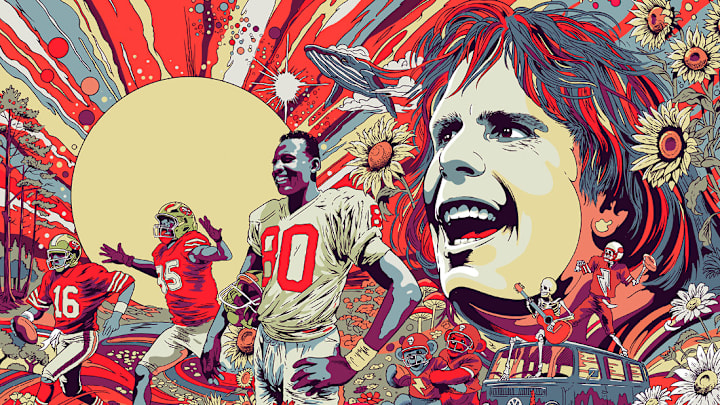
For the purposes of this story, it shouldn’t matter that the GM had also been playing the Shoreline that night and could summon a backstage pass for anyone he wanted with the snap of a finger. That he was arguably one of the most famous musicians of his day. A Hall of Famer and, by his own reckoning in a documentary made about his life, someone who had spent more time playing in front of a live audience than any other singer or guitar player who had ever lived. But when it came to football, the sport was both a respite and obsession for Bob Weir, the beating heart, rhythm lead and whooping voice behind the Grateful Dead. He wouldn’t have wanted to be known as anything other than what he was away from the stage: a baseball-mitt-for-hands quarterback who could sling it, turned crushing blocking back, turned, in the latter years, maniacal, Belichickian flag football executive and dedicated play designer who would have given Sean McVay a run for his money.
“He loved to win,” says Douglas Rosenberg, a longtime friend of Weir’s and Chiefs quarterback (he was recruited by Weir following a game in which Rosenberg scored six touchdowns against the music icon). “No doubt. This was not just, Let’s go out and have a nice relaxing Sunday morning football game.”
Super Bowl LX features some of the game’s brightest offensive minds, likely unaware that the all-time best had been in the San Francisco area for decades (and helped define the counterculture that remains the city’s most endearing quality to this day). While much is known about Weir’s affinity for football (both flag and the 49ers), interviews with former Tamalpais Chiefs teammates, as well as Mill Valley league members and administrators, paint a broader picture of Weir’s immense acumen, competitiveness and drive. Not just to merely create a flag football league in the sleepy San Francisco suburb where, on a random day, you could play pickup with Todd Rundgren and Prairie Prince, but to dominate it with a Nick Saban-like vise-grip by recruiting the best players, designing the wildest, borderline-illegal concepts and, yes, giving the officials that knowing glance … that perhaps their tickets to see the Dead hinged on the outcome of a call.
After Weir’s death in January at the age of 78, the outpouring of love from NFL players like George Kittle—who wrote dead forever on the tape on his cleats—summed up Weir’s unique connection to the sport he loved. But back in Mill Valley, many of his Chiefs teammates have been circulating tales of their football glory days, which would have meant the world to Weir. Members of the Chiefs are godparents to both of Weir’s daughters. They trade photos and grainy camcorder footage of games, which show Weir in his element: slicked back hair tied off in a ponytail, the neck of his black Chiefs shirt cut off to prevent itching, wearing his trademark short shorts and hunkered down in the backfield ready to chip a blitzing defender.
But most of all, they remember his credo, which aided him as the Mill Valley Flag Football League rose from its humble beginnings where the “flags” were merely torn off pieces of a bedsheet. When the league doubled in size, the Chiefs nearly doubled in age, and the desire to hang on to those moments of respite stayed strong.
“Treachery and deceit,” Weir would say, “overcomes youth and exuberance.”

In a man-cave-like room in Weir’s home sat an early-model Apple computer. The space also contained a multitude of guitars and amps. The kind of room where you’d have to move a pile of stuff if you wanted to lie down.
Weir loved the Mac for its ability to help him draw and design plays. He was especially proud of a feature he had uncovered that would flip the formation without him having to redraw it. Starting in the late 1980s, a time when the Grateful Dead was at the height of its commercial success from the release of the band’s only Billboard Top 10 hit, “Touch of Grey,” teammates say Weir would devote considerable hours to the creation of an official Tamalpais Chiefs playbook.
“I mean, this was, more or less, a pickup flag football league,” says Dennis Fisco, the founder of a rival team called the Weekend Warriors and a two-term mayor of Mill Valley. “But the Chiefs would have a number of these practices where they’d run through these plays. I mean, written-down plays. And if someone screwed something up, you’d hear about it from Bob.”
Weir would print the plays out and copy them onto laminated note cards that he kept inside a fanny pack he wore during games, a kind of bohemian take on the quarterback wristband. The cards were bound together with a metal binder ring; the routes of the intended receivers were in red, while the other players were drawn in black.
“You’d flip through it and he had them named like French 72,” says Russ Eddy, a defensive back on the Chiefs. “You’d have all this stuff and we’d have audibles played in there, too. It was crazy. It was really complicated.”
In the latter years, Weir’s Mac was replaced by a host of whiteboards varying in size, between which he’d bounce with different colored markers, trying to craft a game plan that would capitalize on shorter, quicker passes. Multiple members of the Tamalpais Chiefs confirm that Weir drew inspiration from an actual copy of the 2003 Niners playbook, which he showed off on occasion in the back of his car.
“Where the hell did you get that from?” they’d ask.
“Top secret,” he’d say.
Weir’s curiosity was evident in his music. His affinity for jazz piano and willingness to stretch songs far beyond their intended length—famously, a frustration for topless dancers back in the 1960s who would dance to live Grateful Dead music and were gasping for air after 15 minutes on stage—broke down the confines of traditional music and unleashed the band on millions who longed for a perpetual, harmonic mystery.
It wasn’t a surprise that the staccato tales of Weir’s time heading the Tamalpais Chiefs showed the same willingness to eschew normality in search of something that satisfied his desire for beauty and chaos. Among them:
• Weir was focused on running an offense that used a pro-style snap, in which the quarterback takes the ball from under center. This was highly unorthodox for flag football, where shotgun snaps are the norm. Friends traced Weir’s infatuation back to an association he made between the effectiveness of the pro snap and the man that Weir believed invented it—the legendary Stanford, Rams and Bears coach Clark Shaughnessy. Weir came to study the great football innovator because Shaughnessy’s grandson was Bill Kreutzmann, the drummer of the Grateful Dead.
“He and I would argue intensely over this,” says Ethan Winterling, one of the original members of the Chiefs. “He loved the freaking pro snap and I despised it because it’s flag football, and you’re right there over the football and on the other side there’s an automatic rush. But he was pretty much the owner, the general manager, the captain of the team. He had an innate ability to get his way with people, and he would not take no for an answer.”
• Another one of Weir’s fascinations was a play that included simultaneous double motion. His offense would consist of two receivers in the slot who would run fly patterns down the field and wall off the defenders, while the motion receivers would run 10-yard outs into vast, empty swaths of space. Essentially, this was a very early precursor to some of the legal “pick” plays that are seen around the NFL with regularity now. Weir was instrumental in getting double motion written into the Mill Valley Flag Football League rulebook and carried a copy with him in his car to reference when the play was inevitably challenged.
“We would just intimidate the refs and intimidate the commissioner of the league to the point where they just said, ‘O.K., do whatever you want to do,’ ” Rosenberg says.
• In the latter years of Mill Valley flag, the league expanded and so, too, did the talent pool to include top college players and even recently cut professionals. Weir was notorious for scouting talent, especially on the Chiefs’ top rivals, the Aftershocks. Chuck Doyle, now the president and CEO of a commercial finance company in the area called BizCap, remembers Weir inviting him to dinner after a game and giving him the pitch of a lifetime in order to defect.
“I go, ‘What’s in it for me?’ ” Doyle says. “Weir says, ‘There’s all the teammates and camaraderie and just having a great time … you’ll really love it.’ And I’m like, ‘O.K., well, what else?’ And he goes, ‘Well, you’ll get at least two tickets to each show I play at.’ ”
Weir agreed that the deal was “in perpetuity” for any iteration of the Grateful Dead or for one of Weir’s solo ventures. Doyle wound up on a bus for a show at Alpine Valley after the band had gotten back together following Jerry Garcia’s death. The party was epic, and Doyle fell asleep in his bunk so soundly that he missed his drop-off at O’Hare. He came to hours later when the bus was in Kentucky picking up the Everly Brothers, and Weir affectionately referred to Doyle as “Chucky in Kentucky” afterward.
• On the field, Weir had a strange, unspoken stoicism. During one game in 2003, his friend and teammate Chris Moscone, the son of the late San Francisco mayor George Moscone, remembers one of the Chiefs getting his cleat stuck in the turf and horrifically dislocating his ankle. While the assembled players took a knee, Weir calmly walked over to his teammate and began examining the break. Weir, who famously dropped out of school at 16 to play guitar, had no formal medical training that anyone was aware of.
“We were all just, mouths agape,” Moscone says. “I’m not going over there because I’m an attorney and I’m thinking liability. But Bob just says, ‘Hold on, hold on, I can do this. I can reset it.’ We’re all just thinking, He’s nuts right? He’s out of his brain. F---ing A, he could ruin this guy’s ankle forever. But we also believed it. We knew what was going to happen.”
Weir made the injured guy bite down on a towel and, before an ambulance arrived, counted to three and reinserted the ankle back into place. The player was able to limp into the ambulance and was fine.
“He was kind of, just, otherworldly,” Moscone says. “You could not stop Weir. No matter what.”

Weir fell in love with the 49ers at the age of 8 and also closely tracked the career of rambling Raiders quarterback Kenny Stabler, whose renegade appearance and penchant for nightlife appealed to him.
When he was sent to the Fountain Valley School in Colorado Springs—Weir struggled in school due to dyslexia, which wasn’t commonly diagnosed at the time—he played eight-man football with John Perry Barlow, a man who would become an influential lyricist for the band. In interviews over the years, Weir said he excelled the most as a middle linebacker and warmed up the wide receivers as a third-string quarterback. He’d run off with the Dead by the time he’d have gotten promoted to starter. Even at 72, he told Men’s Health that he could “throw a ball you could hear comin’.”
Weir would have a football on the road. Friends remember games of tackle in the shadow of the Berlin Wall just after it fell and elsewhere in Germany. (You haven’t lived, they said, until you’ve been run over by the long-legged Bruce Hornsby, who played keyboards for the Dead at more than 100 shows, after a few shots of Jägermeister.)
But attempting to distill Weir’s love for football is, fittingly, a little more complicated.
“I love playing in bands because everyone has to feel each other and work with each other and improvise as one,” Weir said in the 2021 documentary The Faithful. “Any of the greats in 49ers history had something of that quality. They loved the game for what football is. It’s such a complex sport, and you need your buddies to do exactly what you know they’re going to do. They need to improvise in a way that the others are going to understand it and to intuit what you’re going to be doing.
“That’s what makes greatness … that’s when football gets really good. It’s glorious to watch.”
After Tamalpais Chiefs games on Sundays, the entire crew would pile into a bar called the 2 AM Club, known to the team as “The Deuce.” (Music historians will note that the interior of the dive is the background of the Huey Lewis album Sports.) After the early games, Weir would host at his place to watch the 49ers later on in the afternoon.
Briefly, the Chiefs had their own clubhouse in an old apartment sublet in town where they could simply exist. Leave beers laying around on the tabletops. Cook abalone. Talk about nothing and hire a cleaning crew to come in and pick up. Weir was in his element there; he even had his bachelor party at the clubhouse.
For most of his sentient life, all Weir had known was some version of that feeling of being one of many. He knew the band. The guitar techs. The roadies. The security guards. That was one of his comforts. A familial atmosphere of brothers where he could be great but hidden. He could be out in the world but inside his tribe. And so while his purpose with the Chiefs could be as simple as blowing off steam after a long run of shows, it could have also been another version of what he left—and missed—every time he returned from one of the band’s mammoth tours. To Weir, football and music were so similar.
The one difference being that, on the field at Tamalpais High, he didn’t have to be Bob Weir of the Grateful Dead anymore. He was just another neighbor in Mill Valley, known for his hugs, his penchant for asking other people about themselves, his shyness and perfectionism. He could take all of his passion, preoccupation, genius and mania, pouring them onto a slice of grass just off the bay where the only people who knew him simply referred to him as “The Chief.” A place where treachery and deceit could overcome anything.
“That’s what we wanted,” Eddy says. “He didn’t want another Deadhead groupie. He wanted somebody he could hang out with and just play football and talk. Be a guy without being a rock star.”
More NFL From Sports Illustrated
 Add us as a preferred source on Google
Conor Orr is a Senior Writer for Sports Illustrated with more than 15 years of experience covering the NFL. His work has been cited in Best American Sportswriting and has won a PFWAA award. Prior to Sports Illustrated, he covered both the Giants and Jets for The Star-Ledger. Conor lives in New Jersey with his amazing wife and three children.
Follow author