%20%20--%3E%0A%3Csvg%20version%3D%221.1%22%20id%3D%22Layer_1%22%20xmlns%3D%22http%3A%2F%2Fwww.w3.org%2F2000%2Fsvg%22%20xmlns%3Axlink%3D%22http%3A%2F%2Fwww.w3.org%2F1999%2Fxlink%22%20x%3D%220px%22%20y%3D%220px%22%0A%09%20width%3D%2239px%22%20height%3D%2240px%22%20viewBox%3D%220%200%2039%2040%22%20enable-background%3D%22new%200%200%2039%2040%22%20xml%3Aspace%3D%22preserve%22%3E%0A%3Cpath%20fill%3D%22%23FFFFFF%22%20d%3D%22M38.5%2C7H28.2v26h10.3V7z%22%2F%3E%0A%3Cpath%20fill-rule%3D%22evenodd%22%20clip-rule%3D%22evenodd%22%20fill%3D%22%23FFFFFF%22%20d%3D%22M26.1%2C25.5c0%2C5.8-4.1%2C7.5-12.9%2C7.5C3.9%2C33%2C0%2C31.2%2C0%2C25.2v-1.1h11.6%0A%09v2.4c0%2C0.7%2C0.1%2C1.4%2C1.2%2C1.4c1%2C0%2C1.2-0.4%2C1.2-1.3v-0.9c0-1.6-0.9-1.6-3.5-2.2C2.2%2C21.7%2C0%2C19.7%2C0%2C15.3v-0.9C0%2C9.3%2C5.5%2C7%2C12.9%2C7%0A%09c10.2%2C0%2C12.8%2C2.6%2C12.8%2C7.4v1.8h-11v-2.9c0-0.6-0.4-1.1-1.2-1.1c-0.6%2C0-1.2%2C0.4-1.2%2C1.1v0.9c0%2C1.5%2C0.9%2C2%2C3.3%2C2.5%0A%09c8%2C1.6%2C10.5%2C3.3%2C10.5%2C7.5V25.5z%22%2F%3E%0A%3C%2Fsvg%3E%0A)
Why the Eagles Are In Salary Cap Trouble, and How They Can Get Out of It
In this story:
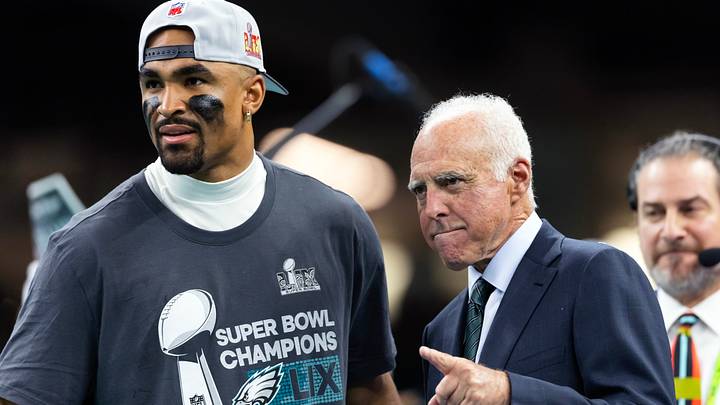
The Eagles who take to the grass at Lincoln Financial Field on Monday night will be a shell of the group that won a championship just 20 months ago. There’s a good chance just three offensive starters and five defensive starters from Super Bowl LIX will be in uniform. Ten starters from that game, five on each side of the ball, are gone entirely and two more are on injured reserve, with doubts that they’ll play again this year.
Looming over all of it is the mountain of cap debt the team has strategically accumulated over the past half decade, building the rosters that made the playoffs in each of Nick Sirianni’s first five years in charge, went to two Super Bowls and won one.
The franchise’s future is, to say the least, cloudy ahead of a rivalry game against the Cowboys set to be played in pristine fall conditions in South Philly Monday night, with the path out unclear.
And no matter how you chart that path, the Eagles’ oft-discussed, seldom-understood economic strategy has to be front and center in the plan. The Eagles were so tight to the cap in the offseason, that they waited three months to trade A.J. Brown because they had no contracts left to restructure. Yet, they have over $9 million of wiggle room months later.
In the short term, the Eagles are 2–4, losers of four consecutive games, two wins behind the Giants in the NFC East and likely without quarterback Jalen Hurts for the rest of the season.
Big decisions are coming on the franchise’s future, too. The offensive line is suddenly riddled with question marks. Saquon Barkley will be going into Year 10 in 2027. There are needs for a tight end, edge rushers and in the secondary looming.
So there’s no time like right now to explain how the Eagles got here, and the level to which the mountain of mortgaging they’ve done corners them in how they’ll build from here.
The first thing to understand is that this strategy isn’t new. The Eagles have evolved in this direction, going all the way back to the days when Joe Banner ran their cap. They got more aggressive when Howie Roseman plucked his childhood friend, Jake Rosenberg, off Wall Street in 2012, and kicked things up a notch again when Roseman regained control of the team’s personnel department in 2016, after winning a power struggle with Chip Kelly.
The easy way to look at what the Eagles do is to simply say the franchise operates with an all-in approach to most seasons. And that is true, to a degree, as is the fact that it does take commitment from owner Jeffrey Lurie to spend cash over cap on a consistent basis.
That said, the idea isn’t just to wildly write checks to everyone.
It’s based on a series of sensible points of logic …
• First, there’s the premise that a dollar today is more valuable than a dollar tomorrow. To translate that into applicable terms: Last year, $10 million represented 3.58% of the salary cap; this year, the same $10 million represents 3.32% of the cap. Which means $10 million in 2025 is worth $10.79 million in 2026. So borrowing from 2026 to spend in 2025—done with bonus money taking the place of base salary, to push cap damage forward—is sound business, if you’re looking to stretch your dollar.
• Second, maximizing flexibility this way doesn’t have a ton of downside. If you take, for example, that $10 million on a one-year deal, set the base at $1 million and spread the rest out with $9 million of the money in a signing bonus, you’re pushing $7.2 million into the next year. If, then, you don’t use that cap space, it rolls over to the next year, and you get it right back. Conversely, if you leave that number in base salary, that money is spent either way, and gone.
• Third, that built-in flexibility more or less gives the Eagles the chance to re-sign their own players whenever they see fit, and re-sign them early. If you’re signing the right players, that will almost certainly add up to cash savings, and absolutely bring cap savings, in that existing years on contracts are folded into extensions. (If a player has two years and $10 million left on an old deal, and signs a four-year, $140 million extension, that’s $35 million per year in new money, but only $25 million per in real money/cap dollars.)
• Fourth, in a year where you are competing for a championship, the cap space creates both a rainy day fund to plug holes created by injury and room to get aggressive. Last year, it allowed the Eagles to flip a 2026 third-round pick for Jaelan Phillips, with the promise that if he left they’d get a 2027 third-round comp pick for him (their gaming of the comp pick formula is another story for another day).
And again, it takes an owner willing to engage in high-end cash spending year after year, which Lurie has been.
The math becomes really interesting. From 2022 to ’26, the Eagles’ dead cap numbers ($33 million, $30 million, $40 million, $51 million, $80 million) add up to roughly $234 million, which would appear to be a debilitating number. Yet, they’re third in cash spending over that time, behind only the Browns and 49ers—having poured $1.481 billion into their roster.
The salary cap for that five-year period adds up to $1.269 billion, meaning the Eagles have spent, over that time, $212 million in cash over the prescribed cap. Their winning percentage of .712 over that time is second only to the Bills, and Philly made the playoffs in each of the first four years in that window (we’ll see about this year), while, again, capturing three NFC East titles, making two Super Bowls and winning it all in 2024.

There is risk here, of course, and it comes back to the one big bet that Roseman and his team make in employing this strategy: that the cap will keep rising.
“It’s maxing your credit card,” one cap manager from a rival team said, “with a risk your limit could decrease.”
One obvious way it can happen is if the cap, for one reason or another, decreases.
That actually happened in Sirianni’s first season, due to COVID-19. League revenue declined due to the pandemic and the cap, which is based on percentages of revenue, crashed, diving from $198.2 million in 2020 (it had risen steadily by about $10 million per year under the 2011 CBA) down to $182.5 million.
And that brings us to the other way this strategy can be stressed: by an unexpected injury, decline or retirement from a key player. In this case, it was Carson Wentz, who got a record-breaking contract in early 2019, and fell apart thereafter, in part due to an accumulation of injuries.
Long story short, the Eagles traded Wentz, which meant (unlike a post–June 1 cut), they had to take all his dead money at once, and that $33.8 million accounted for a large percentage of the $59 million (or so) in total dead money they carried that year. With the lower limit, that meant roughly a third of Philly’s cap was occupied by players who weren’t on the team.
That team started 3–6, then rallied to finish 9–8 and sneak in the playoffs.
So what was the fix? The Eagles drafted well, got really young and developed a rising layer of young players to supplement an older core. In their playoff loss to the Buccaneers that season, their quarterback and every single skill player who touched the ball was on a rookie contract. And with the cap cleaned out after they ate dead money for a year, they got aggressive in 2022, acquiring guys like Brown, Haason Reddick, C.J. Gardner-Johnson and Robert Quinn (Quinn shows these moves don’t all work out), and made the Super Bowl.
This year, they’ve faced some similar unforeseen circumstances. Lane Johnson, their all-world tackle of 14 seasons, retired. The Ravens offered a second-round pick for Cam Jurgens, capital that could be used to get younger (like the capital in the Wentz trade once was), and they couldn’t say no. Hurts’s blood clots, first discovered before the team’s London game and found to be more serious last week, will likely sideline him for the rest of 2026. The season’s gone sideways.
Maybe they can win a wounded NFC East. Maybe not.
Their next steps, either way, will be interesting.

Most of the next steps on the path aren’t uncharted.
Johnson’s retirement was coming, so while it wasn’t necessarily part of the on-field plan for 2026, it was factored into the economic planning for 2027 (hence the team holding him on the roster until June 1). The Jurgens trade and Landon Dickerson’s injury troubles were more unforeseen, and will need to be accounted for. Building for next year won’t be easy, but it also won’t be impossible.
As it is right now, if all the players on expiring contracts are gone next year (pretty likely if you look at a list that includes Dallas Goedert, Tariq Woolen and Hollywood Brown), then the dead money adds up to $41.135 million. More will be added to the total if guys such as Dickerson, Saquon Barkley or even Hurts are gone. And it’s certainly possible they’ll reach the point the Saints did in recent years, where the debt gets to a level that it’s not even about having to get rid of good players, but having to keep guys whose time is up.
The damage coming is strategically stretched out, and the added aggression from the Eagles over the past half decade has come through the June 1 cut mechanism in the cap rules.
The rule allows for you to spread dead money over two years. To go back to the earlier example of the one-year, $10 million deal with a $9 million signing bonus (with void years on it), that deal would have $1.8 million in dead cap over five years if the player were to be cut or traded, meaning there’d be $7.2 million to deal with after that one year. If that player is cut in March, all $7.2 million hits the cap right away. If he’s cut on or after June, the team can take the current year’s debt ($1.8 million) and then push the remainder ($5.8 million) into the following year.
As such, the Eagles have constructed contracts to do that, where they can cut a guy in March, designate it a post–June 1 cut and push the money ahead. They can’t spend the money until after June 1, but that space generally just goes into the rainy day fund anyway. And the premise of a dollar being more valuable today than tomorrow then gets stretched out over another year, which, on paper anyway, would add more value.
You’re allowed two such cuts every year. The Eagles have Johnson and Dallas Goedert lined up to be those guys this year, Zack Baun and Dickerson lined up to be those guys after 2027 (which would make letting Dickerson go before that a little trickier), and Barkley already set up to be one of those two after the 2028 season.
As such, you’ll see names like Darius Slay, Bryce Huff and James Bradberry, who were all gone after the championship year of 2024, still on the Eagles’ cap ledger for 2026 and part of the dead-money total of about $80 million for this year.
If the cap falls for some reason, or the team has to offload Hurts (right now, his dead-cap figure for 2029, if he played out his contract as presently constituted through 2028, would be $98.56 million) then all of this can get sketchy in a hurry for the Eagles.
Regardless, the way out of the situation will go the same way it always has: draft well and spend on the right guys.
From 2020 to ’24, the Eagles drafted Hurts, DeVonta Smith, Dickerson, Milton Williams, Kenneth Gainwell, Jordan Davis, Jurgens, Nakobe Dean, Jalen Carter, Nolan Smith, Tyler Steen, Quinyon Mitchell, Cooper DeJean, Jalyx Hunt and Will Shipley, all of whom either have been extended, have or will bring home comp picks, or are playing key roles now on rookie contracts.
So how this all looks Monday night might not be the same as it looks 12 months from now.
The future is, indeed, cloudy. But not unplanned.
 Add us as a preferred source on Google

Albert Breer is a senior writer covering the NFL for Sports Illustrated, delivering the biggest stories and breaking news from across the league. He has been on the NFL beat since 2005 and joined SI in 2016. Breer began his career covering the New England Patriots for the MetroWest Daily News and the Boston Herald from 2005 to ’07, then covered the Dallas Cowboys for the Dallas Morning News from 2007 to ’08. He worked for The Sporting News from 2008 to ’09 before returning to Massachusetts as The Boston Globe’s national NFL writer in 2009. From 2010 to 2016, Breer served as a national reporter for NFL Network. In addition to his work at Sports Illustrated, Breer regularly appears on NBC Sports Boston, 98.5 The Sports Hub in Boston, FS1 with Colin Cowherd, The Rich Eisen Show and The Dan Patrick Show. A 2002 graduate of Ohio State, Breer lives near Boston with his wife, a cardiac ICU nurse at Boston Children’s Hospital, and their three children.
Follow AlbertBreer