%22%3E%0A%3Cpath%20d%3D%22M0%209.72534H5.31306L11.3609%2017.2239V9.72534H16.9943V26.7196H11.945L5.63335%2018.8819V26.7196H0V9.72534Z%22%20fill%3D%22white%22%2F%3E%0A%3Cpath%20d%3D%22M18.4827%2020.1632V20.1161C18.4827%2016.1595%2021.3276%2013.145%2025.303%2013.145C30.0132%2013.145%2032.1987%2016.4233%2032.1987%2020.4552C32.1987%2020.7472%2032.1987%2021.0864%2032.1704%2021.3784H23.645C24.0313%2022.5465%2024.9545%2023.1494%2026.1414%2023.1494C27.14%2023.1494%2027.9596%2022.6878%2028.8356%2021.7929L31.7936%2024.148C30.4842%2025.8436%2028.6096%2027.04%2025.7458%2027.04C21.403%2027.04%2018.4639%2024.2987%2018.4639%2020.1726L18.4827%2020.1632ZM27.1777%2018.9479C27.0552%2017.6856%2026.3016%2016.9603%2025.3313%2016.9603C24.361%2016.9603%2023.7487%2017.7327%2023.5791%2018.9479H27.1777Z%22%20fill%3D%22white%22%2F%3E%0A%3Cpath%20d%3D%22M32.1045%2013.4653H37.3705L38.727%2018.8066L40.3284%2013.4182H44.7183L46.348%2018.8537L47.7516%2013.4653H52.9517L48.9009%2026.8233H44.285L42.5139%2021.1429L40.6958%2026.8233H36.1081L32.1045%2013.4653Z%22%20fill%3D%22white%22%2F%3E%0A%3Cpath%20d%3D%22M65.3677%2020.7L58.9619%209.72534H65.3206L68.2315%2015.3116L71.1707%209.72534H77.4634L71.0576%2020.6247V26.7196H65.3772V20.7H65.3677Z%22%20fill%3D%22white%22%2F%3E%0A%3Cpath%20d%3D%22M74.9102%2020.1442V20.0971C74.9102%2016.3572%2078.0189%2013.1543%2082.3899%2013.1543C86.7609%2013.1543%2089.8225%2016.3101%2089.8225%2020.05V20.0971C89.8225%2023.8369%2086.7138%2027.0399%2082.3428%2027.0399C77.9718%2027.0399%2074.9102%2023.884%2074.9102%2020.1442ZM84.5283%2020.1442V20.0971C84.5283%2018.7877%2083.558%2017.742%2082.3428%2017.742C81.1276%2017.742%2080.2044%2018.7876%2080.2044%2020.05V20.0971C80.2044%2021.4065%2081.1747%2022.4522%2082.3899%2022.4522C83.6051%2022.4522%2084.5283%2021.4065%2084.5283%2020.1442Z%22%20fill%3D%22white%22%2F%3E%0A%3Cpath%20d%3D%22M91.1602%2013.4652H96.671V16.1406C97.4247%2014.3413%2098.6399%2013.1826%20100.825%2013.2768V19.1268H100.241C97.9145%2019.1268%2096.671%2020.4174%2096.671%2023.3566V26.7291H91.1602V13.4747V13.4652Z%22%20fill%3D%22white%22%2F%3E%0A%3Cpath%20d%3D%22M101.871%209H107.382V17.5442L110.227%2013.4652H116.228L112.073%2018.8537L116.294%2026.7196H110.396L108.475%2023.074L107.382%2024.487V26.7196H101.871V9Z%22%20fill%3D%22white%22%2F%3E%0A%3Cpath%20d%3D%22M122.897%2018.2695V18.2224C122.897%2013.1449%20126.901%209.35791%20132.271%209.35791C135.182%209.35791%20137.537%2010.3282%20139.383%2011.9297L136.199%2015.7637C135.078%2014.8123%20133.844%2014.2847%20132.44%2014.2847C130.226%2014.2847%20128.625%2015.9804%20128.625%2018.2884V18.3355C128.625%2020.7377%20130.302%2022.3862%20132.676%2022.3862C133.646%2022.3862%20134.183%2022.2355%20134.616%2022V20.3043H131.705V16.6587H139.939V24.5246C138.092%2026.0319%20135.521%2027.0775%20132.44%2027.0775C127.146%2027.0775%20122.897%2023.5355%20122.897%2018.2601V18.2695Z%22%20fill%3D%22white%22%2F%3E%0A%3Cpath%20d%3D%22M141.493%209H147.202V12.5232H141.493V9ZM141.587%2013.4652H147.098V26.7196H141.587V13.4652Z%22%20fill%3D%22white%22%2F%3E%0A%3Cpath%20d%3D%22M148.389%2022.961V22.9139C148.389%2020.2668%20150.358%2018.7878%20153.438%2018.7878C154.559%2018.7878%20155.991%2019.0327%20156.566%2019.2776V19.061C156.566%2017.8458%20155.812%2017.1392%20154.116%2017.1392C152.76%2017.1392%20151.62%2017.4313%20150.452%2017.8929L149.481%2014.2283C151.008%2013.6443%20152.76%2013.2581%20155.068%2013.2581C157.762%2013.2581%20159.514%2013.8139%20160.673%2014.982C161.671%2015.9805%20162.058%2017.2617%20162.058%2019.1834V26.7385H156.547V25.4009C155.623%2026.3994%20154.389%2027.0494%20152.731%2027.0494C150.179%2027.0494%20148.389%2025.5893%20148.389%2022.9704V22.961ZM156.622%2021.8117V21.2559C156.302%2021.1334%20155.821%2021.0392%20155.36%2021.0392C154.267%2021.0392%20153.664%2021.6987%20153.664%2022.5182V22.5653C153.664%2023.3378%20154.22%2023.8559%20154.926%2023.8559C155.897%2023.8559%20156.622%2023.0835%20156.622%2021.8211V21.8117Z%22%20fill%3D%22white%22%2F%3E%0A%3Cpath%20d%3D%22M163.716%2013.4652H169.227V15.3116C170.075%2014.2188%20171.412%2013.1543%20173.277%2013.1543C176.066%2013.1543%20177.818%2015.0007%20177.818%2017.9869V26.729H172.307V19.7579C172.307%2018.6181%20171.629%2017.9587%20170.8%2017.9587C169.971%2017.9587%20169.227%2018.6181%20169.227%2019.7579V26.729H163.716V13.4746V13.4652Z%22%20fill%3D%22white%22%2F%3E%0A%3Cpath%20d%3D%22M180.494%2022.2825V17.7231H178.939V13.4745H180.494V10.1492H186.005V13.4745H189.066V17.7231H186.005V21.0767C186.005%2022.0753%20186.466%2022.4333%20187.342%2022.4333C187.851%2022.4333%20188.435%2022.292%20189.019%2022.0188V26.2673C188.143%2026.7289%20186.834%2027.021%20185.496%2027.021C182.246%2027.021%20180.494%2025.5137%20180.494%2022.2825Z%22%20fill%3D%22white%22%2F%3E%0A%3Cpath%20d%3D%22M189.452%2025.1182L191.317%2021.9907C192.918%2022.9892%20194.718%2023.4697%20196.225%2023.4697C196.762%2023.4697%20197.026%2023.3472%20197.026%2023.0363V22.9892C197.026%2022.7254%20196.781%2022.5559%20195.443%2022.2167C192.089%2021.3878%20190.026%2020.4928%20190.026%2017.7515V17.7044C190.026%2014.7935%20192.353%2013.1638%20195.801%2013.1638C197.987%2013.1638%20200.144%2013.7196%20201.755%2014.6899L200.003%2017.9682C198.59%2017.1957%20196.894%2016.7341%20195.773%2016.7341C195.236%2016.7341%20195%2016.8754%20195%2017.1486V17.1957C195%2017.4595%20195.292%2017.6291%20196.63%2017.9682C199.984%2018.7972%20202%2019.7204%20202%2022.4334V22.4805C202%2025.3726%20199.842%2027.0494%20196.244%2027.0494C193.672%2027.0494%20191.336%2026.39%20189.442%2025.1276L189.452%2025.1182Z%22%20fill%3D%22white%22%2F%3E%0A%3Cpath%20fill-rule%3D%22evenodd%22%20clip-rule%3D%22evenodd%22%20d%3D%22M211.368%204.36764C217.191%20-1.45588%20226.632%20-1.45588%20232.456%204.36764C238.279%2010.1912%20238.279%2019.6324%20232.456%2025.4559L221.912%2036L211.368%2025.4559C205.544%2019.6324%20205.544%2010.1912%20211.368%204.36764ZM214.009%207.55761C213.948%207.86849%20213.916%208.39718%20213.916%209.14566V10.4189C213.916%2011.1832%20213.948%2011.7198%20214.013%2012.0267C214.078%2012.3317%20214.278%2012.6168%20214.617%2012.8762C214.956%2013.1376%20215.403%2013.3316%20215.958%2013.4623C216.512%2013.593%20217.1%2013.6584%20217.837%2013.6584C218.573%2013.6584%20219.217%2013.591%20219.769%2013.4524C220.322%2013.3158%20220.761%2013.1178%20221.086%2012.8604C221.411%2012.6029%20221.605%2012.3178%20221.666%2012.0069C221.728%2011.6961%20221.759%2011.1674%20221.759%2010.4189V9.14566C221.759%208.38134%20221.728%207.84473%20221.662%207.53781C221.597%207.23287%20221.397%206.94971%20221.058%206.68834C220.72%206.42696%20220.272%206.23291%20219.718%206.10223C219.163%205.97154%20218.536%205.90619%20217.839%205.90619C217.102%205.90619%20216.459%205.97352%20215.906%206.11213C215.352%206.24875%20214.914%206.44677%20214.589%206.70418C214.265%206.9616%20214.071%207.24673%20214.009%207.55761ZM219.276%2024.8638C222.876%2024.8638%20224.557%2024.2064%20224.557%2021.862V21.858V21.3155C224.557%2019.6581%20223.516%2018.971%20220.252%2018.3136C219.278%2018.1136%20218.908%2017.9136%20218.908%2017.3136V16.9414C218.908%2016.6543%20219.177%2016.5117%20219.413%2016.5117C219.749%2016.5117%20219.918%2016.7137%20219.918%2016.9414V18.1136H224.391V17.3988C224.391%2015.4563%20223.347%2014.4266%20219.177%2014.4266C216.15%2014.4266%20213.896%2015.3414%20213.896%2017.3711V17.7433C213.896%2019.5155%20214.805%2020.3155%20218.201%2021.0303C218.28%2021.0472%20218.355%2021.063%20218.427%2021.0781C219.329%2021.2674%20219.647%2021.3341%20219.647%2021.9174V22.2897C219.647%2022.6619%20219.546%2022.8045%20219.142%2022.8045C218.67%2022.8045%20218.637%2022.5471%20218.637%2022.262V21.2897H213.894V21.7471C213.894%2024.149%20215.476%2024.8638%20219.276%2024.8638ZM225.424%2024.5569H229.925V14.7355H225.424V24.5569ZM226.955%2013.5019H229.925V6.06064H227.092V9.411L225.193%206.06064H222.359V13.5019H225.193V10.1199L226.955%2013.5019ZM218.269%2012.152C218.204%2012.2688%20218.055%2012.3262%20217.825%2012.3262L217.827%2012.3282C217.604%2012.3282%20217.459%2012.2767%20217.398%2012.1758C217.336%2012.0748%20217.305%2011.8074%20217.305%2011.3758V7.90068C217.305%207.51852%20217.352%207.28684%20217.445%207.20962C217.538%207.13239%20217.675%207.09279%20217.851%207.09279C218.059%207.09279%20218.198%207.14031%20218.265%207.23734C218.332%207.33239%20218.366%207.55416%20218.366%207.90068V11.3203C218.366%2011.7579%20218.334%2012.0352%20218.269%2012.152Z%22%20fill%3D%22white%22%2F%3E%0A%3C%2Fg%3E%0A%3Cdefs%3E%0A%3CclipPath%20id%3D%22clip0_15232_2585%22%3E%0A%3Crect%20width%3D%22237%22%20height%3D%2236%22%20fill%3D%22white%22%2F%3E%0A%3C%2FclipPath%3E%0A%3C%2Fdefs%3E%0A%3C%2Fsvg%3E%0A)
A Multistep Plan for Giants to Crush the 2026 Offseason
In this story:
The New York Giants, coming off a third straight dismal season, have finally had enough.
That is, they’ve apparently had enough of the outdated “Giants way,” in which the head coach, despite collaborating with the general manager to build a winning team, was never on equal ground as far as decisions went.
They had enough of taking chances on novice head coaches whom they thought could blossom into the next Ben Johnson (Chicago) or Liam Cohen (Jacksonville). And they had enough of head coaches coming in here promising to establish an identity but having no clue how to do so.
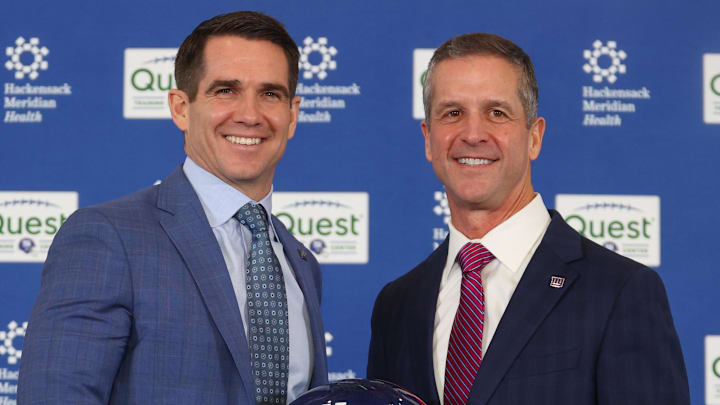
So the fed-up Giants brass went for the gold by bringing in John Harbaugh, the former Baltimore Ravens coach with by far the best resume of any Giants head coach in years, and have given him the power to be on equal footing with general manager Joe Schoen.
They have given Harbaugh everything he required to get the job done right, from unlimited coaching budgets to a promise of no intervention by the team’s ownership to the ability to make changes in other departments that under past head coaches might have been untouchable.
The Giants, simply put, have gotten with the times, realizing that if they are truly sincere about winning, with a coach of Harbaugh’s pedigree, you have to go all in.
Despite the delay in getting the contract done, the full court press to land Harbaugh was the easy part. Now, however, comes the tricky part: putting Harbaugh’s plan into motion.
While we’re sure he has a plan and doesn’t need any outside advice, here is our annual multistep plan to get the Giants back on track.
Get the Salary Cap in Order
Per Over the Cap (as of February 8), the Giants have an estimated $6.941 million in cap space, this number a result of the projected 2026 cap space and based on a $303.5 million leagu-wide cap plus whatever carryover the Giants had from 2025 (which wasn't much).
But the Giants are also among 13 teams whose effective cap space (the space needed to fit players under the “Top 51 rule” which begins at the start of the new league year) is in the red at minus $3.151 million.
Needless to say, the Giants are going to have to do a LOT of work to clean up their cap so they can be competitive in free agency while still having room to re-sign their own pending free agents and the incoming draft class.
Of note, the league has yet to announce the final 2026 salary cap figure, so these numbers will fluctuate albeit not by much.
Regardless of how much the cap actually swells, the Giants will still need to do some clean-up thanks to having a top-heavy cap consisting of ten players whose 2026 cap figures top the $10 million mark.
Four of those figures belong to outside linebacker Brian Burns ($36.55 million, 12.01%), defensive lineman Dexter Lawrence ($26.958 million, 8.86%), cornerback Paulson Adebo ($24.317 million, 7.99%), and left tackle Andrew Thomas ($24.281 million, 7.98%).
While none of those four are in danger of being cap casualties, the first step the Giants, who currently have 57 players under contract for 2026, can take is to reduce some of these hefty contracts, which, had they deployed the use of voidable years in some of them, might not have gotten this far out of control.
Before we get into specifics, it’s worth noting that one thing the Giants have in their favor at the moment is that they have the second-lowest dead-money total ($216,804) currently on the books, behind the Chiefs ($215,641).
This is important, as teams want to ensure that the money being spent is put to good use and not tied up with numerous players no longer on the roster.
It’s also important because there will be cuts, and the last thing the Giants want is a situation like the one in 2024, when they had the second-most dead money ($82.676 million) in the league.
So, how do the Giants make more space? The obvious place to start is roster cuts, of which we suspect could include the following to open just over $24 million in additional cap space:
Kicker Graham Gano: $4.5 million savings, $1.25 million dead money
The handwriting was on the wall the moment Gano went through another season that saw him land on IR not once, but twice. With rookie Ben Sauls having settled down the Giants’ kicking situation toward the back end of the season, there should be no reason why the Giants need to carry Gano for the final year of his contract.
OT James Hudson III: $5.38 million savings, $2.305 dead money
Hudson was signed to be a swing tackle for the Giants, but when pressed into action early in the season while left tackle Andrew Thomas was in the final stages of his rehab from a season-ending foot injury suffered the year prior, Hudson was a disaster.
He ended up on the inactive list five times since his ugly Week 2 showing at Dallas, and once, despite being active, he didn’t play.
RB Devin Singletary: $5.25 million savings, $1.25 million dead money
It’s not that Singletary didn’t contribute or was a bad player for the Giants--far from it. But will anyone seriously argue that his 437 rushing yards in each of his last two seasons justify his contract over a younger, cheaper running back who might provide similar production?
LB Bobby Okereke: $9 million savings, $5.462 million dead money
Okereke finished the 2025 season strong after the team finally got rid of defensive coordinator Shane Bowen.
But with new defensive coordinator Dennard Wilson coming in and being a big proponent of playing the nickel (the Titans, under Wilson, were in the nickel for 62.7% of their 1,009 defensive snaps, per NextGen Stats, 16th in the league.
That's far more than the Giants, who deployed the nickel on 59.3% of their snaps, perhaps it makes sense to go with a less expensive option–even a draft pick– at inside linebacker, with whom maybe they can pair with Micah McFadden (assuming he returns) and the occasional contributions by Abdul Carter at that spot.
Once these cuts are made, the Giants can look at restructures–outside linebacker Brian Burns, defensive lineman Dexter Lawrence, and left tackle Andrew Thomas all figure to be candidates for restructures.
But as always, that glass should be broken only in an emergency.
Start Using Voidable Years and Option Bonuses in Free Agency

I can’t understand why the Giants have been so against using voidable years in their free-agent contracts, a method that the Eagles make regular use of.
Voidable years allow for the maximum thinning of signing bonuses, which can be spread out up to five years. When the contract voids, the remaining signing bonus depreciates in value as the league-wide cap rises.
For example, instead of giving a player a $10 million signing bonus over three years, which would come to $3.33 million prorated over the three-year life of the contract, by tacking on two voidable years (years the player won’t see), now the prorated bonus per year drops to $2 million per year.
Moreover, the dead money, in this case taking that same $10 million bonus over five years, which in the case of two voidable years gives you a $4 million dead money hit, depreciates in terms of the percentage of the cap it will take up down the line, given the year-over-year increase of the cap.
The Eagles, per Nick Kolte of Over the Cap, currently lead the league in most cap dollars in void years. The Giants have NO contracts with voidable years.
An option bonuses is another mechanism that teams can use to better control a cap. An option bonus, once exercised, automatically prorates over the remaining life of a contract up to a maximum of five years. It also reduces the base salary for the player in the year it's been exercised, all of which lowers a player's cap hit without depriving a player of any money.
If the Giants want to be aggressive in free agency, they have to be smarter with their spending and take full advantage of every mechanism available to optimize it.
Decline the Option Years for Deonte Banks

In what should be one of the easiest decisions the Giants brass will make this offseason (besides letting offensive lineman Evan Neal walk in free agency), the Giants need to decline the option year in 2023 first-round pick Deonte Banks’ contract.
Banks, per Over the cap, would be owed $11.655 million if his rookie option year were exercised.
Considering Banks lost the starting cornerback job to Cor’Dale Flott and was reduced to a kickoff returner in 2025 (albeit a productive one), the $11.655 million Banks would be owed is a bit of a steep price to pay for a team that, as previous mentioned has to trim the fat, to justify–especially considering how Banks hasn’t shown consistency in becoming the cornerback the team thought they were getting.
Add a Big-bodied Defensive End Type to the Pass Rush Group

This is more of a strategic roster-building approach, given how the Giants' edge rushers are currently constructed. Kayvon Thibodeaux, Abdul Carter, and Brian Burns all range in listed weight from 250 to 258 pounds.
That can put them at a disadvantage on the pass rush against bigger offensive linemen who outweigh them by 50 pounds unless they’re winning with quickness and speed.
A move that might make more sense to help the pass rush be more efficient would be to add a larger bodied defensive end weighing about 25 or so pounds more than any of the three outside linebackers–a Myles Garrett (Browns) type who weighs 272 pounds and who can dominate against the run and command attention that helps freeing the outside linebackers to rush the passer.
Maybe landing such a player can pave the way for the Giants to trade Thibodeaux, who is entering the option year of his rookie deal and who is by no means a slam dunk to sign an extension when the time comes, for some premium draft picks that the Giants can use to fill additional roster holes.
Address the Following Key UFAs
According to Spotrac, the Giants have 21 players set to become unrestricted free agents. Suffice it to say, more than half of those players will not be sporting the “NY” on the side of their helmets in 2026.
I would think guys like receiver Gunner Olszewski, long snapper Casey Kreiter, and inside linebacker Micah McFadden are among those who will be back, as none should draw a contract that would blow the available cap space.
But let’s get to the key members of the Giants’ 2026 UFA class and how those might play out.
WR Wan’Dale Robinson

Robinson’s stock has been steadily rising since he returned from a torn ACL suffered in his rookie season, with his receiving yardage (and receptions) rising each year, culminating in 2025 when he topped the 1,000-yard mark.
Robinson has also evolved beyond being just a slot receiver. This past season, he saw a career-high 31.1% snaps lined up wide, a factor that is sure to make him even more attractive on the open market.
Interestingly, Joe Schoen has avoided spending big money on receivers, the closest being the three-year, $36 million deal he gave to Darius Slayton.
There are two things to consider here besides the money. The first is that Harbaugh’s Ravens teams have been among the top-ranked in 12-personnel (one running back and two tight ends). Will that trend continue with the Giants?
If so, then one would think bringing in another pass-catching tight end (or perhaps even re-signing Daniel Bellinger, who is as underrated as they come) would be a better use of the available cap dollars.
As for receivers, slot guys are typically a dime a dozen both in free agency and the draft. That said, the Giants do need to address the receiver position, and it might just make more sense for them to do so via the draft, where they can put another key piece of the offense on a rookie deal.
OT Jermaine Eluemunor

When it came to pass blocking, Eluemunor stood toe-to-toe with some of the best edge rushers in the league.
Per PFF, he allowed just 19 pressures (four sacks) in 2025, the lowest total in his two seasons as a Giant and his lowest total in at least 500 pass-blocking snaps played dating back to 2022.
Yes, there were the 14 accepted penalties, nine of which were false starts and six of which resulted in stalled drives, per league stats, but to be fair, he is so quick off the snap that the quickness likely contributed to his getting a head start before the ball was snapped by a split second or two.
His run blocking, on the other hand, was choppy. Still, at only 31 years old and having been mostly durable during his two-year stint with the Giants, Eluemunor will probably get himself a nice payday, which Spotrac estimates to be a two-year, $17.33 million deal ($8.7 million APY), which seems kind of low.
While bringing Eluemunor back makes sense–and who knows if he wants to return, given that Carmen Bricillo, his offensive line coach, wasn’t retained by the team–that the Giants drafted and started grooming Marcus Mbow for a starting role at talent could be all the justification they need to let Eluemunor go elsewhere.
CB Cor’Dale Flott

Flott might not be a sexy name in the free-agent cornerback market, but last season, he was one of the few cornerbacks the Giants had who played man and zone coverage equally well.
Just 24 years old, Flott is coming off his best season to date, having recorded one interception and 11 pass breakups, while allowing the seventh-lowest passer rating (72.8) among cornerbacks league-wide who had a minimum of 500 coverage snaps, regardless of scheme.
Spotrac has projected a 4-year, $38.031 million contract for Flott that comes to about $9.5 million APY. That’s not a bad figure for a guy who, while not a CB1, still showed himself fully capable of handling a starting role.
TE Daniel Bellinger
Bellinger doesn’t get many opportunities in the passing game, but when he does, he’s usually pretty reliable. Bellinger’s 73.1% catch rate wasn’t that far off from Baltimore’s Mark Andrews’s 73.8 in 2025, Bellinger being a better pass blocker than Andrews per PFF.
That said, it would not be surprising if the Giants sought to add fullback Patrick Ricard and tight end Isaiah Likely from the Ravens if the plan is to go to more 12-personnel and a run-heavy offense like what Harbaugh had in Baltimore for years.
Those moves would likely spell the end of any potential interest in Bellinger, a player the Giants have tried to either draft or trade for ever since his second NFL season.
Try to Pick Up More Draft Assets
The Giants are not projected to get any comp picks in this year’s draft, thanks to their activity in last year’s free-agency period.
(Side note: had they not signed tackle James Hudson III, who is sure to be a cap cut this year, the Giants would have been in line to pick up a seventh-round comp pick as a result of having lost outside linebacker Azeez Ojulari.)
That said, the Giants have seven picks in the 2026 draft order, and only two in the top 100: Picks 5, 37, 105, 143, 185, 191, and 192.
That 68-pick gap between the Giants’ second round pick (No. 37) and their first pick of Day 3 (No. 104, their fourth round pick), the result of their trade last year with the Texans to move back into the first round for quarterback Jaxson Dart, is a long time to have to wait to make a pick.
The only way the Giants can gain more draft assets is via a trade, something that general manager Joe Schoen hasn’t necessarily been afraid to do. At the same time, when it comes to the trade deadline, he has shown a tendency to overvalue his players rather than meet in the middle.
The most recent example of this came two years ago, when the Giants reportedly wanted a fourth-round pick for Ojulari but, at best, were offered a sixth.
Rather than take the sure-fire thing, Ojulari ended up walking away, and, as already noted, the signing of Hudson nullified what would have been a seventh-round comp pick, one pick worse than what the Giants could have had if they agreed to take something for the pass rusher.
That said, these are the potential players the Giants could trade to acquire more assets.
OLB Kayvon Thibodeaux
Thibodeaux is entering the option year of his rookie deal, his cap figure currently at No. 25 among edge rushers. If the Giants intend to add a big-bodied defensive end to better handle the still bigger offensive tackles, a move we think makes sense, then why not see if there could be a market for Thibodeaux?
WR Darius Slayton
Slayton still has one more year of the three-year deal he signed last season, worth $36 million total ($12 million per year).
While he’s coming off a subpar (for him) season in which he caught 61.7% of his pass targets, posted six drops, his third-highest career total, and had a career worst 27.3% contested catch rate, if the Giants are thinking about adding another receiver via the draft, it wouldn’t be a crazy idea to see if they couldn’t move Slayton to a team in need of a veteran receiver.
Add Depth to These Spots
A team is never going to address every single need in one offseason, as the market and the draft often dictate the best course of action. But the Giants could use additional reinforcement in the following areas (in no particular order).
Linebacker
Bobby Okereke could be a cap casualty, and Micah McFadden is an impending free agent. Regardless of whether one or both are kept, the drop-off in depth behind them this past season was clearly exposed.
With this draft class said to be a strong one at linebacker, it would be surprising if the Giants do not address this spot.
Cornerback
Deonte Banks figures to get one more crack to prove he’s worth retaining, and Cor’Dale Flott is an impending free agent. Much like the linebacker position, the depth behind the starters left something to be desired at this position, so adding another player here would be a wise move.
Offensive Tackle
When the Giants drafted Marcus Mbow, it was likely done with the intention of moving him into the right tackle spot once Jermaine Eluemunor's contract was up.
If that indeed is the plan, that means the Giants lose their swing tackle and would be wise to try to find someone to fill that role, especially if they plan to move on from James Hudson III, as is expected, and especially given all the injury issues that have plagued 27-year-old Andrew Thomas these past few years.
Running Back
Although Cam Skattebo is believed to be on track in his recovery from his season-ending ankle injury, it still wouldn’t be a bad idea to add more depth at this position, especially if the team intends to move on from Devin Singletary in a salary cap-related move.
Dante “Turbo” Miller figures to get a chance at making the roster, but regardless, the Giants should also seek to add another running back to the competition just in case.
Receiver
Malik Nabers is going to be back at some point, whether that’s at the start of training camp or a couple of weeks into the new season, depending on when he gets the green light for a full return.
But there is no guarantee that Wan’Dale Robinson is back, nor is there a guarantee that Jalin Hyatt, who has thus far been a disappointment, will last much longer on this team.
Kicker
Ben Sauls did a pretty nice job late last year in settling down the revolving door at kicker, but he also wasn’t really put to the test in pressure situations. It would be a surprise if the Giants don’t bring in competition for Saults for the upcoming training camp.
What happens next with the NY Giants? Find out! Follow and like us on Facebook. Visit our YouTube channel for the latest videos. Want to send a question in for our mailbag? Send it here.
More New York Giants Coverage
 Add us as a preferred source on Google
Patricia Traina has covered the New York Giants for 30+ seasons, and her work has appeared in multiple media outlets, including The Athletic, Forbes, Bleacher Report, and the Sports Illustrated media group. As a credentialed New York Giants press corps member, Patricia has also covered five Super Bowls (three featuring the Giants), the annual NFL draft, and the NFL Scouting Combine. She is the author of The Big 50: The Men and Moments that Made the New York Giants. In addition to her work with New York Giants On SI, Patricia hosts the Locked On Giants podcast. Patricia is also a member of the Pro Football Writers of America and the Football Writers Association of America.
Follow Patricia_Traina