%20%20--%3E%0A%3Csvg%20version%3D%221.1%22%20id%3D%22Layer_1%22%20xmlns%3D%22http%3A%2F%2Fwww.w3.org%2F2000%2Fsvg%22%20xmlns%3Axlink%3D%22http%3A%2F%2Fwww.w3.org%2F1999%2Fxlink%22%20x%3D%220px%22%20y%3D%220px%22%0A%09%20width%3D%2239px%22%20height%3D%2240px%22%20viewBox%3D%220%200%2039%2040%22%20enable-background%3D%22new%200%200%2039%2040%22%20xml%3Aspace%3D%22preserve%22%3E%0A%3Cpath%20fill%3D%22%23FFFFFF%22%20d%3D%22M38.5%2C7H28.2v26h10.3V7z%22%2F%3E%0A%3Cpath%20fill-rule%3D%22evenodd%22%20clip-rule%3D%22evenodd%22%20fill%3D%22%23FFFFFF%22%20d%3D%22M26.1%2C25.5c0%2C5.8-4.1%2C7.5-12.9%2C7.5C3.9%2C33%2C0%2C31.2%2C0%2C25.2v-1.1h11.6%0A%09v2.4c0%2C0.7%2C0.1%2C1.4%2C1.2%2C1.4c1%2C0%2C1.2-0.4%2C1.2-1.3v-0.9c0-1.6-0.9-1.6-3.5-2.2C2.2%2C21.7%2C0%2C19.7%2C0%2C15.3v-0.9C0%2C9.3%2C5.5%2C7%2C12.9%2C7%0A%09c10.2%2C0%2C12.8%2C2.6%2C12.8%2C7.4v1.8h-11v-2.9c0-0.6-0.4-1.1-1.2-1.1c-0.6%2C0-1.2%2C0.4-1.2%2C1.1v0.9c0%2C1.5%2C0.9%2C2%2C3.3%2C2.5%0A%09c8%2C1.6%2C10.5%2C3.3%2C10.5%2C7.5V25.5z%22%2F%3E%0A%3C%2Fsvg%3E%0A)
How Nebraska’s Heinrich Haarberg Actually Became the Next Taysom Hill
Taysom Hill, soon to be 36, has been Taysom Hill long enough that there is now a cottage industry built on becoming the next Taysom Hill, whenever the NFL manages to finally get rid of him.
Don’t mistake this with the common trope of labeling current NFL quarterbacks with the ability to list more than “throwing a football” on their cover letters (but without a role as a starting quarterback) as Taysom Hill. Poor Justin Fields, for example, said he was willing to be Taysom Hill in Pittsburgh, was reportedly less willing to be Taysom Hill with the Jets, and, having signed with the Chiefs, is—you’re never going to believe this—projected to be the next Taysom Hill.
Instead, this is the year of the college quarterback actually billing themselves as Taysom Hill (either eagerly or by accepting the comparison after being relentlessly worn down).
Here’s Georgia Tech quarterback prospect Haynes King on the Up & Adams show talking about being the next Taysom Hill.
Here’s North Dakota State quarterback Cole Payton saying he is not Taysom Hill and essentially begging people to stop comparing him to Taysom Hill. Here, then, is another piece comparing him to Taysom Hill.
Here’s an actual football conversation—not, as it appears, a shouting match between two people at a Hooters who are about to be removed by security—between Jon Gruden and Vanderbilt’s Diego Pavia. Gruden wants to know if Pavia, who is generously listed as two inches shorter and more than 20 pounds lighter than Taysom Hill (a player, who, again, did a ton of blocking as both a fullback and in-line tight end) is interested in perhaps being the next … right, you guessed it.
“He’s a badass,” Gruden says of Taysom Hill.
“Just put me on the f------ field,” Pavia says when asked what his response would be to performing Taysom Hill–like acts. “Hell, yeah. Put me on the field.”
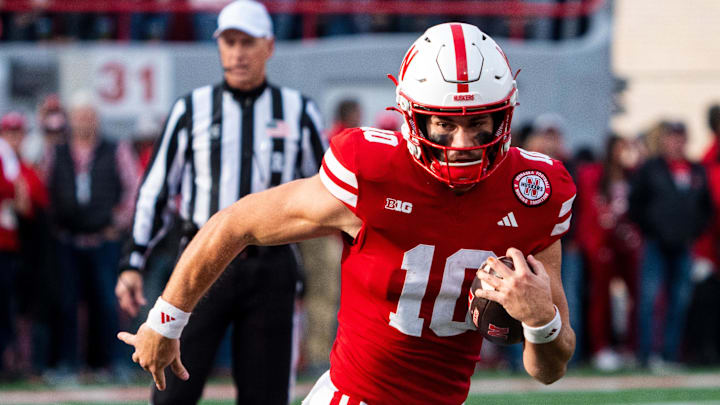
All of this to say that we’re missing the point. There actually is a Taysom Hill in this draft—perhaps the cleanest replica of Taysom Hill we’ve ever seen—and it’s not simply an aged-out collegiate quarterback we can’t comfortably place into a bucket. His name is Heinrich Haarberg and his path to arriving here is fascinating.
As a sophomore starting quarterback for Nebraska, Haarberg had his career-best passing game against the eventual national champions, Michigan. He went 5–3 as a starter, chipped in as an H-back and opted to remain loyal to his hometown program when Dylan Raiola committed to the school, guaranteeing Raiola claim to the starting job. Haarberg switched positions to tight end in-season, just before a bowl game, and remained a willing short-yardage specialist under center instead of committing to the endless slog of the transfer portal to find a starting quarterback gig elsewhere.
He converted roughly 90% of his Tush Push snaps and there’s a great clip of him stepping back in as a Wildcat quarterback, handing the ball off and then absolutely burying a Michigan State defender at the goal line with his newfound blocking skills.
Matt Rhule called him one of the greatest athletes he’d ever coached. He finished fifth in the combine in 40-yard dash times among tight ends, fourth in the vertical jump, third in the broad jump and first in the shuttle. And, he sums up his sales pitch realistically: He is willing to get a team a first down in situations that don’t make sense for full-time quarterbacks. “I got speared in the ribs, in the butt, more than a few times this year from doing [Tush Pushes],” he says. “And you don’t want to put anyone that you’re paying $50 million at risk for [that].”
“I’m probably a little bit closer to prototypical tight end size than [Taysom Hill],” says Haarberg, who is expected to go anywhere from the sixth round to undrafted free agency. “He was just a phenomenal athlete. Like him, I’m willing to do whatever, if that’s the role that a team wants me to play, kind of a Swiss Army knife. I play special teams, play tight end, play tailback, line up in the Wildcat. I do quarterback sneaks. If that’s what a team wants me to do, I’m all for it. I’m willing to do whatever it takes to help a team win.”
Haarberg is essentially a self-taught quarterback, learning to throw in his Kearney, Neb., backyard from his father, a former Nebraska fullback. That meant more of a roughshod approach that carried with it a desire to lift heavy and play a more rugged version of the position even at the Big Ten level. When the chance to pivot to tight end arose, Haarberg didn’t have to change much, aside from adding “a few more chickens before bedtime.”
“I was a fifth-year senior, but I felt like I was swimming out in the ocean by myself,” he says. “You line up against a couple of Big Ten teams and they’ve got some Round 1 draft pick that lined up at edge. You got to figure out how to base block them. Those moments were humbling, but they also built me up a lot because once I figured out that I could do that, then that was a huge confidence boost to me. Once I started to get my footwork, get my hands in the right spot, I kind of knew just from the weight room and from workouts that I could compete with these guys physically.
“It was just getting the technique and having the right mindset.”
This is what many are missing when projecting an actual Taysom Hill replica. His ability to make an impact was always more directly tied to his versatility. His presence could shift the Saints’ offense into something more amoebic, forcing the defense into a situation where it was almost always in the incorrect personnel, almost like a poor man’s Kyle Juszczyk who could hit an out route (seeing as Hill could easily shift positions into a more advantageous look). But that also meant having a proven track record as a blocker who could actually function in an NFL offense as a legitimate tight end or H-back. Hill has been credited with only one quarterback sack allowed in his career among all his pass-blocking snaps. He was, in both 2018 and ’19, graded by Pro Football Focus as one of the more serviceable run-blocking tight ends in the NFL.
Hill’s ability to throw the football was more of an added benefit, a silent threat that also had to be considered by the defense.
And Haarberg is still confident in that part of his game, too, for what it’s worth. During combine prep, he’d arrived three weeks before any of the quarterbacks and served as the primary passer for all of the skill-position players.
“I mean, I probably completed 90% of my passes on air, which should be a hundred, but for not throwing for almost a year, I thought I was doing pretty dang good,” he says.
Perhaps the rush to declare oneself the next Taysom Hill is because Hill is on his way out at a time when the need for a multitooled player may be at its height in the modern NFL. Offenses are still barely converting more than 50% of their third-and-2 situations and a little more than 65% of their third-and-1 situations. While the Tush Push itself has waned a bit in efficacy, it’s still converted at an almost 74% rate leaguewide, with Josh Allen, Jalen Hurts and Justin Herbert among the best in the NFL (all, to Haarberg’s point, quarterbacks who are making far more than $50 million per year). Also, trick plays and their efficacy are at an all-time high, with Ben Johnson riding the wave of designer play-calling into a head coaching job and an 11-win season. The statistics on EPA per trick play are clear: More is better, though without multiple players to present as possible throwers on the field, the Rolodex of trick plays becomes more limited.
It would seem that the onset of a short-yardage specialist quarterback/hybrid player who can also play special teams and serve other functions within the offense in the meantime is not merely a luxury but, soon, an inevitability on every team.
And, while the pool of prospective Taysom Hills feels deeper than ever, the reality is that Haarberg is one of the few already living the lifestyle.
“I hope teams see my physicality, my willingness to put my head down and get into the end zone and run somebody over, and whatever it takes,” he says.
More NFL Draft from Sports Illustrated
 Add us as a preferred source on Google
Conor Orr is a Senior Writer for Sports Illustrated with more than 15 years of experience covering the NFL. His work has been cited in Best American Sportswriting and has won a PFWAA award. Prior to Sports Illustrated, he covered both the Giants and Jets for The Star-Ledger. Conor lives in New Jersey with his amazing wife and three children.
Follow author