%20%20--%3E%0A%3Csvg%20version%3D%221.1%22%20id%3D%22Layer_1%22%20xmlns%3D%22http%3A%2F%2Fwww.w3.org%2F2000%2Fsvg%22%20xmlns%3Axlink%3D%22http%3A%2F%2Fwww.w3.org%2F1999%2Fxlink%22%20x%3D%220px%22%20y%3D%220px%22%0A%09%20width%3D%2239px%22%20height%3D%2240px%22%20viewBox%3D%220%200%2039%2040%22%20enable-background%3D%22new%200%200%2039%2040%22%20xml%3Aspace%3D%22preserve%22%3E%0A%3Cpath%20fill%3D%22%23FFFFFF%22%20d%3D%22M38.5%2C7H28.2v26h10.3V7z%22%2F%3E%0A%3Cpath%20fill-rule%3D%22evenodd%22%20clip-rule%3D%22evenodd%22%20fill%3D%22%23FFFFFF%22%20d%3D%22M26.1%2C25.5c0%2C5.8-4.1%2C7.5-12.9%2C7.5C3.9%2C33%2C0%2C31.2%2C0%2C25.2v-1.1h11.6%0A%09v2.4c0%2C0.7%2C0.1%2C1.4%2C1.2%2C1.4c1%2C0%2C1.2-0.4%2C1.2-1.3v-0.9c0-1.6-0.9-1.6-3.5-2.2C2.2%2C21.7%2C0%2C19.7%2C0%2C15.3v-0.9C0%2C9.3%2C5.5%2C7%2C12.9%2C7%0A%09c10.2%2C0%2C12.8%2C2.6%2C12.8%2C7.4v1.8h-11v-2.9c0-0.6-0.4-1.1-1.2-1.1c-0.6%2C0-1.2%2C0.4-1.2%2C1.1v0.9c0%2C1.5%2C0.9%2C2%2C3.3%2C2.5%0A%09c8%2C1.6%2C10.5%2C3.3%2C10.5%2C7.5V25.5z%22%2F%3E%0A%3C%2Fsvg%3E%0A)
How a Meeting in the TSA Screening Line Turned Around Trevor Lawrence’s Career
In this story:
Albert Breer’s Inside the QB Room Series: Joe Burrow | Jordan Love | Jared Goff
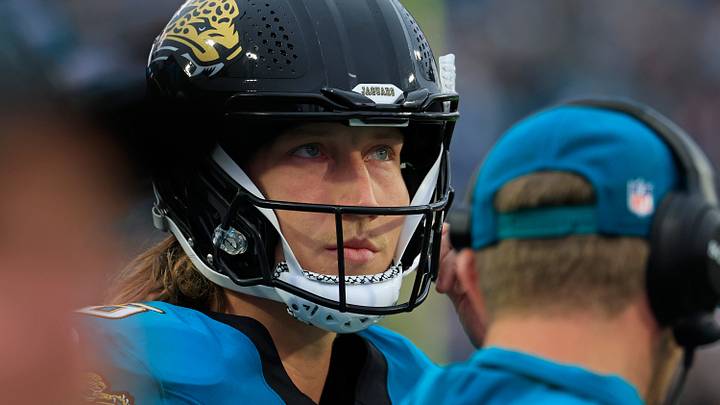
It happened in the TSA line at State Farm Stadium, as Trevor Lawrence recalled it, and was another step in the coach-quarterback relationship that spanned the entire 2025 Jaguars season.
If you were box-score scouting him, Lawrence didn’t play great against the lowly Cardinals. He threw three picks and lost a fumble. You’d think Jacksonville won despite him.
And as they got ready to board the bus, Liam Coen wanted his QB to know he knew better.
“That game, I really thought we started to click offensively,” Lawrence said. “We had a lot of turnovers, but we did some really good things in the passing game. It was the most on the same page, you could say, that we were in the passing game as a unit all season. So, I thought there were a lot of positives. After the game, Liam and I talked; I saw him in the line doing TSA screening, and we were sitting there waiting.
“He was like, Man, I thought you played good. I know we had some turnovers, you had a throw or two you’d want back, but I thought you played well. And I told him I felt the same way.”
It was appreciated, for sure, and also continued the in-game dialogue.
“Throughout that game, that’s when I started to feel him really turning it on,” Coen added. “I would’ve put one pick [on him] that was a bad decision—really bad. Another one was Budda [Baker] making a great play. Another one, he gets hit while he’s throwing it, fumble. But throughout that game, he kept jogging off the field after turnovers, and honestly, I said, Dude, you’re good. You’re playing really well right now. Some unfortunate stuff’s happening, but you’re balling.”
The discussion in the moment, the affirmation leaving the stadium, all of it mattered.
For the new coach and his quarterback, the year was a constant work in progress. They took steps forward. They took steps back. They kept winning along the way. And just as important, through those real discussions, they evolved, and Lawrence and Coen built real trust.
Lawrence’s 2025 numbers didn’t scream that he’s become the NFL superstar that he’s been projected to become since he was a teenager—he finished the year with 4,007 yards, 29 touchdowns, 12 interceptions, a 60.9% completion rate and a 91.0 rating. But his growth came in the details, within the context of a 13-win regular season, and showed in how he finished the year, even if it wasn’t always as clear to those who weren’t watching closely.
Even better, both guys believe it positions Lawrence to finally take off as an NFL quarterback after a tumultuous five-year start to the quarterback prodigy’s pro career.
An early crash out
In the spring of 2025, Lawrence was adjusting to his fourth play-caller and third head coach in five NFL seasons. That, of course, is not how anyone would draw up the development plan for a No. 1 pick at quarterback.
And there was, to a degree, an early crash out.
“I remember those first few practices, I’m like, Holy smokes, this is a lot,” he said. “Just to even call the play in the huddle, because the calls are longer, you have a lot of plays that are two plays in one, sometimes three plays in one. And I had done that before, but not to the extent that we were doing it, which is pretty much every play. That took a while to get used to.”
Indeed, Coen, who came from the Sean McVay school of NFL scheme building (he was on the Rams’ staff for four seasons), had more verbose, long-winded calls than some of the one-word calls Lawrence was accustomed to. Coen also brought the “can” system, where two calls go in on every play, and the quarterback has to decide whether to “can” the first play or not based on coverage and rush indicators.
But it was more than just that. After playing for stable powerhouses in high school and college—in systems built for him—Lawrence suddenly had all of this information from all the Jaguars’ fits and starts rattling around in his brain. He started his NFL career 0–5 after losing fewer games than that in high school and college combined—having carried a 90–4 record over seven seasons at Cartersville (Ga.) High and at Clemson. So out went OC Darrell Bevell and coach Urban Meyer, and in came coach Doug Pederson and OC Press Taylor.
Those two, who wound up trading off play-calling, made it through three seasons, and then acrimony with the front office provoked another organizational restart in 2025. By then, all those systems, calls and philosophies were tangled up in Lawrence’s head, which is common when a young signal-caller goes through so much change.
And having to learn a more intricate, detailed system on top of that was, like Lawrence said, a lot.
“So, then you’re thinking about all that stuff presnap,” he said. “But then the next thing you know, the ball is snapped, and you’re not necessarily playing as fast, because you’re thinking about things that you don’t really want to have to be thinking about. You’re checking your formations. And then at the beginning of the season, it’s sometimes, I’m processing a little slow, or maybe someone lines up wrong, and I’m like, Hey, this guy has to move over here.”
“And it’s all taking away from the things that you want to be able to do as a quarterback presnap, which is to see the defense, anticipating where you’re going to go with the ball, and trying to figure out presnap what they’re playing. And I think that’s all part of the process.”
But the key for Lawrence was that Coen’s process wasn’t so rigid that he couldn’t adjust it on the fly. And the quarterback’s honesty with his coach on how he was feeling would open the door for Coen to show that their partnership was never going to be my-way-or-the-highway.

Lawrence is honest with Coen
Coen still calls the game the “Houston Debacle.”
The Jaguars blew 17–0 and 29–10 leads in the game, with Texans backup Davis Mills directing a 14-play, 93-yard drive to score the game-winning touchdown with 31 seconds left (Sheldon Rankins tacked on another six points at the horn on a strip-sack return). The numbers weren’t objectively terrible for Lawrence, and Jacksonville did score 29 points.
But just as Coen was honest with Lawrence later in the year in Arizona, Lawrence was going to be honest with the coach about how he felt in the aftermath. It wasn’t the first time they’d debriefed after a game, or a loss. It was, though, as raw as could be.
Lawrence knew the truth. The offense scored on a bunch of short fields, and once the Jaguars took the lead, they stopped attacking and went into the football equivalent of a four-corners offense. Worse, against the imposing Houston defense, the scrambling of how Lawrence saw things came to a head.
“We talked all season, and after that game especially, we did a great job of communicating,” Lawrence said. “And I give Coach a lot of credit because it’s our first year together; he’s trying to get a feel for me, and I’m getting a feel for him. And we’re trying to find the best way to get our offense going because it wasn’t clicking yet. So we had a lot of really good conversations on Mondays and Tuesdays in his office after games, especially after the Houston game.
“And I just felt like, I don’t feel like I’m playing as well as I know I can play. I don’t feel like our offense is operating great right now. I feel like we’re leaving a lot of stuff on the field. And I just told him, basically, I don’t think I’m playing as quickly as I need to be playing mentally. I don’t think I’m trusting myself and just letting it rip. I feel like there’s a lot of moving parts presnap that I’m thinking about and not able to go play.”
That struck a chord almost immediately for Coen, from his time playing the position.
He knew if Lawrence didn’t have clarity, the Jaguars didn’t have a chance. They were 5–4 at the time. They had eight weeks left. There was time to change and lean in on Lawrence’s strengths as a player.
“We started to tweak things to tighten the menu of the pass game to things he does at a high level,” Coen said. “And what are the areas that he needs to improve on? Maybe some of those can go on the shelf for the offseason. And also, it was like, in pure-progression reads, it’s, All right, one, two, three, four. You’re just exhausting it. It’s not a coverage read. So we also said, All right, one, two, go. Start using your legs more. I think that helped allow him to play more freely.
“He was loose because he wasn’t worried about, before the snap, going to number four. It was, I’ve got to get all the way back to this guy, maybe I can, I don’t know, and is the protection going to hold up? You’ve got a lot of things going on in your mind. So, man, let’s try to trim the inventory, tighten up what he does well, what our wideouts do well, what our tight ends do well. And then, Hey, man, when one and two aren’t there, let’s start using your legs.”
A week earlier, another piece to the bigger puzzle fell into place, when the Jaguars’ trade for Raiders slot receiver Jakobi Meyers allowed, in time, for Parker Washington, Brian Thomas Jr. and Brenton Strange to play roles tailored to their skill sets, and give Lawrence a trustworthy target over the middle.
The Jaguars ripped off eight consecutive wins to close the regular season.
Lawrence takes command of the offense
Jacksonville didn’t need Lawrence to be a star the next week, a 35–6 blowout of the Chargers at home, and the win in Arizona followed that one. The Jaguars were rolling, and a vital part of it was Lawrence’s command of the offense and his confidence in a way he hadn’t been.
It happened, as he sees it, because he went from trying so hard to get every piece of the offense mastered to simply majoring in what he knew he could do best.
“You train your mind so much in the offseason to get through your progressions, especially when you’re learning a new system, like, How can I get through my progressions as quickly as possible and find the completion?” he said. But then the real element of football that comes up, that doesn’t come up all spring or training camp because you can’t get hit, is the ability to extend the play, to leave the pocket. And that’s something you have to remind yourself of because, as I said, in practice, you’re not getting hit.
“You work on these progressions so much, and you hang in the pocket a lot longer than you typically can in a game because the pass rush can’t hit you. That’s a big part of it.”
Lawrence also missed the back of the 2024 season with an AC joint sprain. He almost had to recalibrate his willingness to run back to what it had been—and Coen’s green light to pull the ball down earlier in his progressions helped him do that.
“I was going through my progressions fine, but I felt like I was slow to see the rush lanes and the scramble lanes,” Lawrence said. “And that’s a part of my game that I think, when I’m on, I’m really good at. And you can see toward the end of the season that changed our offense, and it made us a lot more explosive. So I think that’s a part of it, too, where it was just getting back to being comfortable, the flow of the game, understanding the clock, getting settled back into that.
“And knowing within my progressions, Hey, if the pocket’s clean and I can progress all the way backside and get the ball out, great. But if I’ve got through one, got through two, I start to get backside, and now we have a free defensive end or D-tackle, let’s make a play.”
The offense started to get going as Lawrence did. The run game got untracked in Houston, and really got going the next week against the Chargers. In a rainy home game against the Colts on Dec. 7, Lawrence’s freedom to move around got the downfield passing game rolling, and, finally, Thomas started to come out of his sophomore slump as a result.
Then came the second game against the Colts in Indianapolis in Week 17.
Facing DC Lou Anarumo—“They bring a lot of different pressures, Lou is kind of the GOAT for that, throwing a bunch of junk at you and seeing how you react”—Lawrence felt fully capable of going blow-for-blow with the other team’s mastermind. He made a difference with his legs. He was efficient when it mattered most in the fourth quarter. The Jags controlled the game’s final moments and won.
“We had a great plan, and as a player, it felt like whatever Liam called, we were going to make it right because we knew the plan. We knew our checks. I felt like I was spinning it and guys were making plays,” Lawrence said. “That was a game where you see a lot of different parts come alive, where he had great calls that put us in some great situations, but then we also figured out some things that weren’t the easiest looks for us to go against.”
The Jaguars clinched the AFC South the next week with a 41–7 blowout of the Titans, then bowed out in a close wild-card round loss to Josh Allen and the Bills, a game in which Lawrence had his ups and downs.

Lawrence’s expectations
Any telling of Lawrence’s story has to start with expectations.
From the time he was 15 years old, expectations were on another level than almost any peer he might have. By the time he was 19, he’d won a collegiate national championship. He started to be discussed in the tier of NFL quarterback prospects reserved for guys like John Elway, Peyton Manning and Andrew Luck. And his pristine record before reaching the pros preceded him—any potholes he’d hit were minor compared to what was heard in the pros.
Five years later, he has scars that many figured he’d never have to sustain. His hope, going forward, is that he’ll wind up being better for it.
“One of the biggest things is learning to find that confidence within myself, during a lot of crazy circumstances, where sometimes it’s been challenging, where things aren’t going well,” he said. “My rookie year, and then the next year we had a good year, and we found a spark and played better. And then the next two years, we struggled a little bit. So there have been a lot of ups and downs. And I think for me, I’ve just learned a lot through every season, through every bit of adversity and trials; it’s that confidence piece within myself.
“It also gives me confidence knowing that it’s not just me. It’s a team game. Don’t get me wrong. Don’t take this the wrong way, but I’ve been able to figure it out, still come out the other side, learn something from it and get better. And that gives me a lot of confidence, too. Because we’ve been through …
Lawrence then paused and laughed, “We’ve been through a lot here the past five years.”
As he said, he has come out the other side and is now ready to go forward.
As Coen said, the Jaguars have worked to untangle everything that was tangled up in Lawrence’s head; certain concepts went on the shelf. This offseason, many of those ideas are back and are now being implemented. The communication between quarterback and coach is free and easy. The operation’s resilience had to be earned, and it has been.
So on the morning I was at camp, nearly a month in, the offense missed a couple of opportunities early for down-the-field touchdowns. But they came back in the final period, a call-it period, where the coordinators are basically calling plays against each other with no script, and Lawrence was nails. Even better, in playing the way he was, he was running a more fleshed-out version of Coen’s offense.
“He has complete ownership and autonomy over the run game, the protections,” Coen said. “He’s done a phenomenal job of learning and growing in that area. It’s now just the standard; his standard of performance every day has got to be at an all-time high. And not from a pressure standpoint. Just the way he played toward the end of the year, when you wake up and brush your teeth in the morning, like, that’s who you are, that’s what you expect. You look in the mirror, that’s just you.
“There’s no, I’ve got to get myself to that. I’m there. I’ve got to think that way and feel that way. And that’s how we’ve tried to lift him up that way.”
In turn, Lawrence hopes that he’s finally found the stability that he had playing for Joey King at Cartersville and Dabo Swinney at Clemson.
Most importantly, he’s now well aware of what it’s going to take to get it.
“No doubt,” he says. “It’s hard to think too far ahead in this league just because there’s so much focus and pressure on, What now? And obviously to go and make this year the best we can make it, because I feel like we’ve got a great team and we’re all excited about the opportunity. But to your point, I mean, yes, there is excitement about that possibility. That’s what we all want, right? That means that we’re playing well, we’re winning a lot of games, that coach is doing a great job, that I’m playing well.
“All of those things, if we’re still together in five or 10 years, that means it’s all going right.”
And taking all this in, Lawrence and Coen, together, feel like what happened in 2025, all of it, should give them a heck of a chance to get there.
 Add us as a preferred source on Google
Albert Breer is a senior writer covering the NFL for Sports Illustrated, delivering the biggest stories and breaking news from across the league. He has been on the NFL beat since 2005 and joined SI in 2016. Breer began his career covering the New England Patriots for the MetroWest Daily News and the Boston Herald from 2005 to ’07, then covered the Dallas Cowboys for the Dallas Morning News from 2007 to ’08. He worked for The Sporting News from 2008 to ’09 before returning to Massachusetts as The Boston Globe’s national NFL writer in 2009. From 2010 to 2016, Breer served as a national reporter for NFL Network. In addition to his work at Sports Illustrated, Breer regularly appears on NBC Sports Boston, 98.5 The Sports Hub in Boston, FS1 with Colin Cowherd, The Rich Eisen Show and The Dan Patrick Show. A 2002 graduate of Ohio State, Breer lives near Boston with his wife, a cardiac ICU nurse at Boston Children’s Hospital, and their three children.
Follow AlbertBreer