%20%20--%3E%0A%3Csvg%20version%3D%221.1%22%20id%3D%22Layer_1%22%20xmlns%3D%22http%3A%2F%2Fwww.w3.org%2F2000%2Fsvg%22%20xmlns%3Axlink%3D%22http%3A%2F%2Fwww.w3.org%2F1999%2Fxlink%22%20x%3D%220px%22%20y%3D%220px%22%0A%09%20width%3D%2239px%22%20height%3D%2240px%22%20viewBox%3D%220%200%2039%2040%22%20enable-background%3D%22new%200%200%2039%2040%22%20xml%3Aspace%3D%22preserve%22%3E%0A%3Cpath%20fill%3D%22%23FFFFFF%22%20d%3D%22M38.5%2C7H28.2v26h10.3V7z%22%2F%3E%0A%3Cpath%20fill-rule%3D%22evenodd%22%20clip-rule%3D%22evenodd%22%20fill%3D%22%23FFFFFF%22%20d%3D%22M26.1%2C25.5c0%2C5.8-4.1%2C7.5-12.9%2C7.5C3.9%2C33%2C0%2C31.2%2C0%2C25.2v-1.1h11.6%0A%09v2.4c0%2C0.7%2C0.1%2C1.4%2C1.2%2C1.4c1%2C0%2C1.2-0.4%2C1.2-1.3v-0.9c0-1.6-0.9-1.6-3.5-2.2C2.2%2C21.7%2C0%2C19.7%2C0%2C15.3v-0.9C0%2C9.3%2C5.5%2C7%2C12.9%2C7%0A%09c10.2%2C0%2C12.8%2C2.6%2C12.8%2C7.4v1.8h-11v-2.9c0-0.6-0.4-1.1-1.2-1.1c-0.6%2C0-1.2%2C0.4-1.2%2C1.1v0.9c0%2C1.5%2C0.9%2C2%2C3.3%2C2.5%0A%09c8%2C1.6%2C10.5%2C3.3%2C10.5%2C7.5V25.5z%22%2F%3E%0A%3C%2Fsvg%3E%0A)
Alone in his two-toned blue bedroom, where he spent most of his time, a young Jeremiyah Love had what he’s now certain is a core memory.
He was watching Seven Deadly Sins, an anime series on Netflix. The protagonist is a quasi-immortal with spiky blond hair named Meliodas, who will be endlessly reincarnated but is doomed to have his emotions blunted every time he dies. After mercilessly killing one of his enemies, Meliodas becomes frightened by the prospect of turning back into his original, demonic form. But he needs to access that power to save the one he loves, and when he realizes that, tears pour from his eyes.
To that point in his life, Love had struggled with accessing his own emotions. Once, he told his mom that he didn’t feel happiness, love, grief or sadness. Yet here was Meliodas, the most powerful being in the universe, crying. The warrior facade had come undone. Love then realized it was O.K. to express himself and let his emotions show.
“That kind of opened it up to me,” Love says. “It was like, Oh, I am who I am. Before I watched anime, I was tired. I didn’t have many emotions. I didn’t really cry. I didn’t really feel too much of anything. And, just seeing that opened my eyes to allow myself to be able to feel those things or to feel different types of emotions. From that time, it’s allowed me to progress in my knowledge of how to express myself.”

During an interview for a televised pregame segment last fall, Love’s parents detailed his preference for solitude alongside some other perceived quirks. Their son grappled with common social situations. He took an eternity to get ready for school, insisting that his clothing fit in a specific way. All of his shoes had to be lined up in a certain order. (Notre Dame coach Marcus Freeman says that when he went to the Love’s home for his first visit, he was warned not to touch them.) A family pediatrician suggested that Love may have autism spectrum disorder. His parents did not feel the need to pursue accommodations for Jeremiyah, but they finally understood that he saw the world in a different way.
Now Love approaches the NFL draft, where he is a sure-fire top-10 pick after a junior season at Notre Dame that included 1,652 all-purpose yards and a third-place finish behind Fernando Mendoza for the Heisman Trophy. Certainly, football helped transform Love. But Love also transformed nearly everyone he came in contact with along the way, too. As impressive as his on-field exploits have been, his off-field heroics carry with them a weighty sense of morality and justice.
“He’s such a unique individual,” Freeman says. “He is so much more than a football player. There’s so much that he does, and who he is when no one is around. He doesn’t love attention. He doesn’t do anything for attention. Certain guys thrive on acknowledgement and there’s guys that, this is just who they are on the inside.
“That’s who Jeremiyah is.”
Love is not different for the sake of being different. For the sake of marketability. For the sake of presence. He is different like Clark Kent was, having been born of another world with unbelievable powers and trying to make the best of it here, in the place where he happened to land.
Whatever team drafts Love will acquire a back who can instantly alter a game with the potential to score from anywhere. Once, in high school while sitting out with a hamstring injury, Love sensed the momentum shifting, checked himself in for one play and ran 70 yards for a score before checking back out again. And, if you believe the coaches who have worked with him in college and high school, he’s actually better at blocking than running and could be a legitimate NFL prospect as a wide receiver.
But it’s Love himself who may end up providing the largest windfall for his next franchise. As he continues to explore personal growth, he feels he has taken his social and emotional evolution and applied it to his superpower: an unrelenting work ethic that, Love says plainly, “has got to be like that.”
“I wanted to get to know myself more,” Love says, downplaying, like a hero from the pages of one of his comic books, exactly what that means and just how much it took to get here.

The Cadets of Christian Brothers College High ran an offense with two running backs on the field at the same time, positioned on either side of the quarterback. During the week, the coaching staff would explain to Love that certain plays were explicitly for him, necessitating that he would line up here and carry the ball there. The other calls belonged to Dylan Van or Ralph Dixon. Van has been Love’s best friend for more than a decade and had a permanent place on the floor of Love’s bedroom.
Despite this, quarterback Cole McKey would get the signal from the sideline (the Cadets didn’t huddle) and look for Love on his left only to find him on the right.
In the frantic nanoseconds before the snap, McKey would look over and yell: “What are you doing?!”
Love would reply: “Just go with it.”
Scott Pingel, the head coach at Christian Brothers, in St. Louis, notes that Love averaged just 10 carries per game during his final season despite being one of the top recruited backs in the country. He was switching spots not to get more carries, but because he wanted the ball to go to his best friend. (When he did carry the ball, he usually scored, including all five touchdowns in an overtime thriller to win the state title as a senior.) Love felt Van needed more opportunities to establish himself as a top prospect and he was willing to take on a blocking role as a result, which is what the other running back had to do. Van, now a junior running back at Pittsburgh State (and poised for a breakout season, Love is quick to mention), says that when Love was being recruited by all of the sport’s biggest programs, he would text some of them, like Dan Lanning from Oregon, and say: “Yeah, but have you seen my friend Dylan?” Before ultimately committing to the Irish, Love told Notre Dame coaches that he would give a verbal on the spot if they agreed to sign Van, too.
Van says that being Love’s best friend is “not what you’d expect.” A lot of their time hanging together consisted of Love watching anime and Van watching TikTok in another part of the room. Still, despite it not being expressed, the (sometimes) silent bond felt—and still feels—unbreakable.
“If Jeremiyah loves you and you’re close to him, he’s going to be there for you,” Van says, recalling the time Love spent his entire 18th birthday driving Van around and comforting him after Van learned a girl he liked was out on a date with someone else. “I’ve never had a friend in my life I’m closer to than Jeremiyah. He’s not going to judge you for anything.”
Another example: Before his senior year on the day the Cadets got their jersey numbers, Love was incensed to find that some of his best friends did not get their favorite—and highly-coveted—single-digit numbers despite being upperclassmen. The jersey number order was determined by an algorithm of factors that included attendance in offseason activities, which sometimes gave preference to sophomores and juniors. Love, however, wouldn’t rest until he had made his case and secured the numbers for those he felt deserved a chance to wear them. When that story is told by coaches and teammates, Van says, it often omits a key detail: Love’s number had already gone to a freshman who had no idea that he was snagging No. 4 from one of the best players in the country. But Love was more concerned about the people around him.
It is in these moments that one keenly understands what Love means when he says, “Looking at superhero stories, looking at their morals and what they deemed right or wrong helped me to decipher in real life, Is it right to do this? Is it wrong to do this? And it kind of shaped my moral code.” Why shouldn’t his friends get carries, too? Why shouldn’t the older kids get the better numbers? It’s black and white. Good and evil. Stripped of any machinations.
“Jeremiyah and his warmth—it’s so unforced,” says his mother, L’Tyona.
Love’s growth has been a process. His family, for example, began pulling him out of his room at every opportunity to encourage him to socialize, spoke to his coaches about Love’s needs and eventually secured him an individual dorm room at Notre Dame. Watching their son develop was full of incredible chapters.
To some parents, these otherwise forgettable happenings may land below the line of highlight-worthy—typical right-of-passage box-checking. But the Loves knew that Jeremiyah was changing his world, just as he had changed the world around him. L’Tyona remembers wandering around Christian Brothers one day to pick him up after practice. When she reached the chapel, she heard beautiful music echoing throughout. After asking several of his friends and teammates where Jeremiyah was, it became clear that he was seated behind the piano. He’d learned how to play the instrument (around the same time he began picking up conversational Japanese) without his parents knowing.
Then, there was the time he agreed to take a date to prom, then attend another prom at a different school after that. The time he picked Notre Dame. The time he stopped calling from South Bend to say he wanted to come home (his parents had debated moving somewhere close to campus, but ultimately allowed him to progress at an arm’s length). The time he staged his first end zone dance with his teammates and, eventually, developed his signature heart celebration.
This, from the same kid who once attended a mixer at the University of Missouri on a recruiting visit and spent the entire time on the opposite end of the pool than everyone else. Totally content. Not lonely. Just telling his mom, “I’m enjoying myself.”
“Now, to see him really be brotherly with his teammates, to see him celebrate, we were so elated,” she says. “The first time we saw those outward expressions of his emotion—we were like, Is he doing a dance?”

Perhaps the simplest way to get Love to do something is to tell him that he cannot.
Slow down his 94-yard touchdown run against Boston College and watch the moment when Love is between the 40-yard lines. Love is staring at Notre Dame’s sideline with the intensity of a model car builder gluing a rat’s nest onto a Corvette.
The initial thought was that Love may have been taunting someone, though it was just a blur of his own teammates and coaches. The truth, says his Notre Dame running backs coach, Ja’Juan Seider, is that during a television timeout just before that play, he had leaned over and said to Love: “I bet you won’t go 94.”
Then, Seider explained to Love methodically in the huddle that the Irish were going to come out in a two-by-two formation (one receiver and tight end on either side), short motion the wide receiver to the left, crack block the safety and leave one cornerback whom Love would have to make a move on, which would only materialize if he were patient over the development of the play.
“It couldn’t have gone any different than how I told the kid,” Seider says, laughing.
Love cut back to the other side of the formation and burst through the heart of the Eagles’ front seven like one of his favorite anime characters, Naruto, surging into battle. After he had cleared the last defender with only open space ahead, he started searching for Seider himself.
“He was talking s---,” Love says, laughing. “I was looking for him.”

The corollary here is that, while no one told Love he couldn’t overcome his very human default setting, he became aware of the challenge: to be himself while simultaneously existing in the chest-thumping, fraternity-glorifying, pack mentality that is organized football. To this day, different interactions will yield further understanding, that perhaps someone was inferring something he hadn’t picked up, or that he had unintentionally telegraphed a message he hadn’t intended to.
Love arrived precisely on time for an interview in mid-March atop the complex of his temporary living space in Santa Ana, Calif., by himself, without a handler moving him around from place to place like a Ken doll (standard procedure these days for some top picks) or a cellphone to drown out his attention span. Love simply smiled and introduced himself, gliding through the gym onto a patio with sprawling views of the mountains.
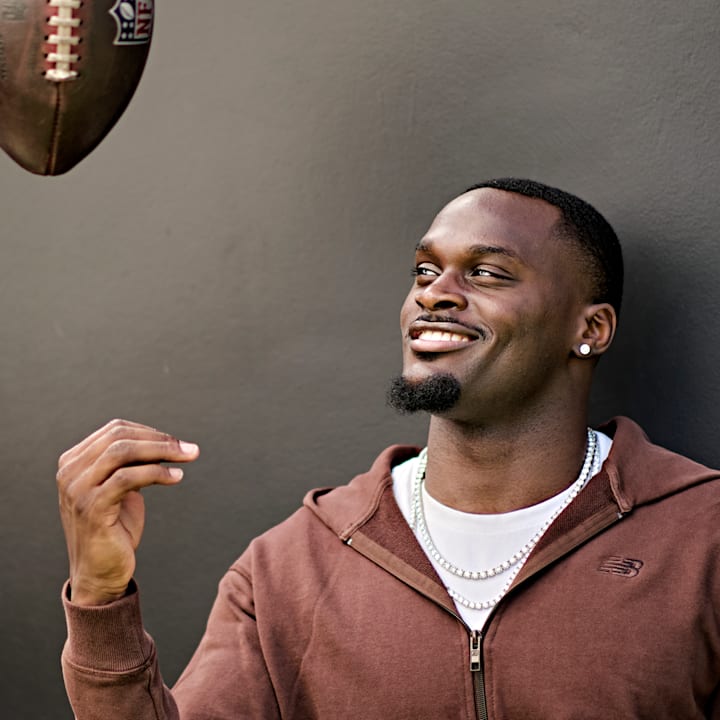
Wearing a brown New Balance sweatsuit, a crisp white T-shirt, two diamond chains and sneakers with chrome accents, Love slipped seamlessly into a warm, honest conversation about Notre Dame, Freeman, life, anime and his two-yard touchdown run against Penn State in the 2025 College Football Playoff semifinal that featured five broken tackles. He counts that among his favorites.
Love says he likes doing media, so long as it’s a subject he likes talking about.
He mentions his own comic book, Jeremonstar. The debut issue is the launching point of his sports anime comic universe. His father, Jason, narrates the story of Jeremiyah through his eyes. Nearly all of Freeman’s seven children received an autographed copy for Christmas.
When asked what his hopes were for the comic—what he wanted the audience to understand—Love didn’t hesitate. He leaned in just slightly, explaining that he wants readers to know him as someone who loves video games and anime. He wants them to understand that something bigger is coming that they’ll one day have to pour themselves into. He wants them to appreciate the fact that, even in their own life, they won’t always be the star.
But, he says, “At the same time, be authentically you. Be yourself.”
More NFL Draft from Sports Illustrated
 Add us as a preferred source on Google
Conor Orr is a Senior Writer for Sports Illustrated with more than 15 years of experience covering the NFL. His work has been cited in Best American Sportswriting and has won a PFWAA award. Prior to Sports Illustrated, he covered both the Giants and Jets for The Star-Ledger. Conor lives in New Jersey with his amazing wife and three children.
Follow author