%20%20--%3E%0A%3Csvg%20version%3D%221.1%22%20id%3D%22Layer_1%22%20xmlns%3D%22http%3A%2F%2Fwww.w3.org%2F2000%2Fsvg%22%20xmlns%3Axlink%3D%22http%3A%2F%2Fwww.w3.org%2F1999%2Fxlink%22%20x%3D%220px%22%20y%3D%220px%22%0A%09%20width%3D%2239px%22%20height%3D%2240px%22%20viewBox%3D%220%200%2039%2040%22%20enable-background%3D%22new%200%200%2039%2040%22%20xml%3Aspace%3D%22preserve%22%3E%0A%3Cpath%20fill%3D%22%23FFFFFF%22%20d%3D%22M38.5%2C7H28.2v26h10.3V7z%22%2F%3E%0A%3Cpath%20fill-rule%3D%22evenodd%22%20clip-rule%3D%22evenodd%22%20fill%3D%22%23FFFFFF%22%20d%3D%22M26.1%2C25.5c0%2C5.8-4.1%2C7.5-12.9%2C7.5C3.9%2C33%2C0%2C31.2%2C0%2C25.2v-1.1h11.6%0A%09v2.4c0%2C0.7%2C0.1%2C1.4%2C1.2%2C1.4c1%2C0%2C1.2-0.4%2C1.2-1.3v-0.9c0-1.6-0.9-1.6-3.5-2.2C2.2%2C21.7%2C0%2C19.7%2C0%2C15.3v-0.9C0%2C9.3%2C5.5%2C7%2C12.9%2C7%0A%09c10.2%2C0%2C12.8%2C2.6%2C12.8%2C7.4v1.8h-11v-2.9c0-0.6-0.4-1.1-1.2-1.1c-0.6%2C0-1.2%2C0.4-1.2%2C1.1v0.9c0%2C1.5%2C0.9%2C2%2C3.3%2C2.5%0A%09c8%2C1.6%2C10.5%2C3.3%2C10.5%2C7.5V25.5z%22%2F%3E%0A%3C%2Fsvg%3E%0A)
Jerry Jones’s Comments About Coach Pay Have No Basis in Reality
In this story:
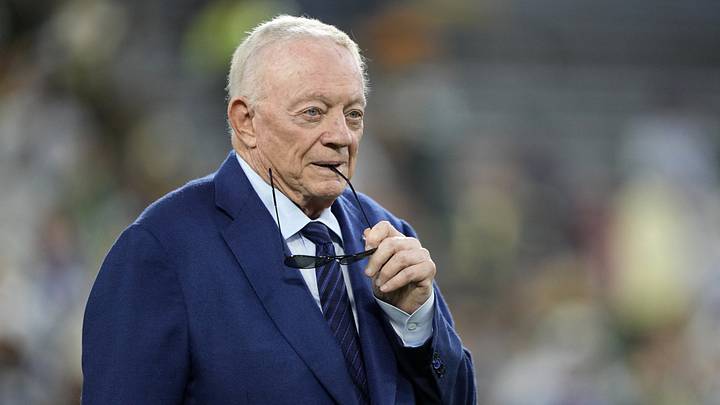
We are a society of grand proclamators. And what’s strange is how, very often, the loudest chest-thumpers and rabble-rousers carry a fact-based track record that is the very antithesis of the ideals they claim to have and the ideas they profess. Cowboys owner Jerry Jones is a person who contains multitudes both good and bad. He is also the kind of person I am referring to.
In Jones’s case, it is the self-styled man-of-wealth persona. He said just a few months ago that there is nothing more dangerous than an old man with money. Alongside car keys and a Facebook account, Jones is correct on his point about the elderly. These are very dangerous resources for old people to have access to. The error is in associating himself with the kind of man who spends “dangerously” on his football team. It’s simply not true. Also factually inaccurate is the statement that Jones made Tuesday that there is no correlation between paying a head coach a lot of money and winning football games. This one came after Jones was challenged by hosts on a weekly radio spot about whether the Cowboys have applied appropriate resources to an uncapped area of the football team where Jones could theoretically flaunt this wealth.
After conversations with industry veterans, the estimate is that Jones is very likely in or around the bottom five in the NFL when it comes to coaching spend, taking into account both the head coach and coordinators. A third industry source estimated that Dallas was not quite that low in coaching spend, though not that far away. The most expensive coaches in the NFL right now are three-time Super Bowl winner Andy Reid; one-time Super Bowl winner John Harbaugh, who is now reviving the Giants despite losing more talent between offseasons; and one-time Super Bowl winner Sean Payton, who took one of the most dead-money-strapped teams in the NFL to the playoffs and then the AFC title game in subsequent seasons.
Also hovering in that conversation are perpetual contenders such as Kyle Shanahan and Sean McVay. Mike Vrabel, who cost significantly more than his Patriots predecessor, Jerod Mayo, took a four-win team to the Super Bowl the following season.
Since 2023, the coaches who have generated some degree of a bidding war or interest in multiple teams that led to a contract coming in over average include: Payton, DeMeco Ryans, Jim Harbaugh, Ben Johnson, Liam Coen, Mike Vrabel, Kevin Stefanski, John Harbaugh and Jesse Minter. Jones, I’m guessing, is leaning on examples like Aaron Glenn and, to broaden the scope of what we’re looking at, Matt Rhule. Both of those coaches were big, expensive swings for their respective organizations that did not pan out.
But, as many experts in the field will tell you, there is such a limited amount of IP in coaching right now, which inflates the cost and ultimately legitimizes the benefit weighed against the cost. This is especially true when it comes to having a steady hand at the play-calling role who can also head an organization from a leadership perspective. McVay, Shanahan, Reid, Payton, Johnson, Coen, Kevin O’Connell and Matt LaFleur are golden geese in that sense. It helps lead to what many big-picture thinkers in the NFL relay as the most definitive advantage of the modern NFL: continuity. (Especially in an NIL era where players are coming out of college less capable of immediately diving into the complexities of an NFL offense.)
These coaches can evolve on the nuances of a scheme year over year and deepen how difficult they are to prepare for, while constructing an ever-expanding bank of material to draw from. Jones views his team and the drama he creates around the organization, along with its sprawling ancillary shops, hotels and restaurants, as the destination rather than the performance of the actual football team. It’s very easy to draw a line between the Cowboys’ lack of big-picture success alongside Jones’s pivot from a victory-starved fan/owner to an ideologue more concerned about the overall financial growth of the product.
Jones is trying to start a conversation that has no basis in reality. When the Cowboys split with McCarthy late in the annual firing cycle—also with money at the root of the issue—sources around the league balked at connecting Jones with high-profile candidates at the time for two main reasons: Jones tends to skimp there and Jones has a type when it comes to his head coaches (meaning, the ones who won’t cut into his air time or share of the credit).
The Cowboys weren’t even in the conversation for Johnson, the runaway success story of the 2025 coaching class, despite having a perennial top-10 quarterback in Dak Prescott. The existence of a proven commodity at quarterback, or the ability to select one very soon, is one of the main prerequisites for a sought-after coaching candidate who isn’t simply grateful to have “one of 32 jobs.” While Brian Flores and the defensive coordinator position is a different case altogether—sources close to the coach paint a picture of an ideal setup in Minnesota that allows Flores to be a true “head coach of the defense” and that Flores would not pass it up for a lateral move, thus making him a very unlikely candidate to swoop in and save Dallas’s defense this offseason, even with a blank check—the sentiment that Dallas was not swinging for the financial fences at defensive coordinator was likely true and that Flores was way, way out of Jones’s price range is accurate. (A second caveat: I loved the Parker hire, and he has been believed to be an ascending coach in this league with experience under one of the best defensive coordinators of all time in Vic Fangio.)
The one line you can draw between Jones’s business success and his football success is that Jones is a buyer of distressed assets. His best post–Troy Aikman quarterbacks were an undrafted free agent (Tony Romo) and a fourth-round pick (Prescott). His best pro personnel moves—see: 2025 George Pickens—are the result of another team getting incredibly tired of dealing with a person. His best coaching decision was hiring Dan Quinn, who had recently been fired as the head coach of the Falcons, to be his defensive coordinator. Jones takes these swings because he is unfireable as the de facto general manager and bears no responsibility when they don’t work out, or if the player becomes exactly who his former team made him out to be. McCarthy was coming off a dismissal from the Packers and a gap year, to which many legitimate questions about his success being tied to Aaron Rodgers and Brett Favre percolated. Brian Schottenheimer, one of the most stunning coaching hires of the past two decades, was quintessential Jones: a Temu attempt at getting the advantages of a consistent play-caller and leader-of-men head coach without paying for one. Jones, at Schottenheimer’s opening press conference, conflated experience and lineage with the reality that Schottenheimer had 16 seasons as an offensive coordinator or head coach. Nine of those seasons saw his team finish outside the top 10 in points scored, five of them outside of the top 20 in points scored, 10 of them outside the top 10 in rushing yards per attempt and all but two of them outside the top 10 in net passing yards per attempt.
Some NFL teams are so far ahead of the curve right now in terms of hiring head coaches that they have honed analytics that are able to determine a coach’s individual efficacy as a play-caller and isolate their individual accomplishments and use those during the hiring process. Jones, it seemed, declined to even look at Pro Football Reference.
It creates an interesting thought: Quite possibly the only way Jones would go after a coach who was believed to be the guy is if the coach had a significant amount of offset money stemming from a currently active contract. While this example is my thought and my thought alone, former Cowboys quarterback and OC Kellen Moore would be a classic Jones hire because he is both a predictable personality to orbit around Jones as a sun and, if the Saints were to move on from Moore after this season, would likely shave some of those costs.
That is, of course, if Jones could even stomach paying the remainder of an existing contract (Schottenheimer’s). While I’m not of the opinion that Schottenheimer should be fired yet—I do think Jones picked up on Schottenheimer’s endearing personality and consummate likability, which can sometimes rescue teams battling grand expectations, and Schottenheimer has hit on some of his hires like offensive coordinator Klayton Adams—Jones needs to, at some point, take ownership of a mess that is entirely his own. His budget team and budget coach are, like many products on sale, a reflection of a universe that did not want them anymore.
The only thing more dangerous than an old man with money, it seems, is one blinded by hubris.
 Add us as a preferred source on Google

Conor Orr is a Senior Writer for Sports Illustrated with more than 15 years of experience covering the NFL. His work has been cited in Best American Sportswriting and has won a PFWAA award. Prior to Sports Illustrated, he covered both the Giants and Jets for The Star-Ledger. Conor lives in New Jersey with his amazing wife and three children.
Follow author