%20%20--%3E%0A%3Csvg%20version%3D%221.1%22%20id%3D%22Layer_1%22%20xmlns%3D%22http%3A%2F%2Fwww.w3.org%2F2000%2Fsvg%22%20xmlns%3Axlink%3D%22http%3A%2F%2Fwww.w3.org%2F1999%2Fxlink%22%20x%3D%220px%22%20y%3D%220px%22%0A%09%20width%3D%2239px%22%20height%3D%2240px%22%20viewBox%3D%220%200%2039%2040%22%20enable-background%3D%22new%200%200%2039%2040%22%20xml%3Aspace%3D%22preserve%22%3E%0A%3Cpath%20fill%3D%22%23FFFFFF%22%20d%3D%22M38.5%2C7H28.2v26h10.3V7z%22%2F%3E%0A%3Cpath%20fill-rule%3D%22evenodd%22%20clip-rule%3D%22evenodd%22%20fill%3D%22%23FFFFFF%22%20d%3D%22M26.1%2C25.5c0%2C5.8-4.1%2C7.5-12.9%2C7.5C3.9%2C33%2C0%2C31.2%2C0%2C25.2v-1.1h11.6%0A%09v2.4c0%2C0.7%2C0.1%2C1.4%2C1.2%2C1.4c1%2C0%2C1.2-0.4%2C1.2-1.3v-0.9c0-1.6-0.9-1.6-3.5-2.2C2.2%2C21.7%2C0%2C19.7%2C0%2C15.3v-0.9C0%2C9.3%2C5.5%2C7%2C12.9%2C7%0A%09c10.2%2C0%2C12.8%2C2.6%2C12.8%2C7.4v1.8h-11v-2.9c0-0.6-0.4-1.1-1.2-1.1c-0.6%2C0-1.2%2C0.4-1.2%2C1.1v0.9c0%2C1.5%2C0.9%2C2%2C3.3%2C2.5%0A%09c8%2C1.6%2C10.5%2C3.3%2C10.5%2C7.5V25.5z%22%2F%3E%0A%3C%2Fsvg%3E%0A)
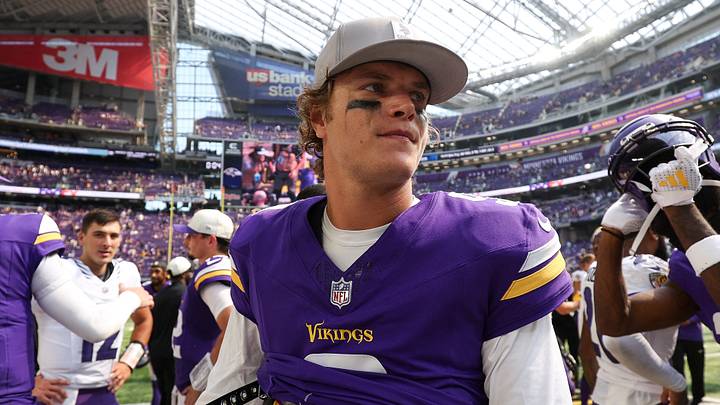
Why J.J. McCarthy Didn’t Succeed in Minnesota and Why He Can Still Turn His Career Around
In this story:
J.J. McCarthy is a New York Giant.
And the path he took to get there should be instructive to the trail he and his new team try to blaze out of the messy start to his career.
First, the reality of the situation: The Vikings still need a long-term solution at the most important position on the field, and had become certain McCarthy wasn’t going to become that answer by the expiration of his rookie deal in a year and a half. Even with a veteran roster and even with a veteran coaching staff, stocked with sturdy infrastructure for any quarterback.
Time will tell whether they’re right. But it’s also indicative of where McCarthy is right now as a player, and how far he has to go. Even as the Vikings reeled off five consecutive wins to finish 2025—McCarthy started four of those games, Max Brosmer started the other one—the book on the then 22-year-old was written. Defensive coaches saw a quarterback who wasn’t seeing the field well, didn’t look comfortable and was taking too many hits.
Hit him enough, they’d say, and it’d be over.
This, by the way, is the case with a lot of young quarterbacks. They go out and play early, and if the effort to minimize their youthful shortcomings doesn’t work, they start to get hit too much, doubt creeps in and the problem metastasizes. The game moves at warp speed as is, and if a quarterback starts internally questioning what he’s seeing, things can go downhill fast.
And this is where you can look at McCarthy’s situation specifically and start to understand better how it happened. At Michigan, he was on the superior team most Saturdays, most play calls would go to plan, and he didn’t throw the ball as much, meaning while he had plenty of starts, he didn’t have the number of applicable reps that some of his peers did.
Then, he got to the Vikings and got hurt over the summer to follow. So at 21, he was newly married, having a kid, and suddenly had football taken from him—which can be an awfully isolating experience for a player. He struggled with that. He came back to the facility in February 2025 with good weight on, throwing the ball great, and a month later, after Minnesota swung and missed on keeping either Sam Darnold or Daniel Jones, he was handed the starting job.
The Vikings figured they could make him a top-20-or-so quarterback that fall, and that that would be enough for the team to win, and to buy him time developmentally. Instead, two issues kept short-circuiting the plan: durability and consistency. When he was right, and confident, Minnesota saw the guy it believed in enough to take with the 10th pick. He just wasn’t right enough, physically or performance-wise, for a contending team.
His last game action as a Viking, in the preseason just last month, was a continuation of how the 2025 season had gone. After starting 5-of-6 for 81 yards in Minnesota’s second preseason game, he missed on his last four attempts, took a sack and injured his ankle badly enough to miss the preseason finale. Kevin O’Connell had already named Kyler Murray the Week 1 starter. But that night moved the Vikings a little closer to where they wound up, pushing him to third on the depth chart and further dimming his light at the end of the developmental tunnel.
Could the Giants brighten that light now and find that path out?
It’ll be tough, and it’s a bit like the situation Trey Lance—another gifted kid who came from a dominant college team with a run-based offense—found himself in three years ago.
To begin with, both guys were drafted into situations that looked perfect for a young NFL quarterback, with teams ready to win that had proven track records for maximizing players at the position. The trouble with those sorts of situations, though, is that those teams can’t ride out the struggles of a young passer the way a bad team can, nor can they throw seasons overboard in the name of developing at a single position. Both McCarthy and Lance got the longer leash once, wound up struggling and getting hurt, and then never got it again.
And what both guys really needed was just that: to take their lumps and grow. You can have them do it by sitting and learning. But eventually, they need game reps, to build up their own library of plays run and defenses seen, and the sooner those come, the more risk there is that the aforementioned lumps are going to be felt by the team, too. Also, when you aren’t the recent first-round pick anymore, it’s harder to find a team willing to go through that with you.
Now, the hope would be McCarthy landing in a place that will, and I think there’s reason to believe the Giants can be that place for him. John Harbaugh has assembled a staff with guys like Matt Nagy, Greg Roman, Brian Callahan and Willie Taggart, who’ve worked with accomplished veterans and young, developmental guys at the position. The offense is built for Jaxson Dart, who, stylistically, had a lot of similarities to McCarthy coming out of college.
So if the Giants had to throw McCarthy out there, could they put together an offense that moves the pocket, incorporates RPOs and gets him playing fast? Yes, though there is the injury risk that accompanies playing a quarterback like McCarthy that way.
What they can’t do is treat him like the savior, and I trust Harbaugh wouldn’t. Which brings us to one final reason for optimism here: Harbaugh himself.
He talked to his brother, Jim, McCarthy’s college coach, before making the trade, and even got to know McCarthy himself while McCarthy was at Michigan. That means he knows not just what kind of player he’s getting; he knows what kind of person is coming, too. Along those lines, McCarthy checks a lot of boxes. He’s smart, and understands coverages and protections, and football in general. He’s tough. He’s shown he can lead and was very well-liked in the Vikings’ locker room. He’s also, I believe, conscientious enough to learn from his missteps.
From there, you can only hope everyone takes how this all happened into account.
If they can, I’d still say McCarthy has a chance.
 Add us as a preferred source on Google
Albert Breer is a senior writer covering the NFL for Sports Illustrated, delivering the biggest stories and breaking news from across the league. He has been on the NFL beat since 2005 and joined SI in 2016. Breer began his career covering the New England Patriots for the MetroWest Daily News and the Boston Herald from 2005 to ’07, then covered the Dallas Cowboys for the Dallas Morning News from 2007 to ’08. He worked for The Sporting News from 2008 to ’09 before returning to Massachusetts as The Boston Globe’s national NFL writer in 2009. From 2010 to 2016, Breer served as a national reporter for NFL Network. In addition to his work at Sports Illustrated, Breer regularly appears on NBC Sports Boston, 98.5 The Sports Hub in Boston, FS1 with Colin Cowherd, The Rich Eisen Show and The Dan Patrick Show. A 2002 graduate of Ohio State, Breer lives near Boston with his wife, a cardiac ICU nurse at Boston Children’s Hospital, and their three children.
Follow AlbertBreer