%20%20--%3E%0A%3Csvg%20version%3D%221.1%22%20id%3D%22Layer_1%22%20xmlns%3D%22http%3A%2F%2Fwww.w3.org%2F2000%2Fsvg%22%20xmlns%3Axlink%3D%22http%3A%2F%2Fwww.w3.org%2F1999%2Fxlink%22%20x%3D%220px%22%20y%3D%220px%22%0A%09%20width%3D%2239px%22%20height%3D%2240px%22%20viewBox%3D%220%200%2039%2040%22%20enable-background%3D%22new%200%200%2039%2040%22%20xml%3Aspace%3D%22preserve%22%3E%0A%3Cpath%20fill%3D%22%23FFFFFF%22%20d%3D%22M38.5%2C7H28.2v26h10.3V7z%22%2F%3E%0A%3Cpath%20fill-rule%3D%22evenodd%22%20clip-rule%3D%22evenodd%22%20fill%3D%22%23FFFFFF%22%20d%3D%22M26.1%2C25.5c0%2C5.8-4.1%2C7.5-12.9%2C7.5C3.9%2C33%2C0%2C31.2%2C0%2C25.2v-1.1h11.6%0A%09v2.4c0%2C0.7%2C0.1%2C1.4%2C1.2%2C1.4c1%2C0%2C1.2-0.4%2C1.2-1.3v-0.9c0-1.6-0.9-1.6-3.5-2.2C2.2%2C21.7%2C0%2C19.7%2C0%2C15.3v-0.9C0%2C9.3%2C5.5%2C7%2C12.9%2C7%0A%09c10.2%2C0%2C12.8%2C2.6%2C12.8%2C7.4v1.8h-11v-2.9c0-0.6-0.4-1.1-1.2-1.1c-0.6%2C0-1.2%2C0.4-1.2%2C1.1v0.9c0%2C1.5%2C0.9%2C2%2C3.3%2C2.5%0A%09c8%2C1.6%2C10.5%2C3.3%2C10.5%2C7.5V25.5z%22%2F%3E%0A%3C%2Fsvg%3E%0A)
Jason Kelce Scolds Lions for ‘Bull---’ Treatment of Frank Ragnow After Center’s Retirement
In this story:
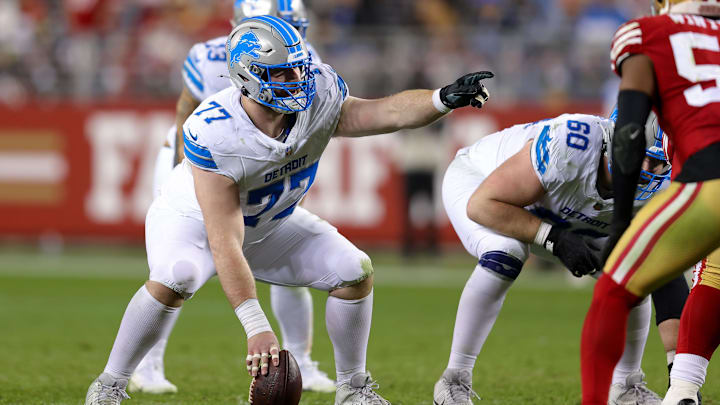
Consider Jason Kelce unimpressed with how the Lions handled the retirement of center Frank Ragnow.
Kelce took to social media to write a lengthy post questioning the Lions’ decision to make Ragnow return a chunk of his signing bonus following his retirement last year. The former three-time All Pro center announced he was hanging it up at age 29 in June 2025; months later, Ragnow attempted to come out of retirement to rejoin the Lions in November but he failed a physical and never suited up for a game.
Earlier this week, it was reported that the Lions forced Ragnow to return part of his signing bonus that he earned back when he signed an extension in 2021. Given Ragnow’s history with the organization, Kelce openly criticized Detroit for what he seemed to believe was a classless move.
“Let me say this first, if a player truly just retires without reason, or because they’ve lost the desire to play, I completely get and acknowledge teams should be able to recoup compensation when players don’t fulfill there contractual obligations and agreements,” Kelce wrote on X (formerly Twitter). “However, Frank was known for being hurt and playing through injuries most players wouldn’t play through constantly. Broken foot, a torn pec, multiple knee injuries, back issues. There was always something, and I’m sure he was continuously dealing with multiple ailments to try and continue playing the game.
“His body clearly had deteriorated to a degree that made football no longer a viable option, physically, and probably mentally. In my opinion, the signing bonus is supposed to protect players from future physical ailments limiting their availability on the field, that’s one of the reasons you want more guaranteed money upfront.”
Kelce went on to argue that while the Lions asking for money back makes sense with certain players, he didn’t agree with the organization’s decision to short-change Ragnow, who arguably paid his dues with all the injuries he suffered across his 96 games in his seven-year tenure Detroit.
“So while I get that the team has a right to ask for money back, in the spirit of the agreement, I think it’s bull---- Frank is being asked to return money,” continued Kelce. “This was clearly a player that the game had physically taken its toll on, and his body was clearly no longer holding up to the rigors of the NFL. It wasn’t just some player deciding he didn’t want to play anymore, it wasn’t that simple, and these signing bonuses are there to protect players from the inevitable injuries they incur on the field.”
This is interesting. It feels like it’s obvious that Frank retired because he was physically fighting through injuries and pain, and it got to a point that he no longer could play the game in an enjoyable, effective, or healthy way.
— Jason Kelce (@JasonKelce) March 31, 2026
The whole purpose of a signing bonus is to… https://t.co/pvjgvLrsA0
Kelce does make a fair point. As a former center himself, the ex-Eagles icon unsurprisingly sides with Ragnow and delivers a passionate critique of the Lions in the name of something all former and current NFL-ers can get behind: more protection for the players of the game.
As Kelce stated, had Ragnow been declared “medically unfit” to play, there would be absolutely no issue with the money. The Lions wouldn’t have been able to ask for a prorated portion of his signing bonus back, per the collective bargaining agreement. Since there was no official doctor’s note attached to Ragnow’s retirement, and the record shows he retired voluntarily, the Lions can recoup part of that bonus—but it doesn’t necessarily mean they should.
Why Lions are forcing Frank Ragnow to pay back part of his signing bonus
Despite the risk of permanently damaging relationships, the Lions have stubbornly set a controversial precedent for recouping players’ signing bonuses with franchise legends Barry Sanders and Calvin Johnson.
Sanders and the Lions notoriously engaged in a tense financial dispute when Detroit forced him to repay more than $7 million of his signing bonus after Sanders retired in 1999. The organization did the same with Johnson, whom they shook down for $1.6 million following his retirement in ‘16 (they could have forced him to pay back up to $3.2 million).
With Ragnow, the veteran center received a $6 million signing bonus as part of his 2021 contract extension, an amount that was evenly spread out against the cap over the length of his deal. When he walked away from the game in 2025 with two years left on his contract, there was still $3 million in prorated cap hits that the Lions were then allowed to recoup under the terms of the CBA.
Lions president Rod Wood confirmed that the team got back a portion of the $3 million after Ragnow’s retirement, though the exact amount was not disclosed.
“Our precedent goes all the way back to Barry Sanders,” Wood said. “And if Barry Sanders paid back money. … And I think the reality is, they’re not paying back their money, they’re returning our money. Cause they were paid in advance for services that they hadn’t completed.”
Former Lions player Alex Anzalone seemed to agree with Kelce that the Lions were in the wrong for asking Ragnow to return some of his signing bonus. “Played through fractured throat, one week post meniscus clean up w/ stitches barely out, inoperable/unrepairable toe, etc.. “Hey let me get that prorated signing bonus back,” Anzalone wrote on X. “Do business as business is being done.”
Played through fractured throat, one week post meniscus clean up w/ stitches barely out, inoperable/unrepairable toe, etc.. “Hey let me get that prorated signing bonus back” 😂😂😂
— Alex Anzalone (@AlexAnzalone34) March 31, 2026
Do business as business is being done https://t.co/itr9jxhrqP
Just because the Lions have set a historical precedent for collecting the money that they’re legally entitled to doesn’t meant they can’t break tradition. The Colts, for example, didn’t ask for a penny of Andrew Luck’s $16.8 million in bonuses after his retirement. At the end of the day, every NFL franchise has its own way of handling business, and this is just how the Lions do theirs.
More NFL from Sports Illustrated
 Add us as a preferred source on Google
Kristen Wong is a staff writer on the Breaking and Trending News team at Sports Illustrated. She has been a sports journalist since 2020 and has a bachelor’s in English and linguistics from Columbia University. Before joining SI in November 2023, Wong covered four NFL teams as an associate editor with the FanSided NFL network and worked as a staff writer for the brand’s flagship site. She is a lifelong Liverpool fan who enjoys solving crossword puzzles and hanging out at her neighborhood dive bar in NYC.
Follow kriscwong