%20%20--%3E%0A%3Csvg%20version%3D%221.1%22%20id%3D%22Layer_1%22%20xmlns%3D%22http%3A%2F%2Fwww.w3.org%2F2000%2Fsvg%22%20xmlns%3Axlink%3D%22http%3A%2F%2Fwww.w3.org%2F1999%2Fxlink%22%20x%3D%220px%22%20y%3D%220px%22%0A%09%20width%3D%2239px%22%20height%3D%2240px%22%20viewBox%3D%220%200%2039%2040%22%20enable-background%3D%22new%200%200%2039%2040%22%20xml%3Aspace%3D%22preserve%22%3E%0A%3Cpath%20fill%3D%22%23FFFFFF%22%20d%3D%22M38.5%2C7H28.2v26h10.3V7z%22%2F%3E%0A%3Cpath%20fill-rule%3D%22evenodd%22%20clip-rule%3D%22evenodd%22%20fill%3D%22%23FFFFFF%22%20d%3D%22M26.1%2C25.5c0%2C5.8-4.1%2C7.5-12.9%2C7.5C3.9%2C33%2C0%2C31.2%2C0%2C25.2v-1.1h11.6%0A%09v2.4c0%2C0.7%2C0.1%2C1.4%2C1.2%2C1.4c1%2C0%2C1.2-0.4%2C1.2-1.3v-0.9c0-1.6-0.9-1.6-3.5-2.2C2.2%2C21.7%2C0%2C19.7%2C0%2C15.3v-0.9C0%2C9.3%2C5.5%2C7%2C12.9%2C7%0A%09c10.2%2C0%2C12.8%2C2.6%2C12.8%2C7.4v1.8h-11v-2.9c0-0.6-0.4-1.1-1.2-1.1c-0.6%2C0-1.2%2C0.4-1.2%2C1.1v0.9c0%2C1.5%2C0.9%2C2%2C3.3%2C2.5%0A%09c8%2C1.6%2C10.5%2C3.3%2C10.5%2C7.5V25.5z%22%2F%3E%0A%3C%2Fsvg%3E%0A)
With Myles Garrett On Board, the Rams Can Break Offensive Football
In this story:
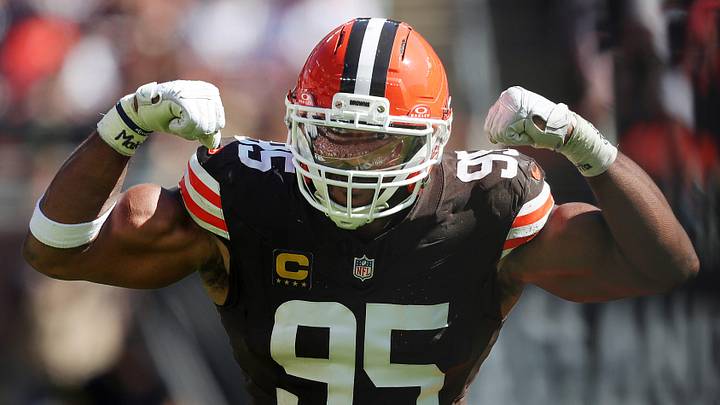
Ultimately, this is far bigger than Myles Garrett being traded to a Super Bowl contender. The Rams under Les Snead and Sean McVay have understood the value of an experienced veteran over the uncertainty of late-round draft picks (while still managing to develop an adequate farm system) more than almost any other team in professional football. The fact that the duo managed to sniff out the Browns’ interest in trading Garrett and pounce on the opportunity is not a surprise. Really, the fact that other teams did not after Cleveland altered the structure of Myles Garrett’s contract and then begged reporters to stop asking about it is the most surprising development of Monday’s bombshell.
But with McVay in particular, he has understood how the addition of individual players into lineups can short-circuit the hardwiring of almost any other team. He and Kyle Shanahan have taken over the NFL not by schematic force but by tinkering with the delicate scales that often balance an offense and defense. The development of a 49ers offense in which nearly every skill-position player could perform exceptionally well at two positions changed football. The Rams’ discovery of a wide receiver prototype that could block like a tight end changed football, just like the Rams’ usage of three-tight-end sets last year. If you had any doubt, go back through recent football history and watch the drafts subsequent to great Rams or 49ers seasons. Tight ends throttled up draft boards this year, for example, with 12-personnel (a set involving two tight ends) very likely becoming industry standard, with three-tight-end usage also skyrocketing.
Garrett is the defensive equivalent of those respective evolutions. Again, this is not just the Rams acquiring a great player. This is the Rams attempting to break offensive football the way the team has already successfully broken defense. One offensive coordinator with a long history of experience against Garrett said he, along with Aaron Donald and J.J. Watt, were very likely the only three players that warranted absolute down-to-down consideration from a play-caller and a minimum of four hands blocking at all times. That is an incredible tool in the hands of a team, especially one that has been outpacing the rest of the NFL in terms of raw intelligence for the past decade.
Under normal circumstances that is like replacing your defensive coordinator’s handgun with a grenade launcher.
Under McVay, this is handing the Rams passwords to every computer in every facility in the NFL. McVay and DC Chris Shula in concert, having a broader grasp on offensive football, will be able to use Garrett in ways that we have not seen previously, or to simply use the idea of him in a more devastating way. By allowing offenses each week to present their desperate attempts at containment—a process that will involve a cadre of wing players, tight ends and tackles deployed in various ways to maintain a proper phalanx around Garrett—McVay and Shula can then more easily understand what counterpunch can break the remainder of an offense that has now understaffed itself out of singular respect for Garrett. McVay can also more authoritatively advise how another team will attempt to stop Garrett, which opens Shula up for a suite of creative secondary blitzes, stunts and other chicanery at the snap.
Garrett is such an incredible outlier when it comes to the rate of double teams he receives, which occur on more than 55% of his snaps, and the skill he possesses, even amid that extra pressure. When reduced to its simplest form, Garrett is altering the math on a football field, allowing a defense to play 11 on 10, or, really, in the case of a nonmobile quarterback, 11 vs. 9. Nevermind the fact that Garrett will actually be playing with leads.
A defensive coach added this for thought: Teams tend to run away from Garrett at a very reliable rate. Teams also tend to slide their pass protection on every down toward Garrett. Teams tend to send fewer receivers out for passing routes when facing Garrett. That statistical dependency, when placed in the hands of coaches who have manipulated those odds better than any staff in the NFL, is a doomsday scenario. McVay and Shula now know exactly which way you’re running the football, exactly where your offensive linemen will move and exactly which receivers are going to be looking for passes before the ball is even snapped.
The best teams in the NFL often have coaching staffs that are not siloed from one another. Kevin O’Connell and Brian Flores often battle schematically and, through that process, have developed a better understanding of how to attack and how an attack will come. The same can be said for Andy Reid and Steve Spagnuolo, and Shane Steichen and Lou Anarumo. It’s why the Shanahan tree prioritizes coaches who have made the transition from defensive coaching to offensive coaching. It’s why Bill Belichick staffed his brightest young defensive coaches under the wings of offensive coaches. Until you know how to line up a series of blockers to shut down a dominant defensive end, you are less likely to be able to design a defense that is beyond effective and more virus-like in nature.
For those saying this is sad for Cleveland, I look at it differently. The Browns somehow managed to get the season out of Garrett that will keep him in the record books forever and one day be etched on the bust of a statue that sits outside the team’s stadium, then get Jared Verse and a handful of picks in return a year later.
But Cleveland’s legacy with Garrett, as was the case with other transcendent players during the Browns’ reboot, like Joe Thomas, will be the inability to properly weaponize beyond individual accomplishments. The Browns have always had access to great players because the Browns have always had high draft picks. Since 1999, the Browns have had 17 top-15 selections (not including the years wiped out for the Deshaun Watson trade) and nine selections inside the top five. We can use this as the basis of an interesting thought experiment as to why there is so much confidence in whatever the draft capital from Garrett becomes versus the benefit of actually trying to build that transcendently great unit around one of the best players in NFL history, but that is a decision Cleveland has wrestled with individually since its self-rebrand about 10 years ago as an analytically forward organization. The team has always seemingly understood the economics. What it has lacked is the ability to make individual greatness into universal greatness.
There is no doubt that Cleveland has done the right thing with Garrett in terms of the timing, the return and, really, the humanity. Keeping Garrett there simply to say he was never anywhere else is like caging a rare butterfly or buying da Vinci’s Salvator Mundi just to box it up in your garage under some old newspapers. The metaphor is something like an aspiring artist realizing that, before he does any more damage to his canvases, brushes, paints and other supplies, he can sell them on Facebook marketplace and recoup some of the cost.
The only difficulty is finding out what happens to those brushes and canvases once in the hands of an artist.
More NFL from Sports Illustrated
 Add us as a preferred source on Google
Conor Orr is a Senior Writer for Sports Illustrated with more than 15 years of experience covering the NFL. His work has been cited in Best American Sportswriting and has won a PFWAA award. Prior to Sports Illustrated, he covered both the Giants and Jets for The Star-Ledger. Conor lives in New Jersey with his amazing wife and three children.
Follow author