%20%20--%3E%0A%3Csvg%20version%3D%221.1%22%20id%3D%22Layer_1%22%20xmlns%3D%22http%3A%2F%2Fwww.w3.org%2F2000%2Fsvg%22%20xmlns%3Axlink%3D%22http%3A%2F%2Fwww.w3.org%2F1999%2Fxlink%22%20x%3D%220px%22%20y%3D%220px%22%0A%09%20width%3D%2239px%22%20height%3D%2240px%22%20viewBox%3D%220%200%2039%2040%22%20enable-background%3D%22new%200%200%2039%2040%22%20xml%3Aspace%3D%22preserve%22%3E%0A%3Cpath%20fill%3D%22%23FFFFFF%22%20d%3D%22M38.5%2C7H28.2v26h10.3V7z%22%2F%3E%0A%3Cpath%20fill-rule%3D%22evenodd%22%20clip-rule%3D%22evenodd%22%20fill%3D%22%23FFFFFF%22%20d%3D%22M26.1%2C25.5c0%2C5.8-4.1%2C7.5-12.9%2C7.5C3.9%2C33%2C0%2C31.2%2C0%2C25.2v-1.1h11.6%0A%09v2.4c0%2C0.7%2C0.1%2C1.4%2C1.2%2C1.4c1%2C0%2C1.2-0.4%2C1.2-1.3v-0.9c0-1.6-0.9-1.6-3.5-2.2C2.2%2C21.7%2C0%2C19.7%2C0%2C15.3v-0.9C0%2C9.3%2C5.5%2C7%2C12.9%2C7%0A%09c10.2%2C0%2C12.8%2C2.6%2C12.8%2C7.4v1.8h-11v-2.9c0-0.6-0.4-1.1-1.2-1.1c-0.6%2C0-1.2%2C0.4-1.2%2C1.1v0.9c0%2C1.5%2C0.9%2C2%2C3.3%2C2.5%0A%09c8%2C1.6%2C10.5%2C3.3%2C10.5%2C7.5V25.5z%22%2F%3E%0A%3C%2Fsvg%3E%0A)
Post-CFP NFL Mock Draft: Raiders, Steelers Pick Franchise QBs
In this story:
The NFL season is down to three games—two conference championship matchups and Super Bowl LX—and 28 teams have no more opponents to prepare for, no more snaps to play, and no more title-winning dreams.
There are, however, budding opportunities to find players who can help elongate next season.
Practices begin Friday for the East-West Shrine Bowl, and four days later, the Senior Bowl begins its three-day practice showcase ahead of the Jan. 31 kickoff.
The college football season, at long last, ended Monday night in Miami Gardens as Indiana captured its first national championship. All-star season and predraft events are officially underway. The NFL combine is a little over one month away.
Draft season, by all accounts, is here—as is Sports Illustrated’s latest first-round projections.
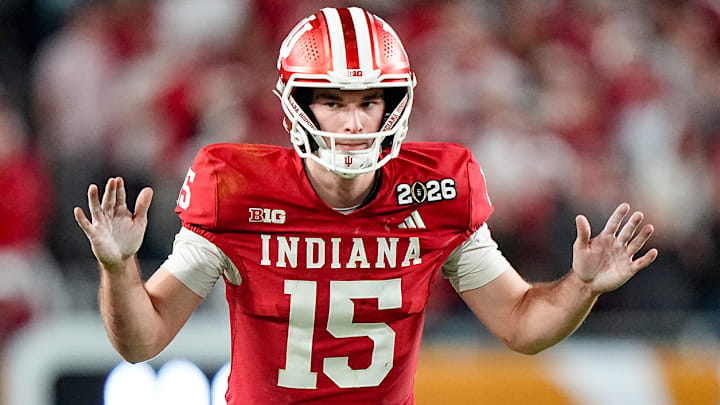
1. Las Vegas Raiders (3–14): Fernando Mendoza, QB, Indiana
While the Raiders still haven’t hired a coach, Mendoza remains a no-brainer. Geno Smith led the NFL with 17 interceptions this season, and Mendoza is the top quarterback in the class. The Heisman Trophy winner grew up watching and idolizing Tom Brady, who’s now a minority owner in Las Vegas. At 6' 5" and 225 pounds, Mendoza has a strong arm, three-level accuracy, a tremendous blend of pre- and post-snap processing and the athleticism to be a scrambling threat.
2. New York Jets (3–14): Arvell Reese, LB, Ohio State
The Jets’ draft choices may have been more impacted than any other team by Oregon quarterback Dante Moore’s decision to stay in school. Moore appeared likely to change shades of uniform color, going from Oregon’s legacy green to the Jets’ Gotham green, but he opted for another year with the Ducks. However, Reese is a fine consolation prize. The 6' 4", 243-pound Reese can play linebacker and edge rusher, and he’s explosive, violent and rangy. He can be a game-changing piece on the Jets’ defense.
3. Arizona Cardinals (3–14): Francis Mauigoa, OT/G, Miami
The Cardinals still don’t have a coach or an offensive coordinator, and they haven’t decided on quarterback Kyler Murray’s future. Mauigoa will be a popular pick for the Cardinals in mock drafts. Arizona needs upgrades at guard and right tackle, and the 6' 6", 315-pounder can play either spot. Mauigoa is strong and physical, opening lanes as a run blocker. In pass protection, he has quality grip strength to prevent second-effort counters, along with a strong anchor.
4. Tennessee Titans (3–14): Rueben Bain Jr., edge, Miami
The Titans have a franchise cornerstone in Jeffery Simmons, but no other blue-chip players on their defensive line. Bain, the ACC Defensive Player of the Year, projects favorably as a game-wrecker early at the next level. The 6' 3", 275-pound Bain is rooted in power. He sets a strong edge and has active hands to discard blockers in the run game. He was one of college football’s best pass rushers due to his hands and an arsenal of pass-rushing moves.
5. New York Giants (4–13): Caleb Downs, S, Ohio State
Giants coach John Harbaugh drafted defensive backs three of the past four years with the Ravens, including two safeties—Kyle Hamilton in 2022 and Malaki Starts in ’25. New York needs to upgrade its skill-position talent around second-year quarterback Jaxson Dart, but it must also elevate a defense that ranked in the bottom fourth in yards and scoring. Downs tarred for three years and pairs athleticism and instincts with the versatility to play in the box, in coverage and make plays in pursuit.
6. Cleveland Browns (5–12): Carnell Tate, WR, Ohio State
The Browns’ new coaching staff faces a dilemma at quarterback, and apart from Mendoza, no other passers in the draft rank high enough to gamble at No. 6. Regardless, Cleveland needs to add weapons and give receiver Jerry Jeudy a running mate. Tate, a standout for the Buckeyes this fall, stands 6' 3" and 195 pounds. He has a wide catch radius, strong hands to finish through contact and can stretch defenses vertically. He’s not the draft’s most explosive receiver, but he’s a tough, competitive, reliable pass catcher worthy of a top-10 pick.
7. Washington Commanders (5–12): David Bailey, edge, Texas Tech
Commanders coach Dan Quinn parted ways with both coordinators, and his team could go either direction with its first pick. But Washington had one of the NFL’s worst defenses this past season in both yards and points allowed, and Quinn, a defensive-minded coach, will likely address that side first. Bailey is a Quinn-esque pass rusher—disruption is his calling card, as he led the FBS in pressures through Texas Tech’s loss in the College Football Playoff quarterfinals. Bailey is quick off the snap and can win with bend around the arc, with power through the offensive tackle or with an inside counter.
8. New Orleans Saints (6–11): Jeremiyah Love, RB, Notre Dame
New Orleans should prioritize adding an interior offensive lineman in free agency, and it may look for a receiver at No. 8. But Love is a tough player to pass up for the Saints, who had the league’s fifth-worst rushing offense this season. Though his draft slot won’t show it due to positional value, Love is one of the three best players in the class and the class’s best all-around offensive player. Love is an explosive, home run-hitting ballcarrier with the contact balance necessary to create his own yards, and he proved he’s a three-down player this season.

9. Kansas City Chiefs (6–11): Jordyn Tyson, WR, Arizona State
The Chiefs need to improve their pass rush, but they should also give Patrick Mahomes more playmakers this offseason. Love is an option if he falls, and Kansas City could turn toward Oregon tight end Kenyon Sadiq as a potential Travis Kelce replacement. But Tyson, one of the draft’s best route runners and pure separators, gets the nod. He’s explosive with the ball in his hands and a reliable winner against man coverage. Injuries are a concern, but there’s no denying Tyson’s talent.
10. Cincinnati Bengals (6–11): Peter Woods, DT, Clemson
The Bengals have long struggled defensively, and 2025 was no different. They were last in run defense, second-to-last in total defense and third-to-last in scoring defense. There are holes in several places, but Cincinnati’s interior defensive line stands out as an area of key concern, and Woods is the draft’s best defensive tackle. While the 6' 3", 315-pound Woods didn’t have the junior season expected of him, he’s a twitchy, smooth-moving big man who can stop the run and create interior disruption.
11. Miami Dolphins (7–10): Makai Lemon, WR, USC
The Dolphins need a head coach before finding their quarterback solution, plus determining the futures of Tua Tagovailoa and Quinn Ewers. However, there are no viable options post-Mendoza worth taking at No. 11. Miami should add to a receiving corps that likely won’t have Tyreek Hill, and Lemon, the winner of the Biletnikoff Award given annually to the nation’s best wideout, is a strong fit. He plays bigger than his listed 5' 11", 195-pound frame, and he’s a quick-footed, strong-handed receiver who wins with both finesse and ball skills.
12. Dallas Cowboys (7–9–1): Mansoor Delane, CB, LSU
Dallas gave up a league-leading 251.5 passing yards per game and intercepted only six passes. The age-old debate about pass rush vs. secondary certainly applies to the Cowboys, and whoever replaces Matt Eberflus as defensive coordinator will have a significant impact in the answer. But Dallas needs another piece to its back end, and Delane, one of college football’s best cover corners, is a quality piece. Delane has tremendous instincts and route recognition—he’s often in-phase and in position to disrupt throwing windows. Delane can play man or zone and press or off, thanks to his intelligence and athleticism. He should be a Day 1 starter.
13. Los Angeles Rams (from Atlanta): Jermod McCoy, CB, Tennessee
The Rams have the rare fortune of competing for a conference championship while having a top-15 pick in their back pocket after trading with the Falcons during last year’s draft. Los Angeles didn’t select a cornerback in 2025 and has, at times, had reason to regret it. McCoy didn’t play this season due to a torn ACL sustained in January of 2024, but his pre-injury tape showed a player with impressive long speed, quick hips and quality ball skills—he picked off four passes in ’24. McCoy is wiry but competitive, and he’d be an added benefit to the Rams’ secondary.
14. Baltimore Ravens (8–9): Keldric Faulk, edge, Auburn
Aside from firing Harbaugh and enduring an injury-riddled, substandard year from quarterback Lamar Jackson, the pass rush was the most surprising part of the Ravens’ struggles this season. They had only 30 sacks, tied for the third-worst in the NFL. Once upon a time, they lived in the top 10. Faulk has room for refinement and may not burst onto the scene as a difference-maker, but the 6' 6", 285-pounder blends size, smarts, effort and first-step quickness. He’s further along as a run defender than a pass rusher, but there’s reason to believe he’ll eventually reach an enticing ceiling.
15. Tampa Bay Buccaneers (8–9): Sonny Styles, LB, Ohio State
Tampa Bay’s draft-day decision could ultimately come down to linebacker and edge rusher, and 14-year veteran LaVonte David’s retirement decision will play a key factor. Regardless, Styles helps the Buccaneers as an infusion of youth in the front seven, and he can impact games as a blitzer. Styles moved from safety to linebacker in the spring of 2024 and has made incredible strides in two seasons. The 6' 5", 243-pound Styles has strong, effective hands and loads of athleticism. He’s still developing his feel for coverage, but he’s a tremendous run defender—and his tape against Indiana in the Big Ten title game was superb.
16. New York Jets (from Indianapolis): KC Concepcion, WR, Texas A&M
The Jets’ leading receiver in 2025 was Garrett Wilson, who played only seven games, and finished with fewer than 400 receiving yards. This is a more viable landing spot for Alabama quarterback Ty Simpson, but it may still be too early. And New York needs to elevate its skill-position talent no matter who steps foot under center next season. Concepcion has the versatility and intelligence to play inside and outside, and he’s explosive and nuanced during his routes, which enables him to create space. Concepcion is a dangerous run-after-catch player, too.
17. Detroit Lions (9–8): Vega Ioane, OG, Penn State
Starting left tackle Taylor Decker faces an uncertain future in Detroit, and the Lions need improvements on their interior offensive line. No matter which direction general manager Brad Holmes and coach Dan Campbell lean, this pick should be an offensive lineman, and Ioane is the draft’s best interior blocker. At 6' 4" and 323 pounds, Ioane is physical and moves defenders in the run game. He’s stout as a pass blocker, too, as he didn’t allow a sack or quarterback hit this season, according to Pro Football Focus.
18. Minnesota Vikings (9–8): Avieon Terrell, CB, Clemson
The Vikings should heavily look into the cornerback market this spring in free agency, though questions remain at quarterback and along both the offensive and defensive lines. Terrell is the draft’s No. 3 corner and best available. The 5' 11", 180-pound Terrell plays bigger than his size—there’s an element of fire, passion and competitive toughness that jumps off his tape. He’s instinctive and has quality, reactionary quickness in coverage. In the run game, Terrell is a willing tackler—again, physical. The younger brother of Falcons cornerback A.J. Terrell, Avieon projects as an early starter at the next level.
19. Carolina Panthers (8–9): Cashius Howell, edge, Texas A&M
The Panthers tapped into Texas A&M’s well of pass rushers last season, using a second-round pick on Nic Scourton, who had five sacks in an encouraging rookie campaign. They should consider returning to College Station. Carolina needs to add a bell-cow pass rusher and few more consistently disruptive players, more dominant than Cashius Howell. Wiry and undersized at 6' 2" and 249 pounds, Howell may never be an above-average run defender, but he’s a ready-made pass rusher. He’s explosive off the snap, wins around the perimeter and on inside counters, and he has enough power to condense pockets.
20. Dallas Cowboys (from Green Bay): C.J. Allen, LB, Georgia
In some form or fashion, Dallas appears likely to fill needs on Day 1 of the draft with players from two of three positions: cornerback, linebacker or edge rusher. Dallas addressed corner with LSU’s Mansoor Delane at No. 12. While there are capable pass rushers—Miami’s Akheem Mesidor and Missouri’s Zion Young among them—Allen is a quality player and fit. Tough, smart, physical, reliable and a leader in the middle of the defense, Allen checks a lot of boxes, and he’d elevate the Cowboys’ defense early next season.

21. Pittsburgh Steelers (10–7): Ty Simpson, QB, Alabama
Simpson is the draft’s clear No. 2 quarterback, and Moore’s decision to stay in school may help the Alabama passer go earlier than most expect. Nonetheless, he did enough during the first half of the season to warrant a first-round selection, though his second half knocked him out of contention for QB1. The Steelers still must hire Mike Tomlin’s replacement and make a final decision on Aaron Rodgers, but if Simpson is available, he’s a logical bet to land in Pittsburgh.
22. Los Angeles Chargers (11–6): Akheem Mesidor, edge, Miami
Mesidor will be knocked during the predraft process for his age—he’ll be 25 on draft day—but his tape and productivity warrant a first-round pick. The 6' 3", 265-pound Mesidor led the ACC with 12.5 sacks. He has the speed and bend to win around the perimeter and the power to win through the blocker’s chest. He’s sturdy at the line of scrimmage as a run defender, too. Age is an issue, but Mesidor is a first-round player—and the Chargers need pass rushers.
23. Philadelphia Eagles (11–6): Spencer Fano, OT, Utah
Fano could go much earlier, but his drop is the Eagles’ gain. Right tackle Lane Johnson is contemplating retirement, and Fano projects as a stellar strong-side blocker for quarterback Jalen Hurts. The 6' 6", 308-pound Fano has quick feet to thwart speed-oriented rushers and handle counters, and he’s potent working in space as a run blocker. Fano, who’s played both tackle spots, still needs to add weight to his frame to handle power rushers better, but he should be an early starter.
24. Cleveland Browns (from Jacksonville): Caleb Lomu, OT, Utah
The Utah tackles going back-to-back is only fitting—there are split reviews about how Lomu and Fanu stack up with one another. Lomu, the Utes’ left tackle, is agile and fleet-footed at 6' 6" and 308 pounds. He’s a tremendous pass protector, thriving with athleticism and technique. Lomu is still developing as a run blocker, and he should only get better as he adds weight, but he’s flashed the ability to create rushing lanes. The Browns need to address their tackle situation, and Lomu is a tremendous value at No. 24.
25. Chicago Bears (11–6): Kayden McDonald, DT, Ohio State
Chicago invested in its defensive line last offseason and made positive strides, but the Bears still need more pieces. McDonald, who stands an imposing 6' 3" and 326 pounds, won Big Ten Defensive Lineman of the Year and is an elite run defender. He’s powerful at the point of attack, resets the line of scrimmage, occupies blocks and has the lateral range to make plays in pursuit. McDonald is a work-in-progress as a pass rusher, but his size and athleticism give him upside.
26. Buffalo Bills (12–5): Denzel Boston, WR, Washington
Finding a No. 1 receiver—among a few pass catchers—for Josh Allen should be the Bills’ top priority this offseason once they find Sean McDermott’s replacement. Boston has a big frame at 6' 4" and 210 pounds, and he plays to his size. He has firm hands to finish through contact and is a proven jump-ball weapon. While Boston doesn’t win with quickness or speed as a route runner, he’s savvy and nuanced enough to create space, and he flashed as a punt returner for the Huskies. He has the size, production and playmaking skills to be Buffalo’s answer on the perimeter.
27. San Francisco 49ers (12–5): Zion Young, edge, Missouri
The 49ers have drafted three defensive ends in the first round since Kyle Shanahan took over in 2017. There’s a strong chance they add a fourth this spring, though defensive tackle—they took one in 2020 with Javon Kinlaw—poses a challenge. Young is long, strong and explosive at 6' 5" and 262 pounds, and he was among college football’s most disruptive pass rushers in 2025. He’s also strong at the point of attack and can make plays in the run game. Young has a high ceiling, and he’d be a strong solution in San Francisco.
28. Houston Texans (12–5): Caleb Woods, DT, Florida
Perhaps unheralded in this draft class after a foot injury limited him to three games this season, Banks is a big-bodied athlete with incredible flashes on his tape. The 6' 6", 330-pound Banks has a powerful punch—he can move the point of attack and condense pockets. He’s twitchier and more agile than expected, given his size, and he has more pass-rush juice than most of the highly rated interior defensive tackles in the 2026 class.
29. Los Angeles Rams (12–5): Kenyon Sadiq, TE, Oregon
The Rams need a potential successor to quarterback Matthew Stafford, but this is a thin quarterback class at the top, and Sadiq is an elite value at a position of need. Sadiq is the draft’s best tight end, a mismatch weapon at 6' 3" and 245 pounds, who’s too big for defensive backs and too athletic for linebackers. He’s a weapon over the middle, but he’s a three-level player who has route nuance and separation skills to beat man coverage and win vertically. If the Rams want to extend Stafford’s career, adding a weapon like Sadiq only helps.
30. New England Patriots (14–3): T.J. Parker, edge, Clemson
The NFL’s biggest surprise with first-year coach Mike Vrabel and second-year quarterback Drake Maye, New England has a real opportunity not only to win a Super Bowl this year, but be amongst the sport’s elite teams for the foreseeable future. The Patriots should add to their defensive line this spring, and Parker has a balanced skill set that projects favorably. Parker, who stands 6' 3" and 260 pounds, is a power-based player and advanced run defender. He has strong hands, sets a firm edge and has a history of pass-rush productivity.
31. Denver Broncos (14–3): Germie Bernard, WR, Alabama
The Broncos enter this draft cycle needing help at receiver and tight end, but they’re in a bit of no-man’s land at No. 31. The five best wideouts in the class are off the board, and Sadiq is the lone tight end expected to go in the opening round. Bernard, however, is a tremendous player. The 6' 1", 204-pounder was a versatile weapon for Alabama, as he was used as a gadget piece but has the route refinement, blocking skills and run-after-catch ability to be an outside receiver at the next level.
32. Seattle Seahawks (14–3): Brandon Cisse, CB, South Carolina
The Seahawks are expected to add to their cornerback room this spring, and Cisse is firmly in the first-round conversation after thriving against elite receivers throughout SEC play. The 6' 0", 196-pounder is ultra-athletic, blending long speed, burst and smooth feet. Cisse is intelligent and has above-average route recognition, enabling him to stay in-phase and take away throwing lanes. He should gain more notoriety as the predraft cycle progresses.
More NFL on Sports Illustrated
 Add us as a preferred source on Google
Daniel Flick covers the NFL draft for Sports Illustrated and Indiana University athletics for OnSI. Proudly a former Indiana Daily Student writer and sports editor, Flick also has boots-on-the-ground experience covering the Atlanta Falcons for OnSI.
Follow ByDanielFlick