%20%20--%3E%0A%3Csvg%20version%3D%221.1%22%20id%3D%22Layer_1%22%20xmlns%3D%22http%3A%2F%2Fwww.w3.org%2F2000%2Fsvg%22%20xmlns%3Axlink%3D%22http%3A%2F%2Fwww.w3.org%2F1999%2Fxlink%22%20x%3D%220px%22%20y%3D%220px%22%0A%09%20width%3D%2239px%22%20height%3D%2240px%22%20viewBox%3D%220%200%2039%2040%22%20enable-background%3D%22new%200%200%2039%2040%22%20xml%3Aspace%3D%22preserve%22%3E%0A%3Cpath%20fill%3D%22%23FFFFFF%22%20d%3D%22M38.5%2C7H28.2v26h10.3V7z%22%2F%3E%0A%3Cpath%20fill-rule%3D%22evenodd%22%20clip-rule%3D%22evenodd%22%20fill%3D%22%23FFFFFF%22%20d%3D%22M26.1%2C25.5c0%2C5.8-4.1%2C7.5-12.9%2C7.5C3.9%2C33%2C0%2C31.2%2C0%2C25.2v-1.1h11.6%0A%09v2.4c0%2C0.7%2C0.1%2C1.4%2C1.2%2C1.4c1%2C0%2C1.2-0.4%2C1.2-1.3v-0.9c0-1.6-0.9-1.6-3.5-2.2C2.2%2C21.7%2C0%2C19.7%2C0%2C15.3v-0.9C0%2C9.3%2C5.5%2C7%2C12.9%2C7%0A%09c10.2%2C0%2C12.8%2C2.6%2C12.8%2C7.4v1.8h-11v-2.9c0-0.6-0.4-1.1-1.2-1.1c-0.6%2C0-1.2%2C0.4-1.2%2C1.1v0.9c0%2C1.5%2C0.9%2C2%2C3.3%2C2.5%0A%09c8%2C1.6%2C10.5%2C3.3%2C10.5%2C7.5V25.5z%22%2F%3E%0A%3C%2Fsvg%3E%0A)
Why the Ravens Were the Right Team to Take a Big Swing for Maxx Crosby
In this story:
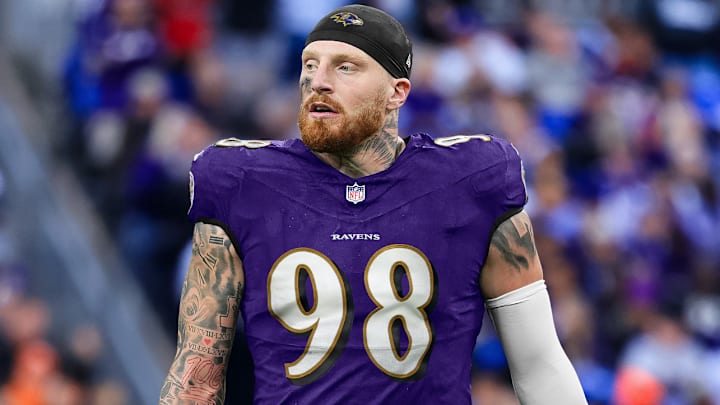
The Ravens have acquired Maxx Crosby from the Raiders for Baltimore’s 2026 and ’27 first-round draft picks. The Raiders had been asking for an additional player in addition to the picks to match the haul Dallas received for Micah Parsons, but did not get a veteran piece in the package for their star pass rusher. This marks the second time in the past decade that the Raiders have had one of the league’s best edge players under contract, but, in an effort to feed another regime change more draft equity, decided to trade that player at the height of, or near the end of, his expected athletic prime.
For Khalil Mack, the Raiders ended up with Josh Jacobs, Damon Arnette, Bryan Edwards and Quinton Bell. None of those players remain with the Raiders, none of them made it to second contracts and only Jacobs made it past a second season with the franchise. This is a cautionary way of saying that sometimes pick hauls in deals like these turn into Sauce Gardner and Garrett Wilson, and sometimes they are simply a delayed realization that the current coaching staff and executive team lack the necessary skills to build an operational organization or scheme.
Because the tentacles of this deal are sprawling, let’s explore a variety of takeaways from the Crosby to Ravens trade:
1. Impact of the AFC North
What makes this trade uniquely smart for the Ravens is the current structure of the division. Shedeur Sanders was one of the most consistently pressured quarterbacks in the NFL last season, with a rate of 52%. Dillon Gabriel also had one of the highest sack rates in the league last season. Deshaun Watson, who is also projected to compete for the starting job in Cleveland, had ascending pressured rates of 36%, 38% and 39% in his final three seasons as an erstwhile starter, all of which would have had him as one of the 10 most pressured quarterbacks of 2025. Cleveland is losing nearly its entire offensive line this offseason and had to trade for Tytus Howard, who had one of the worst pass-block win rates in the NFL last season, among regular starters.
The Steelers are playing footsie with Aaron Rodgers (the most-sacked quarterback in NFL history), have a pronounced vulnerability at left tackle, and, least discussed, have brought on Mike McCarthy as head coach. McCarthy is notorious for putting tackles on islands against pass rushers, and, as one of his former offensive linemen told me, did not emphasize run-fake blocking, which meant tackles were more often forced into taxing, traditional drop-back pass sets.
And then there are the Bengals. Cincinnati had one of the healthiest combinations of starting offensive linemen last year and still allowed 36 sacks, which, had they all been assigned to one quarterback, would make that person one of the 10 most sacked quarterbacks of 2025. Joe Burrow is a masterful play extender from the pocket, and having a collapsing artist like Crosby is another aggressive chess move made at nipping the Achilles heel of nearly every team in the AFC North.
2. Ravens’ evaluation of Crosby
The Ravens’ evaluation of Crosby had to be outstanding, and part of me wonders if this statistic held any particular weight for the analytically minded Ravens: Over the past two seasons, Baltimore’s defense held a lead for almost twice as many snaps as the Raiders’ defense. And while that doesn’t mean we can double Crosby’s impressive numbers, it does mean that he was successfully pass rushing in the worst pass-rushing situation in the NFL.
Baltimore has never traded a first-round pick in 31 years for a veteran player, nevermind two picks. The Ravens also have an impending long-term contract extension for Lamar Jackson, which will open cap space, but ultimately they are entering the first year of Jesse Minter’s regime with a very top-heavy financial structure. This will increase the pressure on the Ravens to maximize their remaining draft selections in 2026 (more on that in a moment). Baltimore will have Crosby on a $30 million base salary and a $29 million base salary over the next two seasons. The Ravens signed Justin Madubuike to a four-year, $98 million extension in ’24. Kyle Hamilton inked a four-year, $100 million extension in August of ’25 before the start of last season. Roquan Smith signed a $100 million deal in ’23.
Again, the inevitable Jackson extension will alleviate some of the initial financial pressure, but there is a reason Baltimore was seen as a bit of a dark horse, organizational precedent aside.

3. Ravens’ draft philosophy
Baltimore dealt the No. 14 selection in the upcoming draft, which would’ve been the highest the Ravens have selected since getting Hamilton at the same slot in 2022. At first glance, it seems to confirm what many executives have said about this year’s class, given how well general manager Eric DeCosta and his front office have managed the draft over the years: After about pick 15, the talent drops off significantly; however, there are solid contributors up until the third round. Baltimore essentially sacrificed the 14th pick in a mediocre draft for the best available veteran pass rusher, and is planning to backfill the roster with two other top-100 picks and a slew of mid-round picks that could allow for some Day 2 and Day 3 flexibility.
Thanks to the team’s consistent mastery of the compensatory pick formula, the Ravens still have four fifth-round picks (including one from the Chargers for Odafe Oweh) and the Nos. 45 and 80 picks.
Baltimore is gambling that the Crosby trade will be so successful that it makes losing a pick in the far more coveted 2027 class irrelevant. Draft capital for ’27 has already been a discussion point, thanks to the Parsons, Gardner and Quinnen Williams trades, the third of which was notable for deferring a first-round selection until that year. The class is already being heralded for top-end talent, and could feature a handful of top-tier quarterback prospects, which makes first-round picks more valuable as trade ammunition for clubs looking to move up.
Obviously, the Ravens don’t plan to be in the quarterback market, which may also have impacted their decision-making.
An important point here: While we praise Baltimore’s draft skills, the trade for Crosby is an acknowledgement that the team did miss on Oweh, who was selected with the 31st pick in the first round in 2021, only to come alive under Minter as a member of the Chargers at the end of last year. Mike Green had some of his best performances toward the end of the ’25 season, but he is nowhere near ready enough to stand in for a unit without Dre’Mont Jones (the team’s 2025 leader in QB hits, in only nine games) and Kyle Van Noy, who are about to hit free agency on March 11. Green was second on the team in quarterback hits, which was ultimately an indication of how desperate the Ravens were for premium pass-rushing assistance.
Even more desperate was the Ravens’ need for a run-stopping edge player, which may be Crosby’s biggest strength.

4. Ravens’ motivations
The Ravens had two very clear motivations to acquire Crosby. One is to alleviate the pressure on Minter, who has the unenviable task of replacing one of the winningest coaches in NFL history and a fixture in Baltimore. The other, while incredibly tropey this time of year, is to capitalize on a rapidly closing window of contention. Lamar Jackson will be 30 at the end of the 2026 season and has missed a not-insignificant number of games in three of the team’s past five seasons. Baltimore’s left tackle, Ronnie Stanley, will turn 32 in two weeks. Mark Andrews will be 31 before the start of the ’26 season and Derrick Henry turned 32 in January. Baltimore let go of John Harbaugh, in part, out of fear of watching another bright, young assistant with organizational ties soar toward a head coaching job elsewhere, just like Mike Macdonald with the Seahawks. All of that leads us to believe that, like Seattle with Macdonald, the Ravens expected an immediate return to contention with this cavalier offseason. They are behaving in kind.
While this is only tangentially related, I do wonder whether this signals not just an aggressive stance from Baltimore but another organizational shift. The Ravens under DeCosta have always tried to maximize what the team felt were less crowded markets. When many teams were hunting for big-school talent in the draft, Baltimore poured more resources into small-school talent. When teams broadened their scouting efforts, Baltimore zeroed in on top collegiate programs.
Now, with a totally unreliable talent pipeline from the NCAA due to the haphazardly enforced eligibility rulings and scattershot draft classes that vacillate between talent rich and barren, perhaps the market inefficiency is in veteran talent itself. I’m seeing a lot of immediate criticism for spending two first-round picks on a player who will be 29 soon, though Crosby has been remarkably healthy and consistent throughout his career. In this upcoming two-year window, it’s a safe bet that he will be just as valuable as any pass rusher taken in the next two classes.
5. Why the Raiders would make this move
Now, to revisit the Raiders’ side of things. Las Vegas promoted Rob Leonard, a Crosby favorite, to defensive coordinator upon the hiring of new head coach Klint Kubiak. Crosby is a cultural force who, according to an Athletic report, was bristling at the increased unpredictability of the new Tom Brady regime, which, like a wonderful returning character from some faraway Marvel universe, has again wrested incredible power from his personal health guru, Alex Guerrero. In Brady’s first season, the Raiders missed out on their top head coaching candidate and defensive coordinator candidate. The team fired its offensive coordinator during the season and its head coach at season’s end. The first first-round pick of the Brady era, Ashton Jeanty, lagged behind other rookie running backs in 2025, and the team’s second-round pick, Jack Bech, caught only 20 passes last season. With Crosby’s departure, the Raiders become the worst roster in the NFL, without much argument to the contrary.
This is … a lot to place on the plate of—we’re guessing—incoming No. 1 pick Fernando Mendoza. My question is whether a mid-round pick in a lackluster 2026 class and, possibly, a very late pick in the 2027 draft are enough to make up for the kind of foundational lift that Crosby would have provided the locker room. Understandably, Crosby may have been mentally checked out to the point where this trade was inevitable. But, revisiting our initial point about Jon Gruden and Mack (and, primarily, any coach or executive who arrives hell-bent on dealing veteran talent) isn’t reversing that callousness part of being a good general manager, or, in the case of the Raiders, iconoclast minority owner?
The Raiders made 11 picks last year and are now on tap to make 11 more selections this coming draft, which includes two first-round picks, three other picks in the top 102, a fourth-round pick courtesy of the Vikings, and two compensatory fourth- and fifth-round picks. Last year’s class was almost unable to be evaluated, given the state of the roster. I don’t imagine that will change much this coming season unless the Raiders are able to supplement their lack of veteran talent in free agency—a prospect made all the more difficult by trading away the team’s biggest draw on Friday night.
More NFL on Sports Illustrated
 Add us as a preferred source on Google
Conor Orr is a Senior Writer for Sports Illustrated with more than 15 years of experience covering the NFL. His work has been cited in Best American Sportswriting and has won a PFWAA award. Prior to Sports Illustrated, he covered both the Giants and Jets for The Star-Ledger. Conor lives in New Jersey with his amazing wife and three children.
Follow author