%20%20--%3E%0A%3Csvg%20version%3D%221.1%22%20id%3D%22Layer_1%22%20xmlns%3D%22http%3A%2F%2Fwww.w3.org%2F2000%2Fsvg%22%20xmlns%3Axlink%3D%22http%3A%2F%2Fwww.w3.org%2F1999%2Fxlink%22%20x%3D%220px%22%20y%3D%220px%22%0A%09%20width%3D%2239px%22%20height%3D%2240px%22%20viewBox%3D%220%200%2039%2040%22%20enable-background%3D%22new%200%200%2039%2040%22%20xml%3Aspace%3D%22preserve%22%3E%0A%3Cpath%20fill%3D%22%23FFFFFF%22%20d%3D%22M38.5%2C7H28.2v26h10.3V7z%22%2F%3E%0A%3Cpath%20fill-rule%3D%22evenodd%22%20clip-rule%3D%22evenodd%22%20fill%3D%22%23FFFFFF%22%20d%3D%22M26.1%2C25.5c0%2C5.8-4.1%2C7.5-12.9%2C7.5C3.9%2C33%2C0%2C31.2%2C0%2C25.2v-1.1h11.6%0A%09v2.4c0%2C0.7%2C0.1%2C1.4%2C1.2%2C1.4c1%2C0%2C1.2-0.4%2C1.2-1.3v-0.9c0-1.6-0.9-1.6-3.5-2.2C2.2%2C21.7%2C0%2C19.7%2C0%2C15.3v-0.9C0%2C9.3%2C5.5%2C7%2C12.9%2C7%0A%09c10.2%2C0%2C12.8%2C2.6%2C12.8%2C7.4v1.8h-11v-2.9c0-0.6-0.4-1.1-1.2-1.1c-0.6%2C0-1.2%2C0.4-1.2%2C1.1v0.9c0%2C1.5%2C0.9%2C2%2C3.3%2C2.5%0A%09c8%2C1.6%2C10.5%2C3.3%2C10.5%2C7.5V25.5z%22%2F%3E%0A%3C%2Fsvg%3E%0A)
They marched to a barren strip of land along the Old Spanish Trail in their business suits and cowboy hats, their single-action revolvers aimed toward the ground, cocked and ready to fire.
Before Houston became a destination sports town in the 1960s, there were swaths of vacant coastal prairie land owned by the Hilton Hotel Corporation. With few buildings around, one could just make out the wooden derricks over at the Pierce Junction oil field. White-tailed deer and coyotes roamed the place alongside vicious mosquitoes.
The rogue politicians, architects and oilmen building stadiums here in the city’s southwest side were participating in an act that, as one of the planners put it, reflected the “affirmative, why-the-hell-not attitude of a metropolitan area that was still a frontier.” Hence, the name of the expansion franchise—the Colt .45s—and the guns and wide smiles for the newspaper cameras instead of little ceremonial shovels. (Though the guns were loaded with wax-coated bullets.)
Their ritual was, unmistakably, a desire not just to puncture the landscape but to create an appropriate, Texas-sized hole in the dirt.

Amid all the steel and concrete that makes up the NRG Stadium and Astrodome complex now, its outlaw roots may feel obscured to those who cut through the muggy June air and take in this tiny, self-contained universe of whizzing golf carts, parking lots and security personnel on walkie-talkies managing the arrival of the World Cup.
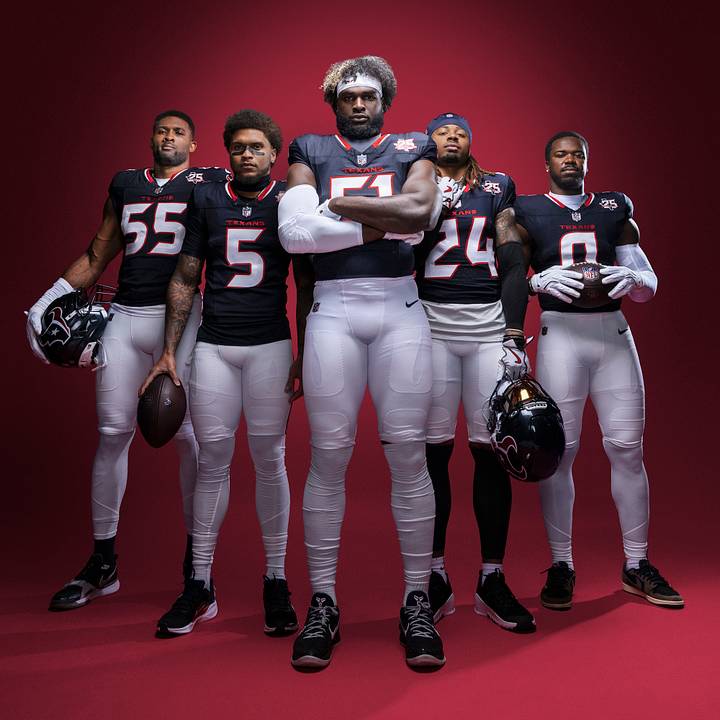
That is, until you meet Will Anderson Jr. and the Texans’ defense. Way more cowboy than the guys in Dallas wearing a star on their helmets. Way more Texas Ranger than the dudes in ball caps over in Arlington. This is a group of people built to destroy the NFL as it is right now by behaving as it was in the old days, led by an edge rusher who, depending on the time of day, could be mistaken for a polished, glad-handing politician or Daken from the Marvel Universe.
This group of pocket philosophers, preachers, freestyle rappers and, in the words of their own defensive coordinator, “card-carrying psychopaths” is on a mission of permanence. After a 3–5 start last year, Houston won its final nine games as the defense put up numbers that rivaled those of the best units in history. The Texans finished with the third-fewest yards allowed in the NFL’s 17-game era. The team was on pace to lead the league in points allowed—by a significant margin—but was surpassed by eventual Super Bowl champion Seattle when, already having secured a playoff berth, Houston subbed out its starters in the second half and let the Colts score 30 in the season finale. Two weeks later the Texans were knocked out of the playoffs by the Patriots.
During that winning streak, one meeting crystallized both the fine line between forgettable and immortal and how close they really were.
And so the task at hand for 2026 became both unmistakable and elemental, the will to compete buried deep in their bones and the grass beneath their feet: It was time to leave a mark.

Anderson is standing back-to-back with fellow edge rusher Danielle Hunter, donning one of the team’s crisp new alternate jerseys. He presents as a metallic storm trooper with powder blue accents. Here in the rodeo center, across the street from the Texans’ offices, players are getting their team photos taken and filming short video clips.
A humdrum of low chatter and white noise is shattered by a Mufasa-like scream, then hearty, booming laughter. Those shuffling around Anderson smile as he blossoms into character. Hunter and Anderson high-five by grabbing each other’s forearms, resulting in a thundering slap.
This is evidence of Anderson’s most endearing quality. In nearly every way, he is still a child. Anderson received a league-record three-year, $150 million contract extension following a season in which he had a career-high 12 sacks and a second-place finish in Defensive Player of the Year voting. His mentor, veteran defensive tackle Sheldon Rankins, takes great solace in the fact that his friend is still enamored with the McDonald’s McGriddle. Anderson, smiling, clarifies that he only eats the breakfast sandwich, which features maple-flavored griddle cakes as the bun, on Tuesdays—his cheat day—along with, maybe, an apple fritter doughnut from Voodoo. “He could be that guy who has a fancy chef making all his meals, but he’s still living life,” Rankins says.
On the field, that ebullience leads to an impossibly draining performance. Anderson treats his game tape like a third-grader treats a spelling test he’s worried about bringing home to his parents. Rod Wright, Anderson’s position coach, traces his star’s on-field DNA—and, really, of the Texans’ current philosophy—back to an otherwise forgettable Week 5 loss in 2023, Anderson’s rookie season. By the second quarter, the run-heavy Falcons were double-teaming Anderson just to try to scheme him out of plays. On second-and-6 at Atlanta’s 47-yard line, the team faked running to the left (away from Anderson), then pulled its center, Drew Dalman, to lead block for running back Bijan Robinson to the right. Anderson, who says the team knew the play was coming, tore into the backfield, not even looking for Robinson. He hit Dalman so hard that the 300-pound center’s body snapped backward, causing Dalman to grab onto Anderson’s jersey as a kind of life preserver to keep from thudding to the turf. It was the first time Wright had ever seen an offensive lineman called for holding on a play where he was nearly split in half.
Wright says on a subsequent pull, Dalman simply avoided Anderson altogether. “Everyone [had been] saying, ‘Oh, the Falcons’ offensive line, they have such a good offensive line, they run the ball.’ So we came in headhunting,” Anderson says. “Whoever showed up, we were going to kill them.”
Later on, before the penultimate game against the Titans, which Houston needed to win to control its playoff destiny, Anderson woke up in excruciating pain. His high ankle sprain brought tears to his eyes during pregame warmups as he limped around waiting for the dull comfort of whatever numbing agent got plunged into his system. At Alabama, Nick Saban told Anderson that the first game he played while truly injured would be a warrior’s proving ground. In Houston, it became concrete evidence to the watchful veterans that Anderson wasn’t just some coddled first-round pick. He played 12 snaps, recording two sacks, six quarterback pressures and three quarterback hits.
“That was the start of something good for me,” Anderson says. “Something just clicked in me.”
It was also the finishing touch on a mold cavity from which all future Texans would be cast. General manager Nick Caserio grades players based on a proprietary formula that seems to prioritize exemplary play amid difficult circumstances (like in moments when the game is out of hand), blocks that would make a player uncomfortable, games that don’t traditionally “matter,” sideline demeanor and a robust on-site team visit in which the player is placed into contact with anyone in the facility who may interact with them on a daily basis.
Anderson’s score glowed like a field of forget-me-nots. Caserio went into the 2023 draft without thinking twice about selecting quarterback C.J. Stroud second overall and then sacrificing two first-round picks, a second-rounder and a third-rounder to trade up to No. 3 for Anderson. The GM got to the building, went through his typical draft-day routine, had a relaxed lunch with his wife around noon and, a few hours later, made the call that now has Houston dreaming of its first Super Bowl appearance.

Azeez Al-Shaair loves sweet potatoes and, if his teammates are being honest, it’s become a bit of an issue.
Purposely assembling a group of hypercompetitive individuals in the vein of Anderson has its advantages and side effects. Members of the Texans’ defense now walk-race one another to meetings and red-light therapy. They have competitions to see who can stay fully immersed in a sauna or ice bath the longest (“It’s not that bad once the pins and needles go away,” says Anderson, whose best is around 10 minutes). They play regular pickup basketball at a secret off-site location and have even tried their hands at pickleball where, almost to a man, everyone agrees that Al-Shaair, the team’s 29-year-old hawking middle linebacker, should never be allowed to have a paddle under any circumstances (“He’s terrible,” says fellow linebacker Henry To’oTo’o).
So came the accusations that Al-Shaair was hoarding the limited number of sweet potatoes to hack his “vegetable score,” a metric used by the team’s nutritional staff. (Yes, the Texans compete to have the highest vegetable score.)
“He’s a cheater, bro,” To’oTo’o says.
“[Linebacker] E.J. Speed kept trying to steal my sweet potatoes,” Al-Shaair clarifies. “Every morning, I ask the staff to make me two sweet potatoes. This man would eat both of them. I was about to strangle him in our position meeting.”
The Texans’ staff now keeps a heaping bowl of prepared sweet potatoes to limit the infighting.
The group assembled in Houston creates a loud, beautiful cacophony. A bit like abstract jazz, it takes a few playbacks to realize just how perfect the component parts fit together. Coach DeMeco Ryans smiles when asked why he loves being around this group so much. He mentions that before 8 a.m. that morning, he was greeted in the facility with a concert-level blast of the rapper YoungBoy blaring from the speakers, courtesy of cornerback Kamari Lassiter. The subwoofers of the unit sit right over the lockers of Anderson and Rankins and emit such a deafening force that the pair can only hear the thud of the bass over their heads.
Other coaches point to a burgeoning Saturday tradition in which Rankins, who prides himself on being quiet, of service and out of the way, begins ripping into a freestyle rap that gets so raucous when teammates join in that staffers will look out their windows, wondering where the various ohhhhs are emanating from.
“This would go platinum,” Anderson says. “People would beg him—Sheldon, please, put me in your bars. We get lit. We get turnt.”
The players want people to know this about the Texans’ defense. It is true that the unit was so disruptive during mandatory minicamp that Ryans debated pulling Anderson out of practices, which led the team’s new running back, David Montgomery, to say, “This is the best defense I’ve ever seen in my entire life. I love this defense, but I get tired of hearing about ’em. I want to hear about our offense, too.”
But the unit’s reputation for creating occasional chaos—Al-Shaair, for example has incurred more than $100,000 in fines for late hits, impermissible use of the helmet penalties and other on-field infractions—is blended with an internal feeling of intense affection. Al-Shaair spent time this offseason with Baraa, a child from Gaza who was born with a congenital limb deformity, had both of his legs amputated as a 5-year-old and has received treatment in Houston. The player is currently reading a book about the different ways people love. Applicable, he thinks, to an NFL locker room.
To’oTo’o went viral this offseason for stepping out of a pair of Prada sneakers, which retail for roughly $1,000, and simply handing them to a high school football player. He walked off the turf field barefoot. Players say that these stories are commonplace enough that they no longer stand out to them.
To’oTo’o, who’s played with Anderson since his junior year at Alabama, explains that Anderson draws people to him, and when teammates enter his orbit, they see nothing but authenticity. “There’s nobody else built like Will, I ain’t going to lie,” he says. “You meet a lot of superstars. You meet a lot of guys that are the star players and sometimes they feel like they’re bigger than the program, but Will, he’s always the nitty-gritty guy that does the dirty work, though he doesn’t have to.”

Anderson remembers being a child at the home of his grandmother, Betty Taylor, sifting through her clothing and finding a large black robe. After placing it over his skinny shoulders, he’d drape a piece of tissue paper around his neck, mimicking the stole often worn by ordained priests and ministers.
By the time he was 7, Anderson’s preaching had become a fixture in the household. Bundled in his makeshift vestments, he would take his grandmother’s Bible and jam a broomstick through a cabinet handle to create his lectern. At a party at his mother’s friend’s home, he once climbed onto a fireplace and started, in his own words, “talking nonsense.”
“Growing up, I would just have these moments where life would get really quiet and I didn’t know what it was,” he says. “It was spiritual. I’d catch myself randomly crying one day or taking everything in. That’s why I’m so strong in my faith. I realized that God has been with me this whole time.”
Now, every Sunday at the team’s chapel service, Anderson is a featured speaker. Those who know Anderson speak of a kind of metaphysical and intense religiosity. He will sometimes open a door to someone’s office, stare at them dead in the eyes and ask them to pray for him out of nowhere. Over the past few years, Ryans and the team’s chaplain, Mikado Hinson, have taken to asking Anderson to pray over the team before games. His impromptu words soon carried more impact than those from the guest speakers Ryans had arranged to meet with the team at the same time. One of Anderson’s many nicknames is now “Deac,” which is short for Deacon.
“Sometimes, it’s nerve-racking,” Anderson says. “Obviously, I’m not perfect. Am I worthy to be doing any of this stuff? But I appreciate them asking me because it’s helping me be able to walk in the life God has me in, and to use my platform as more than an athlete.”
As he talks about his daily Bible habit—Joshua 1:9, which says, “Be strong and of good courage; do not be afraid, nor be dismayed, for the Lord your God is with you wherever you go,” stuck with him last year—Anderson shifts his weight on a curved lounge sofa, tucked inside a restaurant at a posh Houston hotel where he’ll soon take more photos. He is flanked by a publicist; a stylist named Dex; one of his five sisters, Teria; and Q, his braider. Anderson is dressed in a silvery leather jacket and matching pants, with boots that could have been pulled straight off of the Tin Man. He arrived with a camera around his neck (a new obsession), having recently toured Brazil photographing the Favelas.
It is rumored that a popular music artist is currently staying in the penthouse and Anderson warms to the idea of taking shots on the helipad atop the building, just above the famous rapper. His faith, he says, has cemented the overwhelming ease with which he goes about his day. He is less a mover than a swooper. Every reaction is big. Every handshake looks like it’s taking place on a graduation stage.
His crew piles into a series of three different elevators, zigzagging across hallways, until the final door opens to a short staircase toward infinity. Walking out onto the helipad, even the slightest wind creates a stomach-churning wobble (there is no fencing around the area). The 24-story Amegy Tower a few feet away pales in size. One member of Anderson’s clique mentions that, out here, they feel “a little too close to God.”
Anderson stands about 30 feet from the edge and spreads his massive arms, leaning back ever so slightly as if beginning a trust fall, not appearing to agree.

RELATED: Check out more pictures of Will Anderson Jr. from our SI photo shoot
Over those bullet holes walked some of the best and the baddest. Nolan and Earl and Bruce and Bum. Moon and Munchak, Biggio and Jimmy Wynn. Teams came and teams went, but what remained was an almost ethereal connection to the land; an understanding that only certain men could play here.
Ryans, Houston’s 42-year-old coach, found out during one of his first days as a player for the Texans back in 2006. After one of his first practices here he watched wideout Andre Johnson, already a Pro Bowler, outworking everyone in the stewy Houston heat. And so Ryans followed Johnson everywhere.
“That’s the dude,” he says.
He needed enough players like Johnson to build a defensive scheme that was going to prey on the weaknesses of an offense the way Sean McVay and Kyle Shanahan found success as play-callers by hunting defenses. Houston’s system is one of the few that successfully dictates an offense’s decision making instead of the other way around. McVay and Shanahan have found success by forcing opponents to defend the run with a lighter nickel-style package or defend the pass in a heavier base formation. Houston has similarly reverse engineered.

The Texans bookend Anderson with Hunter and often align one (or sometimes both) as a “wide-9” positioned on the outside of the opponent’s tight ends. Lining up that way bottles the sweeping outside-zone-style runs popularized by Shanahan and the “jet” motion plays that often allow receivers to take handoffs and find the outside edge. Having Anderson and Hunter on tight ends also ensures they will need help blocking them, taking away more resources devoted to the rest of Houston’s defense.
Playing Jalen Pitre—a defensive back so brutal that he bent the facemask of Colts receiver Alec Pierce in his first NFL game—at nickel corner keeps an offense from being able to trap the Texans on the field with a group of players who are susceptible to either the run or the pass. Having the back end of the defense secured by Derek Stingley Jr.—who in 2025 allowed fewer than 15 yards receiving a mind-boggling five times in a six-game span—and Lassiter means that every offensive choice comes with a grim cost-benefit analysis.
And Houston has recognized that offensive linemen are approaching a breaking point. They get hurt at a dizzying rate, with the increased turnover leading to more vanilla looks up front. Recent classes of offensive linemen have provided uneven results coming out of college. So the Texans have poured historic resources into the defensive line. Anderson and Hunter will receive a $65.6 million cash payout this season. Last year, the pair combined for 27 sacks and 45 quarterback hits. Nearly every down, the two align themselves in a different location, intent on isolating a weak point on the opposing line.
At the peak of its powers last season, the group assembled for a meeting coming out of its Week 6 bye week. Defensive coordinator Matt Burke acknowledged that, at the time, the Texans were giving up fewer than 16 points per game and placed those numbers in a historical context. On the screen were the statistics of the greatest modern defenses in NFL history. Teams like the 2002 Buccaneers and the 1986 Bears flashed across the PowerPoint before reaching the gold standard 2000 Ravens—a Super Bowl–winning juggernaut that allowed just 10.3 points per game.
Burke then arrived at a point he didn’t necessarily intend to make as he introduced the fifth team: the 2000 Titans. “No one remembers them,” Burke says, forgoing the obvious movie joke. “Because they lost [in the divisional round] to that Ravens team, which went on to win a Super Bowl.”
There it was. A lousy 1.6 more points per game allowed than Baltimore. A single playoff loss. The dividing line between immortality and a thick suit made of wet cardboard, weighted down by every last almost. At the mention of this, Anderson flashes another one of his best personality traits. He pulls you in, as if you’ve always been in his world, in his head, in his space.
“You want to know something so serious?” he says. “Azeez said something that kind of stuck to me and I think kind of stuck to the whole defense. Do we want to be a really great defense? Yes. But what if we can be a really great defense and win the Super Bowl? You know what I’m saying? The defense … it’s going to be soon forgotten because y’all couldn’t even win the Super Bowl. It would be great. It would be awesome. It would be historic, but it’s just like, we got to win the Super Bowl with it. That’s the mission for all of us.”
At one of the practices that immediately followed the meeting, Anderson says, multiple members of the defense halted the entire workout. Players at every position. Whatever it was, it wasn’t good enough. They needed to renew their focus.
If Anderson and the Texans were going to be remembered forever, every step, every imprint onto this field of dreams had to mean something. Like it always had.
“That’s when I knew,” Anderson says. “We’re close. We’re close.”
 Add us as a preferred source on Google
Conor Orr is a Senior Writer for Sports Illustrated with more than 15 years of experience covering the NFL. His work has been cited in Best American Sportswriting and has won a PFWAA award. Prior to Sports Illustrated, he covered both the Giants and Jets for The Star-Ledger. Conor lives in New Jersey with his amazing wife and three children.
Follow author