%20%20--%3E%0A%3Csvg%20version%3D%221.1%22%20id%3D%22Layer_1%22%20xmlns%3D%22http%3A%2F%2Fwww.w3.org%2F2000%2Fsvg%22%20xmlns%3Axlink%3D%22http%3A%2F%2Fwww.w3.org%2F1999%2Fxlink%22%20x%3D%220px%22%20y%3D%220px%22%0A%09%20width%3D%2239px%22%20height%3D%2240px%22%20viewBox%3D%220%200%2039%2040%22%20enable-background%3D%22new%200%200%2039%2040%22%20xml%3Aspace%3D%22preserve%22%3E%0A%3Cpath%20fill%3D%22%23FFFFFF%22%20d%3D%22M38.5%2C7H28.2v26h10.3V7z%22%2F%3E%0A%3Cpath%20fill-rule%3D%22evenodd%22%20clip-rule%3D%22evenodd%22%20fill%3D%22%23FFFFFF%22%20d%3D%22M26.1%2C25.5c0%2C5.8-4.1%2C7.5-12.9%2C7.5C3.9%2C33%2C0%2C31.2%2C0%2C25.2v-1.1h11.6%0A%09v2.4c0%2C0.7%2C0.1%2C1.4%2C1.2%2C1.4c1%2C0%2C1.2-0.4%2C1.2-1.3v-0.9c0-1.6-0.9-1.6-3.5-2.2C2.2%2C21.7%2C0%2C19.7%2C0%2C15.3v-0.9C0%2C9.3%2C5.5%2C7%2C12.9%2C7%0A%09c10.2%2C0%2C12.8%2C2.6%2C12.8%2C7.4v1.8h-11v-2.9c0-0.6-0.4-1.1-1.2-1.1c-0.6%2C0-1.2%2C0.4-1.2%2C1.1v0.9c0%2C1.5%2C0.9%2C2%2C3.3%2C2.5%0A%09c8%2C1.6%2C10.5%2C3.3%2C10.5%2C7.5V25.5z%22%2F%3E%0A%3C%2Fsvg%3E%0A)
Give Defenses Proper Credit for the Poor Quarterbacking in These NFL Playoffs
In this story:
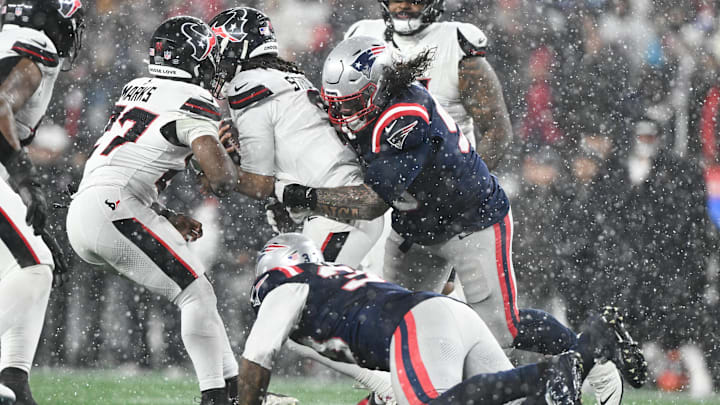
The ugly circumstances of Sunday’s Texans-Patriots game, in which C.J. Stroud tossed four interceptions in a 28–16 loss, was a moment made for our time, capping a series of playoff games featuring abhorrent performances from elite quarterbacks. And when we criticize one elite quarterback, we must measure that, pitch perfectly, against the way we’ve criticized another. And God forbid we forget to mention what we’ve said about a third elite quarterback in the past, knowing that he, too, turned the ball over multiple times in a playoff game while another QB we also poked fun at only did so twice. This is a borderline religious whataboutism. It is our new Sunday purpose.
And, without question, it’s obscuring the real story.
We are going to be more tightly wound than a Celtic knot by the end of all this—truly, I promise, it matters so much less than you know that Jalen Hurts has as many turnovers in 10 postseason games as Josh Allen did on Saturday, given that the Eagles actively work to prevent Hurts from even venturing into turnover-worthy situations while the Bills need Allen to walk a tightrope on every play—and many people haven’t seemed to notice what is happening around us.
Look at the league-wide regular-season stats. While it’s not by much, passing yards per game are down. Completion percentage is down. Quarterback rating is down. Net passing yards per attempt are the second-lowest they’ve been by league average since 2007. Sacks, while hovering in the low 40s per team per season, have remained there the past three seasons after spending the better part of the previous decade in the mid-30s.
Sean McVay, once the Nikola Tesla of our time, is experimenting more with heavier personnel (even though Matthew Stafford did lead the league with 46 touchdown passes). The Eagles tried, and succeeded, in an effort to see whether a team could win the Super Bowl with a quarterback who wasn’t allowed to pass.
Sure, this could be too aggressive a thought after the Texans failed to supply Stroud with a running game and consistently backed him up into third-and-unmanageable situations in horrible throwing weather that seemed to highlight some not-so-Tom-Brady–like, weather-adjusted mechanics. (Their early-down rushing EPA was actually worse than their passing EPA per play, despite all the turnovers.) But why are we not considering the fact that we are in an ideological renaissance for defenses, one that has effectively kneecapped some of our best coaches and quarterbacks over the past two seasons?
Five of the final eight coaches in this year’s playoffs specialize in the defensive side of the ball, while the Broncos were buoyed heavily by a Vance Joseph defense (you can read more stats on that here).
A majority of the top head coaching candidates this cycle are also from the defensive side of the ball. Arguably the best head coaching hire of the past two seasons, the Seahawks’ Mike Macdonald, transformed his team through the installation of a versatile, big-nickel scheme.
Though the mechanisms are different, what defenses are doing to opposing offenses, be it the guerilla Brian Flores method, the more tactical Joseph method, or the almost Nick Saban–esque Macdonald method, is no different than how McVay and Kyle Shanahan stormed through the NFL almost a decade ago, creating winning offenses based on learning a defense’s golden rules and short-circuiting them in real time. It’s just happening the other way around now.
Again, this does not wholly apply to Stroud, who had one of his interceptions tipped, or Allen, who seemed to simply shovel the ball back to his opponent out of the kindness of his heart on one of his turnovers before halftime. Or to Aaron Roders, Trevor Lawrence and Justin Herbert, who were all pressured throughout the wild-card round. But even the accidental mistakes—the ones not directly caused by a scheme victory—could be the byproduct of the fact that these quarterbacks feel more pressure, see less clearly and possess less of an ability to simply maul opponents in the run game than ever before.
This needs to be the backdrop of any big-picture conversation we have about Stroud or Allen moving forward, at least when it comes down to this time of year, in these conditions when nearly all of the defensive opponents are elite and utilizing, to the best of their abilities, an incredible bag of tricks (Stroud, for one, fell victim to the Patriots dropping almost their entire defense into coverage while also utilizing a QB spy to prevent the run, which is a nightmare scenario for a quarterback). No one has been immune.
Stroud played horribly against the Patriots, just like Allen did against the Broncos. But they are not the only ones slogging through what appears to be a miniaturized dead-ball era, even if they are the only ones still playing while many passive fans are just logging on, destined to pay the price.
Now, of course, back to your regularly scheduled intra-quarterback holy war.
More NFL From Sports Illustrated
 Add us as a preferred source on Google
Conor Orr is a Senior Writer for Sports Illustrated with more than 15 years of experience covering the NFL. His work has been cited in Best American Sportswriting and has won a PFWAA award. Prior to Sports Illustrated, he covered both the Giants and Jets for The Star-Ledger. Conor lives in New Jersey with his amazing wife and three children.
Follow author