%20%20--%3E%0A%3Csvg%20version%3D%221.1%22%20id%3D%22Layer_1%22%20xmlns%3D%22http%3A%2F%2Fwww.w3.org%2F2000%2Fsvg%22%20xmlns%3Axlink%3D%22http%3A%2F%2Fwww.w3.org%2F1999%2Fxlink%22%20x%3D%220px%22%20y%3D%220px%22%0A%09%20width%3D%2239px%22%20height%3D%2240px%22%20viewBox%3D%220%200%2039%2040%22%20enable-background%3D%22new%200%200%2039%2040%22%20xml%3Aspace%3D%22preserve%22%3E%0A%3Cpath%20fill%3D%22%23FFFFFF%22%20d%3D%22M38.5%2C7H28.2v26h10.3V7z%22%2F%3E%0A%3Cpath%20fill-rule%3D%22evenodd%22%20clip-rule%3D%22evenodd%22%20fill%3D%22%23FFFFFF%22%20d%3D%22M26.1%2C25.5c0%2C5.8-4.1%2C7.5-12.9%2C7.5C3.9%2C33%2C0%2C31.2%2C0%2C25.2v-1.1h11.6%0A%09v2.4c0%2C0.7%2C0.1%2C1.4%2C1.2%2C1.4c1%2C0%2C1.2-0.4%2C1.2-1.3v-0.9c0-1.6-0.9-1.6-3.5-2.2C2.2%2C21.7%2C0%2C19.7%2C0%2C15.3v-0.9C0%2C9.3%2C5.5%2C7%2C12.9%2C7%0A%09c10.2%2C0%2C12.8%2C2.6%2C12.8%2C7.4v1.8h-11v-2.9c0-0.6-0.4-1.1-1.2-1.1c-0.6%2C0-1.2%2C0.4-1.2%2C1.1v0.9c0%2C1.5%2C0.9%2C2%2C3.3%2C2.5%0A%09c8%2C1.6%2C10.5%2C3.3%2C10.5%2C7.5V25.5z%22%2F%3E%0A%3C%2Fsvg%3E%0A)
The Baker Mayfield Extension Has Destroyed the Middle-Class NFL QB Contract
In this story:
Much like your millennial friends who won’t shut the hell up about it, the Buccaneers purchased their most important asset at the perfect time. In you friends’ case, a home. You know, right before COVID-19, for $400,000 at an interest rate less reminiscent of a medieval dowry. Great school district. Walkable to downtown. Brewery. Yada yada.
In the Buccaneers’ case, a good veteran quarterback for, like, $30 million per season.
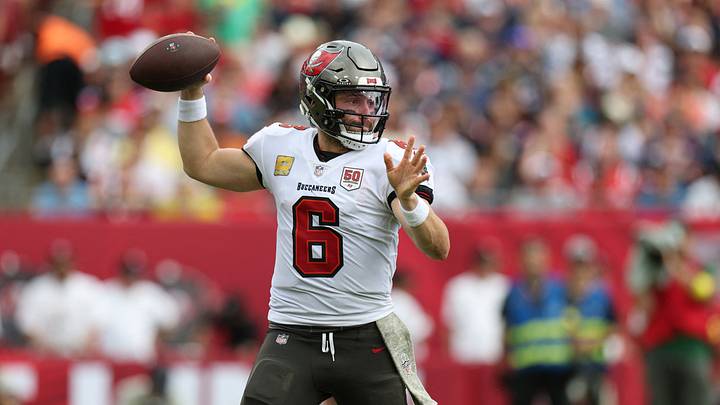
Life was good for a time—until Tuesday, really—when the Buccaneers had to extend Mayfield on a three-year deal worth an average of $55 million per season. In terms of the highest-paid quarterbacks in the NFL, Mayfield goes from the 17th-highest-paid player at his position to fourth, behind Patrick Mahomes, Dak Prescott and Matthew Stafford. I suppose in this analogy, your millennial friends did something dumb like move or refinance for some reason, but who cares about those guys. They’re a bad hang anyway, and the husband uses ChatGPT in a way that makes everyone uncomfortable (is he in love with it?).
The point is that the middle class of the quarterback market, much like your homes, vehicles and other life essentials, has been completely and totally obliterated now as the Buccaneers attempt to wriggle out from between a rock and a hard place. And soon it will be nonexistent altogether. Under general manager Jason Licht and coach Todd Bowles, Tampa Bay has been on a miniature Steelers-esque run, winning a Super Bowl in 2022 and making the playoffs in four subsequent years before last year’s end-of-season collapse. In those seasons, the team was always just good enough to justify reinvesting in the same top-tier core and keeping the head coach (thanks to the team doing a nice job of regenerating a young core underneath those top players). They were also too good to run into the kind of draft pick that could replace a quarterback at a fraction of the cost.
That’s why Tampa Bay had no choice but to pacify Mayfield, just like it did a few weeks ago by extending the similarly disgruntled Vita Vea at the age of 31. Both players are good, don’t get me wrong. But I wonder if guaranteeing Mayfield—in terms of an EPA per play and completion percentage over expectation composite, the 14th-best quarterback between 2023 and ’25—$150 million was in the best interest of the team moving forward.
In doing so, the Buccaneers fascinatingly isolated the only player left in this middle-class hive, which was once populated by both Mayfield and Geno Smith, and last year’s Super Bowl winner, Sam Darnold.
Tampa Bay has already made its bed, but how can our eyes not turn to Darnold, who is coming off back-to-back 14-win seasons and a Super Bowl, and wonder if Darnold will stand for making $21.5 million less this season to do a job that you could very easily argue he’s better at than Mayfield (Darnold, in that same composite, is the 11th-best quarterback during that same timeframe, though a larger sample size weighted down Mayfield’s average). These negotiations tend to trigger negotiations elsewhere. While Darnold is one season further from free agency than Mayfield—who was eyeing the possibility of playing on his lame-duck year—there’s no way that he (or his agent) is thrilled with the idea of being the only reasonably priced home left in the cul de sac.
For a moment in time, reviving the career of a formerly high-drafted quarterback who was clearly talented was excellent business. From 2022 to ’24, Geno Smith played at a higher EPA per play average than Tom Brady and was within the same statistical realm of Matthew Stafford, all for less than $30 million per season. Mayfield, like we pointed out, outplayed a handful of good quarterbacks making way more money. And Darnold literally won the Super Bowl last year, after bringing the Vikings to the threshold of a deep playoff run the year prior. In ‘24, Darnold made $10 million for one season. Last year, Darnold took home less than $35 million.
In looking at those teams the quarterbacks played on, it’s impossible to argue that those deals didn’t provide at least a slightly elevated financial flexibility. The deals weren’t as good as rookie contracts, but veterans offered upside in humility, life experience and professionalism that tend to go a long way in a locker room. In that sense, one could argue that they were only slightly less valuable than a solid quarterback on a rookie deal.
But thanks to Mayfield and the Buccaneers, it’s fair to wonder if this was another bubble that burst, or market inefficiency that can no longer be exploited. Unless a collection of quarterbacks like Mac Jones, Daniel Jones, Kyler Murray and Davis Mills form a new collective and inhibit that space, we are returning to a more traditional era of NFL economics that are simply black and white: quarterback equals expensive.
In the long term—especially heading into a draft where there is expected to be multiple quarterbacks worthy of high picks—deals like Mayfield’s may push more teams to sacrifice their stockpile of picks to garner the all-too-precious rookie contract. If Mayfield costs $55 million per season, the actual worth of someone like Arch Manning or Dante Moore (assuming they are good enough to occupy the Jayden Daniels, Caleb Williams, Bo Nix, Drake Maye space) increases exponentially.
In the short term, I’m guessing Darnold will do his best to vacate the label of “affordable” as soon as humanly possible, much like Mayfield did just before the opener.
 Add us as a preferred source on Google
Conor Orr is a Senior Writer for Sports Illustrated with more than 15 years of experience covering the NFL. His work has been cited in Best American Sportswriting and has won a PFWAA award. Prior to Sports Illustrated, he covered both the Giants and Jets for The Star-Ledger. Conor lives in New Jersey with his amazing wife and three children.
Follow author