%20%20--%3E%0A%3Csvg%20version%3D%221.1%22%20id%3D%22Layer_1%22%20xmlns%3D%22http%3A%2F%2Fwww.w3.org%2F2000%2Fsvg%22%20xmlns%3Axlink%3D%22http%3A%2F%2Fwww.w3.org%2F1999%2Fxlink%22%20x%3D%220px%22%20y%3D%220px%22%0A%09%20width%3D%2239px%22%20height%3D%2240px%22%20viewBox%3D%220%200%2039%2040%22%20enable-background%3D%22new%200%200%2039%2040%22%20xml%3Aspace%3D%22preserve%22%3E%0A%3Cpath%20fill%3D%22%23FFFFFF%22%20d%3D%22M38.5%2C7H28.2v26h10.3V7z%22%2F%3E%0A%3Cpath%20fill-rule%3D%22evenodd%22%20clip-rule%3D%22evenodd%22%20fill%3D%22%23FFFFFF%22%20d%3D%22M26.1%2C25.5c0%2C5.8-4.1%2C7.5-12.9%2C7.5C3.9%2C33%2C0%2C31.2%2C0%2C25.2v-1.1h11.6%0A%09v2.4c0%2C0.7%2C0.1%2C1.4%2C1.2%2C1.4c1%2C0%2C1.2-0.4%2C1.2-1.3v-0.9c0-1.6-0.9-1.6-3.5-2.2C2.2%2C21.7%2C0%2C19.7%2C0%2C15.3v-0.9C0%2C9.3%2C5.5%2C7%2C12.9%2C7%0A%09c10.2%2C0%2C12.8%2C2.6%2C12.8%2C7.4v1.8h-11v-2.9c0-0.6-0.4-1.1-1.2-1.1c-0.6%2C0-1.2%2C0.4-1.2%2C1.1v0.9c0%2C1.5%2C0.9%2C2%2C3.3%2C2.5%0A%09c8%2C1.6%2C10.5%2C3.3%2C10.5%2C7.5V25.5z%22%2F%3E%0A%3C%2Fsvg%3E%0A)

00:17:16 |
Up Next

Inside Packers Camp: How Far Jordan Love Has Come | Albert Breer
Aug 12, 2026
Jerry Jones Didn't Delay Quinnen Williams HUGE Contract
Aug 12, 2026

The Lakers Shocking $12B Sale & The NBA Starts The Schedule Release
Aug 13, 2026

Browns QB Battle Is Wide Open | Top 5 Browns Camp Takeaways | Albert Breer
Aug 13, 2026
Inside Packers Camp: How Far Jordan Love Has Come | Albert Breer
Aug 12, 2026
Jerry Jones Didn't Delay Quinnen Williams HUGE Contract
Aug 12, 2026
The Lakers Shocking $12B Sale & The NBA Starts The Schedule Release
Aug 13, 2026
Browns QB Battle Is Wide Open | Top 5 Browns Camp Takeaways | Albert Breer
Aug 13, 2026
Albert Breer on Kyler Murray, Packers Optimism, New Regime in Cleveland
Aug 13, 2026

J.J. McCarthy Found Himself In A Trey Lance Situation
Aug 12, 2026

DJ Moore Is Making the Bills More Dangerous | Top 5 Bills Camp Takeaways | Albert Breer
13 hours ago

The Vikings Are Taking On Kevin O’Connell’s Identity | Top 5 Vikings Camp Takeaways | Albert Breer
Aug 12, 2026

Extend CJ Stroud or Wait for Loaded 2027 QB Class?
Feb 25, 2026

Tom Verducci Explains What Makes Konnor Griffin’s Swing Elite
Feb 27, 2026

UFC Middleweight Reinier de Ridder Calls for Major Weight Cutting Reform
Mar 5, 2026

The Biggest WINNERS of NFL Free Agency
Mar 10, 2026
Transcript
It's also a pretty damn good deal if you think about it.
All right.
Welcome in.
It's the Brew Report for March 4th.
We're gonna have a more conventional brew report for you this week.
We're pushing the mailbag back to later in the week because of some of the news that happened on Tuesday, and we wanted to cover all of that for you with franchise tags.
And transition tag, singular, um, going out and sort of setting the table for the free agent market and what's gonna happen here over the course of the next week and a half or so.
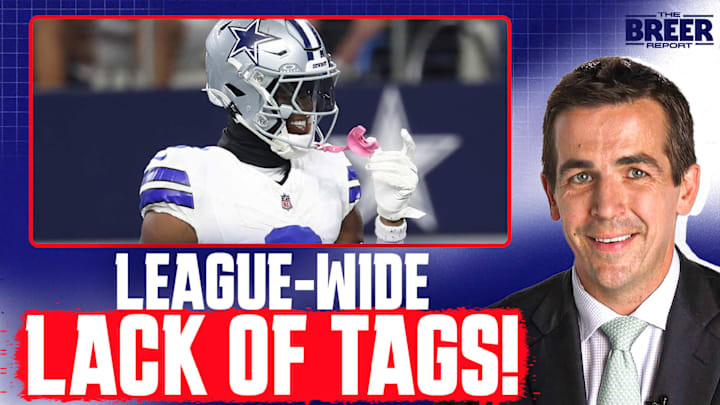
So, we're going to start with the 3 players who were franchised.
And those 3 players are Cowboys receiver George Pickens, Falcons tight end, Kyle Pitts, and Jets running back, Bruce Hall.
And I'd put these 3 guys in 2 separate categories.
I'd say Pickens and Pitts are in one category, and they are in the we'll see category.
And this is sort of the older school way of using the franchise tag.
These are high-end numbers, of course, now, and so it's a little more expensive to do this than it's ever been.
But the old idea of using the franchise tag, when franchise tags were a little bit more affordable, was when you weren't quite sure about a guy, you would tag him to put a hold on him essentially for a year, and then make a decision if you wanted to do a long-term deal with him.
So I think that that is where the Falcons are on Pitts, and I think that's where the Cowboys are on Pickens.
And they are different cases, but again, the same sort of logic, which is, we wanna see more.
Now, in the case of Pitts, it is, of course, performance-related.
Um, Kyle Pitts had a devastating knee injury in 2022 after a promising rookie year in 2021.
That injury affected him in 20023 and even into 202024 when he was Um, splitting time with Charlie Werner at, at tight end, and that was a merit thing.
He was not a good enough player to be the clear-cut starting tight end of the Falcons three years in a row.
He failed to even get to 750 yards or 5 touchdowns, and then last year, of course, he broke out, had an 88 catch season.
And he's starting to look again like the player that they thought they were gonna get when they drafted him in the top 10.
Of course, that was two coaching staffs ago.
Arthur Smith, that was Arthur Smith's first 1st round pick.
Um, as Falcons coach, since then, of course, they've gone through Smith, they've gone through Raheem Morris, and now Kevin Stefansky is the coach there.
Kevin Stefansky coming in in his first year, will get a chance now to look at Kyle Pitts if they don't wind up extending him, and then they can make a decision on whether or not they want to keep him long-term.
Now, the important thing to remember here is that They do have until mid-July to do a long-term extension.
So, if a guy like Pitts, if a guy like Hall, if a guy like Pickens proves himself, um, and shows to the staff like, I really am worth the money, whatever you can do between the months of April and May and June and July, then maybe something gets done.
But I think the idea here is to see more from Kyle Pitts and to see whether or not he's worth making a long-term commitment to.
Um, And mechanically, the idea is the same with Pickens.
The concerns are different.
He had 1400 yards last year, just dynamite, an incredible season playing opposite CD Lamb.
The Cowboys' offensive points looked unstoppable with those two playing opposite each other.
They're obviously already paying CD Lamb at a very high level.
He's making $34 million per year.
And so do they want to pay two receivers at that level.
Additionally, there are questions with George Pickens.
That go back to his time in Pittsburgh, that are not related to how good a football player is, they're more related to what sort of leader he is, what sort of motivation he has to continue to get better.
Um, and how hard he plays on a down to down basis, and, and we all saw this at the end in Pittsburgh in his 2nd and 3rd years in the league, there were plenty of points where he didn't block in the run game, he didn't give full effort when the ball wasn't going into him in the passing game.
There was, you know, questions about his attitude, and a lot of these questions with Pickens go all the way back to when he was a teenager.
So it's not like this is a 1 or 2-year problem.
This is something that sort of metastasized over years.
And, you know, when I look at cases like this, I think of a saying that Troy Brown once, once, once, once, once gave me.
And I thought this was a really interesting saying.
Troy used to say it about players in general, and, uh, you know, obviously had an incredible career himself as a slot receiver in the NFL, um, won 3 Super Bowl championships with the Patriots.
Um, and that saying was money only makes a player more of what he already is.
So I think the concern with Pickens is that if you reward him at the highest level, well, then he's gonna revert to what he's always been.
And maybe being on his best behavior from the time he was traded in May till the end of the season in January was a push to get a contract.
The Cowboys want to see that it's more than that.
The Cowboys need to see that it's more than that.
And so franchising him gives them the opportunity to gather more information on whether or not they want to pay him at the, at the, at the highest level as a receiver.
And here's the thing about it.
All right, I mentioned the word leadership.
I'm not saying that George Pickens needs to be a battleship commander type of leader to get the contract.
We're seeing guys who aren't get those sorts of contracts and not be a problem.
The thing is, when you get paid at that level, you naturally become a leader.
And the reason why is because everyone in that locker room keeps score, and they keep score not based on how many catches you have or touchdowns you have or sacks you have or interceptions you have.
They keep score based on salary.
They know who the highest-paid guys on the team are.
They know who the team's rewarding.
They know what the team's rewarding.
And so, there can be a cascading effect to having somebody on a massive contract who doesn't do things the way that you want them to do.
And Brian Schottenheimer said when he got that job, he wanted to build the greatest culture in the history of professional sports.
Huge culture guy.
And how you build your culture is having your best players be your hardest workers, your toughest guys.
Maybe George Pickett won't be all of that, but he can't be the antithesis of it if they're gonna pay him at this level.
So, they had a really good first year with him.
I think this is a good opportunity for them to say, let's wait and see what happens and see where this goes.
And so again, with Pitts it's the production thing, with Pickens, it's a culture thing, but in both cases, Um, you know , the, the, the, the team wants to see a little bit more from the player before exchanging vows on a long-term deal.
Then there's Bruce Hall, our third case.
He got tagged at $14.
3 million.
I think this is a little more cut and dry.
I think the top of the running back market is gonna remain in that $12 to $16 million dollar range.
My guess would be Kenneth Walker gets around $14 million per year, somewhere, maybe that winds up being.
With the , with the Broncos, maybe that winds up being with the Chiefs.
We'll see.
Walker's gonna have a market, maybe he goes back to Seattle.
Um, but where Breece Hall's tag is in that $14.
3 million dollar range is not only right in the sweet spot for the running back market's gonna be.
It's also a pretty damn good deal if you think about it.
And you look at what receivers are making and at this point, a, you know, a complimentary receiver can make between $15.
20 million dollars a year.
For example, I think Rasheed Shaheed could wind up getting close to $20 million per year on the market.
I think Romeo Dobbs could wind up getting maybe $15 to $18 million a year on the market.
You're telling me Bruce Hall, who touched the ball 17 times per game last year for the Jets, isn't worth 14 $15.
16 million dollars a year for a team that's got a ton of cap space and no one to spend it on.
Um.
It just makes too much sense.
It's, it's, it's commensurate with the market.
It's when you compare it to other players, not a bad deal.
So I think with Bruce Hall, this becomes what they hope is the precursor to a long-term deal and a guy who they're gonna give the ball a lot to and rely a lot on in a year when the quarterback position could be in flux.
So those are your franchise tags.
Our second topic, and this is a bigger picture topic here, and that's the transition tag.
Daniel Jones was transitioned by the Indianapolis Colts.
They didn't have much in the way of talks over the last couple of days, so there wasn't a whole lot of momentum going there.
Um, so, I think the easy question to ask here is a $6 million difference, right?
So the franchise tag for quarterbacks is $43.
9 million.
The transition tag is $37.
8 million.
Why would you transition tag him rather than franchise tag him?
Um, when the franchise tag essentially takes him off the market because it will require a team giving up two first-round picks to get him, whereas with the transition tag, all the Colts retain is matching rights.
If another team comes in and signs him to a deal the Colts don't want to do, then he gets to walk.
Well, I think there's a couple of things at play here.
First, I think what Daniel Jones and his camp are looking at.
is a deal that would be in the range of $50 million per year, maybe with about $100 million over two years, and that sounds like a big number.
It actually isn't.
If you were to franchise him, then you'd be talking about a two-year average, two franchise tags would come to about $96 million over two years.
So you're right in that $50 million per year range and You know, in that case, that's the leverage point for, for Jones , is Jones can sit there and say, OK, you want to franchise me, franchise me this year, franchise me again then next year, then I'm a free agent after that.
So, Uh, asking for what is the rough equivalent of two franchise tags and $100 million over two years wouldn't be out of line.
At the lower number, it is above where, where the leverage point is.
And so you frame negotiations at $37.
8 million.
Here's the other thing you do.
You give them a chance to see what's out there.
You give them a chance to look at the market and see if somebody's willing to go above and beyond.
And if you aren't willing to spend $45 million per year or $50 million per year, and he goes and gets it somewhere else, well, then, that's business .
Um, you know, I think it does set you up to have a better chance of getting a long-term deal done, even if it's a little scary right now.
Um, and it gives the player the peace of mind of knowing what the market is.
So the talks can be a little less contentious, um, as you get into it over the course of the next week or two.
So, they're gonna continue to work on trying to get a long-term deal done.
Uh, the market last year, I think the, the easiest comp would be Sam Darnold, who got a little over $100 million over 3 years from the Seahawks.
That is less than the transition tag.
You count inflation in.
Um, and you look at the number, the $37.
8 million dollar number, you could be looking at a contract that might be similar to what Daniel Jones got from the Giants three years ago.
So it frames negotiations where the, where Jones' camp was looking in that 100/2 range.
You bring that down a little bit and you see where it goes from there.
But I think this is an interesting move by the Colts.
Um, the other effect of it, of course, is that it does take The tag away from Alec Pierce, and Alec Pierce has been resolute with them as they've talked, that he wants to know who his quarterback is before re-signing.
Well, now, Alec Pierce is 5 days away from the tampering period with a chance to have teams like New England and Buffalo and San Francisco and Tennessee jump into the race to get him on a contract that I think will land between $25.
30 million dollars per year.
So, that would be the sort of second-order effect of, of, of tagging Daniel Jones.
But obviously, there's a lot of business.
To be done for the Indianapolis Colts with a couple of players that they want to keep.
And that brings us to our third topic, which is sort of the big picture topic here, which is the question, why are fewer franchise tags being used?
This is an interesting topic.
There were only 2 franchise tags we used last year, only 3 this year.
The transition tag has become a little bit more common now.
It looked like it was dead for a long, long time.
And this is coming out of a period of 10 years from 2015 to 2024, when in each year, at least five tags were used and that number rose as high as 14 at one point.
And I think to really understand this, you got to follow the bouncing ball.
The reality is the tag numbers have risen to the point, and this is the first piece of it.
The tag numbers have risen to the point where they're no longer a great deal for teams.
And that is made plainly obvious by the shift in the result of these franchise tags when you go through the whole cycle.
So you get there to that deadline in mid-July to sign the guys to long-term extensions.
So in 2020, there were 14 guys tagged.
Now, that was related to COVID, of course, but 14 guys were franchised in 2020.
Only two of them wound up signing long-term extensions rather than playing on the tag.
The other 12 played on the tag.
In 2021, 10 guys were tagged, and 6 of them wound up playing on their one-year tender.
So only 4 guys signed long-term extensions.
So, that had been the norm for a while where you had a lot of guys who would get tagged and then would just be forced to play in the one-year tender.
In 2023, that shifted.
In 2023, 6 guys tagged, 4 were signed to long-term deals.
In 2024, 8 guys tagged, 7 signed to long-term deals.
Um , and the reality is in those 23 and 24 cycles, The team signed those deals not out of the goodness of their heart.
They signed them because it was better for them to do long-term deals than deal with the one-year lump sum because the one-year lump sum had risen to a point where it was a problem on their salary cap, and so they were motivated to do longer term deals.
So now, rather than more guys being tagged and more guys being signed, you have less guys being tagged in general.
So, the franchise tag isn't as good for teams anymore.
That's the first piece of this, right?
Which brings us to the second piece of it, which is that the salary cap has risen to the point where doing long-term deals isn't that difficult anymore anyway.
And so if you want to keep somebody, Then you're gonna sign him to a long-term deal ahead of time, or if he's that valuable a player, you're gonna get ahead of it, and this is what depletes the free agent market.
You're gonna get ahead of it and trade him a year ahead of time.
Either way, you know, you're going to, and that's Micah Parsons.
Either way, you're not going to get to a point where you have to tag the player.
You're either not gonna view him as a core player and let him go to free agency.
Sign him early or decide that you're not gonna sign him early, but he's a good enough player where you're gonna be able to trade something for him a year ahead of time or at the trade deadline in his contract year and, and, and, and get a real return for him.
So, I think this has matured to a point where, where you want to have it.
And that doesn't mean it's great for everybody.
It does restrict the markets and there's a lot of things that I think could be reworked with it.
Um, but I don't think it's the problem for players that it used to be.
I remember having an agent call it the prison tag.
This is probably 12 or 13 years ago, call it the prison tag, uh, because it kept the guy off out of free agency, kept the guy from really cashing in on his ability.
Uh, I don't think it's that way anymore.
I, I don't think the, the, the players, the coaches, the front office people view it that way anymore.
Um, you know, and in this case, I think for Pitts and, and, and Pickens, you have that one-year explosion in production, and it's like, OK, like let's justify it.
You have Bruce Hall who's in a position that's undervalued.
This isn't just a, you know, teams deciding like, OK, like, like this is a better deal for us than doing a long-term deal with the guy.
Those are circumstantial.
You're not seeing it widespread anymore, which I think is a good development for, again, the players, the coaches, the front office people, everybody who's part of being on a team, building a team.
Those are good things, and I think again, it's reflected in a relatively quiet tag day.
Appreciate you guys coming out.
Um, as always, you can leave your comments down below here on the YouTube page or on my social media at Albert Breer on Twitter, at Albert R Breer on Facebook, at Albert_Breer on Instagram.
We got one more Brew report coming for you this week.
We will bring you a mailbag edition, and there will be a print mailbag later in the week too, but a mailbag edition here on the YouTube page will be up and live on Friday from my short ski trip before free agency in Maine.
We'll see you guys then.