%20%20--%3E%0A%3Csvg%20version%3D%221.1%22%20id%3D%22Layer_1%22%20xmlns%3D%22http%3A%2F%2Fwww.w3.org%2F2000%2Fsvg%22%20xmlns%3Axlink%3D%22http%3A%2F%2Fwww.w3.org%2F1999%2Fxlink%22%20x%3D%220px%22%20y%3D%220px%22%0A%09%20width%3D%2239px%22%20height%3D%2240px%22%20viewBox%3D%220%200%2039%2040%22%20enable-background%3D%22new%200%200%2039%2040%22%20xml%3Aspace%3D%22preserve%22%3E%0A%3Cpath%20fill%3D%22%23FFFFFF%22%20d%3D%22M38.5%2C7H28.2v26h10.3V7z%22%2F%3E%0A%3Cpath%20fill-rule%3D%22evenodd%22%20clip-rule%3D%22evenodd%22%20fill%3D%22%23FFFFFF%22%20d%3D%22M26.1%2C25.5c0%2C5.8-4.1%2C7.5-12.9%2C7.5C3.9%2C33%2C0%2C31.2%2C0%2C25.2v-1.1h11.6%0A%09v2.4c0%2C0.7%2C0.1%2C1.4%2C1.2%2C1.4c1%2C0%2C1.2-0.4%2C1.2-1.3v-0.9c0-1.6-0.9-1.6-3.5-2.2C2.2%2C21.7%2C0%2C19.7%2C0%2C15.3v-0.9C0%2C9.3%2C5.5%2C7%2C12.9%2C7%0A%09c10.2%2C0%2C12.8%2C2.6%2C12.8%2C7.4v1.8h-11v-2.9c0-0.6-0.4-1.1-1.2-1.1c-0.6%2C0-1.2%2C0.4-1.2%2C1.1v0.9c0%2C1.5%2C0.9%2C2%2C3.3%2C2.5%0A%09c8%2C1.6%2C10.5%2C3.3%2C10.5%2C7.5V25.5z%22%2F%3E%0A%3C%2Fsvg%3E%0A)
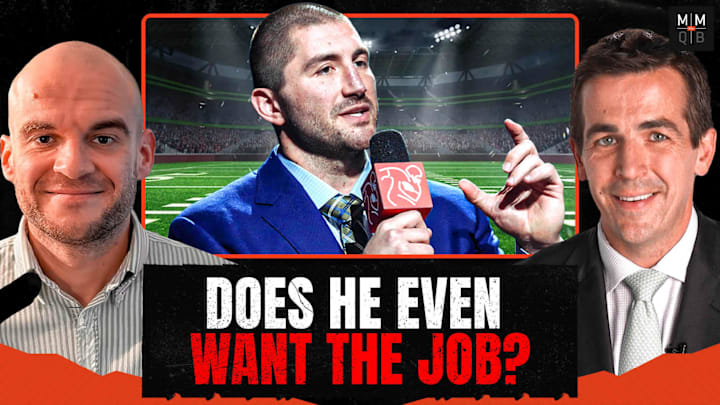

00:18:39 |
Up Next
Albert Breer on Bears Explosive Offense, Bills Shootout Win and Vikings QB Situation
Sep 14, 2026

In The Corner: Hayden Johnson’s Unlikely Road to Becoming a Power Slap Contender
Sep 14, 2026
We're Not Worried About the Texans After Their Week 1 Loss
Sep 14, 2026
Albert Breer & Conor Orr on the Giants’ New-Look Offense
Sep 14, 2026
Albert Breer on Bears Explosive Offense, Bills Shootout Win and Vikings QB Situation
Sep 14, 2026
In The Corner: Hayden Johnson’s Unlikely Road to Becoming a Power Slap Contender
Sep 14, 2026
We're Not Worried About the Texans After Their Week 1 Loss
Sep 14, 2026
Albert Breer & Conor Orr on the Giants’ New-Look Offense
Sep 14, 2026
The Ins and Outs of an NBA Fight
Mar 13, 2026
Movsar Evloev Isn’t Here to Talk—He’s Here to Win
Mar 21, 2026
Alexa Grasso Locked In on Maycee Barber… But Still Wants Shevchenko 4 👀
Mar 26, 2026
The Cleveland Browns Want NBA-Style Trades
Mar 30, 2026
The NBA's Anti-Tanking Proposals Make No Sense
Mar 31, 2026

“Knock His Head Off” — Chris Duncan Sends Warning to Renato Moicano 😳
Apr 2, 2026
A Title Contender is Not Giving LeBron $50 Million
Apr 3, 2026

Farmers Insurance Open Betting Preview
Jan 27, 2026
Transcript
In lieu of kind of talking about the draft a little bit too early, I think what we should do is, we should get out in front of these storylines that I think are going to plague us throughout the offseason and beyond.
It's just gonna be those sticky things that are just in the back of my mind that I, I think just deserve a little bit of attention.
And the first one that I'll lob into center court here .
It's the fact that JC Tretter was elected as the head of the NFL Players Association after a much maligned process that he sat in on that got Lloyd Howell in the seat before this, and then JC Trotter saying that he was removing his name from consideration, that he didn't want the job, and then all of a sudden after all of this scandal, um, ESPN has kind of done a great job digging up a lot of the dirt on this, and I'd encourage you to go back and read it.
Treader's been in the mix on this and is now the director of the NFLPA and, and, and listen, there's just some uncomfortable, the, the last administration Treader was a part of, there's these uncomfortable hand-holding moments between them and the NFL, um, and, you know, we got, you know, 18-game schedules on, on the fold.
We got the fight for natural grass on the, on the hold.
And, you know, you could see it with Howell, I think, um, When, when he was, uh, new, and I remember us going to the event together, the meet and greet with him, and kind of the, the fact that he was planning on slow playing a lot of this, you know, OK, we'll get to natural grass.
OK, we'll get to a lot of this stuff.
Does JC Treader actually come in and start fighting for the players here because that's a big deal, Albert.
I mean, this is a big appointment.
I mean, I think, you know, so we saw it, and, and I always think like it's interesting to look at the background of these guys, right?
So.
Um, like coming out and, and this is just the, the, the history, and, and people want to hear more about football, you can fast forward to us talking about everything else.
But like, for people who are interested, there is like real history here that I do think is fascinating to look at.
So, if you want to go back all the way to the beginning of the millennium, right?
So Gene Upshaw was the executive director of the NFLPA and the perception was that, uh, I'd say the perception was that he was way too friendly with Paul Tagliabu, right?
And there was this feeling that those two guys would disappear, and I think it was on both sides, right?
Like the owners felt the same way about Tagliabu with Upshaw, that like on both sides there was a little bit too much buddy buddy, like everything gets done behind closed doors, no one sees the process, and, you know, like, so for years there were questions, is Gene Upshot being confrontational enough and then You know, I would say, you know, you got to, um, you got to the end, and what ended up creating the, the, the lockout of 2011 was the CBA in 2006, which was, I think a lot of people looked at it like Paul Taglibu was hot, was, was, was appointed as commissioner right after two strikes, and like he wanted to keep a perfect record of labor peace.
So did he just shove the 2006 CBA through he could go off into retirement, right, and have that on his record that he had a perfect, he had a perfect record of, of labor peace.
So all that stuff's floating around.
So the players know, OK, a lockout is coming, and they just need a war daddy, you know what I mean?
Like they need somebody who's gonna come in and not be friends with the owners and come in and fight because they know what the owners are coming to do now is to reassert who's boss and stomp them out.
And so they hire a trial lawyer and a very accomplished trial lawyer in DeMorris Smith.
Now, I, I, I think.
There are a lot, there are a lot of varying opinions on DeMorris Smith's time in charge.
I, I think one criticism you could not have of DeMorris Smith was that he was any sort of shrinking violet, right?
He fought and fought and fought and was never afraid to take on, um, you know, Roger Goodell, um, who became commissioner a couple of years before he became executive director of the NFLPA.
He was never afraid to butt heads with them.
Um, You know, so like that's what they needed in the moment.
I think going to Lloyd Howell was a play the other way , which was.
Let's bring in a business-minded guy and let's see if we can relationship build and become partners and all this money is coming into the game and it blew up right in their face because this guy, I mean, was too close to the owners and I mean like in in actual tangible ways too and that, you know, like and we don't have to get into that chapter and verse but it's like legitimately like invested in the owners, you know.
And so, like, I think coming out of that now, do you need to go back to another .
Tough guy, do you need to go, and to me, like the main thing was.
What the players need now is someone they can trust because they had a fighter and an outsider in DeMorris Smith.
Then they bring in like a business side insider and that guy completely.
Violates their trust.
Like, I think most players look at well how fair or not, like he was the Manchurian candidate, right?
100%.
And so now I think they need somebody who can win their trust and who can fight.
And to me like that's.
Like, is that JC Trotter, we'll see.
I think JC Trotter has shown a willingness to publicly fight.
Now, can he put his, can he, can he put his, his, his pad, can he get his pads down and run it into the, run them into the owners, you know, um, to use a football analogy.
I, I, I think it's interesting and then, you know, his involvement in the whole Lloyd Howell thing, of course, raises questions about how on the level all this is, which is fair, and we should look at, and um I'm fascinated to see how all of this goes, you know, I, I really am.
I mean, for, for people out there and I can hear it, uh, I, I, I can hear everything you guys say, uh, through your car, speakers, through your cell phone.
That's the point of being a podcast host.
It's not actually creating a podcast.
It's like, I'm like the Dark Knight in Batman.
I now have access to all of your devices and I can hear what you're doing in the comfort of your own homes.
You're all disgusting.
Um, but the, uh, the, the, I, I know what you, I know what everybody out there is saying.
I don't care about the NFLPA president.
And here's why I have to counter with that, because this has myriad.
Kind of cascading consequences if you have a bad one, players dealing without.
Labor peace are in a bad spot, right?
I mean, like they're, you know, when, when, whenever you're dealing, um, without a, um, whenever you're dealing without someone you can trust in that position, I think that that bakes in cynicism.
I think that that motivates people to, whether it's retire early, just to take the money and then cut out to kind of check out and just, you know, you need someone in there that.
is going to be kind of a revitalizing candidate because, and you need someone in there that's gonna push for stuff like natural grass because guys, this is a billionaire's issue.
It's just billionaires not wanting to pay for it, OK?
And this would make every player happy, even though the NFL is so aggressively lobbying against it because people just don't want to pay for it.
And Trotter's interesting because Listen, stepped on my toes a little bit because I think everyone knows like I'm still a fan of Russell Wilson, the human, and Treader got unearthed in those documents calling him like a wuss.
And you can't have the biggest, and, and now maybe a lot of people agree with him, maybe a lot of NFL players agree with Treader, you know, but like, you also, you have to be so pro player now, I think to be able to get these guys back that that stuff in your past is just gonna kind of be lurking there in the closet, no.
Yeah, I agree.
I, I think it's like, it's so much this again, like, like to your point is gonna be building trust.
And like cause Uh, one of the most important parts of that job is rallying guys, you know, and being able to get guys behind you.
And so, if you do have to endure a work stoppage, you've got the sort of support from all of the guys, and it's harder in football.
I know the football union has taken a lot of shots over the years.
It is so much harder in football than it is in baseball or basketball or even hockey.
There are no guaranteed contracts.
Most of the guys in your union are in and out of the league in 2 or 3 years, and that means the idea of giving up a year of earning power for them, um, to serve some sort of greater cause, which you have to be willing to do, doesn't mean you have to go through with it, but you have to be willing to do, that has to be real, becomes almost impossible, you know.
Um, and so like how do you galvanize the group?
How do you get the group behind you?
How do you get the group to stick with you, um, you know, in 11, and I was on the ground for all of that, the owners knew in the back of their heads, these guys aren't gonna miss a paycheck, you know, like these guys are not going to, there's no way, and the , and the players operated like that.
And so there was only so far the players could push it before they had to go into deal-making mode and I don't know that you'll ever be able to get the players all on board with the idea of, if they lock us out, we'll stick it out, and we'll miss a month of paychecks or we'll miss 22 months of paychecks, we'll really make it hurt for them because now they'll be losing money.
Um, are they willing to do that, you know, and can they find somebody who can galvanize them to a level where they'll be able to do that.
Again, it's so tough because the rank and file football player isn't like the rank and file basketball or baseball player.
The rank and file football player is in and out of the league, and giving up those paychecks actually is significant for them.
So , um, that part's really important, and we're also a really critical juncture here because The television deals are getting redone, so having labor peace is important to that, and there is the prospect of 18 games which the players have to approve.
And if you look at the, like, just look at it for what it is, OK, so we have, I believe, 2 more Super Bowls are scheduled out, right?
So it's LA next year.
And then Atlanta the year after that, and then everybody believes it's gonna be Vegas in, in, in, in 29.
Move that aside for a second.
So, Los Angeles Super Bowl is set for next year.
That's President's Day weekend, February 14th.
Connor, did you know that they have not set a date for the Atlanta Super Bowl?
Yes, because I complain about this stuff all the time, and I know that I'm in the minority here, but I like Labor Day as sacred, and I like the weekend after the season is over as sacred, and now we're just like, like, like a person who hasn't worked out in a while and is busting out of their pants.
The NFL is just gonna grow and just take away the things that I love, which is very to me, and so.
Um, well, why wouldn't they set a date?
Why wouldn't they set a date for the 2028 Super Bowl at the end of the 2017th because they're not sure when it's going to take place, and this has caused actually a problem for the Atlanta people.
The organizers there are not happy about this because instead of having to block off two weeks, um, which is generally what you have to do, you get hotel blocks, convention blocks.
You have like emergency plans for if they had to ever had to move the game.
They've basically had to block off the entire month of February.
And that prevents you from bringing other events to the city.
So, um, the fact that they have not set a date for that Super Bowl, I think would indicate that that's when they're planning to go to 18 games because that will give them a couple of years of runway where they can say, OK, they can go back to the networks and say, OK, we've got like a new package of games, we're able to go overseas now 16 times in a year.
Um, and we're gonna have a full slate of international to sell.
It allows them to go to the market with something, with a different product.
So, um, that is, I think, front burner now, and that's something the owners have been sort of frozen on, like their, their intention, I think, was to get to it before this, but because the NFLPA didn't have an executive director, they really couldn't.
Now they can.
And so, um, I think that'll be an interesting topic, especially, I mean, the owners' meeting is.
Two weeks away.
So, my guess is that it'll be a big topic of conversation at the owners meeting.
Here's something else I wanna, I, I wanna, uh, put on your table here, cause when, when everybody's saying that, oh, you know, This doesn't matter, this doesn't matter.
Why did JC Treader get mad at Russell Wilson in the first place, Albert?
He got mad at Russell Wilson because he thought that Russell Wilson caved in his negotiations with the Broncos en route to a fully guaranteed contract.
He thought that he could keep that momentum going .
And make this the norm for quarterbacks, and then it would essentially have a right, like sort of a cascading effect.
Now, I'm not saying everybody's gonna get fully guaranteed contracts, but certainly, once really valuable quarterbacks start getting fully guaranteed contracts, you could see the world where, OK, you're the team like the Browns and you have a Miles Garrett type player, and so he needs to get a fully guaranteed, right?
And so we see the world where this is happening.
That's part of, yeah, and I, I think like the point that Treader was making on Wilson was Wilson seemed to have You know, a pretty good amount of leverage in his situation.
And, um, you know, I, I think, here's, here's the thing, is the owners care about precedent.
And so, one of the reasons the quarterback market has escalated to the level that it has, right?
And it's just, it's an outer space now, it's it's 60 and probably when Drake May and Caleb Williams come up, Maybe CJ Stroud pushes it this year.
Caleb Williams, Drake May, Jaden Daniels in a year are gonna maybe push it to 70.
The, the reason that's happening is because the owners really don't like, we'll pay the quarterbacks whatever.
We just don't want to set the precedent of doing fully guaranteed contracts, so they will pay more to avoid the guarantees even though.
That money that those quarterbacks are probably getting that money anyway, you know, in a lot of cases it's like I would rather just pay you more and maintain the precedent of the structure that I've already set.
So now I can go to every other player and say, well, we didn't even give him a guaranteed contract.
So that's why Treader, you know, I think that that's the sort of thing that Treader was getting at was like the quarterbacks have to set the precedents here and Wilson might have been one of the rare players that had the, had the, the, the, the leverage to do it and still didn't.
Um, I'm, I'm curious, um, if Treader now can come in and there's a, there's kind of a sneaky, and this is sort of a subcategory of stories that are going to linger over the offseason, Albert, and then we'll get to your, uh, we'll get to yours in a minute here, is that who hasn't?
What quarterback very famously wanted a fully guaranteed deal the last time he had, he was up, texted his GM in all caps, I would like a fully guaranteed contract, and now plays for a franchise that is, uh, smarting optically after having a trade cancel or after canceling a trade and is vulnerable.
Um, it does Treader take up Lamar Jackson's cause now and try to win some points with players by getting a fully guaranteed contract.
That's an interesting one.
I mean, so he's got 2 years left on his deal, yeah, but Lamar, you, we know that he's had to, he's like the cap numbers out of control, right?
Like you have to do it again this offseason, right?
I'm not mistaken on that.
Like, like you do have, if you're him, you do have leverage, you know.
So it's like if we are, if I'm Uh, if you're paralyzed, if I, if my deal can paralyze you from a, from a cap standpoint, then that is leverage.
And again, this has to start with the quarterback.
So, Lamar's ability to leverage that sort of deal, um, It, it'll be interesting because he could, you know, and he could just say no.
And does he just say no if it's not a fully guaranteed deal.
Um, and if they, cause what the, what, what a team will do, and this isn't Ravens-specific, but what a team will do is they will keep putting sweeteners in it.
It's like, well, here's the cash flow you wanted.
Here's the guarantee structure, we're not gonna fully guarantee it, but here's the guarantee structure you wanted.
You know, here's how we're gonna get money to you faster.
We won't defer this payment.
We won't, they'll do whatever they need to do to make sure it's not fully guaranteed, you know, and so, You know, it's somebody, like, it's, and I've made this point.
And like people don't want to listen to this, right?
The union doesn't, no union in sports negotiates.
Like whether there's no league in American sports, in major American sports, not the NBA, not the NHL, not Major League Baseball that either requires or prohibits fully guaranteed deals.
The four majors, it does, it does not exist.
In every sport, where they are is a result of where individual negotiations got them.
And in football, Individual negotiations have not led the players to fully guaranteed deals.
And that's why it needs to start somewhere and, you know, the quarterbacks will be the obvious place.
Yeah, I think it's, uh, so the rub with Jackson's contract, by the way, is that when he signed his, and just to clarify, it's, he signed that deal at 52 million, which was then a market topping extension.
Um, but now he, in order to be the highest-paid quarterback in the NFL, he'd need about 10 million extra per year .
Um, clearly, Baltimore is not getting rid of him.
Uh, they, Jackson's a big part of the new head coach.
And so I think this is going to be the stare down of the offseason and I think it has some interesting, uh, connections.